Imaging Project Portfolio - Filtered Views
Quick reference
- Quick Views are shortcuts that instantly load a themed view of the gallery.
- Current view appears above the results as an informational status field (it’s not another Quick View button).
- Use the filter menus to narrow results; you can combine filters.
- Click the x on any selected filter to cancel it (returns to “All”).
- Use Sort to change sequencing.
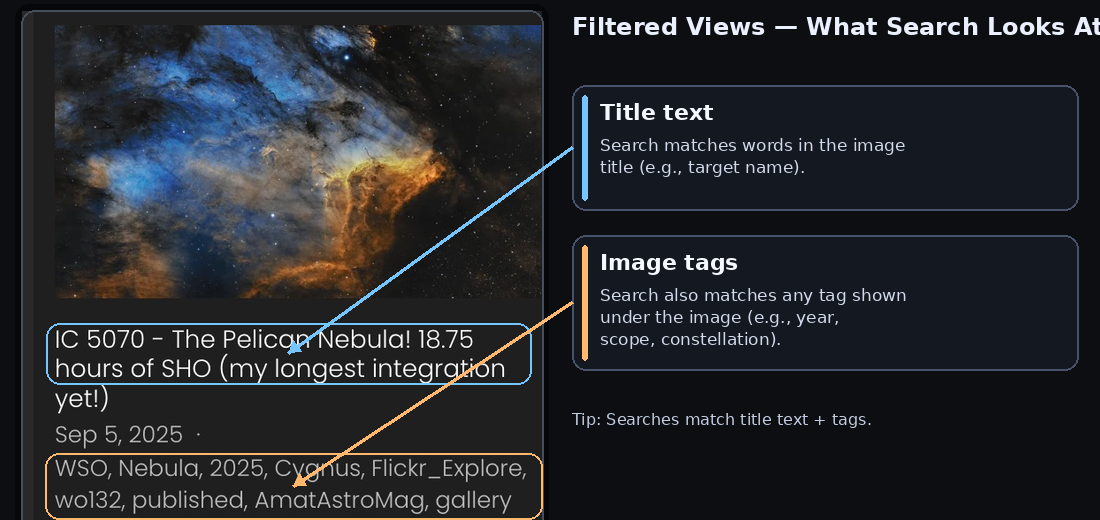
- The Search field matches tags and also text in project titles.
- The item count is shown above the images.
- Click an item to open the project page with technical details and links.
Quick Views
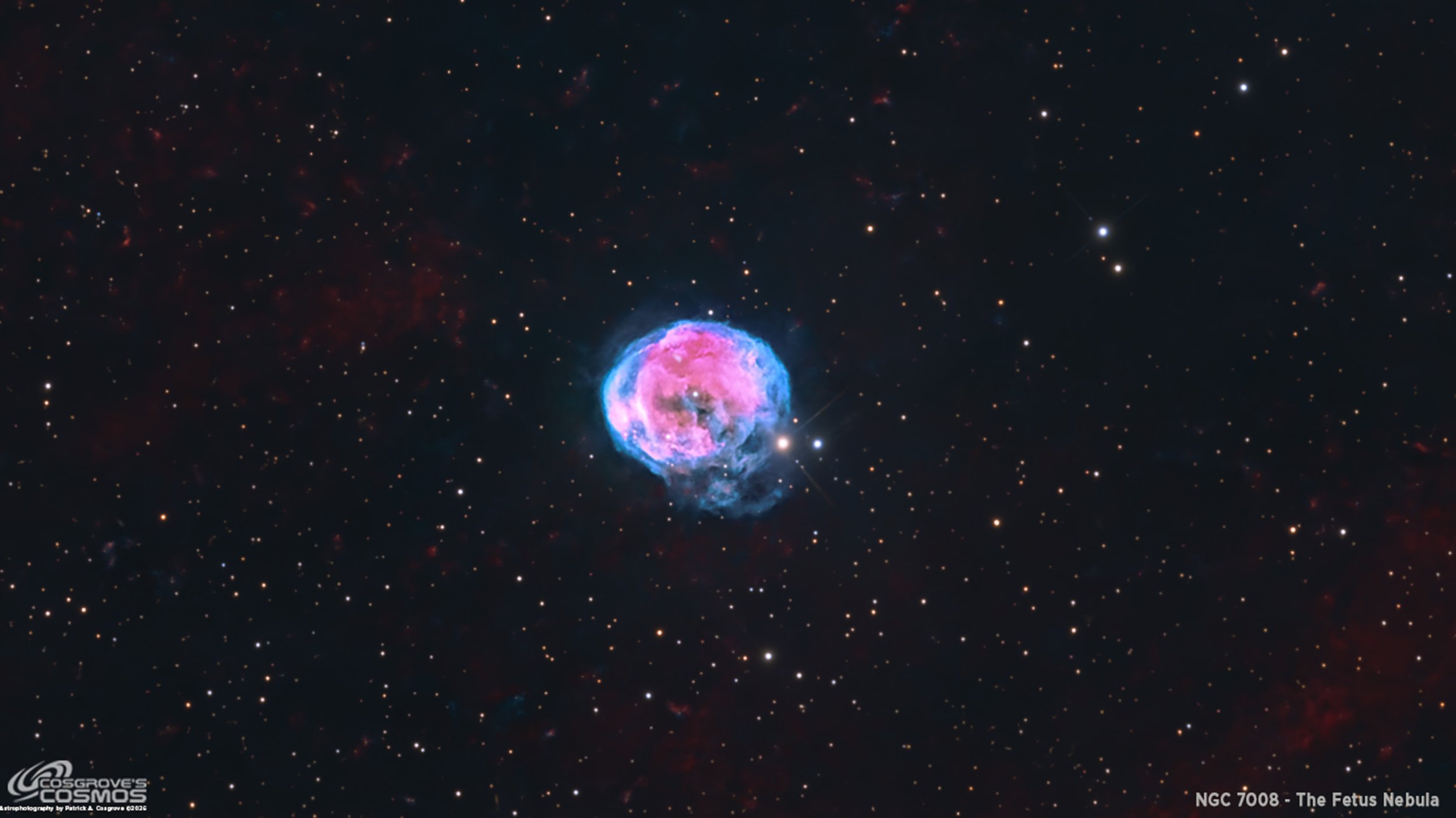
NGC 7008, the Fetus Nebula, became a small-target processing challenge wrapped inside a wide-field Cygnus scene. Captured over four July nights with the SCA260 platform, this HOO image with RGB stars combines 10.5 hours of data to reveal the nebula’s compact, knotted shell while preserving a natural star field around it. The final result balances the science and the struggle: a dying Sun-like star’s glowing remnant, only about 86 arcseconds across, pulled carefully out of a rich and imperfect summer sky.
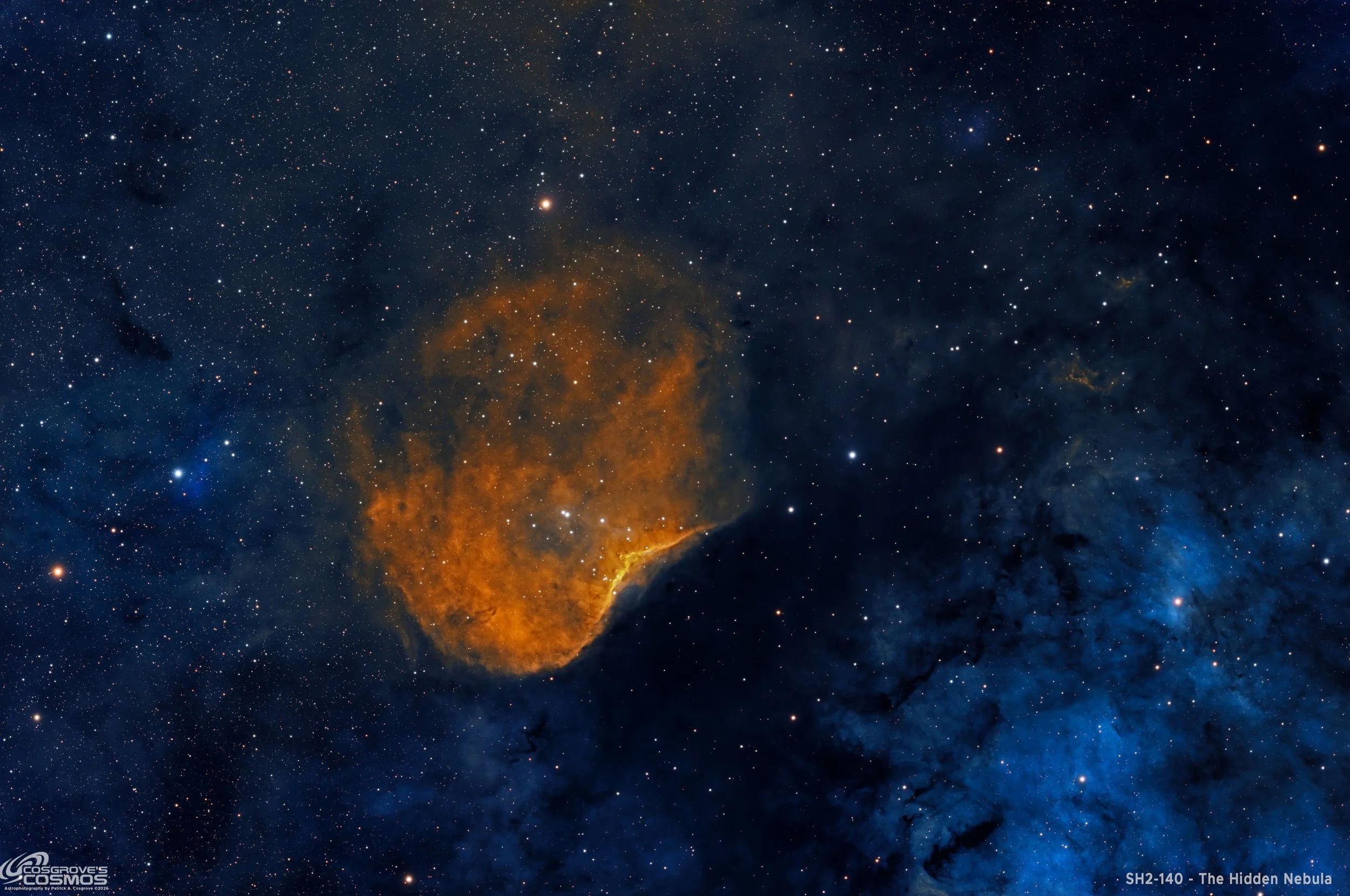
A wide-field view of the Sadr Region in Cygnus, combining 12 h 46 m of SHO narrowband data with RGB stars captured through the Askar FRA400 and ZWO ASI2600MM-Pro. This image reveals glowing emission nebulae, dark molecular clouds, young star clusters, and the bright foreground star Sadr along one of the richest stretches of the Milky Way.
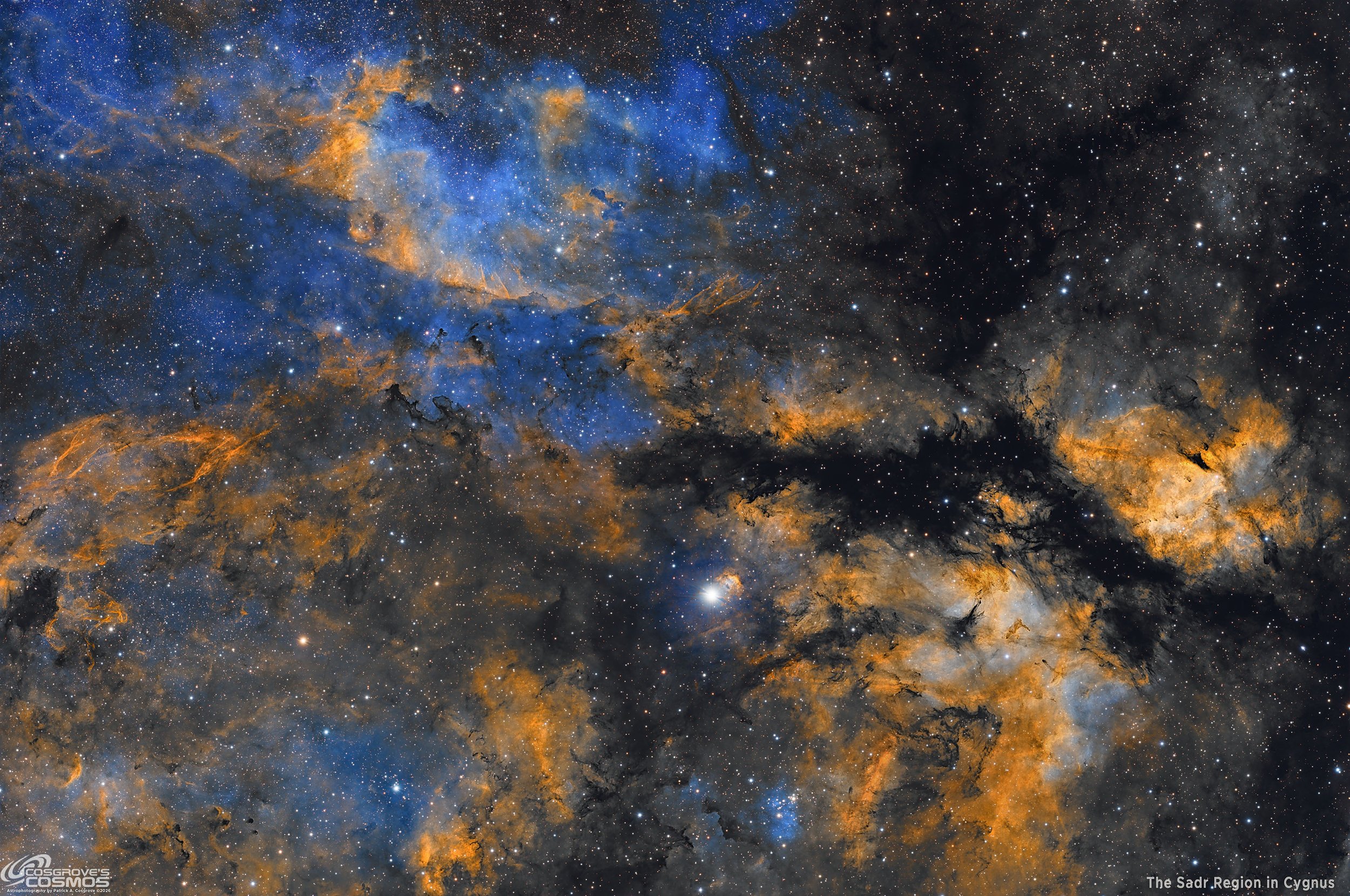
A wide-field view of the Sadr Region in Cygnus, combining 12 h 46 m of SHO narrowband data with RGB stars captured through the Askar FRA400 and ZWO ASI2600MM-Pro. This image reveals glowing emission nebulae, dark molecular clouds, young star clusters, and the bright foreground star Sadr along one of the richest stretches of the Milky Way.
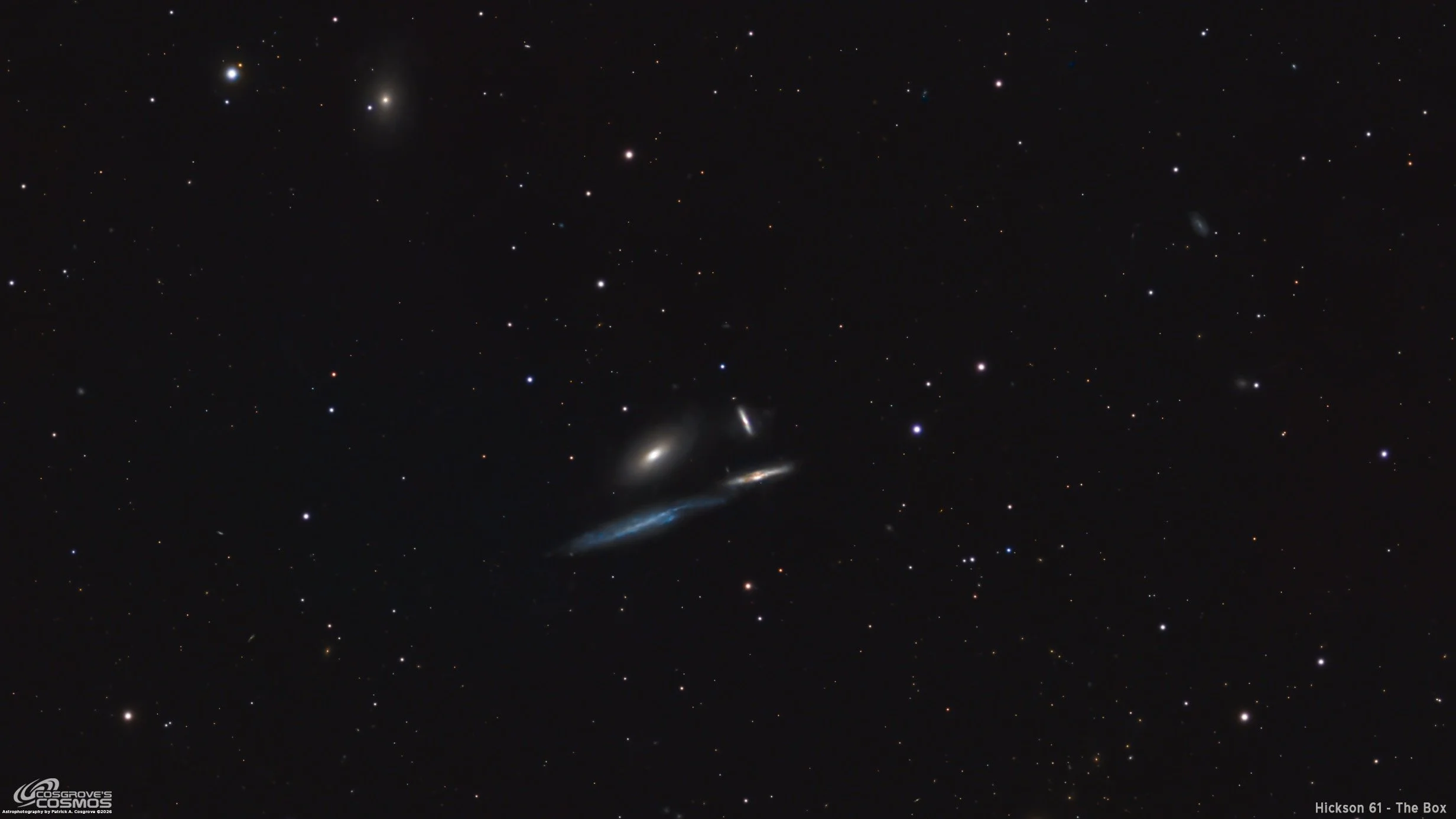
Hickson 61, better known as “The Box,” is a tiny apparent grouping of faint galaxies in Coma Berenices. This LRGB image captures NGC 4169, NGC 4173, NGC 4174, and NGC 4175 — four small galaxies arranged in a striking box-like pattern. Most of the group lies roughly 170–200 million light-years away, while NGC 4173 is likely a closer foreground galaxy that happens to line up with the others. Captured from Whispering Skies Observatory over two April nights, this 7-hour 48-minute project highlights the challenge and reward of imaging small, distant galaxy groups where scale, faintness, and perspective all matter.
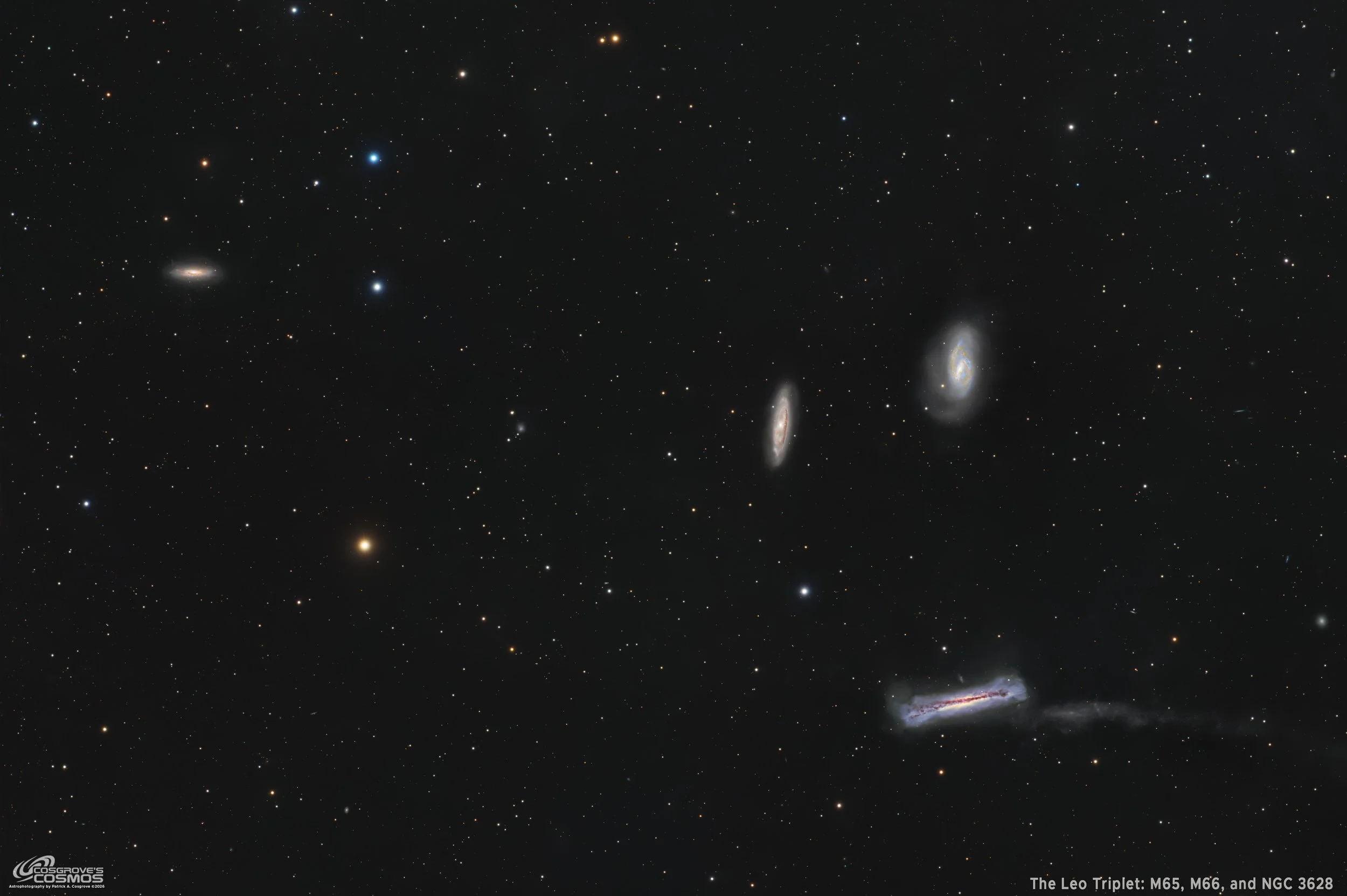
This image captures the Leo Triplet — M65, M66, and NGC 3628 — along with nearby NGC 3593 in a wide-field LRGB view from Whispering Skies Observatory. With 12.6 hours of integration, the image reveals the three main galaxies, the smaller surrounding galaxy field, and the faint tidal tail extending from NGC 3628. This project also served as first light for the new ASI2600MM-Pro camera on my FRA400 platform.
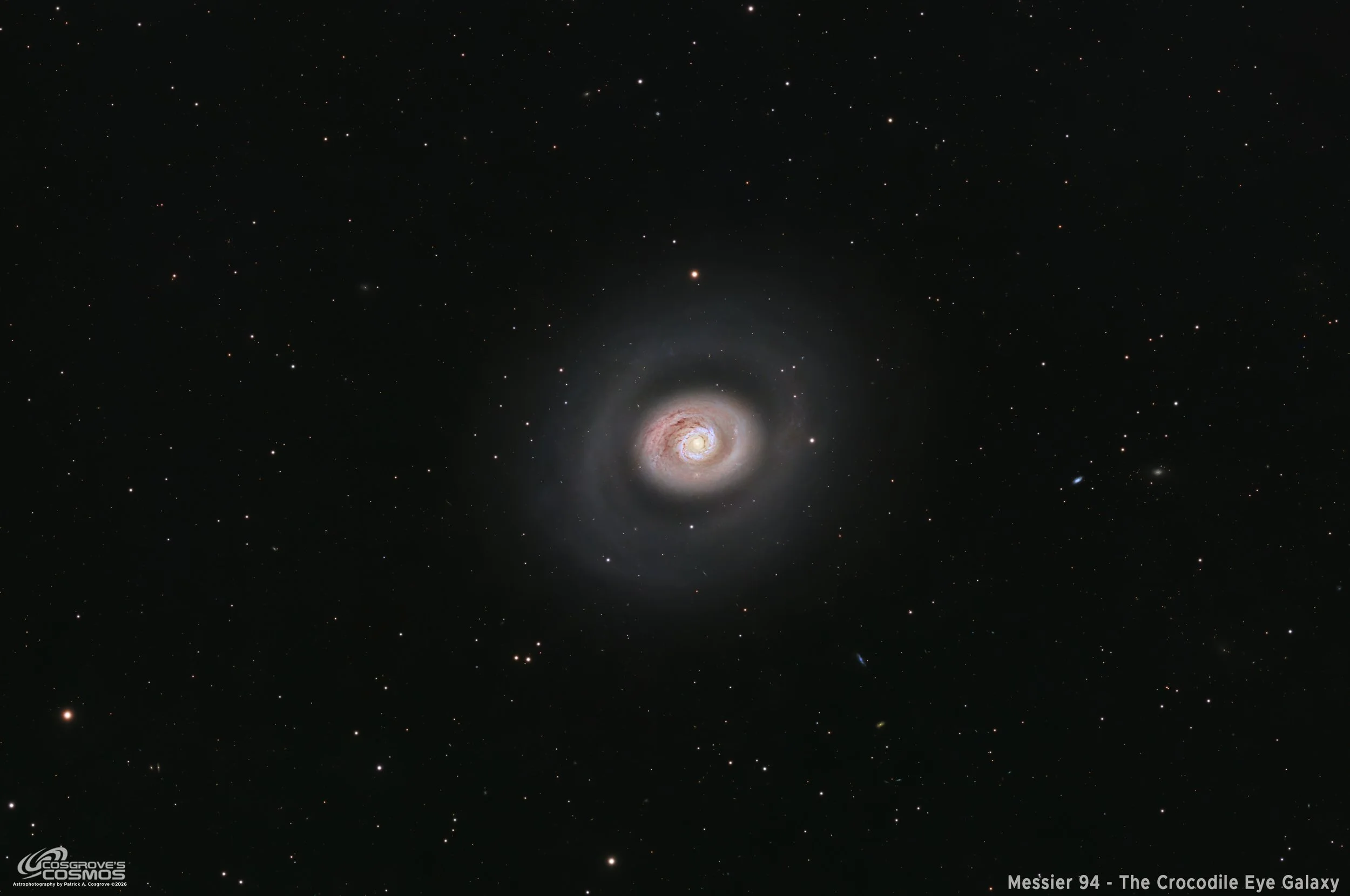
Messier 94, the Crocodile Eye Galaxy, is a compact but structurally complex spiral galaxy in Canes Venatici, about 16 million light-years away. This LRGB image captures its bright central core, active star-forming inner ring, and faint extended outer disk using 12h 49m 30s of data from Whispering Skies Observatory.
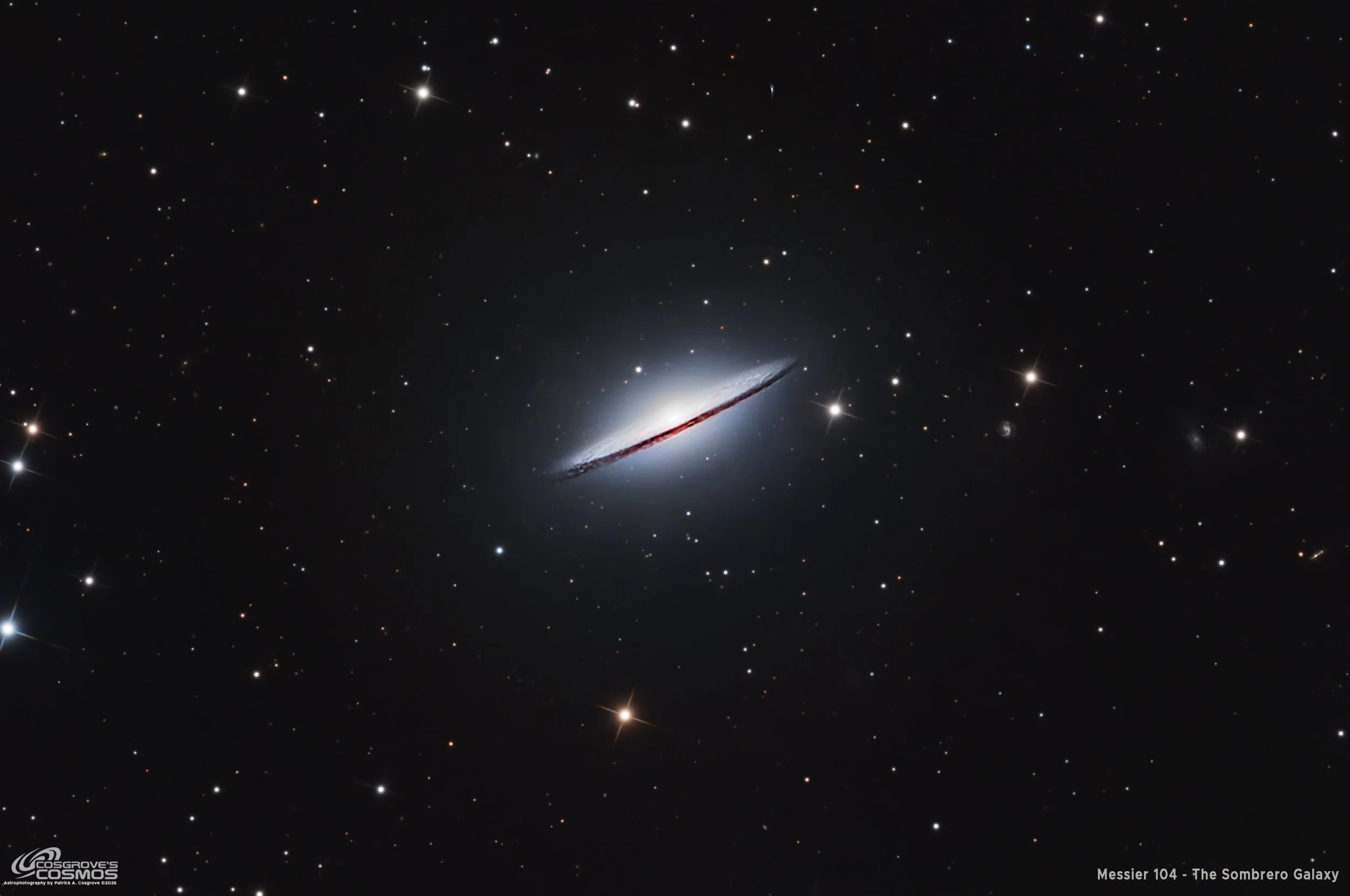
Messier 104, the Sombrero Galaxy, is one of the most recognizable galaxies in the spring sky. This project captures its bright central bulge, sharp equatorial dust lane, and faint outer halo using 11 hours of LRGB data from the Sharpstar SCA260 V2 at Whispering Skies Observatory.
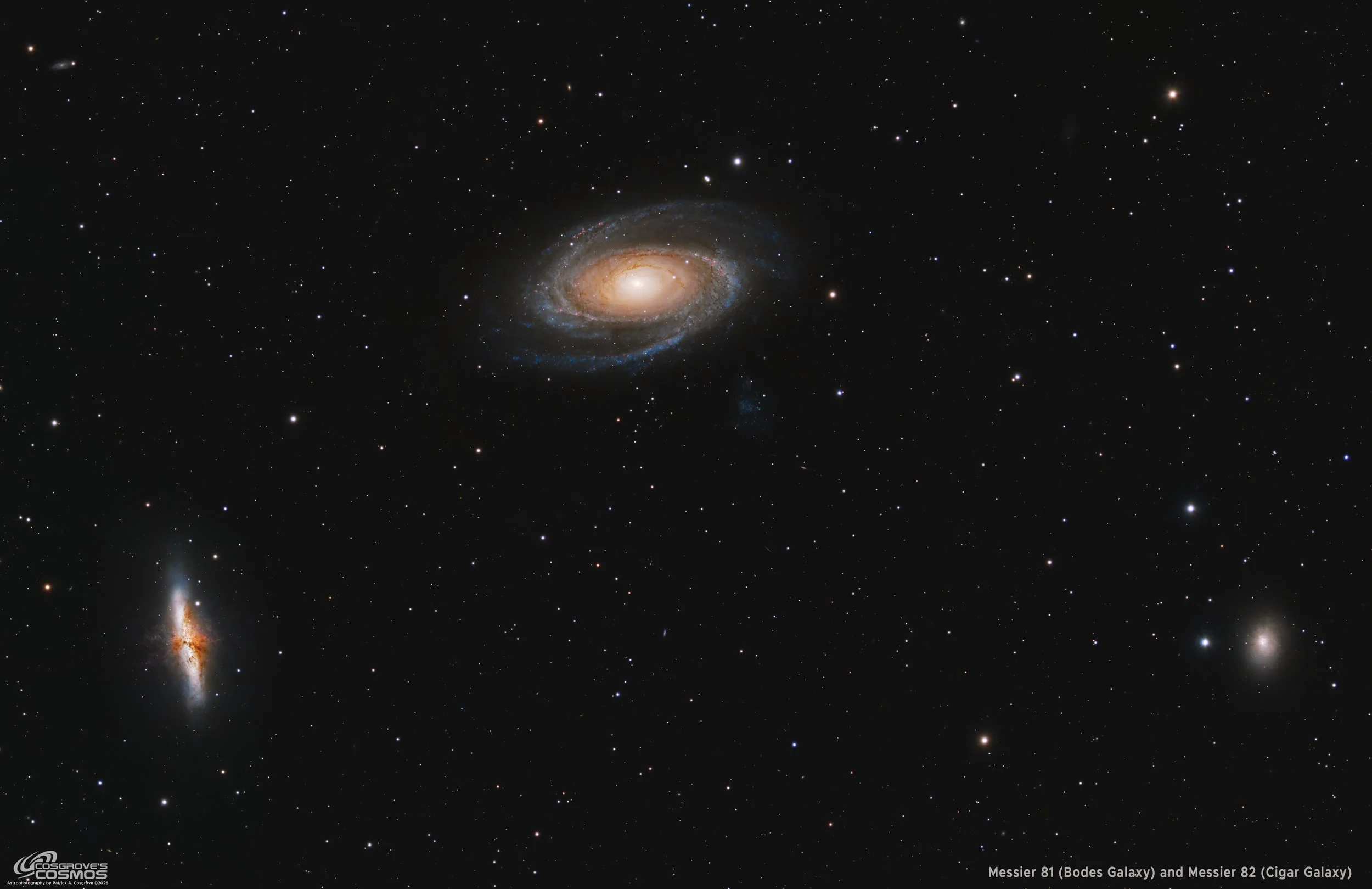
First light on my Astro-Physics 155mm Starfire EDFS platform captured a classic interacting galaxy field in Ursa Major: M81, M82, and NGC 3077. This image combines LRGB and H-alpha data to highlight the contrast between the grand-design spiral structure of M81, the starburst-driven outflow in M82, and the disturbed companion galaxy NGC 3077.
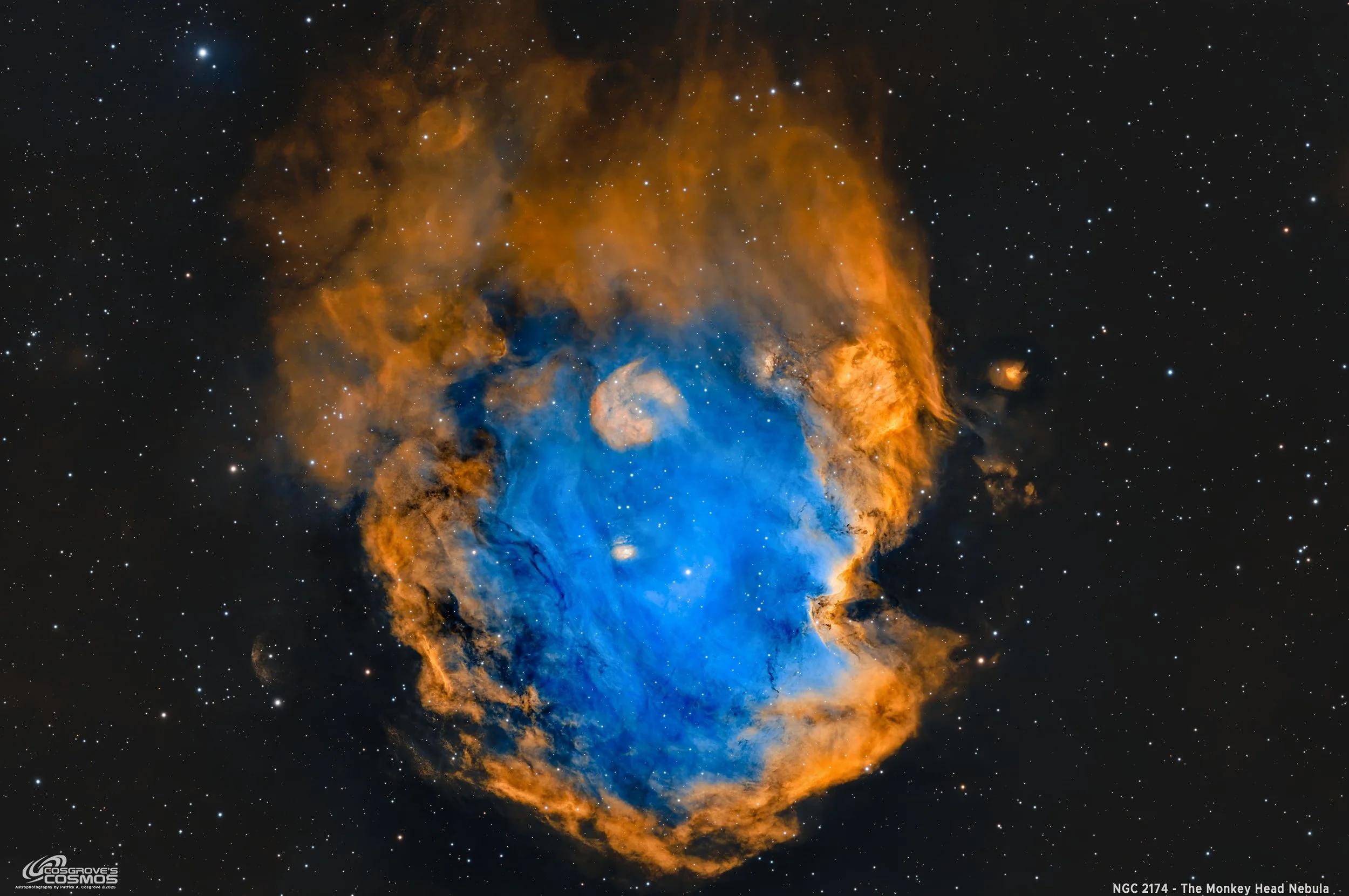
NGC 2174 — the Monkey Head Nebula — is a luminous star-forming cloud in Orion, roughly 6,400 light-years away. In this project I captured the nebula in narrowband (Hα, OIII, SII), revealing glowing hydrogen arcs, oxygen-rich structure, and dark dust lanes sculpted by intense radiation from young, massive stars. The result is a high-contrast look at an active H II region where stellar feedback is actively reshaping its birth cloud.
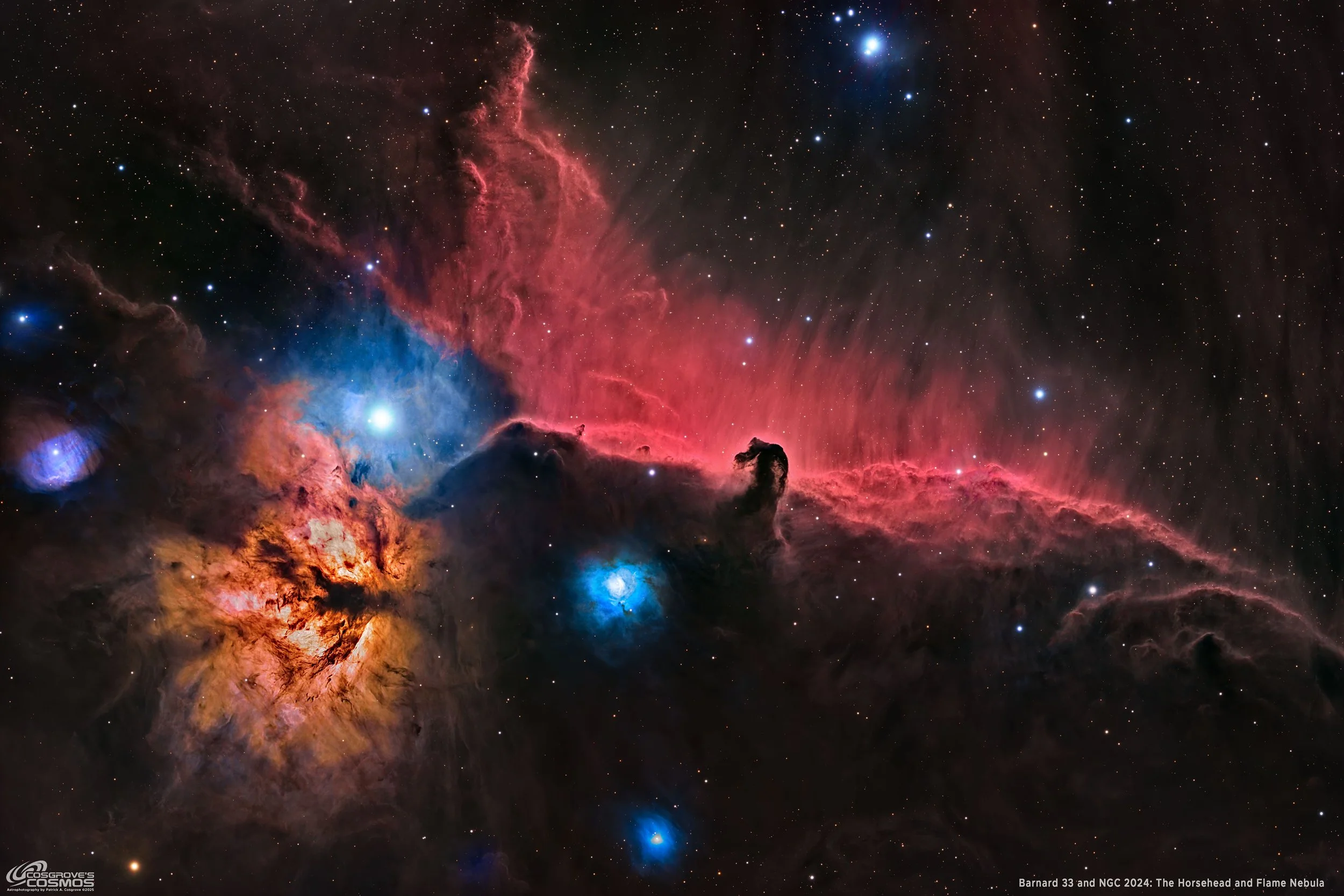
A new Orion classic from Whispering Skies Observatory: B33 (the Horsehead Nebula) silhouetted against IC 434, paired with NGC 2024 (the Flame Nebula) and its intricate dust lanes. Captured October 27–28, 2025 using LRGB + Hα for a total of 5 h 59 m 30 s, this project emphasizes clean star color and high-contrast dust structure while preserving the region’s faint, extended nebulosity.
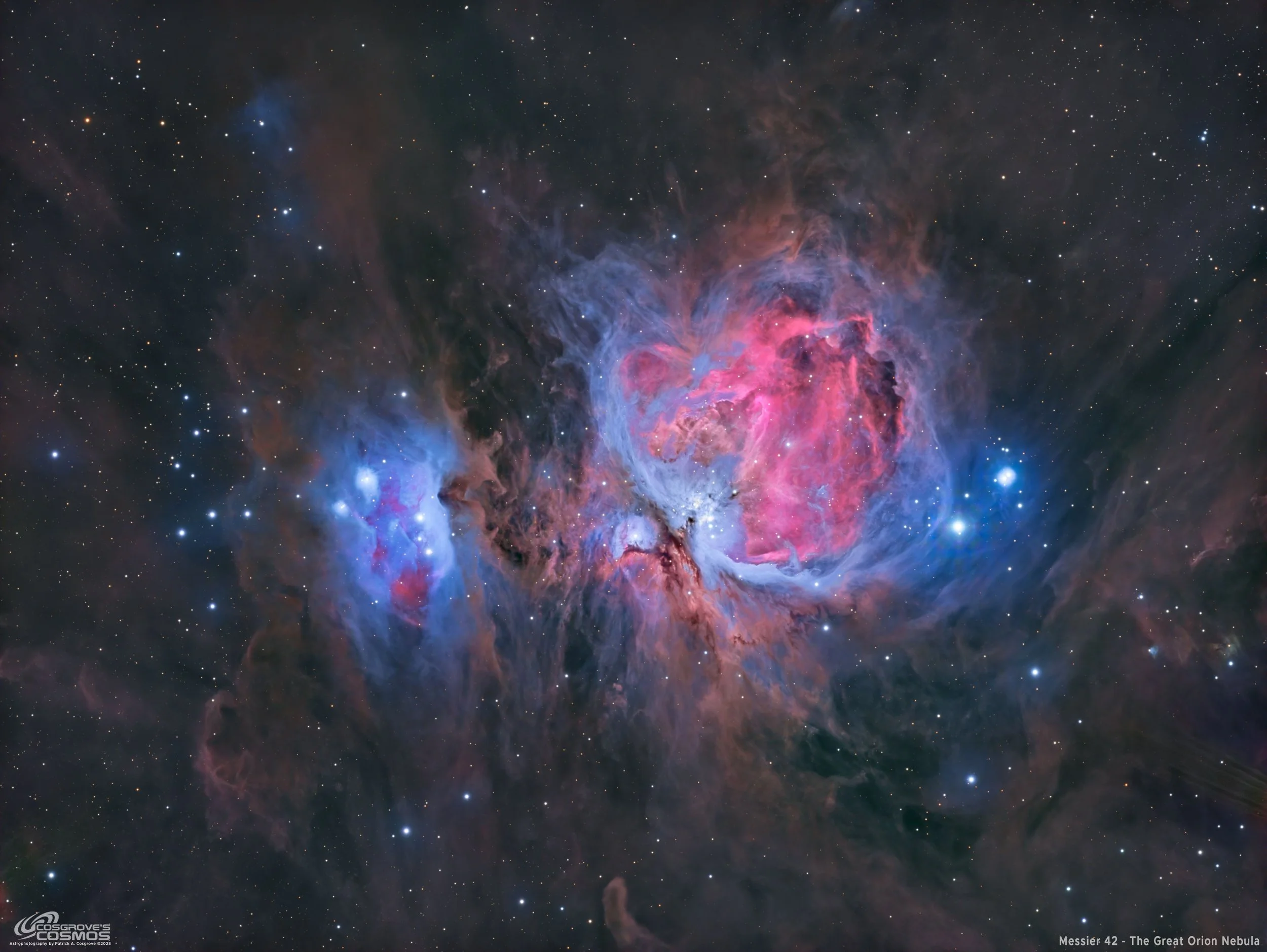
Orion’s sword is one of the most famous regions in the night sky, and for good reason. This widefield take on M42/M43 and the Running Man blends short and longer RGB/L exposures with H-alpha to balance the bright core against the faint, sculpted outer nebulosity—an image that showcases both the beauty and the ongoing starbirth of our nearest major stellar nursery.

Stephan’s Quintet is a compact group of galaxies in Pegasus caught in the middle of a slow-motion cosmic collision – four true members being stretched, stripped, and reshaped by gravity while a fifth foreground spiral simply photobombs the scene. This deep LRGB image reveals distorted spiral arms, long tidal tails, and the bright cores of galaxies that are gradually merging into a single massive system hundreds of millions of light-years away.

This project explores Sh2-171, part of the NGC 7822 star-forming complex in Cepheus, a sprawling H II region about 3,000 light-years away where hot young stars are carving pillars and cavities into the surrounding gas. Captured over 33.5 hours in narrowband SHO with an Astro-Physics 130 mm Starfire and ASI2600MM-Pro, the image reveals the intricate structure and subtle filaments of this faint but remarkably active stellar nursery.

A 34.5-hour SHO+RGB portrait of Sh2-157 (the Lobster Claw) with the Bubble Nebula in frame—captured over five October nights with the FRA400/ASI1600 and processed in PixInsight; full workflow and annotations inside.

My Second Attempt - and my finest - with NGC 7380 - The Wizard Nebula.
This is the result of 25 hours of narrowband and RGB exposure on my Williams Optics 132 FLT APO platform, equipped with a 0.8 reducer and an ASI2600MM-Pro camera.
This was another image captured from my new observatory, which allowed for capture on marginal nights.
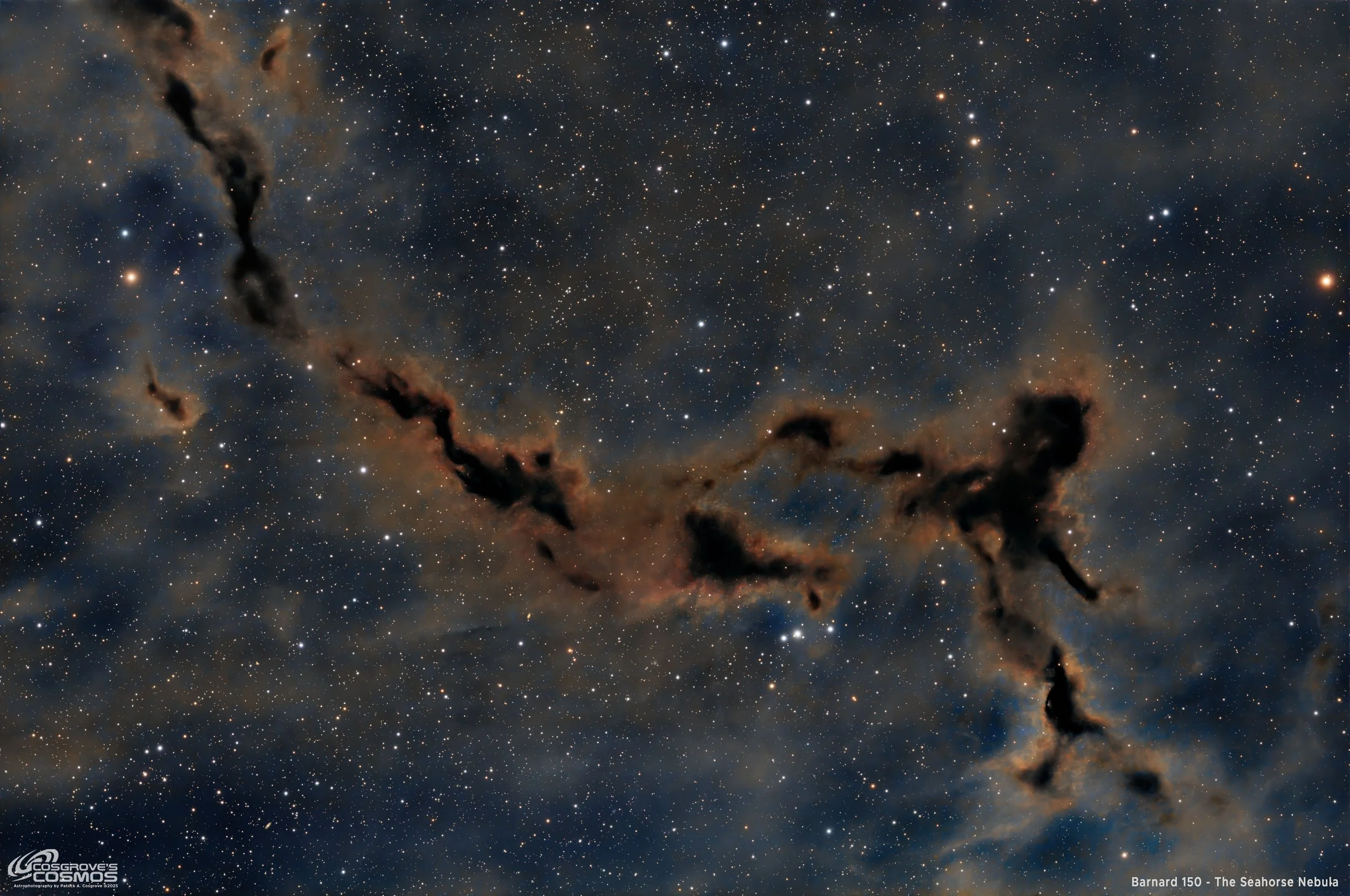
This is the first year I have started targeting Dark Nebulae. It’s been a learning experience.
On this project, I targeted Barnard 150 - The Seahorse Nebula. Even with more than 18 hours of integration, I ran into noise issues.
You need to do a lot of stretching, and this amplifies the high noise. While NoiseXterminator is extremely effective, when handling this much noise, I encountered some ugly artifacts, which greatly frustrated me. So the project reportsto learn more!
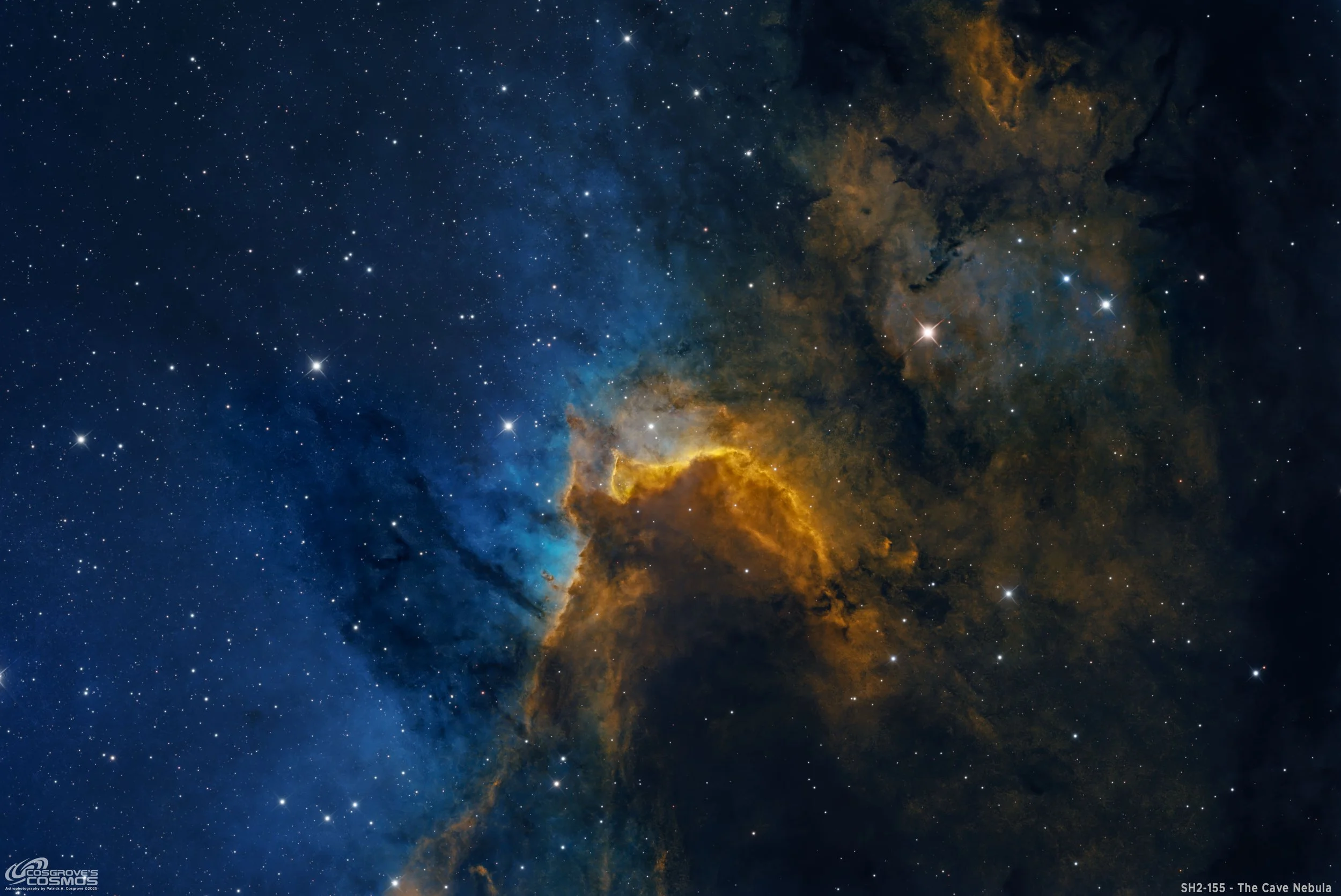
After 5 years, I revisited SH2-155 - The Cave Nebula, this time gathering 13.5 hours narrowband data. This was shot with my new galaxy scope and the resulting colors really pop and dark dust is very mysterious looking!
This data was collected over three nights at the end of August 2025.
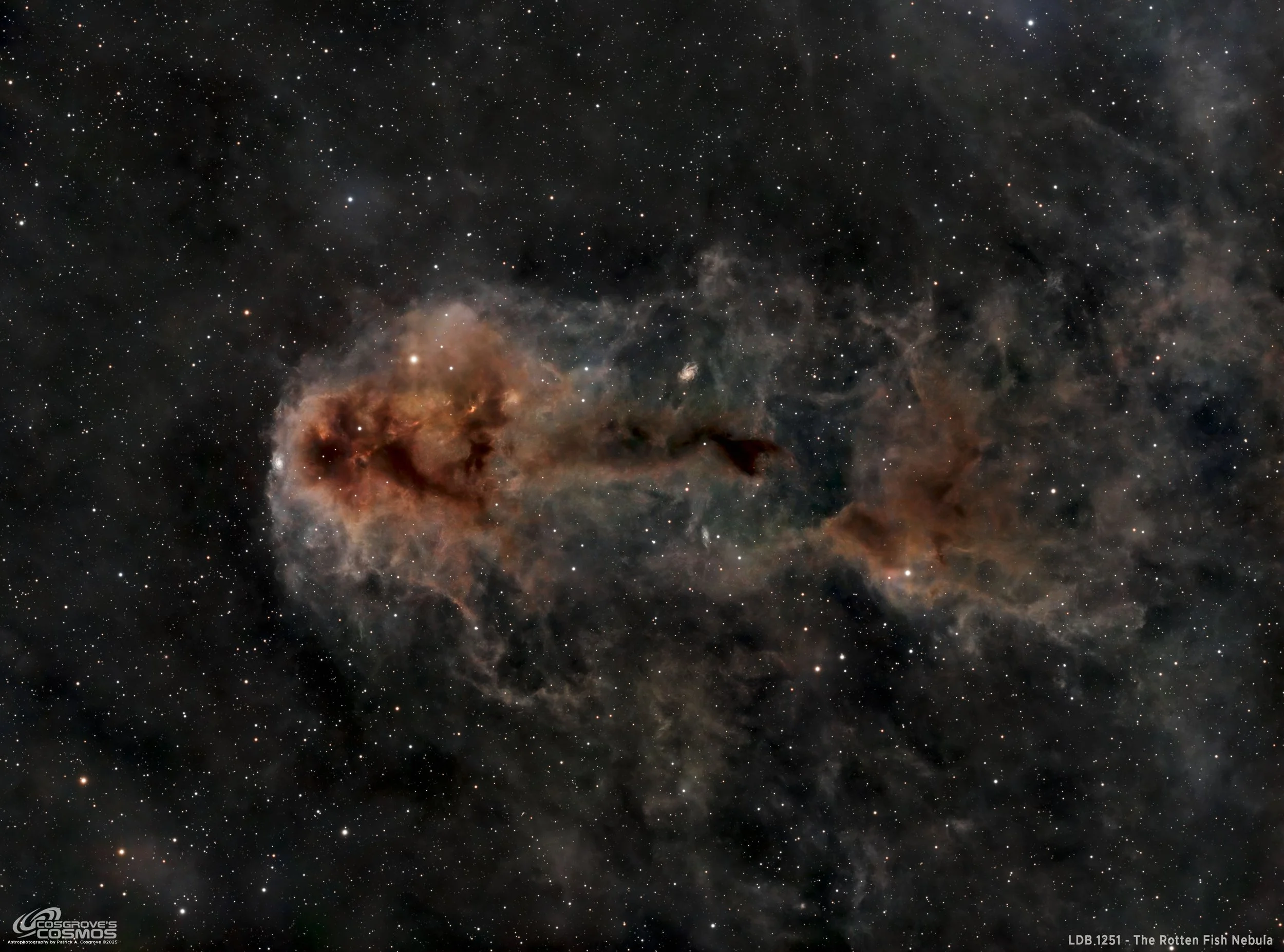
My second dark nebula image ever!
This image results from 19 hours of LRGB exposure with my FRA400 scope.
This was a challenging image to process as the nebula was so tenuous. I also had to deal with microlensing effects on the bright stars due to the ASI1600MM-Pro sensor.
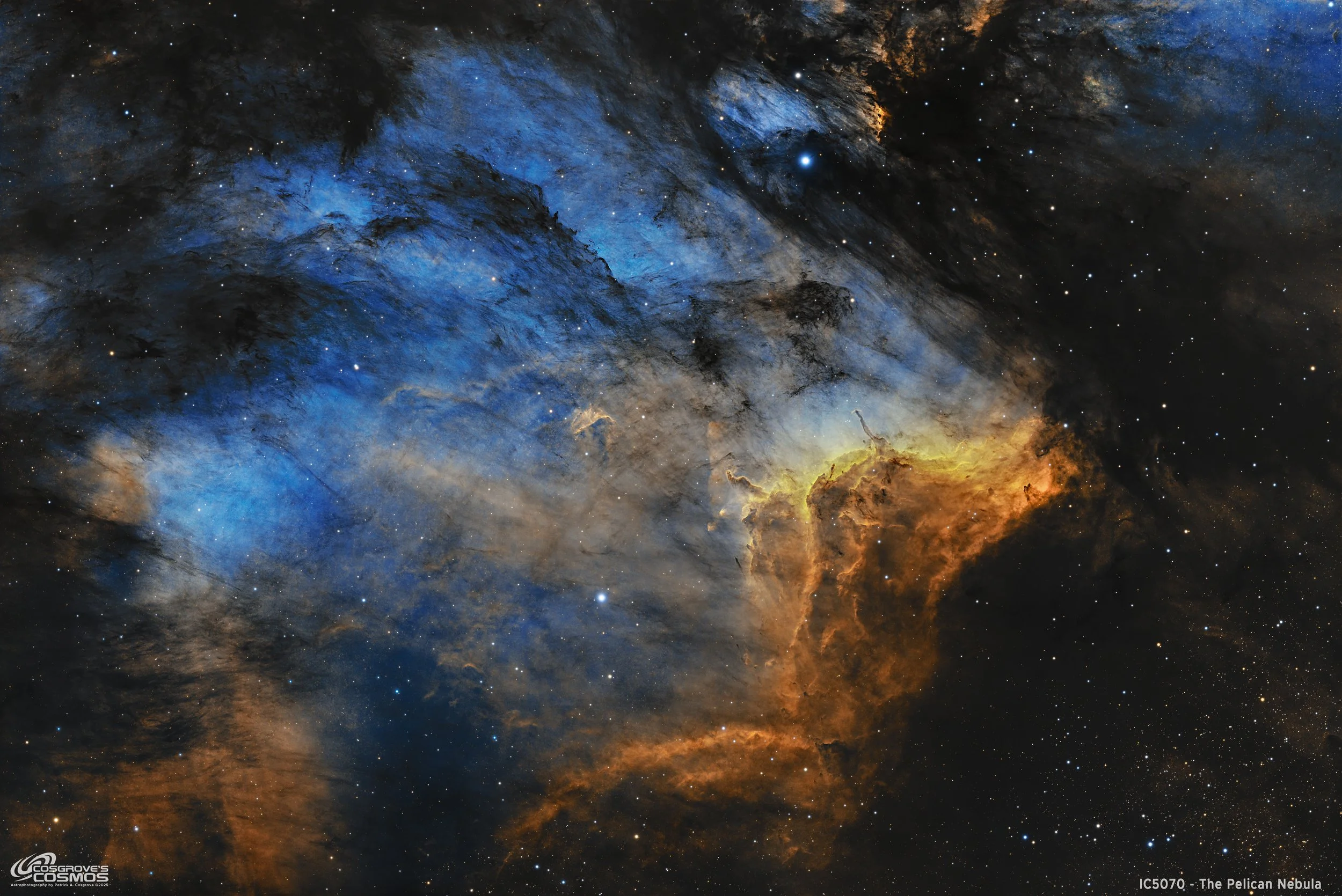
My third attempt - and my finest - at IC 5070 - The Pelican Nebula.
This is the result of almost 19 hours of narrowband exposure on my Williams Optics 132 FLT APO platform with a 0.8 reducer and an ASI2600MM-Pro camera.
This was another image that was captured from my new observatory tht allowed capture on marginal nights.
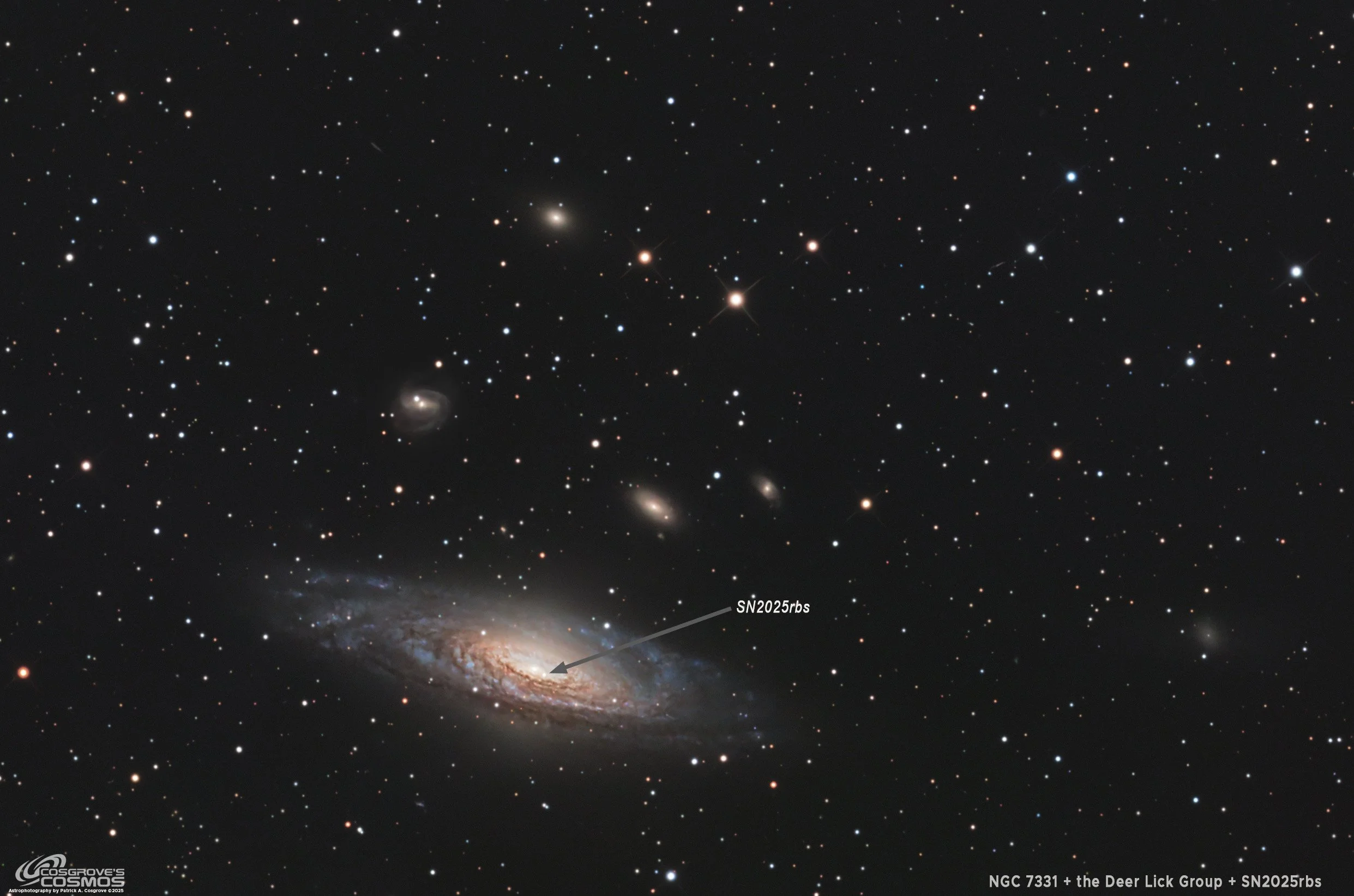
While on a multi-night streak of capturing subs on my Sharpstar SCA 260 Galaxy scope, I retasked one night of shooting to try and get an image of NGC 7331 while Supernova SN2025rbs was still visible.

SH2-124 is a rich region of stars, dark dust, and emission nebulae located about 8,500 light-years away in the constellation of Cygnus.
This image is the result of 14.2 hours of SHOrgb data collection with my small Akskar FRA400 telescope platform.

Astrobin Top Pick Nominee!
IC 5068 is a very faint nebula that is part of the North American/Pelican Nebula region and is often passed over for these brighter nebulae. But this region is a beautiful piece of the sky in narrowband!
Shot with my AP130 Platform with ~12 hours of SHO and RGB-Stars capture.

This image of NGC 6543 - The Cat’s Eye - is the result of 14.6 hours of LRGB data captured with my Sharpstar SCA260V2 Platform. It was a faint and challenging object that also had very bright portions. This made it one of the most challenging targets I have processed yet. I must have reprocessed that data 8 or 9 times before I ended where I did. Was this the best image I could get from that data? I don’t think so. In the end, the effort exhausted me and I was ready to move on!!
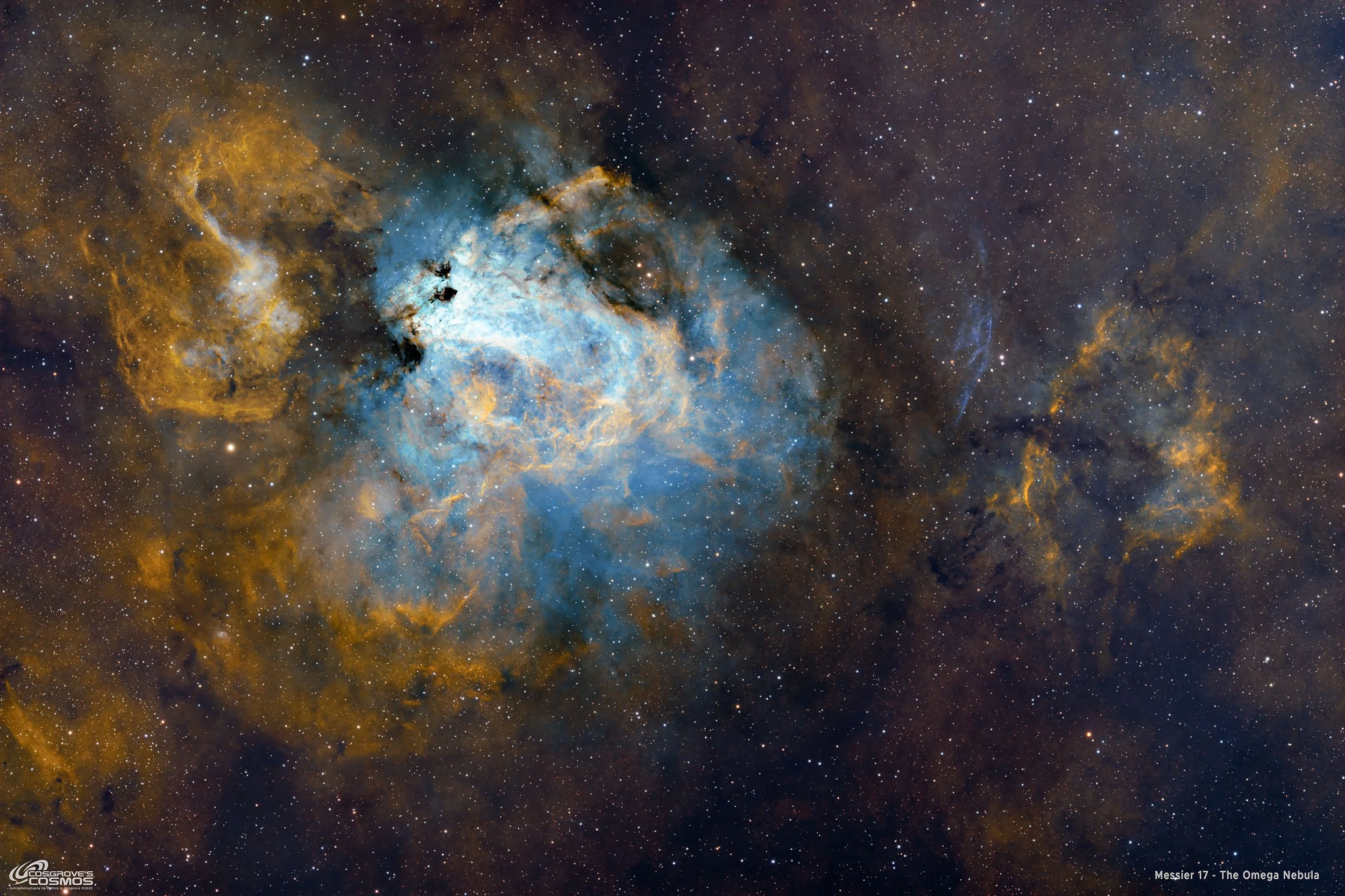
Messier 17, The Omega Nebula, is a bright and popular target in the summer constellation of Sagittarius.
This image is the result of 17 hours of SHOrgb exposure on my William Optics 132 LFT platform.
The narrowband view of this shows the target in a way that is not often seen.
Considering that this project started with three nights of exposure, where 2 of the nights had all of the frames out of focus, I am really happy with the final results.
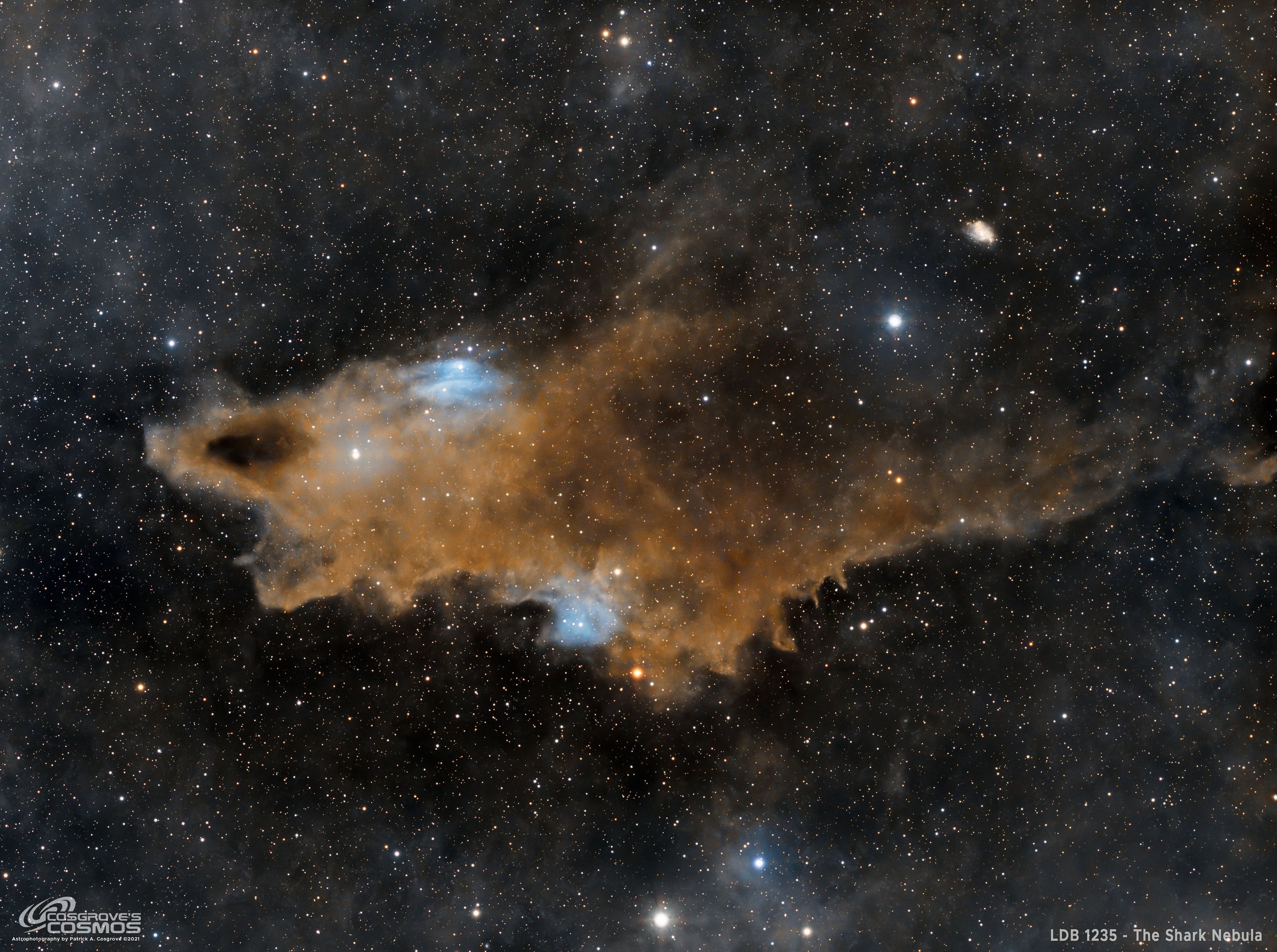
My first dark nebula image!
This image results from 7.4 hours of LRGB exposure with my FRA400 scope.
This was a challenging image to process as the nebula was so tenuous. I also had to deal with microlensing effects on the bright stars due to the ASI1600MM-Pro sensor.
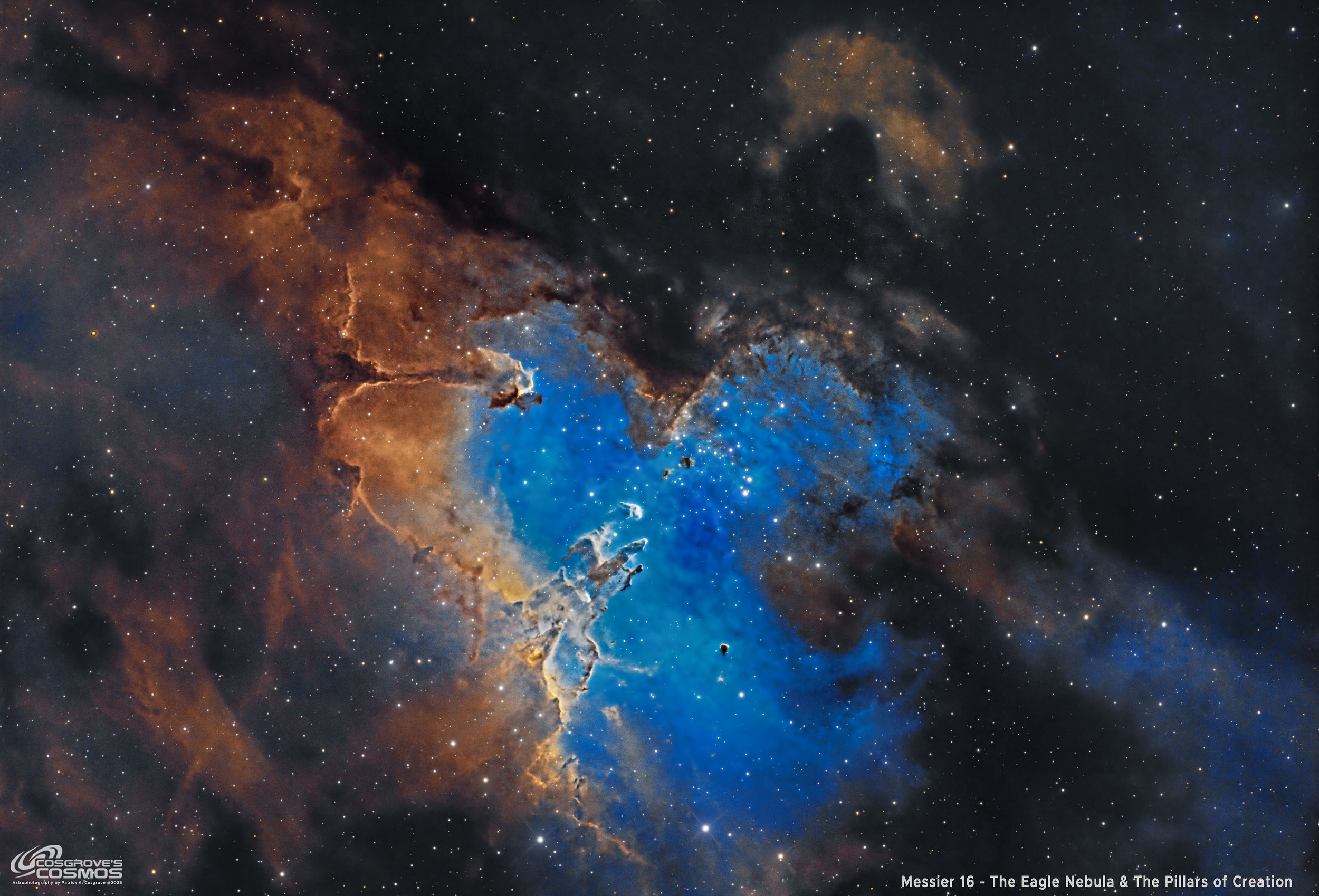
This was a quick test to see how the Sharpstar SCA260 V2 scope did with a narrowband target. Selected was Messier 16, centered on the Pilrs of Creation. This was the result of 4.75 hrs of data collected on a very hot night, with the camera only getting to -10C.
Processing was a challenge due to Star Removal blemishes and some optical artifacts on some bright stars.
See the full report for details.

Sh2-54 is an interesting HII region with some dark dust located in the constellation Sperpens Cause (The Tail). Also seen is the open cluster NGC 6604. This image is a result of 8.9 hours of SHO Data.
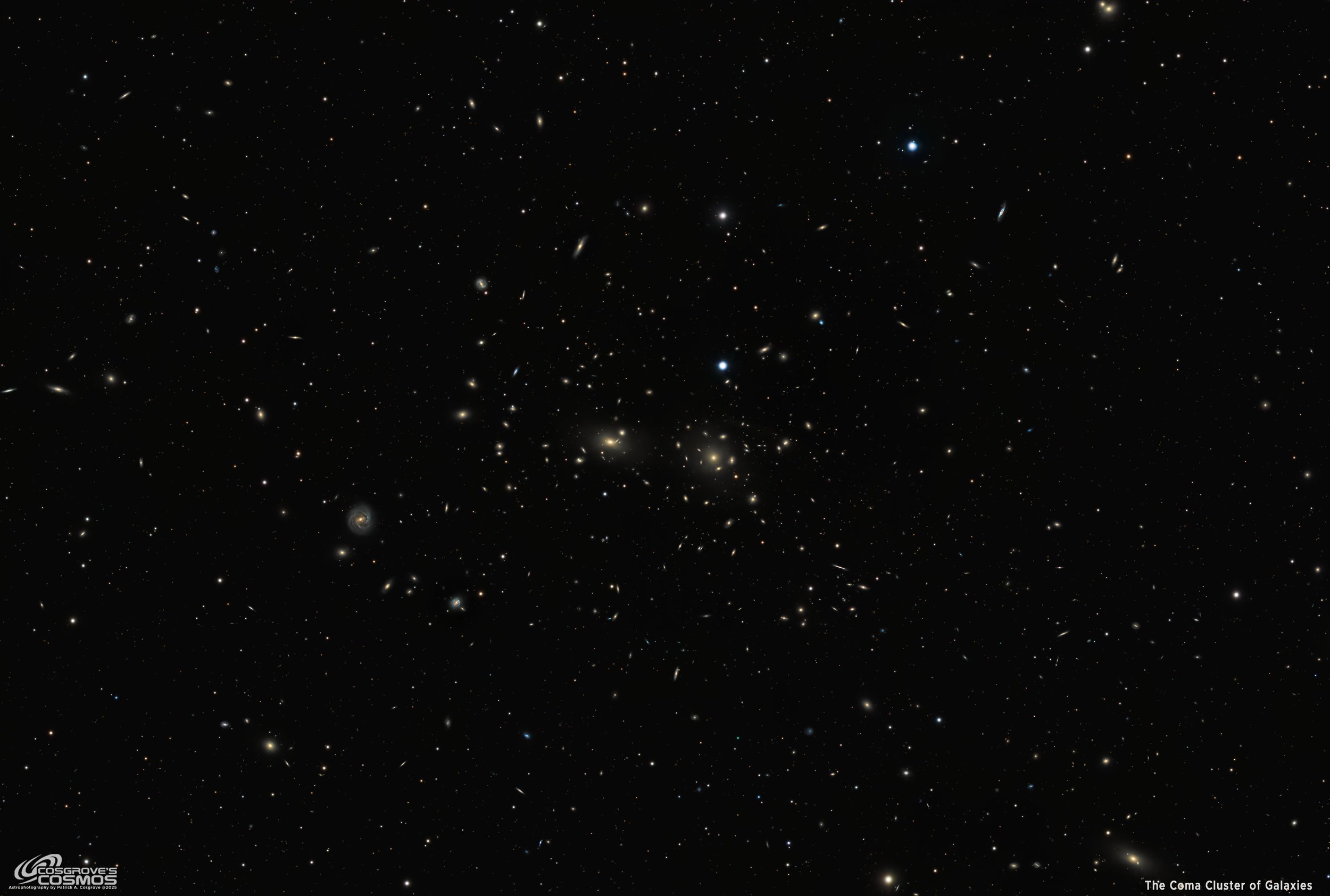
This is not just some star cluster! This image shows an immense cluster of over 1000 galaxies that are on average 320 million light-years away!
This image was the result of 8.2 hours of LRGB exposure taken on my William Optics platform from data collection during the first light of my Whispering Skies Observatory!

The NGC 5364 Group is part of the vast Virgo Cluster of Galaxies and showcase a mix of galay morphologies in one frame.
This shot was the very first from my AP130 platform after it had been installed in my new observatory.
NGC 7129, the Flower Bud Nebula, is a young star-forming region in Cepheus where blue reflection nebulosity, dark molecular dust, and newborn stars share the same field. This 13-hour, 54-minute LRGB project captures the glowing central nebula, surrounding Cepheus dust clouds, and nearby clusters including NGC 7142, revealing a scene where starlight is just beginning to break out of the cloud that formed it.