SH2-134: Glowing Gas and Dark Clouds in Cepheus: A Dew-Drenched 18 hours of SHOrgb
Date: October 19, 2026
Cosgrove’s Cosmos Catalog ➤#0170
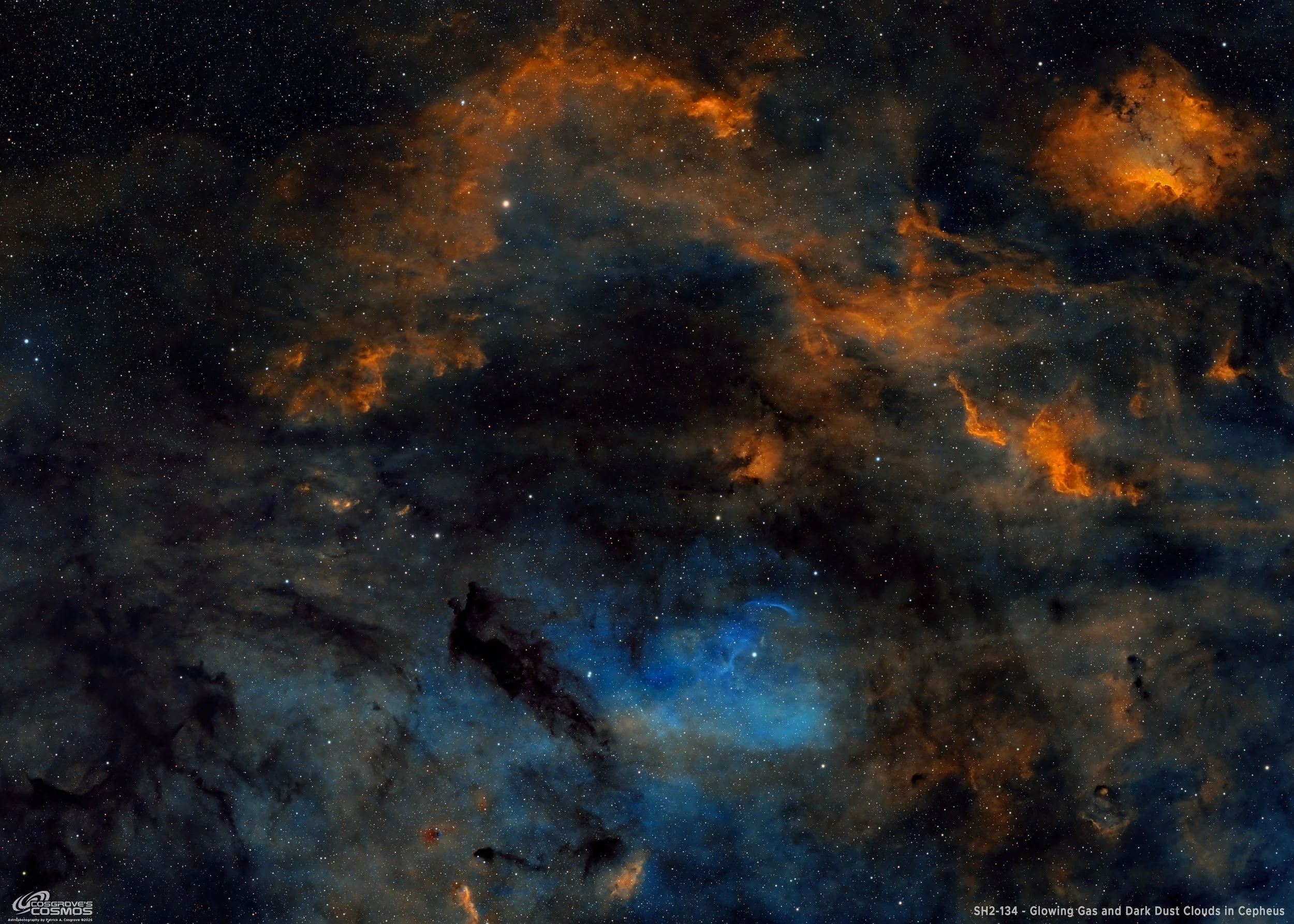
SH2-134 in Cepheus, captured with my FRA400 platform. (Click image for hi-res version via AstroBin.com.)
Sh2-134 — a sweeping landscape of glowing gas, intricate dust clouds, and sculpted filaments in the rich Milky Way of Cepheus.
🌌 Introduction
Sh2-134 — Glowing Gas and Dark Clouds in Cepheus
Some regions of the night sky are best appreciated as a landscape. This field in Cepheus is filled with overlapping clouds, luminous ridges, and dark silhouettes, with new structures appearing wherever you look. Broad orange-gold filaments sweep across the upper part of the image, while a cooler blue glow surrounds the star Lambda Cephei below the center. Between them, intricate dust clouds interrupt the light and give the scene much of its depth.
The principal target is Sh2-134, an extensive emission-nebula complex whose boundaries are far less obvious than those of a neatly defined bubble or ring. The surrounding field includes the more compact Sh2-135, numerous patches of bright nebulosity, and several dark clouds recorded in the Barnard and Lynds catalogs. Together, they reveal how much structure can hide in a seemingly ordinary stretch of the Milky Way.
🔭 Project Summary
Target: Sh2-134 / Sharpless 134 / LBN 490 — emission nebula complex around Lambda Cephei
Capture Dates: September 6, 11, and 14, 2026
Constellation: Cepheus • Distance: Approximately 2,900 light-years for Sh2-134
Type: Wide-field emission nebula complex with glowing filaments, dark interstellar clouds, and the hot supergiant Lambda Cephei
Imaging Period: September 6–14, 2026 • Total Integration: 17 h 52 m 00 s (SHO narrowband + RGB stars)
Filters: Ha · OIII · SII (Astronomik 36 mm 6 nm) + R · G · B (ZWO 36 mm LRGB Gen II)
Telescope: Askar FRA400 72 mm f/5.6 Quintuplet Air-Spaced Astrograph
Camera: ZWO ASI2600MM-Pro (−15 °C; Gain 100 narrowband, Gain 0 RGB)
Mount: ZWO AM5 on custom steel pier
Processing: PixInsight (SHO narrowband + RGB stars) & Photoshop
Location: Whispering Skies Observatory · Honeoye Falls, NY (USA)
Acquisition Notes: Ha: 68 × 300 s; OIII: 67 × 300 s; SII: 75 × 300 s; R: 14 × 30 s; G: 15 × 30 s; B: 15 × 30 s, all bin 1×1 at −15 °C. Total integration after culling bad or questionable frames: 17 h 30 m narrowband + 22 m RGB.
Image Note: This wide-field SHO narrowband image explores the rich region around Sh2-134 and Lambda Cephei, including the compact emission nebula Sh2-135, numerous Lynds bright and dark nebulae, and Barnard dark clouds such as B169, B170, B171, B173, and B174.
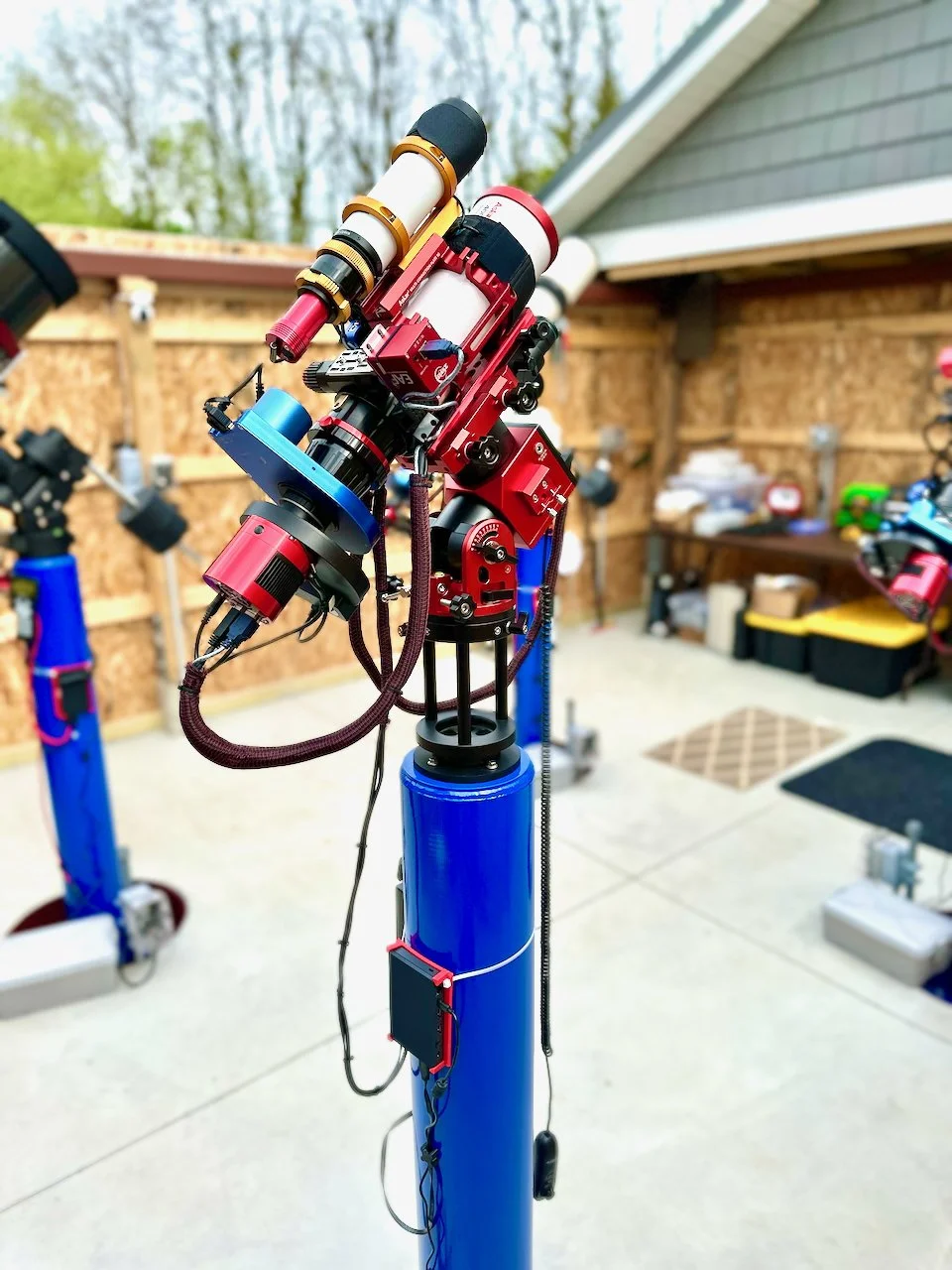
The FRA400 (click on image to go to the blog entry for this scope)
📸 Capture Details
Nights: September 6, 11, and 14, 2026
| Channel / Filter | Frames × Exposure | Settings | Total |
|---|---|---|---|
| Ha — Astronomik 6 nm Hydrogen-alpha (36 mm unmounted) | 68 × 300 s | bin 1×1 • −15 °C • Gain 100 | 5 h 40 m |
| OIII — Astronomik 6 nm Oxygen III (36 mm unmounted) | 67 × 300 s | bin 1×1 • −15 °C • Gain 100 | 5 h 35 m |
| SII — Astronomik 6 nm Sulfur II (36 mm unmounted) | 75 × 300 s | bin 1×1 • −15 °C • Gain 100 | 6 h 15 m |
| R — ZWO Red (36 mm unmounted) | 14 × 30 s | bin 1×1 • −15 °C • Gain 0 | 7 m |
| G — ZWO Green (36 mm unmounted) | 15 × 30 s | bin 1×1 • −15 °C • Gain 0 | 7 m 30 s |
| B — ZWO Blue (36 mm unmounted) | 15 × 30 s | bin 1×1 • −15 °C • Gain 0 | 7 m 30 s |
| Total Integration (after culling): 17 h 52 m 00 s (SHO narrowband + RGB stars) | |||
Calibration Frames
- 25 × dark frames @ 300 s, bin 1×1, −15 °C, Gain 100
- 25 × dark frames @ 30 s, bin 1×1, −15 °C, Gain 0
- 30 × dark-flats @ each flat exposure time, bin 1×1, −15 °C, Gain 0 for RGB and Gain 100 for narrowband
- Flats: 15 each — Ha, OIII, SII, R, G, B
Table of Contents Show (Click on lines to navigate)
Annotated Image
This annotated image was created with the ImageSolver and FinderChart scripts in PixInsight.
The Location in the Sky
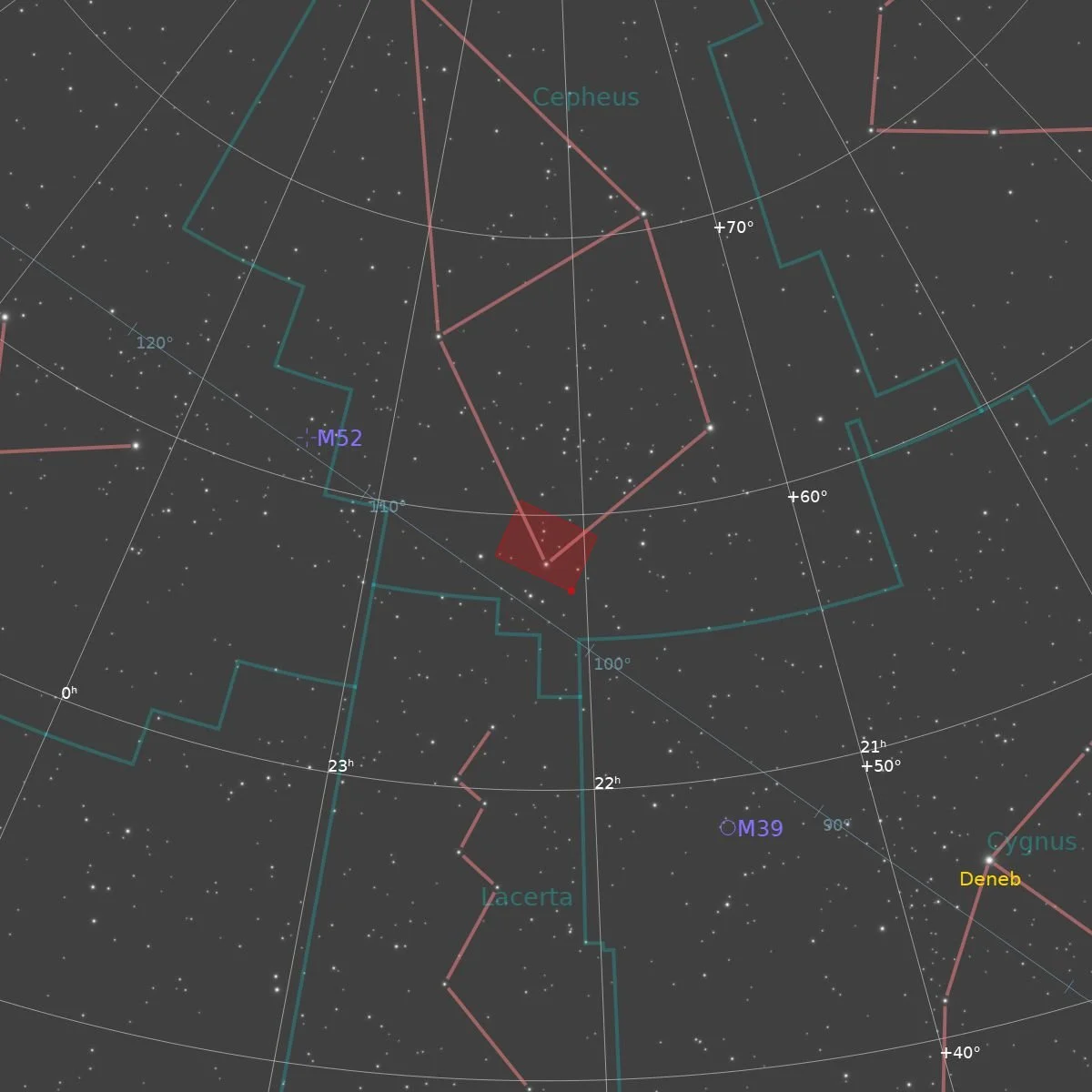
This finder chart image was created with the ImageSolver and FinderChart scripts in PixInsight.
About The Target
📍 Overview — What and Where Is Sh2-134?
Sh2-134 lies in the southern part of Cepheus, the King, along the northern Milky Way. Its catalog position is approximately right ascension 22h 12m 44s, declination +59°, placing it well north of the celestial equator. For observers across much of the northern United States, this region remains above the horizon throughout the year, although its high placement on late-summer and autumn evenings makes those seasons particularly favorable for imaging. SIMBAD catalog entry
It is an H II region: interstellar gas in which hydrogen has been ionized by energetic radiation from hot stars. Rather than shining mainly by reflected starlight, the gas produces its own emission as electrons recombine with ions and excited atoms release energy. NASA’s guide to nebulae
A commonly quoted distance is approximately 2,900 light-years, or 900 parsecs. Its often-listed angular extent of about 160 arcminutes corresponds to roughly 2.7 degrees—more than five full-Moon diameters across. At that assumed distance, the span would be about 135 light-years. These are useful estimates for a sprawling complex whose apparent edges depend on how faint a glow an observation can reveal. Sh2-134 overview and references
🏷️ Names and Designations
Sh2-134, Sh 2-134, and Sharpless 134 refer to the same cataloged region. “Sh2” identifies Stewart Sharpless’s second catalog of H II regions, published in 1959, and “134” is its entry number. NASA’s Sharpless catalog documentation
SIMBAD also lists LBN 490 and LBN 104.28+02.09 as identifiers for the object. LBN stands for Lynds’ Catalogue of Bright Nebulae. Catalog boundaries can differ: one survey may describe a broad complex, while another records individual bright patches within it. That helps explain why the annotated image contains so many overlapping labels. SIMBAD identifiers
The other catalog prefixes visible here describe complementary parts of the landscape. LDN identifies entries in Lynds’ dark-nebula catalog, while B identifies dark clouds cataloged by Edward Emerson Barnard. These labels mark obscuring material that can be just as visually striking as the glowing gas.
📜 History — From Photographic Surveys to Modern Imaging
Sh2-134’s modern designation comes from Stewart Sharpless’s 1959 A Catalogue of H II Regions, compiled through examination of the Palomar Sky Survey photographs. Comparing the appearance of nebulosity on red and blue survey images helped distinguish emission regions from other objects.
Sharpless described entry 134 as “Isolated patches of nebulosity around λ Cep.” That brief observation captures something still apparent in this image: Sh2-134 presents itself as scattered, irregular structures spread around a bright star, with faint emission connecting the more obvious features. The catalog also identified Lambda Cephei among its associated early-type stars. Sharpless’s original 1959 paper
The 1959 publication securely documents its cataloging, but it should not automatically be treated as a precisely dated first discovery. Establishing who first recorded every part of such an extended region would require tracing the earlier photographic surveys and their differing boundaries.
🔬 Science — What Makes the Clouds Glow?
The key ingredient is ultraviolet light. Hot stars emit photons energetic enough to strip electrons from hydrogen atoms. When electrons recombine with hydrogen ions, the resulting cascade can produce hydrogen-alpha emission, a deep-red wavelength particularly valuable for photographing faint nebulae.
Dust creates the contrasting dark structures. Tiny grains absorb and scatter visible light, hiding stars and obscuring emission behind them. The darkest areas therefore contain material; they are not simply empty openings between luminous clouds. NASA’s explanation of emission and absorption nebulae
Lambda Cephei, labeled 22 λ Cep in the annotated image, is an especially interesting inhabitant of this field. It is a hot, massive O-type supergiant and a runaway star moving through the surrounding interstellar medium. Its powerful stellar wind interacts with that material, producing a bow shock—the stellar equivalent of a bow wave ahead of a moving boat. The star and its surroundings have become a subject of detailed studies of stellar winds, magnetic fields, and shock structures. Research on Lambda Cephei’s astrosphere
🎨 Understanding the Colors
The photograph’s gold and blue tones help separate structures that would be much harder to distinguish in a faint visual view. In narrowband imaging, selected emission lines are assigned to display colors so that differences in the recorded signals become visible.
Hydrogen, sulfur, and oxygen emit at characteristic wavelengths. Their relative brightness depends on conditions such as temperature, density, and ionization, as well as the amount of each element present. Color therefore provides clues about the gas, but it is not a direct map of elemental abundance. Processing choices also influence the final appearance. NASA’s explanation of emission-line spectroscopy
Without specifying the exact channel combination used for this image, the safest description is a contrast between warm-colored emission ridges and the blue-toned region around Lambda Cephei.
🔎 A Tour Through the Image
The annotated version provides a useful guide to the scene:
Sh2-134 and Lambda Cephei: The main complex extends broadly through the field, with Lambda Cephei lying within the blue-toned region below the center. The cataloged nebula encompasses considerably more than that blue patch alone.
Sh2-135: The compact, bright cloud near the upper-right corner has its own Sharpless designation and a sharply textured interior.
Barnard 174: The prominent dark silhouette just left of the lower center is one of the photograph’s strongest features. The annotation also places LDN 1164 and LDN 1165 in this area.
Barnard 169, 170, and 171: Additional dark clouds gather toward the lower-left edge.
The Lynds bright nebulae: Labels including LBN 474, 479, 485, 486, and 489–493 identify brighter patches distributed across the field.
These objects share our line of sight, but their proximity in the photograph does not establish that every cloud lies at the same distance or belongs to one physical structure.
✨ Interesting Facts
An enormous object can still be faint. Sh2-134 covers a large area of sky, but its light is spread thinly across that area. Long exposures reveal structures that its apparent size alone would never suggest.
A bright star can reshape its surroundings. Lambda Cephei contributes more than a point of light to the scene. Its radiation and wind illustrate how massive stars alter the interstellar material around them.
This field belongs to a much larger astronomical landscape. Sh2-134 has been discussed in connection with the Cepheus Bubble, a roughly ten-degree ring of gas and dust surrounding the Cepheus OB2 association. Studies of that broader region examine how stellar winds and past supernova activity have shaped successive generations of interstellar clouds. Research on the Cepheus Bubble
The shadows are part of the subject. Much of this image’s character comes from material that blocks light. The glowing gas reveals where energy is being deposited; the dark clouds reveal where dust conceals what lies behind it.
Weather and Conditions
September is my favorite month of the year to do astrophotography. It gets dark early, and we have long, cool nights. Sometimes I can capture 2 targets per scope per night!
But this year we have had extremely variable weather and relatively few nights of clear skies that are free of the Moon. September was no exception, and we didn't have the long clear stretches I have seen in the past.
We did get three marginal nights. I say marginal because all the weather apps predicted some level of clouds, but beggars cannot be choosers, so I took the risk and got data on all three nights.
We did have thin clouds coming through that we had to deal with, and we had some of the heaviest dew I have ever seen! This caused a major issue that I will talk about later.
Choosing the Target
This time of year, there is a huge list of potential targets to shoot. When considering targets for the Askar FRA400, I look for rich skyfields that suit its wider field of view. Cepheus is well positioned in the sky this time of year - high enough that I do not have to worry about the light dome of Rochester that can be seen towards the north.
This is a great region to shoot. Lately I have been inspired by the Sharpless Catalog for choosing targets. I chose SH2-134 because it was in a rich field of both bright and dark nebulae.
Data Collection
I collected data on the nights of September 6th, 11th, and 14th.
My camera cooler aim temperature was -15 degrees C.
I set up 300-second narrowband exposures and 30-second RGB exposures so I could have natural stars.
In the past month, I had dew problems - not with the main objective as you might think, but on the camera sensor window of my ASI2600MM-Pro camera! To avoid this, my NINA sequence turned on the camera dew heater at the start of the session.
Or so I thought….
I typically copy the NINA session from one night over to a new file for the next night, updating the date in its filename. I checked that the first one enabled the camera dew heater, and it did.
But somehow, for nights of the 11th and the 20th, I grabbed a version that DID NOT enable the camera dew heater. BIG MISTAKE!
I ended up having to remove many subs that had the characteristic dark center that comes from dew on the sensor glass! Worse, many of the bright stars ended up with terrible, strange flare artifacts. More on that later!
Calibration Frames
After the third night, the Moon was beginning to dominate, so I took one evening to get all of my calibration frames. This was made very convenient by my AstroWanderer Motorized Telescope cover. The whole operation could be done remotely from my den (aka Astro Man Cave).
Processing Overview
Pre-processing
It took almost a month before I finally had a chance to process the collected data.
As always, I blinked all of my image data and my cal data.
This was when I started to see the dew problems!
I removed the obvious issues, and WBPP ran without error.
Post-Processing
The processing plan for this image was pretty straightforward.
I used my typical Narrowband workflow with RGB Stars. At a high level, this looks like the diagram below:
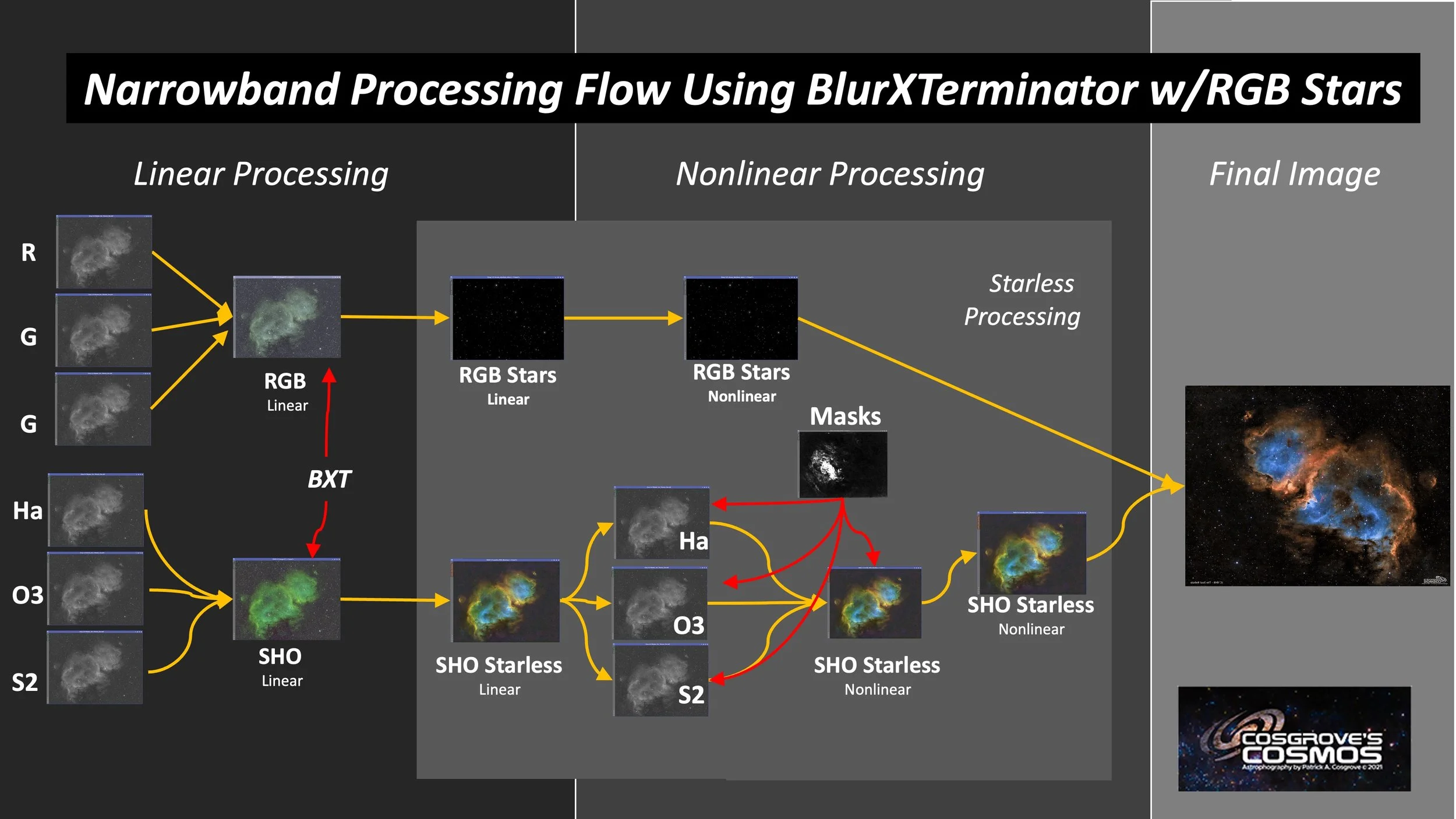
My typical SHO with RGB Stars Workflow.
The big difference this time around was that I planned to use a new tool I have been working on to handle the star processing.
In this case, I would do the linear processing on the RGB stars and leave them in the linear domain.
Then I would process my SHO starless image.
Finally, I would run my new tool, now called Astro Star Lab (ASL). It would do an adaptive stretch, show the star field on the backdrop of the starless image, and let me use preference sliders to adjust star size and color saturation. Once I was happy, it would compose the stars and star images into a new master image.
I did this, and the Astro Star lab lets me assess the stars themselves with an inspector, where I found the weird flare pattern on some of the brighter stars.
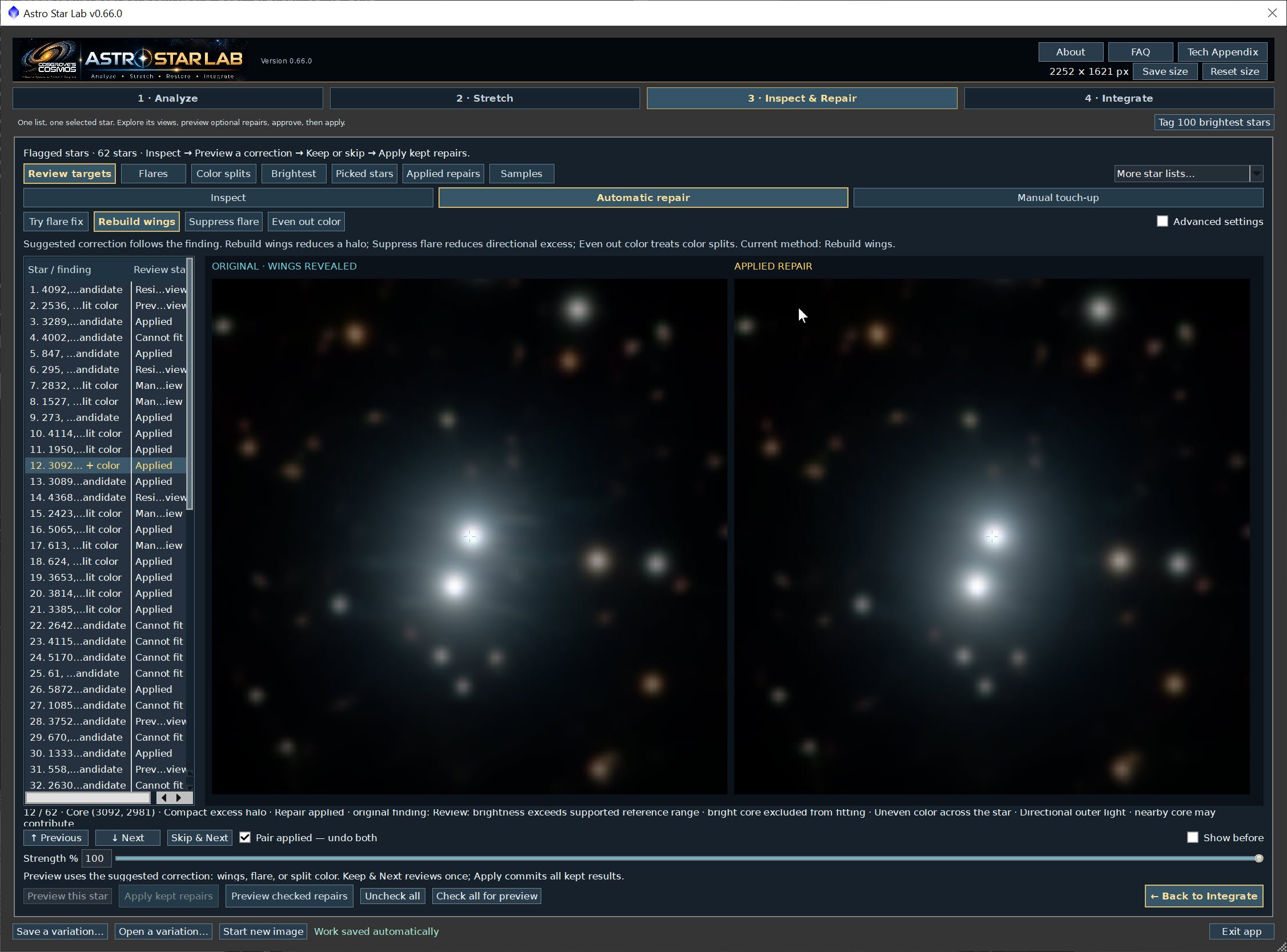
Example of the star flare issue I was dealing with.
Faced with this problem, I added code to ASL to detect and flag stars with odd artifacts in their structure, and even a tool to try to correct it. This helped many stars but not all, so I am still working on it.
While I used color masks for the initial processing of the Cool and Warm colors in the image, I used my Astro Color Mixer (ACM) tool to finalize the color.
I typically use my Astro Contrast Enhancer (ACE) on my images, but I didn't use as much for this one. Why? The image field is very rich and also very faint. While 18 hours is a long integration by my standards due to our local weather, this image could have benefited from a much longer integration time. Many areas suffered from noise, and while the NoiseXTerminator did a great job, there still was a granular nature to teh image that held me back from doing much sharpening or other contrast enhancement. I kept that kind of processing really light. I use ACE to add some Clarity and Dehaze, but I stayed away from Texture enhancements.
Detailed and Annotated Image Processing Walkthrough
Typically, I conclude one of these imaging projects by documenting the processing steps I used on this image. But this section can make the overall post very large and, at times, slow to load.
I am now creating a secondary, standalone page to hold this information. You can access this page by clicking the link below. To return to this page, click the back arrow in your browser or select a different menu option at the top of the page.
I hope you like this new format!
Use the link below to view the detailed image-processing walkthrough for this imaging project.
SH2-134 Image Processing Page
Final Results
Given the crummy weather, dew issues, and weird star artifacts, I was pretty happy with this image. It is such a rich field that includes all kinds of bright and dark nebulae; I just kind of find it facinating. The FRA400 has been a great platform for this type of target.
Is this the best technical image? No - not by a long shot. But I still find it interesting and am happy to have it in my portforlio!
More Info
🔭 Target Details & Sky Exploration
SIMBAD — Sh2-134 / LBN 490 — A reference for the nebula’s coordinates, classification, alternate catalog designations, and published research.
CDS Aladin Lite — Interactive Sky Atlas — Explore astronomical survey images of the field. Enter “Sh2-134” in the target search, then zoom out to investigate the surrounding nebulosity or search for nearby Sh2-135.
📜 History & Designations
NASA HEASARC — The Sharpless H II Regions Catalog — Background on Stewart Sharpless’s 1959 catalog, the source of the Sh2-134 designation, with explanations of the catalog’s naming conventions and recorded properties.
🔬 Science & Observations
NASA — Hubble’s Nebulae — An illustrated introduction to emission, reflection, and dark nebulae. Explains how ultraviolet radiation makes interstellar gas glow and how dust creates the dark silhouettes seen in images like this one.
AAS Nova — When Stars Run Away — An accessible discussion of runaway stars and their bow shocks, including Lambda Cephei in this field. The article explores a proposed connection to gamma-ray sources and explains why further observations were needed to confirm it.
Star Forming Regions in Cepheus — Research Review — For readers wanting more depth, this handbook chapter by Mária Kun, Zoltán T. Kiss, and Zoltán Balog reviews the clouds, stellar associations, and star-forming environments across Cepheus. The linked page includes an abstract and access to the full paper.
💡 Wider Context & Inspiration
NASA Astronomy Picture of the Day — The Complete Sharpless Catalog — A photographic collection of all 313 Sharpless entries, placing Sh2-134 within the wider family of objects covered by the catalog. A useful starting point for discovering other imaging targets.
Imaging Platform Used
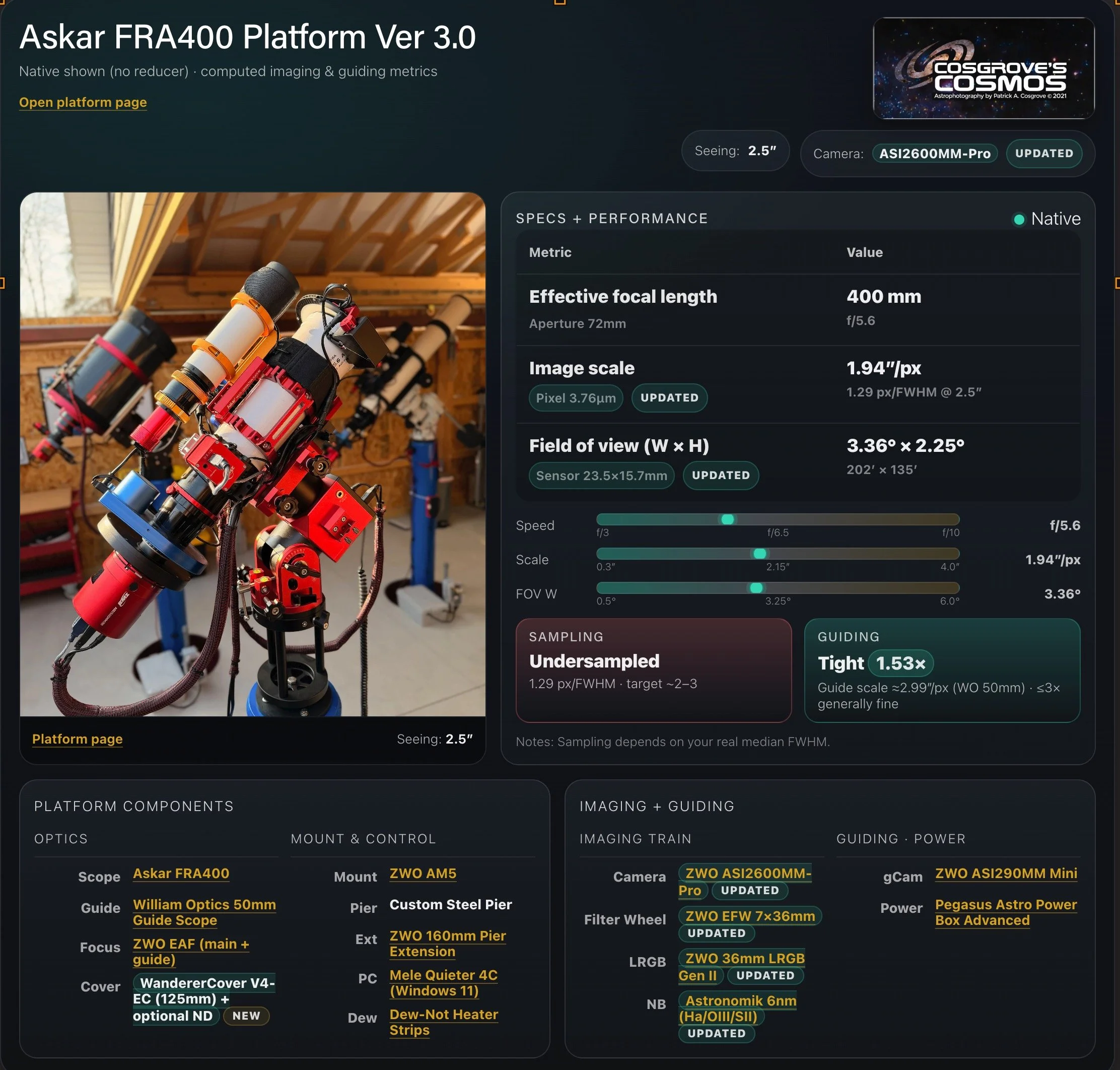
The details for the FRA400 Platform.
Platform used for this project
Software
Capture Software: PHD2 Guider, NINA
Image Processing: PixInsight, Photoshop, Astro Color Mixer (ACM), Astro Contrast Enhancer (ACE), and Astro Star Lab (ASL)- assisted by Coffee, extensive processing indecision and second-guessing, editor regret, and much swearing…