Statement of Astro Imaging Ethics
Update January 25, 2026
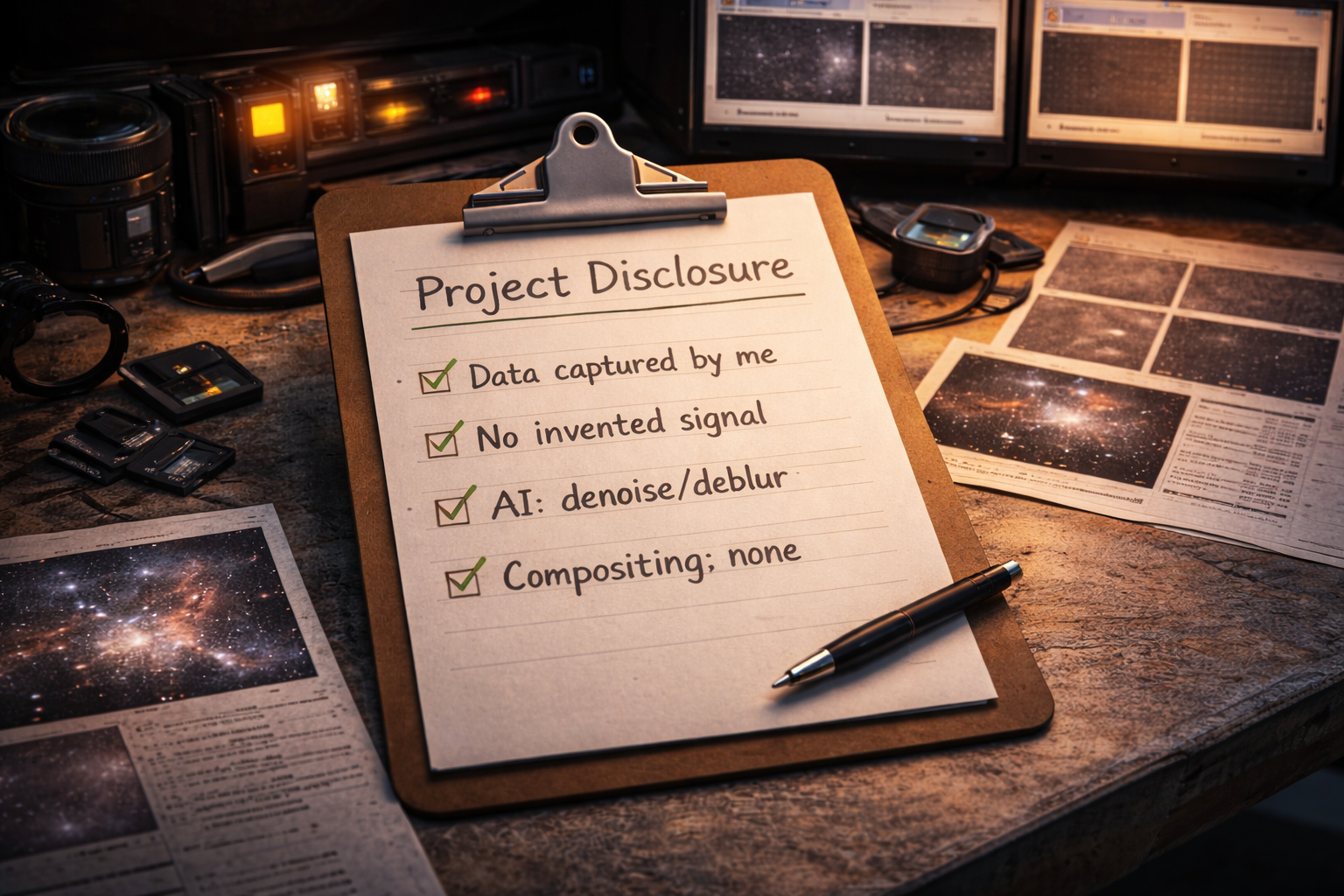
I wanted to share my own, personal Astro Imaging Ethics. These are right for me - they may not be right for you. But I thought you should know where I am coming from.
Statement of Astro Imaging Ethics
These statements describe how I create and present my images.
Quick Summary
My intent is straightforward: the final image should represent my individual acquisition and processing decisions, with clear disclosure when anything non-standard is used.
1 My Data
My images are created from data I personally captured. I do not use public/professional data sets (NASA/ESO/public archives), and I do not currently participate in team capture efforts, because I want the final image to represent my individual acquisition and processing decisions.
2 My Gear
My data was collected on my gear. This means the telescope platform that collected these photons was equipment that I own, assembled and configured myself. I will not use data collected with Telescope.Live or other such for-hire or free sources.
3 My Gear Set Up
I set each telescope platform used myself. Balancing, polar alignment, PHD2 settings, etc., are all done by me (though I may break this someday — see the Special Note below).
4 My Processing
I handle all pre- and post-processing myself. My processing decisions, and the look of the final image, are under my exclusive control. My images reflect my vision for a particular project.
5 My Disclosure & Labeling Standard
Every project page will state: data source, acquisition location, whether remote, any third-party capture assistance, and any non-standard processing (star removal, heavy star reduction, compositing, etc.).
6 Compositing & Content Integrity
- No adding structures/details not present in the data.
- Cosmetic fixes allowed: satellite trails, hot pixels, dust motes, mild artifact cleanup — provided they don’t invent an astronomical signal.
7 Attribution
If I reference a workflow, script, or technique from others, I will credit or link appropriately.
8 Star Handling
- If I use starless workflows, I’ll disclose the method and intent.
- No star replacement from other data sets.
9 Use of AI Tools
I use discriminative AI tools that operate on the captured signal (e.g., BlurXTerminator, NoiseXTerminator, StarXTerminator) to improve clarity and manage noise without introducing new astronomical content. I do not use generative AI to add, invent, or hallucinate structures that were not present in the original data.
10 Policy Deviations
If I ever deviate, I will clearly label it on the image page.
Special Note
I live in an area with poor weather and relatively few clear nights. I am also not located at a dark-sky site. I am very intrigued by what StarFront is doing. I see great value in the idea of a remote telescope at a dark-sky site with 300 clear nights a year. If I were to do this, I would have to soften my stance on “My Gear Set Up” to accommodate it. But the remainder of my stated ethics would hold. I would buy and assemble the telescope platform, but I would need it set up by StarFront's staff.