Date: November 8, 2026
Cosgrove’s Cosmos Catalog ➤#0171
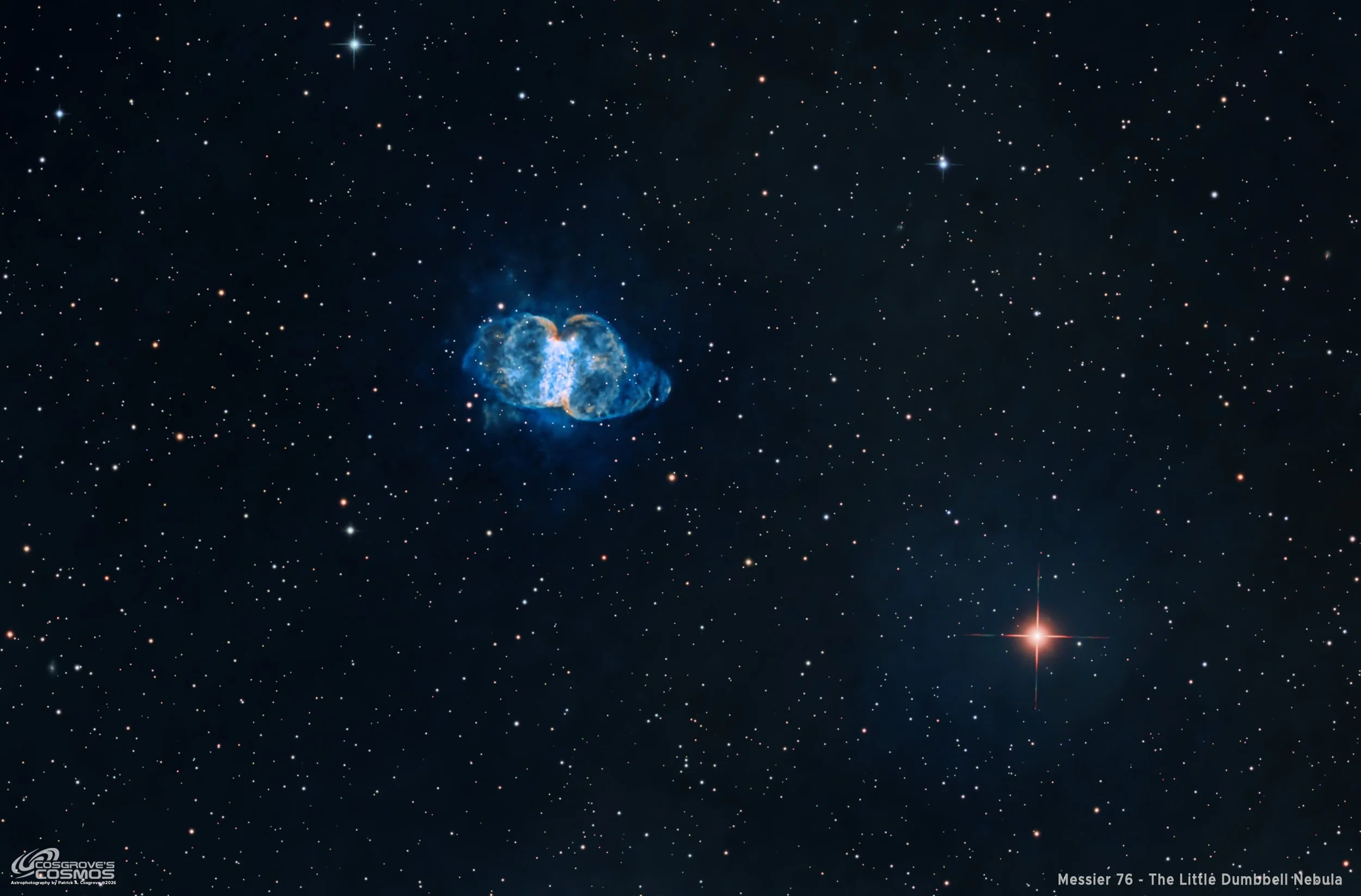
Messier 76 captured with my SCA260 platform. (Click image for hi-res version via AstroBin.com.)
The Little Dumbbell Nebula — a dying star's final masterpiece, revealing intricate glowing structures and sweeping bipolar lobes sculpted by stellar evolution.
Introduction
Messier 76 (M76), commonly known as the Little Dumbbell Nebula, is a fascinating planetary nebula located in the constellation Perseus, approximately 3,400 light-years from Earth. Although considerably smaller and fainter in our sky than its better-known namesake, Messier 27 (the Dumbbell Nebula), M76 is a remarkably complex object with an unusual structure and an interesting story to tell.
At first glance, M76 appears as a bright, somewhat rectangular central region surrounded by two large, faint lobes of glowing gas. But this seemingly simple shape is actually the result of a much more complicated three-dimensional structure, formed as a dying star expelled its outer atmosphere into space.
In this image, captured with my Sharpstar SCA260 V2, the bright central region reveals intricate blue and orange emission structures, while the much fainter outer lobes extend well beyond the central nebula. These delicate outer regions are particularly interesting because they help reveal the geometry and evolutionary history of this stellar remnant.
🔭 Project Summary
Target: Messier 76 (M76) — The Little Dumbbell Nebula / NGC 650 & NGC 651 / PN G130.9−10.5
Capture Dates: September 6, 11, and 14, 2026
Constellation: Perseus • Distance: ≈ 3,400 light-years
Type: Bipolar planetary nebula — the glowing expelled atmosphere of an evolved star approaching the white dwarf stage
Angular Size: ≈ 2.7 × 1.8 arcminutes, including the extended lobes
Imaging Period: September 6–14, 2026 • Total Integration: 12 h 16 m 30 s (SHO narrowband + RGB stars)
Filters: Ha · OIII · SII (Astronomik 36 mm 6 nm) + R · G · B (ZWO 36 mm LRGB Gen II)
Telescope: Sharpstar SCA260 V2 260 mm f/5.0 Special Cassegrain Astrograph
Camera: ZWO ASI2600MM-Pro (−15 °C; Gain 100 narrowband, Gain 0 RGB)
Mount: iOptron CEM70 on custom steel pier with modified iOptron top pier plate
Guiding: ZWO OAG-L with ZWO ASI174MM-Mini guide camera
Processing: PixInsight (SHO narrowband + RGB stars) & Photoshop
Location: Whispering Skies Observatory · Honeoye Falls, NY (USA)
Acquisition Notes: Ha: 50 × 300 s; OIII: 47 × 300 s; SII: 47 × 300 s; R: 12 × 30 s; G: 11 × 30 s; B: 10 × 30 s, all bin 1×1 at −15 °C. Narrowband exposures used Gain 100; RGB exposures used Gain 0. Total of 177 accepted light frames, providing 12 h 16 m 30 s of integration after culling bad or questionable subs.
Calibration Notes: 25 darks at 300 s, bin 1×1, −15 °C, Gain 100; 25 darks at 30 s, bin 1×1, −15 °C, Gain 0; 30 dark flats at each flat exposure time (Gain 100 for narrowband, Gain 0 for RGB); 15 flats each for Ha, OIII, SII, R, G, and B.
Imaging Challenges: Cloud interference during the three-night imaging campaign required substantial rejection of affected exposures. The surviving RGB data, used primarily for natural-color star rendering, amounted to only approximately one-third to one-half the number of frames normally acquired for this purpose. Despite the reduced RGB integration, the narrowband dataset provided substantial signal for revealing the nebula's complex internal structures and faint outer lobes.
Image Note: This SHO narrowband image with RGB stars captures Messier 76, a compact but remarkably intricate bipolar planetary nebula in Perseus. Its bright central region reveals a complex network of blue-cyan emission, filamentary structures, and warmer-colored knots, while two broad, faint lobes extend outward into the surrounding star field. The apparent rectangular central region is believed to represent a dense equatorial ring viewed nearly edge-on, with the extended lobes tracing material expelled along the nebula's polar axis. The image highlights the striking contrast between the bright inner structure and the delicate outer emissions that reveal the nebula's three-dimensional geometry and evolutionary history.
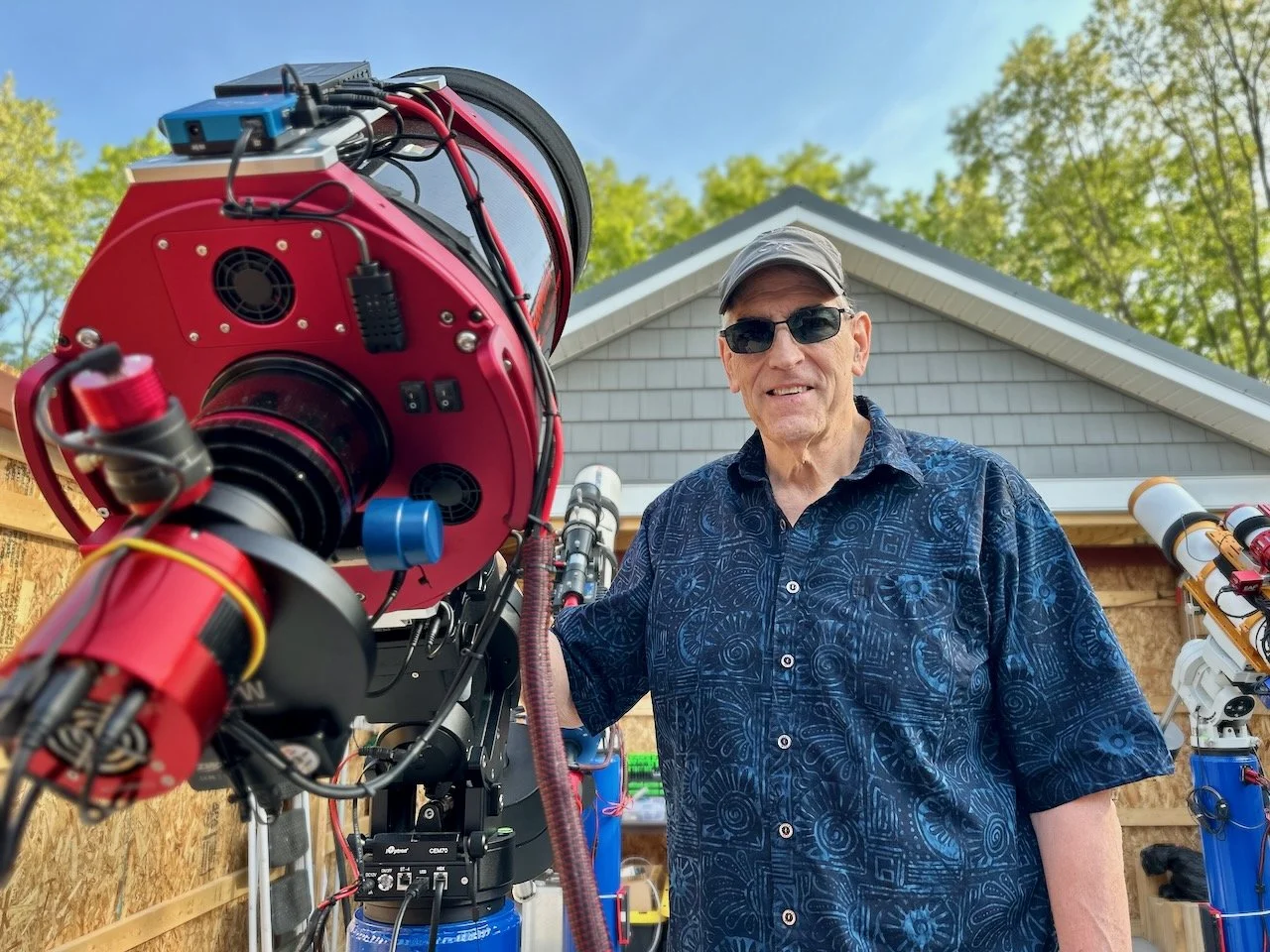
The SCA260 Platform (click on image to go to the blog entry for this scope)
📸 Capture Details
Nights: September 6, 11, and 14, 2026
| Channel / Filter | Frames × Exposure | Settings | Total |
|---|---|---|---|
| Ha — Astronomik 6 nm Hydrogen-alpha (36 mm unmounted) | 50 × 300 s | bin 1×1 • −15 °C • Gain 100 | 4 h 10 m |
| OIII — Astronomik 6 nm Oxygen III (36 mm unmounted) | 47 × 300 s | bin 1×1 • −15 °C • Gain 100 | 3 h 55 m |
| SII — Astronomik 6 nm Sulfur II (36 mm unmounted) | 47 × 300 s | bin 1×1 • −15 °C • Gain 100 | 3 h 55 m |
| R — ZWO Red (36 mm unmounted) | 12 × 30 s | bin 1×1 • −15 °C • Gain 0 | 6 m |
| G — ZWO Green (36 mm unmounted) | 11 × 30 s | bin 1×1 • −15 °C • Gain 0 | 5 m 30 s |
| B — ZWO Blue (36 mm unmounted) | 10 × 30 s | bin 1×1 • −15 °C • Gain 0 | 5 m |
| Total Integration (after culling): 12 h 16 m 30 s (SHO narrowband + RGB stars; 177 accepted light frames) | |||
Calibration Frames
- 25 × dark frames @ 300 s, bin 1×1, −15 °C, Gain 100
- 25 × dark frames @ 30 s, bin 1×1, −15 °C, Gain 0
- 30 × dark-flats @ each flat exposure time, bin 1×1, −15 °C, Gain 0 for RGB and Gain 100 for narrowband
- Flats: 15 each — Ha, OIII, SII, R, G, B
Acquisition Notes
All frame counts reflect accepted subexposures after rejecting bad or questionable frames. Cloud interference during the three-night imaging campaign required substantial frame rejection. The RGB dataset, used primarily for natural-color stars, was particularly affected, leaving approximately one-third to one-half the number of exposures normally collected for this purpose.
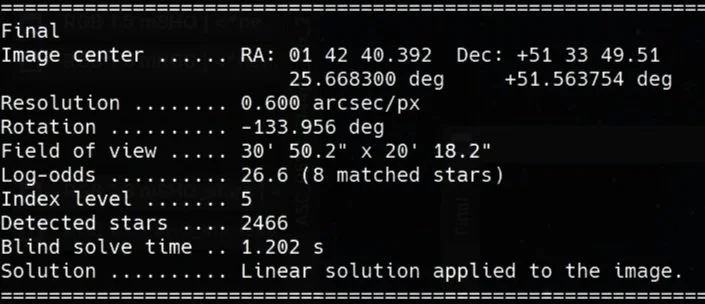
Basic Stats for the captured image. (output from the new PixInsight Blind Solver)
Table of Contents Show (Click on lines to navigate)
Annotated Image
This annotated image was created with the ImageSolver and FinderChart scripts in PixInsight.
The Location in the Sky
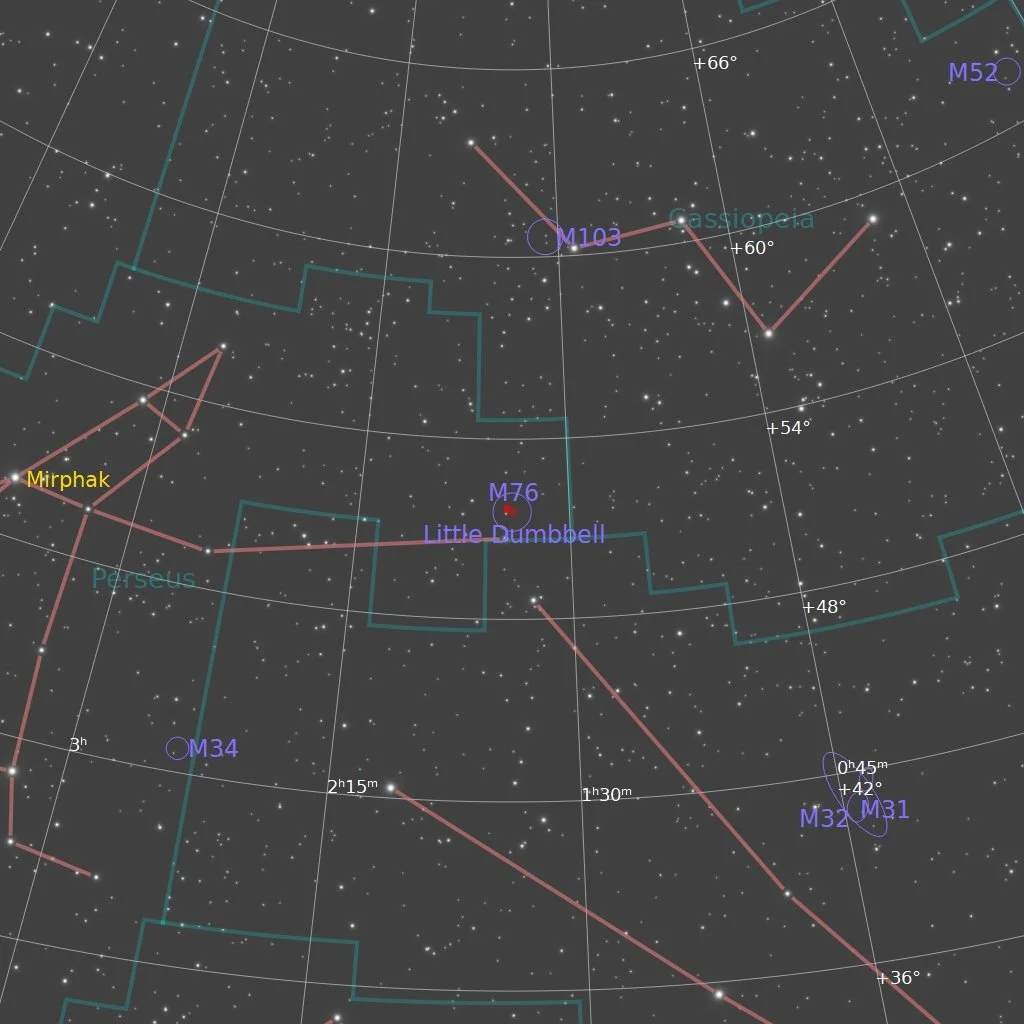
This finder chart image was created with the ImageSolver and FinderChart scripts in PixInsight.
About The Target
🌌 Overview
Messier 76, also cataloged as NGC 650 and NGC 651, is a planetary nebula in Perseus. Despite the name, planetary nebulae have nothing to do with planets. They represent a relatively brief stage near the end of the lives of stars with low to intermediate initial masses, including stars broadly similar to our Sun.
M76 is approximately 3,400 light-years away, although historical distance estimates have varied considerably. Its brighter central region is only a few arcminutes across, making it a relatively small target for astrophotography. The fainter outer lobes extend considerably farther, giving the complete nebula a much larger apparent size.
The central structure is believed to be a thick ring or torus of gas viewed nearly edge-on. This produces the bright, rectangular appearance that earned the object its Little Dumbbell nickname. Extending outward from this central structure are two large lobes of ionized gas, creating a distinctly bipolar appearance.
The colors visible in astrophotographs reflect radiation from different chemical elements. The prominent blue and cyan emission is associated primarily with doubly ionized oxygen (OIII), while the warmer regions trace emissions from hydrogen. The exact colors depend on the filters and processing techniques used to construct the image.
📜 History
Messier 76 was discovered in 1780 by Pierre Méchain, a French astronomer and colleague of Charles Messier. Messier subsequently included it in his famous catalog of celestial objects that might otherwise be mistaken for comets.
The nebula's unusual appearance led to some confusion among early observers. Its two brighter sections appeared sufficiently distinct that they were eventually assigned separate entries in the New General Catalogue: NGC 650 and NGC 651. We now know that these are simply different parts of the same planetary nebula.
M76 has accumulated several nicknames over the years, including the Little Dumbbell Nebula, Cork Nebula, and Barbell Nebula. Each reflects an attempt to describe its unusual shape.
Although not as visually prominent as M27, M76 has become a favorite target for astrophotographers because its complex internal structure and faint outer lobes offer considerable detail to explore.
🔬 Science
M76 provides an excellent example of what happens when a star approaches the end of its nuclear-burning lifetime.
As the progenitor star evolved into a red giant, it began shedding material into the surrounding space. Eventually, the star lost much of its outer atmosphere, exposing an extremely hot stellar core that is evolving toward a white dwarf.
The intense ultraviolet radiation from this exposed core ionizes the expelled gas, causing it to glow. What we see as the planetary nebula is therefore not material illuminated by reflected starlight, but gas producing its own characteristic emission as electrons recombine with ions and excited atoms release energy.
One of the most intriguing aspects of M76 is its bipolar structure.
The bright central region is thought to represent a dense ring of material seen nearly edge-on. The two extended lobes project outward along a different axis, suggesting that material was expelled or accelerated preferentially away from the equatorial plane.
The formation of this geometry is an important scientific question. One possibility is that the progenitor star interacted with a binary companion, producing a dense equatorial concentration of gas that helped channel subsequent outflows. Such interactions are thought to play an important role in shaping many planetary nebulae, although the details of M76's history remain uncertain.
The nebula continues to expand into surrounding space. Over time, its gases will disperse and become part of the interstellar medium, contributing material that may eventually be incorporated into future generations of stars and planetary systems.
✨ Interesting Facts
One object, two NGC numbers. M76's double designation, NGC 650 and NGC 651, is a reminder of how difficult these objects were to interpret with early telescopes. What once appeared to be two separate nebulae is actually one connected structure.
We are looking at a three-dimensional object from a particular angle. The central rectangular structure is not really a rectangular cloud. It is the projected appearance of a thick ring viewed nearly edge-on. This is a good example of how the apparent shape of a nebula can be misleading without understanding its geometry.
The outer lobes tell an important part of the story. The bright central region naturally attracts attention, but the faint, extended lobes are equally significant. Their shapes and relative brightness provide clues about the direction of the expanding gas and the processes that shaped the nebula.
A possible history of stellar interaction. Astronomers suspect that interactions with a companion star may have helped produce M76's unusual structure. NASA's 2024 Hubble observations highlighted the possibility that a former companion influenced the central ring and may even have been engulfed during the progenitor's evolution. This remains a hypothesis rather than an established fact.
A glimpse of our Sun's distant future. In several billion years, the Sun will also evolve into a red giant and ultimately leave behind a white dwarf. Although its final nebular structure is uncertain, M76 illustrates one possible outcome of the processes that return stellar material to space.
For me, one of the most compelling features of M76 is the contrast between the bright, intricately structured central nebula and the much fainter outer lobes. Together, they transform what might initially seem like a small, relatively obscure Messier object into a remarkable example of stellar evolution.
About the Project
Planning and Weather
I’ve been doing astrophotography now for about 7 years, and I would have to say that 2026 has been the worst year weather-wise by far!
August is typically a very hot, dry month for us, and that can lead to clear, dark nights. However, these nights have relatively few hours of true darkness.
Then September comes along and the nights get longer, and we often have some really nice stable periods. These long, clear nights are outstanding for capturing data.
But this year, August was very stormy, unsettled, and cloudy! We also had smoke from forest fires drifting our way.
September was just as unsettled.
Despite this, I found three nights where I could catch photons. The weather apps predicted marginal conditions for each night, but beggars cannot be choosers, so I fired up the gear each night expecting to be shut down after a few hours. I lucked out and had clear skies all night.
I say clear skies, but in fact we did have some thin clouds coming through, some light smoke, and the heaviest dew I have seen in many years. So things were not ideal!
This less-than-ideal weather impacted all of my capture sessions during this period, but in some ways the M76 was hit hardest, as you will see. I lost many frames to clouds and dew.
Picking Targets
I have recently started using ChatGPT to help with target selection. It knows my location, treeline, the scopes I use, and of course the time of year. With this information, it selects some lists of potential targets for each scope.
It also knows the kinds of targets I prefer for each scope platform.
The SCA260 is my “galaxy” scope. This simply means that it has the highest focal length of any of my telescopes, and is about as high as I can go given the quality of my skies. I am very much seeing-limited.
Because of this, ChatGPT knows that I am looking for a smaller target for the SCA260 - but not so small that it would lack detail and interest.
ChatGPT suggested several targets that might interest me, and one of them was Messier 76.
As soon as I saw it, I chose it!
Why?
It’s one of the Messier objects that I have never shot before, and I was eager to add it to my collection.
This is a small target. I hadn't shot this before because I thought it would be too small for my other scopes, but the SCA260 might have enough reach to do it justice.
I knew there were some wild physics going on in that object, and I thought that a narrowband capture might be really interesting
I decided to shoot this with 300-second exposures and also capture some 30-second exposures in RGB so I could have natural-looking stars.
As the nights became cooler, I lowered my usual camera-cooling target from −10 °C to −15 °C.
Data Collection
I opened the roof around 7 pm, which also helped things cool down a bit.
On the nights in question, the gear appeared to perform flawlessly.
I did see some very thin clouds come through, but nothing that shut down capture
Tracking ran very well each night - at least according to PHD2 plots.
I did have two concerns, however:
We did have some of the heaviest dew I have seen. Water was dripping from all surfaces in the observatory. I have continued to have dew problems with the SCA260, with dew forming on the outer surface of my secondary mirror and the ring around he end of the scope. I did not believe the dew got to the mirror surfaces, but I was concerned about the dew rolling off and dripping onto the primary mirror itself
I looked at some of the subs I was collecting, and at first glance, they looked good, but when I zoomed in, the stars had a strange triangular shape. This was NOT good.
I was not sure what was causing the problem:
Tracking? The CEM70 has been a solid mount, and PHD2 tracking looked great. This did not seem likely
Flexure? I used OAG on this scope, and things are solid there.
Dew? Perhaps some dew got onto one of the mirror surfaces at some point?
Scope Alignment? I have never needed to collimate the scope since I got it. But we just shifted from the hot temperatures of summer to the cool night temperatures of fall. Could this have thrown the alignment off?
I was not sure. After the first night, I checked the scope alignment with my OCAL 4.9 rig, and it looked good. So I assumed this was an artifact of dew. If this was the case, there was not much I could do until I had a better dew solution.
(Note: I do have one now. You read about it in SCA260 Dew Control post.
If the final stars are affected, I hoped BlurXTerminator in its Correct Only mode could help. Also - the effect on my much shorter exposure RGB data was not as pronounced - probably due to the short 30-second exposure times.
Calibration Frames
A few nights after collecting the last data, I decided to grab a complete set of calibration data.
With the Wanderer Astro cover, I could easily do the entire process remotely. Talk about convenience!
I collected a complete set of darks, dark flats, and flats for this project.
Processing Overview
Pre-processing
As always, I blinked all of my image data and my cal data. In the first project I did this session (The Sadr Region), I lost many frames due to clouds and smoke. But that was a wide-angle scope and took in a relatively larger portion of the sky. With the SCA260 platform, I saw a narrower chunk of sky, which can help.
But in this case, that wasn’t true!
I ended up culling 31 frames, losing about 1 hour and 23 minutes of integration time. Ouch.
Even worse, I had taken a small number of RGB subs - only about 15 each for red, green, and blue. I ended up with only about 10 frames each! Double ouch!
This left me with 12 hours, 16 minutes, and 30 seconds of usable data.
Post-Processing
The processing plan for this image was pretty straightforward and very similar to what I often do when processing images that use both narrowband and RGB Broadband for the stars.
At a high level, this looks like the diagram below:
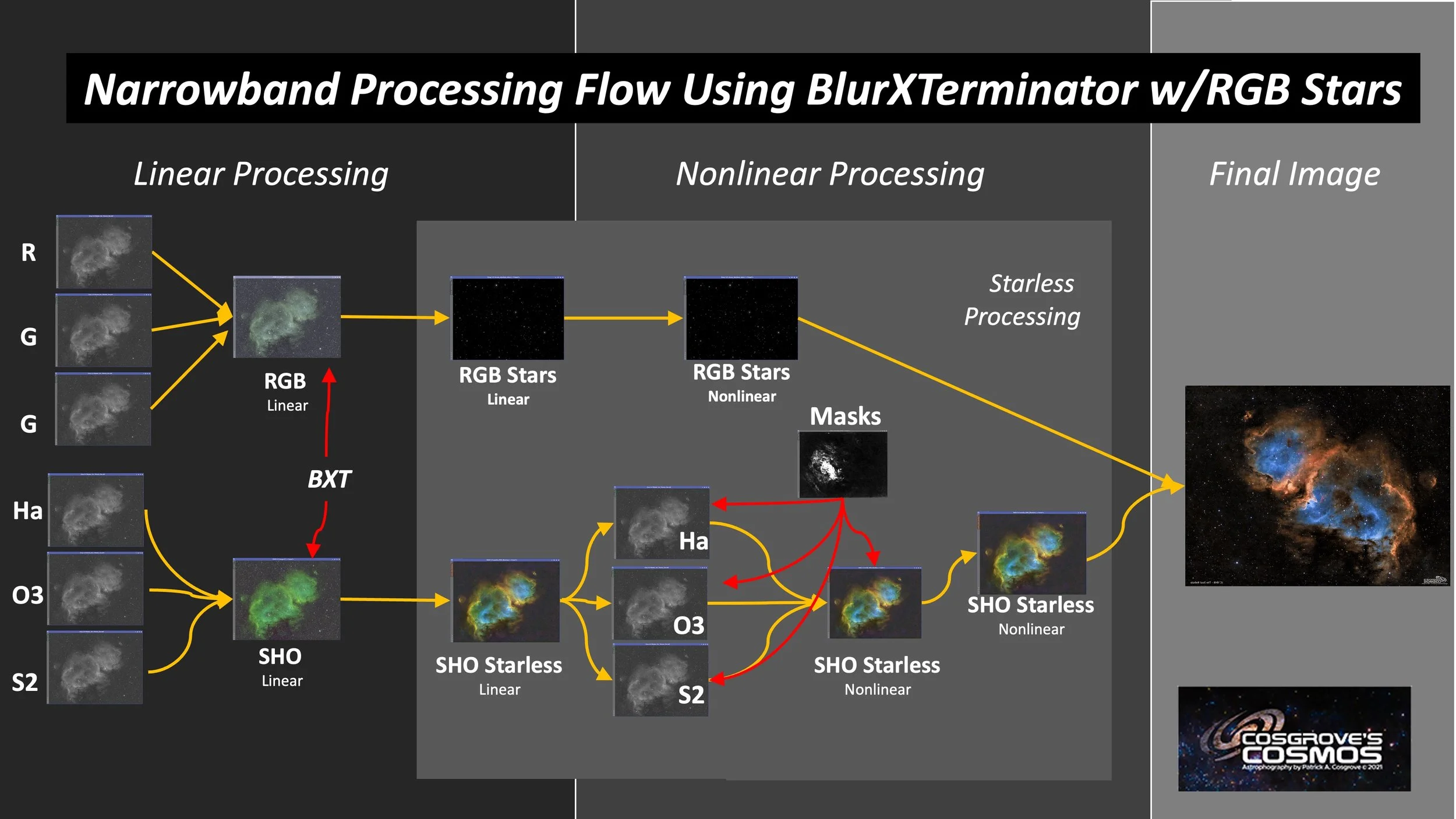
My typical SHO with RGB Stars Workflow.
The Triangular Star Issue
I hoped BlurXterminator could fix the bad star issue when run in Correct Only mode. But there was always a chance it couldn't handle it, and I would end up with a failed imaging project. So I was very interested to see how BXT did with this problem.
The first time I could check this out was when I processed the SHO image data.
I expected the star problem to be worse here, since the subs were 300 seconds long and had more time to “bake in the problem.” It was also a bit of an academic problem because I would not be using the SHO star data anyway- it would be eliminated and replaced with the RGB star data.
As it turned out, BXT did an amazing job of cleaning this issue up!
A sample of the bad stars as seen in the SHO Master image (click to enlarge)
After the BXT Correct Only Run - Amazing! (click to enlarge)
So what about the RGB star data? On one hand the subs were only 30 seconds and shorter sub might reduce the problem. But on the other hand I removed 1/3 of the total RGB star subs because of cloud an smoke issues.
RGB Star Data - The “triangular” stars can still be seen here. (click to enlarge)
BXT did a great job here as well, and salvaged the project! (click to enlarge)
BXT did a great job here and salvaged the project.
Color Handling
Since the Ha and O3 channels had the strongest signals, the nebula's base color was green-cyan. As I did my standard processing to address this, I found that the SHO palette showed areas with very weak “warm” colors.
Usually, I create a warm and cool color mask to enhance these two prominent areas. But I found the warm regions were very weak, and standard color masking didn't work well. I also found that pushing the warmer color saturations too hard quickly blocked up those areas. So I handled color very gently. I applied several CT adjustments with weak saturation boosts at various times to tease out what I could. And at the end of the processing chain, I used my ACM tool with the weak color protections off to get to the final color position.
Zoom and Crop
M76 is still pretty small. Once processed, the image looked like this:
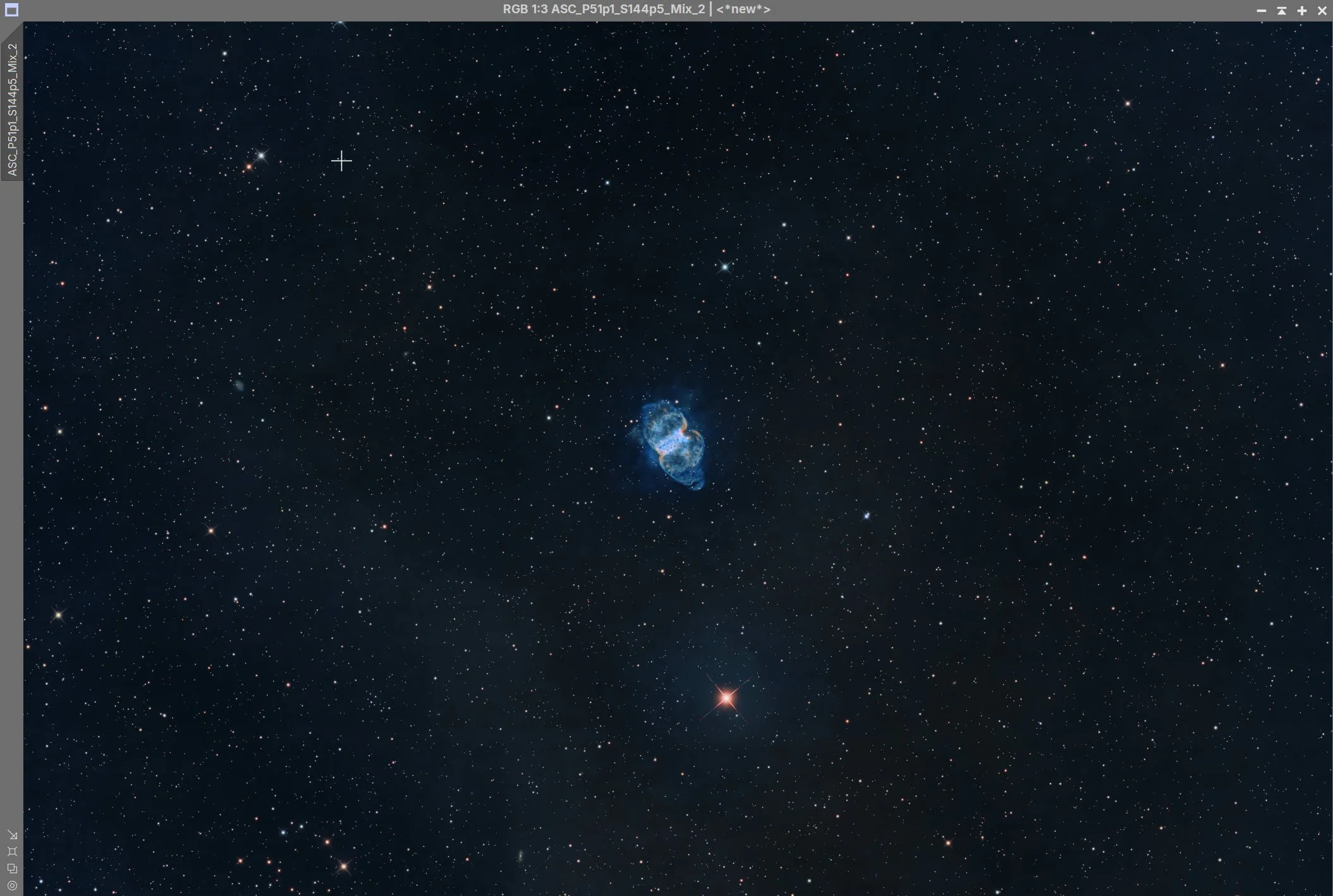
The full frame from the camera before cropping!
I really did not like this framing. The nebula is lost in a sea of black. So once I was in Photoshop for the final step, I played with several possible zooms and crops, and the one I ended up with preserved the nebula and the brightest star, with a framing that removed a lot of the black emptiness.
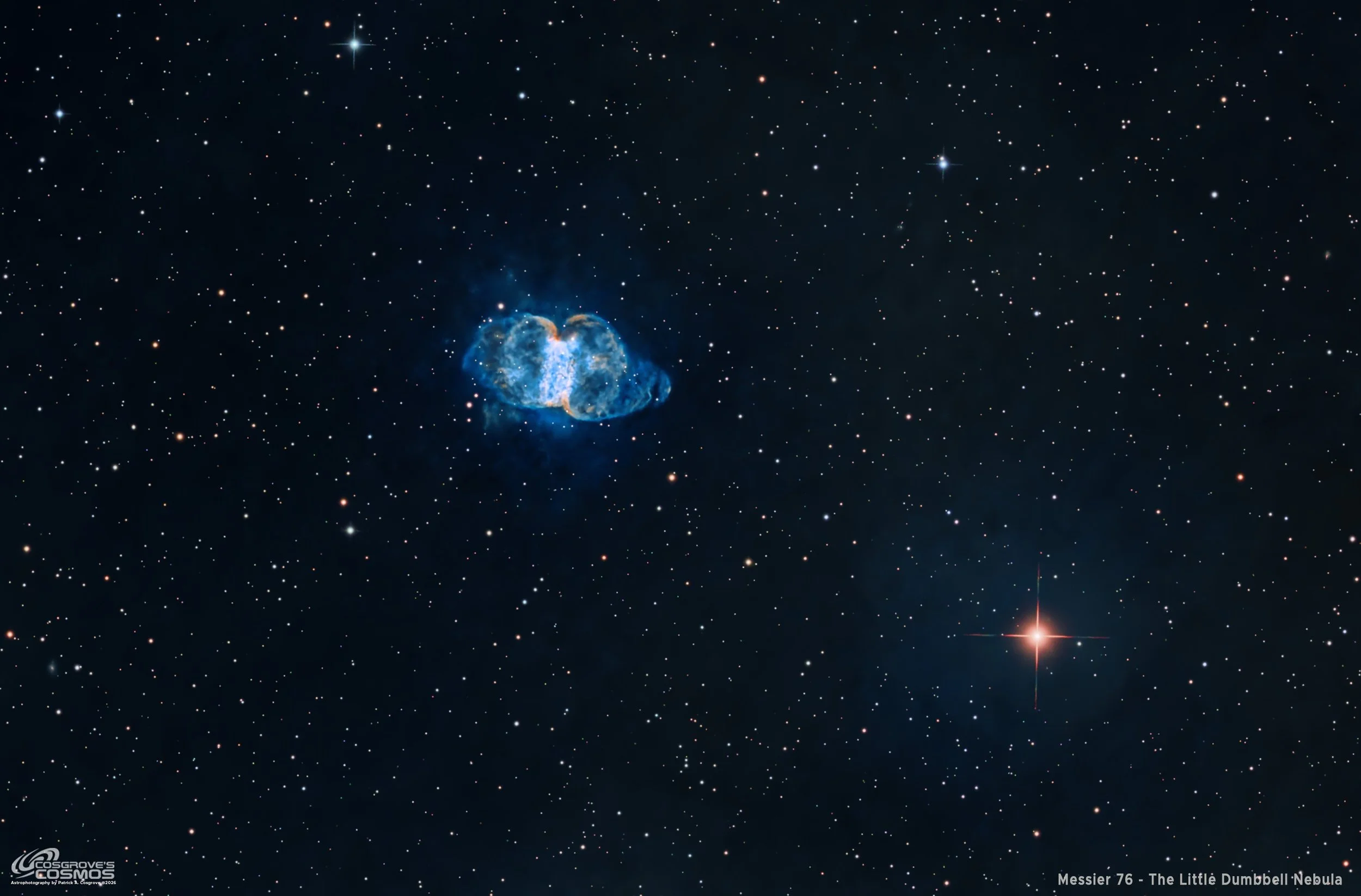
The final crop and adjustments.
I think this is the best framing compromise.
Detailed and Annotated Image Processing Walkthrough
Typically, I conclude one of these imaging projects by documenting the processing steps I used on this image. But this section can make the overall post very large and, at times, slow to load.
I am now creating a secondary, standalone page to hold this information. You can access this page by clicking the link below. To return to this page, click the back arrow in your browser or select a different menu option at the top of the page.
I hope you like this new format!
Use the link below to view the detailed image-processing walkthrough for this imaging project.
Messier 76 2026 Image Processing Walkthrough
Final Results
Given the problems I had with the star data and the dew, I am surprised that the image came out as well as it did, and I am very pleased with the final result! It’s great to have a new Messier image in the portfolio!
More Info
🔭 Target Details
NASA Hubble Messier Catalog — Messier 76 — Official NASA reference for the Little Dumbbell Nebula, including its location in Perseus, approximate distance of 3,400 light-years, apparent magnitude, discovery history, and unusual double-lobed appearance.
NASA Hubble — Little Dumbbell Nebula Anniversary Feature (2024) — Detailed presentation of Hubble's high-resolution observations, explaining the bright central ring, expanding bipolar lobes, ionized gases, and the possible influence of a former binary companion.
ESA/Hubble — Little Dumbbell Nebula — European Space Agency release with Hubble imagery and explanations of the nebula's structure, stellar evolution, and the possible binary interaction responsible for its unusual geometry.
📜 History & Naming
NASA Astronomy Picture of the Day — Messier 76 (2006) — Historical and astronomical background on one of the fainter Messier objects, including the distinctive rectangular appearance, its nearly edge-on ring structure, and its relationship to the larger Dumbbell Nebula, M27.
Sky & Telescope — A Collection of Bipolar Planetary Nebulae — Discusses the Little Dumbbell's discovery by Pierre Méchain in 1780, its historical observations by Lord Rosse, and its place among the classic bipolar planetary nebulae.
Deep-Sky Corner — Perseus NGC/IC Catalog — Historical and modern catalog information identifying M76 as NGC 650/651, including coordinates, angular dimensions, brightness estimates, planetary nebula classification, and alternate designations.
🔬 Science & Observations
MNRAS (2018) — The Interaction of the Halo Around NGC 650-1 with the Interstellar Medium — Particularly relevant research combining deep narrowband imaging, spectroscopy, and three-dimensional modeling. Describes the inclined central torus, bipolar outflows, intricate filaments, and an extremely faint outer arc potentially produced by interaction with the surrounding interstellar medium.
Astronomy & Astrophysics (2013) — A Herschel Study of NGC 650 — Comprehensive investigation of M76 using far-infrared observations and photoionization modeling. Examines dust properties, chemical abundances, gas temperatures, and the extremely hot central star, estimated in the study to have an effective temperature near 208,000 K.
MNRAS (1984) — Kinematics and Morphology of NGC 650–651 — Early quantitative study using hydrogen-alpha and nitrogen emission-line measurements to determine the nebula's expansion velocities and investigate the physical processes responsible for its symmetrical structure.
MNRAS (1979) — The Internal Kinematics of NGC 650/1 — Spectroscopic study revealing complex velocity patterns within the bright nebular regions. Provides important historical context for attempts to reconstruct M76's three-dimensional geometry from its observed emission-line structure.
💡 Interesting Facts & Outreach
NASA Astronomy Picture of the Day — M76 Above and Below (2008) — Deep narrowband image by Don Goldman revealing exceptionally faint oxygen-rich structures extending beyond the brighter central nebula. An excellent comparison for the faint outer lobes visible in deep amateur astrophotography.
NASA Astronomy Picture of the Day — The Dumbbells (2008) — Side-by-side comparison of M76 and the larger-appearing M27, illustrating their similar physical nature, different apparent sizes, and complex emission structures revealed through narrowband imaging.
NASA Hubble — A Tour of Messier 76 — Short educational video exploring the nebula's bright equatorial structure, expanding bipolar lobes, central dying star, and the gases responsible for its colorful appearance.
NASA Hubble — Little Dumbbell Nebula High-Resolution Image — Official Hubble WFC3 image resource with observation details, filter information, image credits, and high-resolution versions useful for comparing fine-scale nebular structures with ground-based astrophotography.
Imaging Platform Used
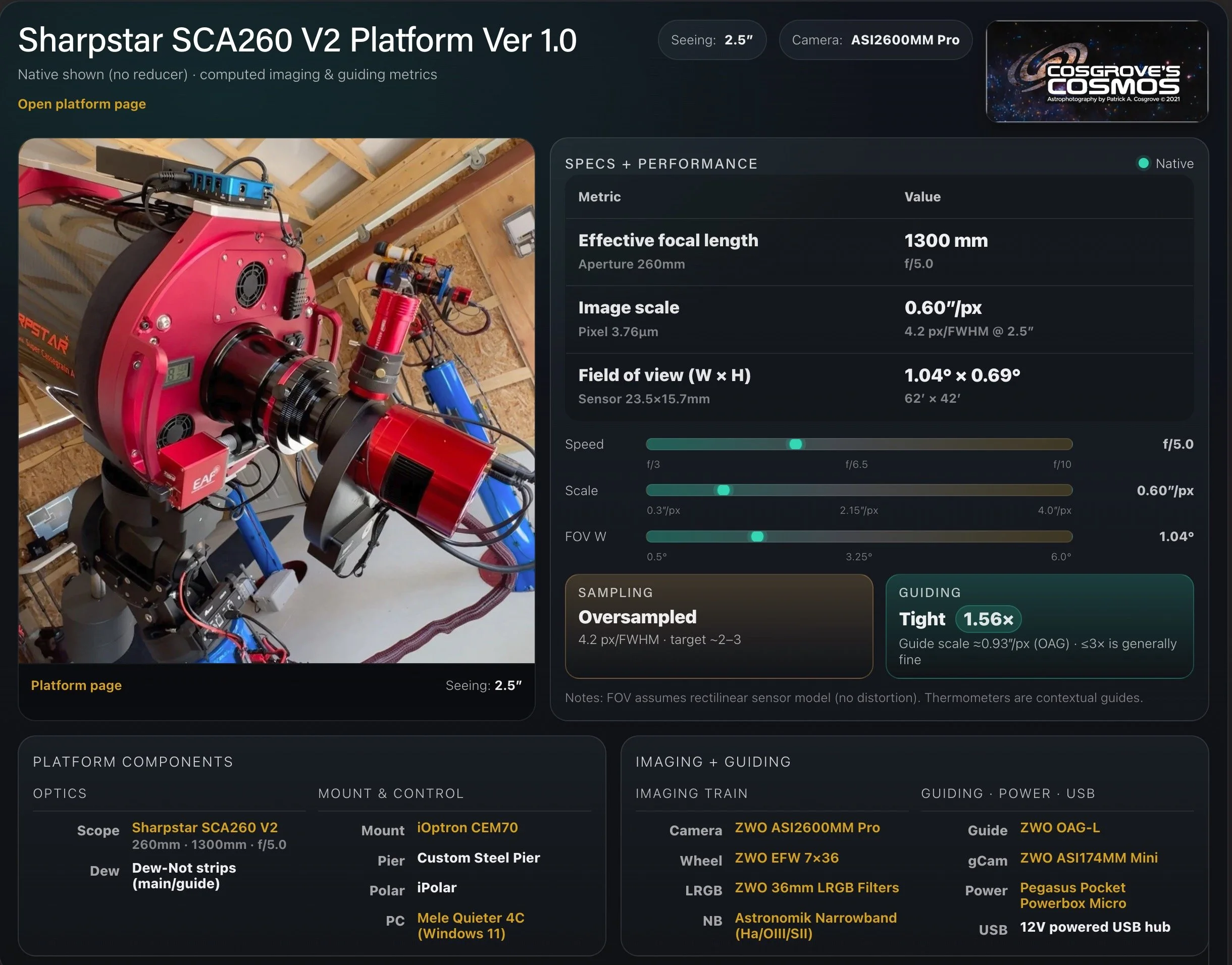
The details for the SCA260 Platform.
Platform used for this project
Software
Capture Software: PHD2 Guider, NINA
Image Processing: PixInsight, Photoshop - assisted by Coffee, extensive processing indecision and second-guessing, editor regret, and much swearing…