Date: November 25, 2026
Cosgrove’s Cosmos Catalog ➤#0172
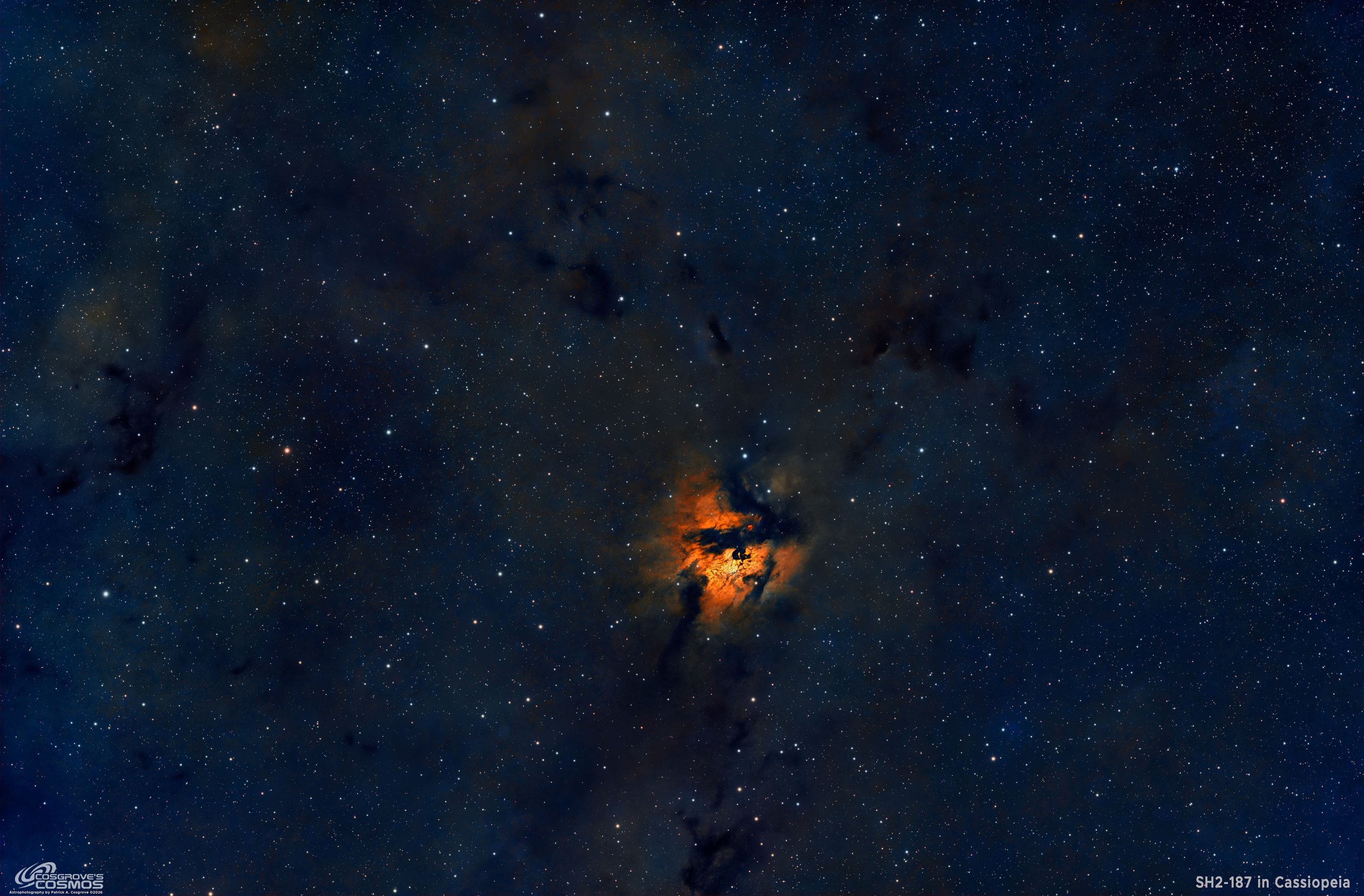
SH2-187 captured with my WO132 platform. This is a false-color SHO rendering: sulfur is mapped to red, hydrogen to green and oxygen to blue. RGB data were used for the stars. (Click image for hi-res version via AstroBin.com.)
Sh2-187 — a jagged dust lane cuts through this stellar nursery in Cassiopeia and leads the eye into the surrounding Milky Way.
Introduction
The first thing I noticed about Sh2-187 was the jagged dust lane cutting through its orange-gold core. What made me want to keep the wider framing was how far I could follow that dust. The lane runs down toward the bottom of the image, and once your eye has adjusted to the fainter parts of the field, other filaments start to show up among the stars.
I captured this field in Cassiopeia with my William Optics FLT132, using 17.5 hours of SHO narrowband and RGB star data.
🔭 Project Summary
Target: Sh2-187 — Sharpless 187 / LBN 630 / KR 120
Capture Dates: October 6, 9, and 17, 2026
Constellation: Cassiopeia • Distance: ≈ 4,600 light-years (photometric estimate)
Type: Compact H II region within a larger star-forming cloud
Imaging Period: October 6–17, 2026 • Total Integration: 17 h 29 m 30 s (SHO narrowband + RGB stars)
Filters: Hα · O III · S II (Astronomik 36 mm 6 nm) + R · G · B (ZWO 36 mm LRGB Gen II)
Telescope: William Optics 132 mm f/7 FLT APO refractor with P-FLAT7A 0.8× reducer/flattener (platform v4.1)
Camera: ZWO ASI2600MM-Pro (−15 °C, gain 100 for narrowband and gain 0 for RGB)
Mount: iOptron CEM60 on a custom steel pier
Location: Whispering Skies Observatory · Honeoye Falls, NY (USA)
Acquisition Notes: Hα: 65 × 300 s · O III: 67 × 300 s · S II: 66 × 300 s · R: 40 × 30 s · G: 40 × 30 s · B: 39 × 30 s. All frames were captured at bin 1×1 and −15 °C. After culling, 317 light frames remained, with 16 h 30 m of narrowband data and 59 m 30 s of RGB star data.
Image Note: A jagged dust lane cuts across the orange-gold core of Sh2-187. The wider framing lets you follow that lane toward the bottom of the image and pick out fainter dust filaments in the surrounding Cassiopeia star field.
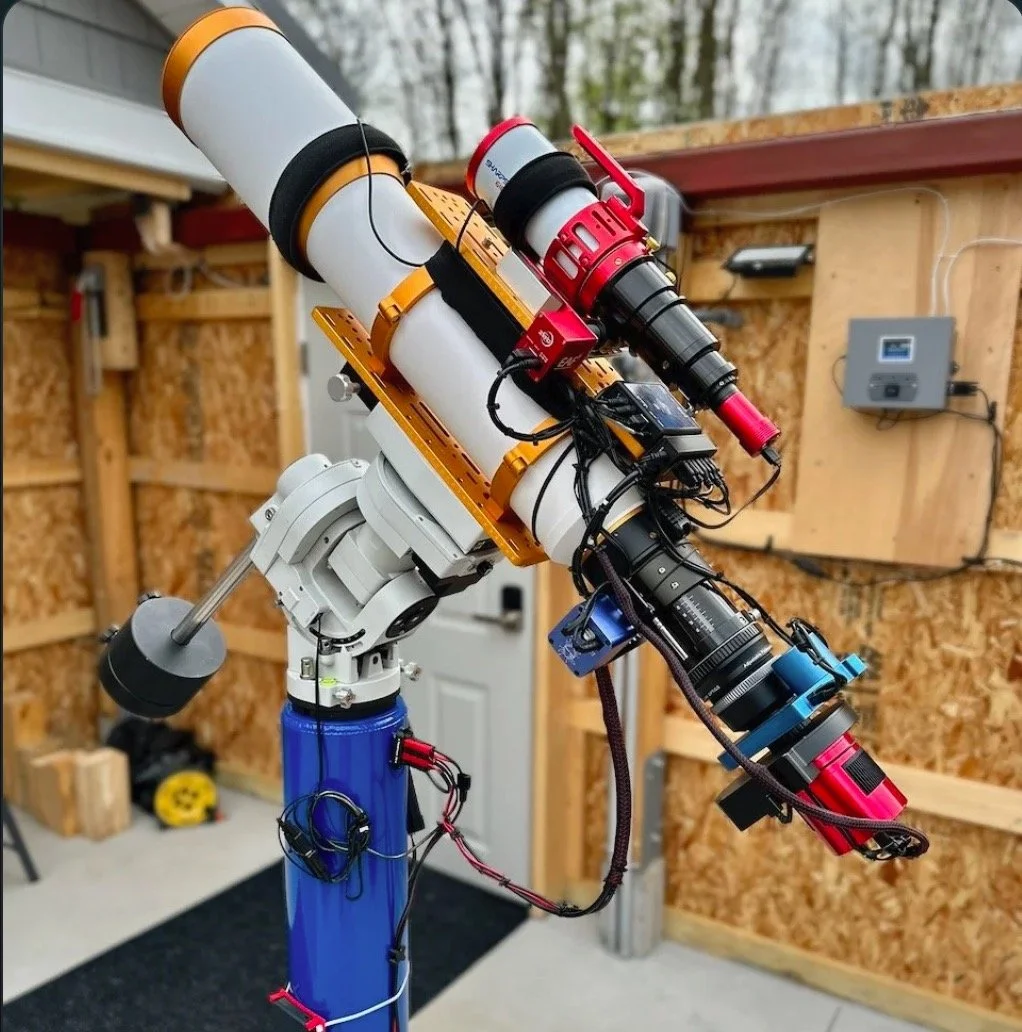
The WO132 Platform (click on image to go to the blog entry for this scope)
📸 Capture Details
Nights: October 6, 9, and 17, 2026
Frame counts reflect the 317 light frames retained after culling bad or questionable exposures.
| Channel / Filter | Frames × Exposure | Settings | Total |
|---|---|---|---|
| Hα — Astronomik 6 nm Hydrogen-alpha (36 mm unmounted) | 65 × 300 s | bin 1×1 • −15 °C • Gain 100 | 5 h 25 m |
| O III — Astronomik 6 nm Oxygen III (36 mm unmounted) | 67 × 300 s | bin 1×1 • −15 °C • Gain 100 | 5 h 35 m |
| S II — Astronomik 6 nm Sulfur II (36 mm unmounted) | 66 × 300 s | bin 1×1 • −15 °C • Gain 100 | 5 h 30 m |
| R — ZWO Red Gen II (36 mm unmounted) | 40 × 30 s | bin 1×1 • −15 °C • Gain 0 | 20 m |
| G — ZWO Green Gen II (36 mm unmounted) | 40 × 30 s | bin 1×1 • −15 °C • Gain 0 | 20 m |
| B — ZWO Blue Gen II (36 mm unmounted) | 39 × 30 s | bin 1×1 • −15 °C • Gain 0 | 19 m 30 s |
| Total Integration (after culling): 17 h 29 m 30 s (SHO narrowband + RGB stars) | |||
🎛️ Calibration Frames
- 25 × dark frames at 300 s, bin 1×1, −15 °C, Gain 100
- 25 × dark frames at 30 s, bin 1×1, −15 °C, Gain 0
- 30 × dark-flats at each flat exposure time, bin 1×1, −15 °C, Gain 0 for RGB and Gain 100 for narrowband
- Flats: 15 each — Hα, O III, S II, R, G, B
Table of Contents Show (Click on lines to navigate)
Annotated Image
This annotated image was created with the ImageSolver and FinderChart scripts in PixInsight.
Location in the Sky
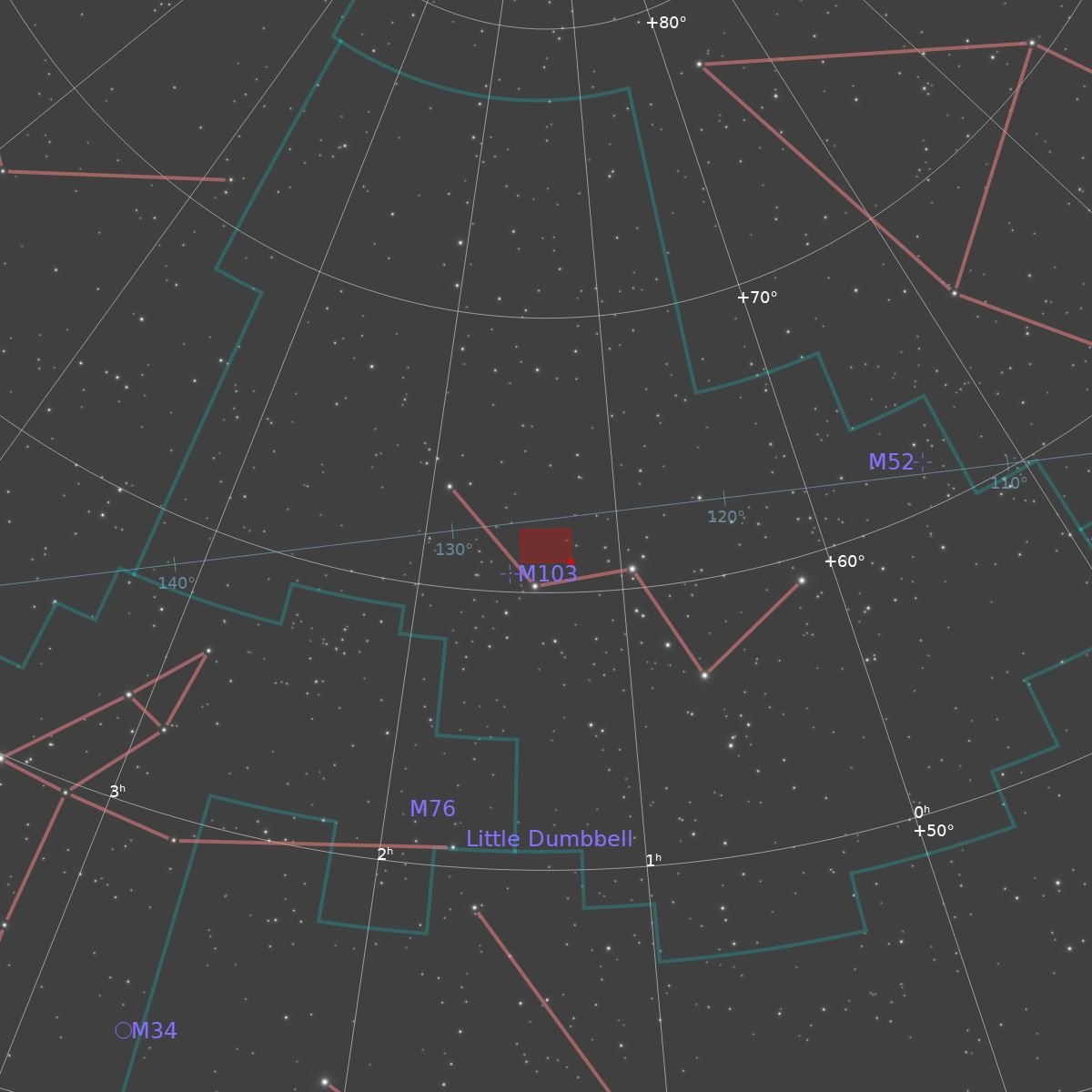
This finder chart image was created with the ImageSolver and FinderChart scripts in PixInsight.
About The Target
🌌 Overview — A Small Nebula in a Much Larger Cloud
Sh2-187 is a compact H II region in Cassiopeia, about 4,600 light-years from Earth according to the distance adopted in a 2022 study. A separate estimate based on Gaia data and molecular-gas observations puts it closer to 2,900 light-years. Ultraviolet light from hot young B-type stars ionizes the hydrogen and powers the visible nebula. Along our line of sight, a dust cloud cataloged as LDN 1317 blocks part of that emission and gives the core its broken outline. oup.silverchair-cdn.com
LDN 1317 is one of several dark nebulae in this part of Cassiopeia. The wider neighborhood includes LDN 1316, 1319, 1322, and 1323. The rich Milky Way star field makes these clouds easier to see. Where the dust is thickest, fewer faint background stars come through. Where it thins, the stars gradually reappear. That’s worth looking for as you move from the bright core into the rest of the image. Annotated view of the wider field www.jthommes.com
📜 History — What Sharpless and Lynds Saw on the Plates
Stewart Sharpless recorded this nebula as entry 187 in his 1959 catalog of H II regions. Beverly Lynds used the Palomar sky survey to look for clouds that absorbed background light. To make it into her 1962 dark-nebula catalog, a cloud had to be visible on both the red and blue survey photographs. The bright nebula also has a Lynds designation, LBN 630, from her separate catalog of bright nebulae. I like that the same patch of sky gives us both kinds of entry. You can see why each caught an observer’s attention. Sharpless catalog · Lynds catalog of dark nebulae cdsarc.cds.unistra.fr
🔬 Science — An Expanding Shell and Two Very Different Cores
The optical image shows where ionized gas is bright enough to see and where dust blocks the view. Radio measurements at 21 centimeters show another part of the story. Neutral hydrogen surrounds the nebula in a fragmented shell about 13 light-years across at the distance adopted by the study. The gas is expanding at roughly 7.5 kilometers per second, an estimate astronomers made by measuring Doppler shifts in the hydrogen emission. oup.silverchair-cdn.com
Two dense concentrations of molecular gas sit near the shell. The southeastern core contains embedded young stars and molecular outflows, which are streams of gas driven by forming stars. The northeastern core shows signs of being compressed by the expanding shell, and the study found little evidence of star formation inside it. That difference is one of the most interesting things about Sh2-187. The same expanding nebula is interacting with two nearby clouds that are at very different stages. Multiwavelength study of Sh2-187 oup.silverchair-cdn.com
✨ What Stands Out in This Image
At full size, look just below center for the small orange ridges where the emission meets the main dust lane. Then jump to the far left, where a narrow filament stands out against a richer patch of stars. The broad patches above and to the right of the core are harder to pick out. I find those easiest to see by looking at the faint stars along their edges. Near the nebula, the dust shows up as a crisp silhouette. Farther away, you see it in the gradual thinning of the star field.
About The Project
Planning and Weather
This is the part where I whine about the weather and how tough it is to have clear nights with no moon in this part of the country!
While the whine is certainly valid, 2026 has been one of the worst years in that regard; I did have the advantage of having an observatory. This means that I can go after marginal nights with little equipment setup and takedown.
Because of this, I was able to capture data on the evenings of October 6, 9, and 17. These were not wonderful evenings by any means, but beggars can't be choosers!
We had thin clouds coming through and a very heavy dew to contend with. In the end, I collected 17.5 hours of data!
Picking Targets
Cassiopeia is at its best location in the sky for me right now. Other times of the year, it's lower on my northern horizon, and it dips into the light dome from Rochester, NY. But since it was high and tended to be a target in the right environment, I wanted to select at least one target there.
I often use the Sharpless catalog to choose objects, and when I did that here, I came across SH2-187. With all of that dust and its glowing ball of new star formation, I was instantly intrigued and chose it as my target
I decided to shoot this as a narrowband target with 300-second exposures and also capture some 30-second exposures in RGB so I could have natural-looking stars. (This - in hindsight- was a mistake - more about that later!)
As the nights became cooler, I lowered my usual camera-cooling target from −10 °C to −15 °C.
Data Collection
Since it was dark early, I opened the roof around 5 pm, which also helped things cool down a bit.
On the nights in question, the gear performed flawlessly. The WO132 platform was once again completely reliable and performed flawlessly on all three nights.
Tracking ran very well each night.
We did have some heavy dew. While water was dripping from all surfaces in the observatory, the WO132 dew straps kept the optics clear.
Good data collection with no drama! Just the way I like it!
Calibration Frames
A few nights after collecting the last data, I decided to grab a complete set of calibration data.
With the Wanderer Astro cover, I could easily do the entire process remotely. Talk about convenience!
I collected a complete set of darks, dark flats, and flats for this project.
Processing Overview
Pre-processing
To prepare to process this image, I migrated to PixInsight version 1.9.6.
As always, I blinked all of my image data and my calibration data. I saw thin clouds coming through, so I had to drop frames. I also lost some frames as the scope was pointing into the trees. Apparently I need to do a better job of mapping my horizon for NINA!
As I reviewed the subs, I came away with the conclusion that I had made two mistakes in setting up for this image:
Framing - I really wish now that I had framed this 90 degrees from where it is now. This would have better captured the long dust ridge leading to the main nebula. The dark dust is not so evident in the plates used for framing in NINA, and I blew it!
The narrowband signal for the O3 and S2 channels was very weak. I might have done better to do an LRGB shot of this target. Some day I will do just that!
In the end, left me 30 seconds short of 17.5 hours of data. I think that is the record for this year. Last year - with better weather- I had some longer integration times.
Post-Processing
The processing plan for this image was pretty straightforward and very similar to what I did on the previous project.
I used my typical narrowband workflow with RGB Stars. At a high level, this looks like the diagram below:
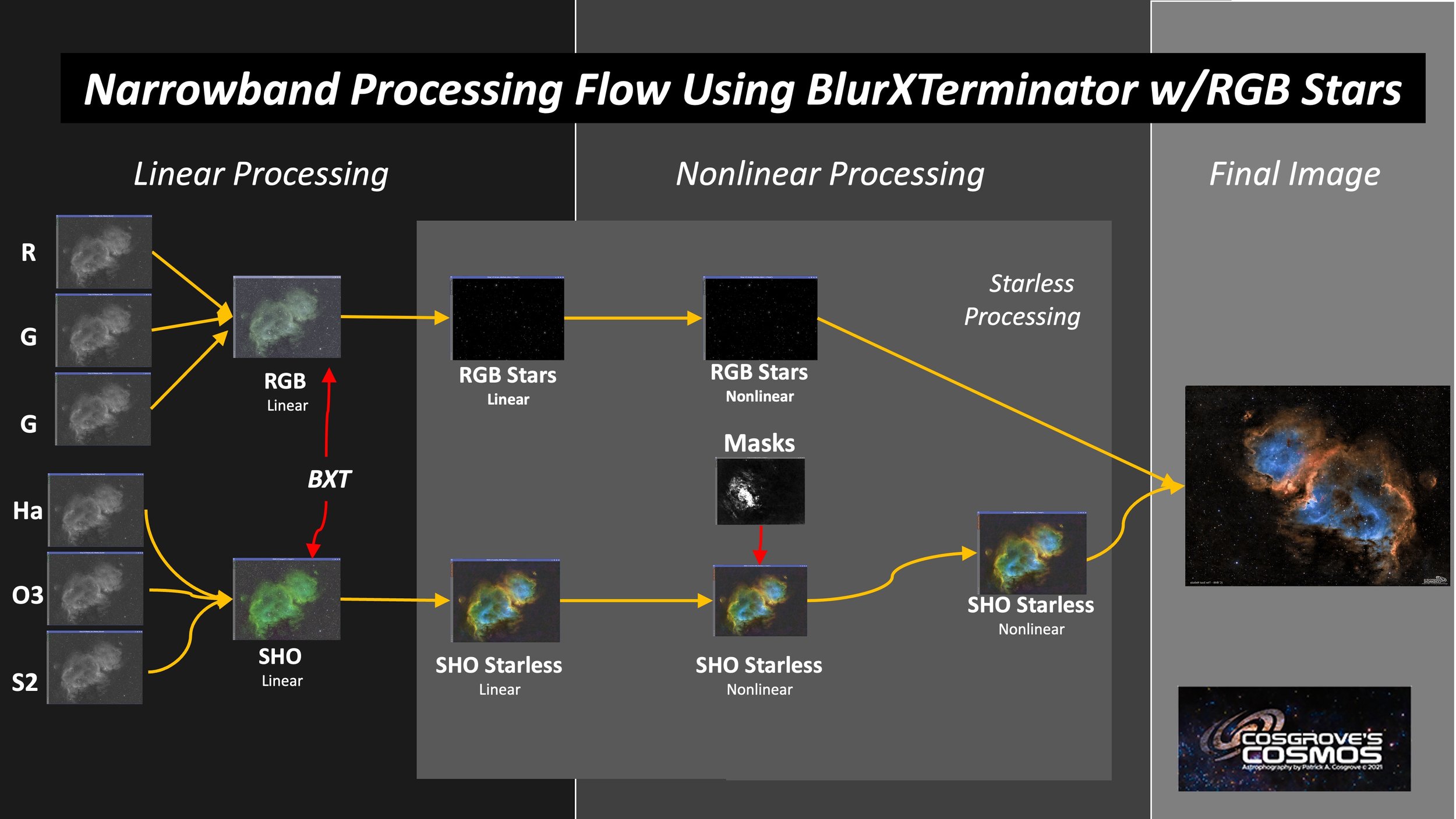
My typical SHO with RGB Stars Workflow.
The front end of the processing was pretty standard.
Linear processing produced an SHO starless image and an RGB star image.
Because the OIII and SII filter datasets have such weak signals, I didn't do as much color mask processing. So that somewhat simplified my workflow.
I used ACM to manage the color position.
I used ATR to recover signal from the highlights.
And I used ACE to bring out the nebula's detail.
One big problem I ran into was larger-frequency color noise that NXT didn't handle. The near-final starless SHO image has regions of low signal that looked pretty bad. It was only in certain locations. I finally dealt with this by exporting the image to Photoshop, selecting these regions with a lasso with a 100-pixel feather, and using the recently improved Camera Raw Filter Detail controls to add just a touch of color and neutral noise reduction. This really seemed to help.
The color noise pattern that I found disturbing is in the middle of the frame. (click to enlarge)
Light denoie with Photoshop Camera Raw seemed to help! (click to enlarge)
In the past, I had used another tool to transform my linear star image into the nonlinear domain. But for a while now, I have been developing my own tool, which I am tentatively calling the Astro Star Lab.
The tool analyzes the star data and adaptively calculates an initial stretch. Star Presence and Color Boost controls then let you refine the initial result. It then provides a rich set of tools that let you compare the new position with the baseline so you know what you are getting.
A screen snap of ASL with the final Stars + Starless combination (click to enlarge)
I have used this tool for a few projects now and really like it. However, it is very compute-intensive, and previous versions had long processing delays that could be frustrating for the user. I am happy to say that this tool has evolved wth use and is much more efficient now. I think it has evolved to the point that I expect to release it soon. The only thing holding me back is a video to review its use. So stay tuned if you are interested! This, like everything at CosgrovesCosmos, will be freeware.
Detailed and Annotated Image Processing Walkthrough
Typically, I conclude one of these imaging projects by documenting the processing steps I used on this image. But this section can make the overall post very large and, at times, slow to load.
I am now creating a secondary, standalone page to hold this information. You can access this page by clicking the link below. Returning to this page is as simple as clicking the back arrow in your browser or selecting a different menu option at the top of the page.
I hope you like this new format!
Use the link below to see the detailed image processing walkthrough for this imaging project.
SH2-187 2026 Image Processing Walkthrough
Final Results
In the master images, I had good data in Ha, but the OIII and SII data were very weak. Narrowband normalization really boosted the scale of those images, and this made their noise evident. NoiseXterminator helped, but it can only do so much.
Even with over 12 hours of integration on an f/5.6 system, I still needed much more exposure on the O3 and S2 filters to get the best result, and the weather window didn't allow time for that.
Given that limitation, I think the image came out well.
My first image was very color-saturated. I backed off from my starting position as I went further; I felt the drama was leaving the image. So I found a compromise: I dialed back the orange hues to keep the strong color without making it too saturated. I adjusted the blue hues by a much smaller amount.
I think the final image hits the right balance for me.
More Info
🔭 Target Details & Catalogs
SIMBAD — Research Bibliography for Sh2-187 — A bibliography for the nebula under its coordinate-based Lynds designation, LBN 126.70−00.80. It brings together studies of the ionized nebula, nearby molecular clouds, and embedded young stars.
Stewart Sharpless — A Catalogue of H II Regions (1959, PDF) — The original publication behind the Sh2 designation. Sh2-187 is entry 187 in this survey of 313 ionized nebulae compiled from Palomar photographic material.
NASA HEASARC — Lynds Catalog of Dark Nebulae — Explains how Beverly Lynds identified dust clouds on red and blue survey photographs and recorded their apparent size and opacity. This is the catalog behind LDN 1317 and several other dark clouds in the surrounding field.
🧭 Exploring the Surrounding Field
Jim Thommes — Annotated Wide-Field View of Sh2-187 — The annotation identifies LDN 1316, 1317, 1319, 1322, and 1323, along with several clouds from the Dobashi catalog. It’s a good companion to my annotated image if you want to follow the dust beyond the bright nebula.
Irida Observatory — A Closer View of Sh2-187 — Velimir Popov and Emil Ivanov’s image gives a second look at the bright core and the dust silhouetted against it. The page includes an annotated version, field coordinates, and image orientation.
🔬 Research — Distance, Gas, and Star Formation
Zemlyanukha and colleagues — The Fragmented Shell Around Sh2-187 (2022, PDF) — Radio, infrared, and molecular-line observations reveal an expanding shell of neutral hydrogen and two dense molecular cores. The southeastern core contains young stars and outflows, while the northeastern core shows signs of compression. The paper also discusses the two published distance estimates.
Russeil, Adami, and Georgelin — Revised Distances of Northern H II Regions (2007) — The reference for the stellar photometric estimate of roughly 4,600 light-years used in this write-up. The study estimated distances by examining the stars that ionize these nebulae.
Arvidsson and Kerton — Submillimeter and Molecular Views of Three H II Regions (2011, PDF) — Compares Sh2-187, called KR 120 in the paper, with Sh2-124 and Sh2-165. The authors use submillimeter dust emission and carbon monoxide observations to look for dense material and investigate whether expanding nebulae may have helped trigger new star formation.
Joncas, Durand, and Roger — The Sharpless 187 Gas Complex (1992) — A bibliographic record for an early study that combined observations at several wavelengths to investigate how the ionized nebula interacts with the surrounding gas.
Imaging Platform Used
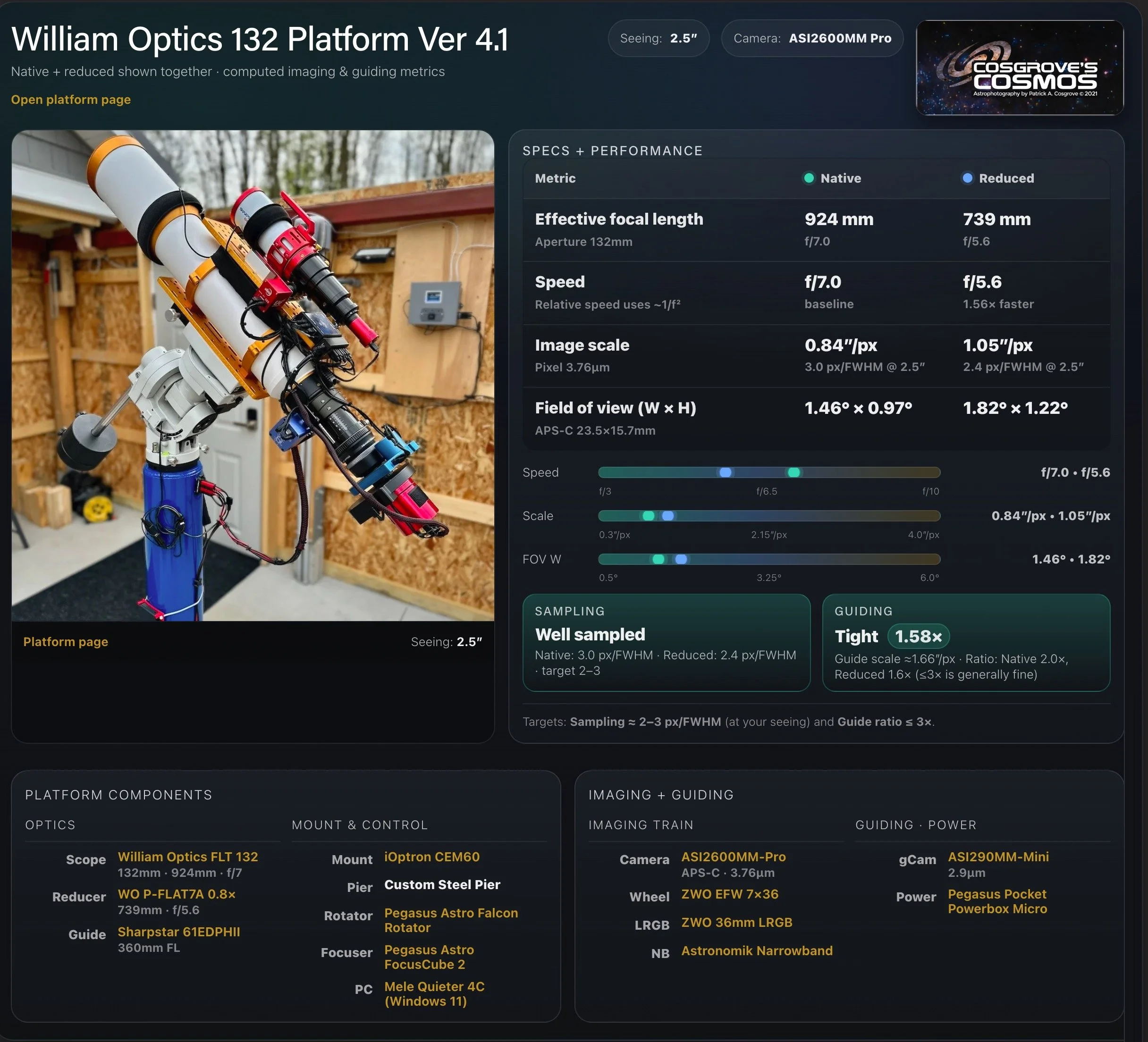
The details for the WO132 Platform.
Platform used for this project
Software
Capture Software: PHD2 Guider, NINA
Image Processing: PixInsight, Photoshop - assisted by Coffee, extensive processing indecision and second-guessing, editor regret, and much swearing…