The Sadr Region of Cygnus: IC 1318 & Gamma Cygni Nebula - 12.75 hours of SHRrgb.
Date: Aug 7, 2026
Cosgrove’s Cosmos Catalog ➤#0164
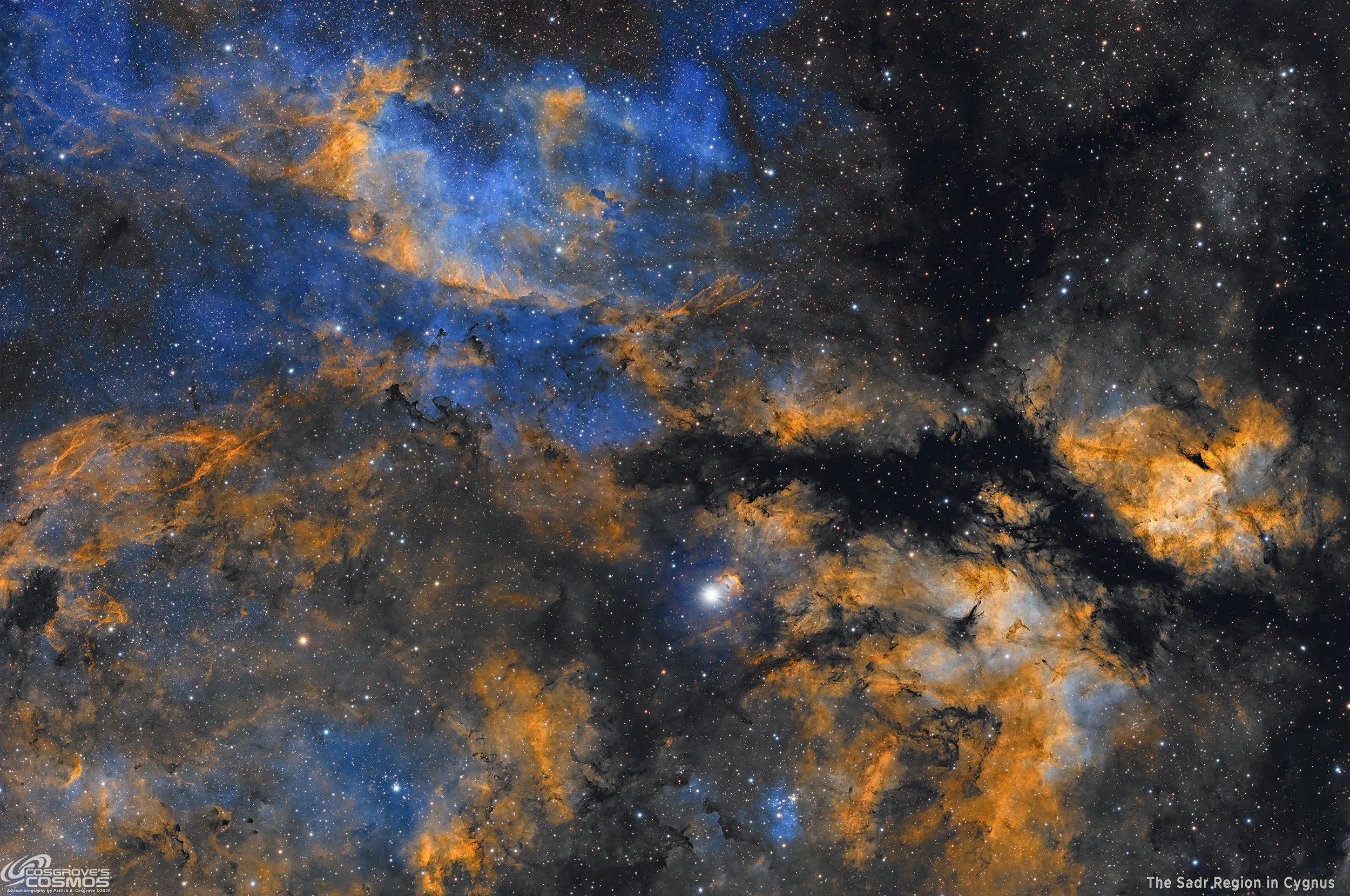
The Sadr Region in Cygnus, captured with my FRA400 platform. (Click image for hi-res version via AstroBin.com.)
The Sadr Region — glowing emission nebulae, dark molecular clouds, and young star clusters in the heart of Cygnus.
Published in the November 2026 Issue of BBC Sky At Night Magazine!
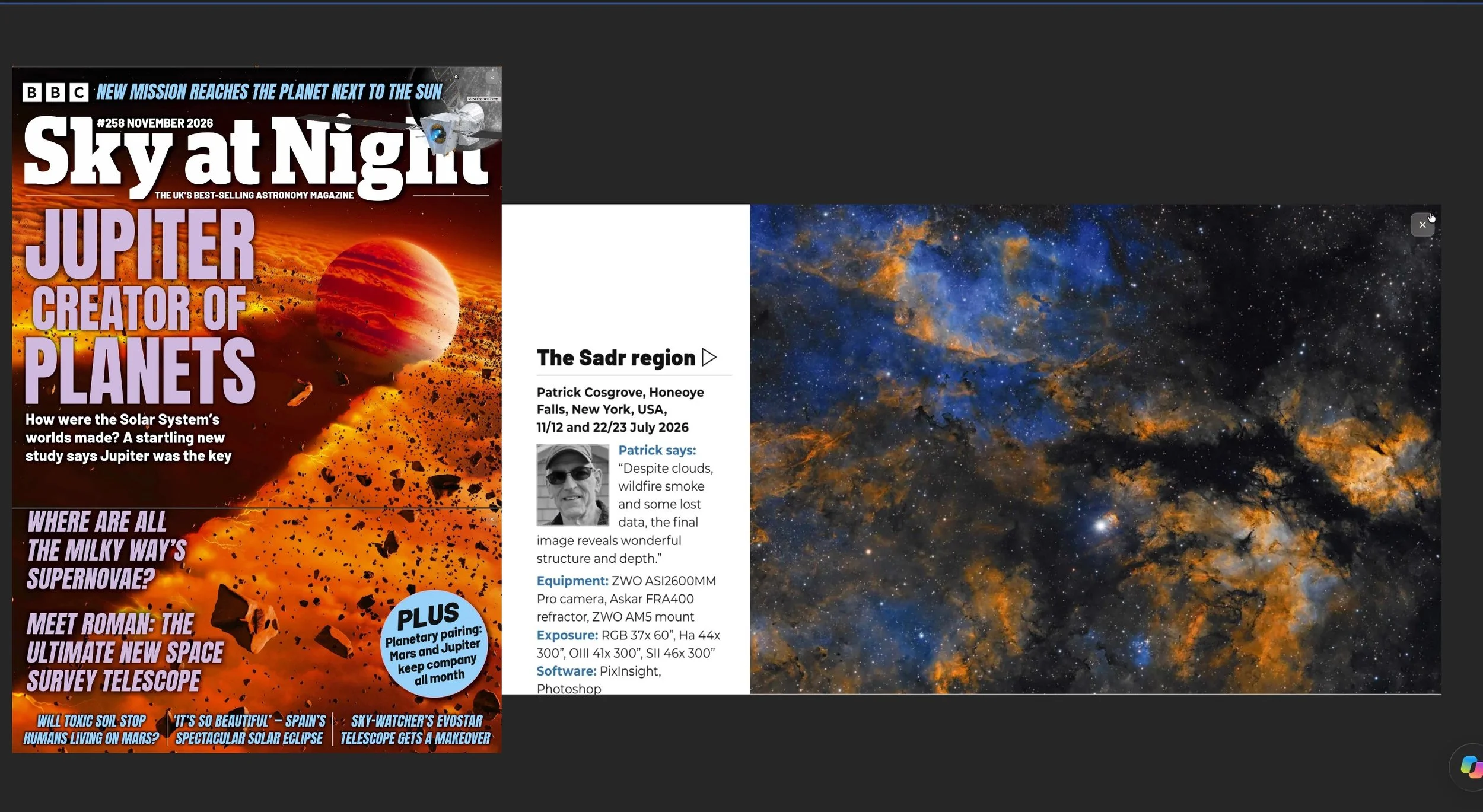
Seen on page 83!
🔭 Project Summary
Target: The Sadr Region — IC 1318 / Sh2-108 / Gamma Cygni Nebula complex
Capture Dates: July 11, 12, 22, and 23, 2026
Constellation: Cygnus • Distance: ≈ 4,500–5,000 light-years for the nebular complex; Sadr ≈ 1,800 light-years
Type: Wide-field emission nebula complex with dark molecular clouds, bright nebulae, young stars, and open cluster NGC 6910
Imaging Period: July 11–23, 2026 • Total Integration: 12 h 46 m 00 s (SHO narrowband + RGB stars)
Filters: Ha · OIII · SII (Astronomik 36 mm 6 nm) + R · G · B (ZWO 36 mm LRGB Gen II)
Telescope: Askar FRA400 72 mm f/5.6 Quintuplet Air-Spaced Astrograph
Camera: ZWO ASI2600MM-Pro (−10 °C; Gain 100 narrowband, Gain 0 RGB)
Mount: ZWO AM5 on custom steel pier
Processing: PixInsight (SHO narrowband + RGB stars) & Photoshop
Location: Whispering Skies Observatory · Honeoye Falls, NY (USA)
Acquisition Notes: Ha: 44 × 300 s; OIII: 41 × 300 s; SII: 46 × 300 s; R: 37 × 60 s; G: 37 × 60 s; B: 37 × 60 s, all bin 1×1 at −10 °C; total 12 h 46 m 00 s after culling bad or questionable subs.
Image Note: This wide-field SHO narrowband image frames the Sadr / Gamma Cygni region, including IC 1318, Sh2-108, NGC 6910, Lynds bright and dark nebulae, and Barnard dark nebulae across the dense Cygnus Milky Way.
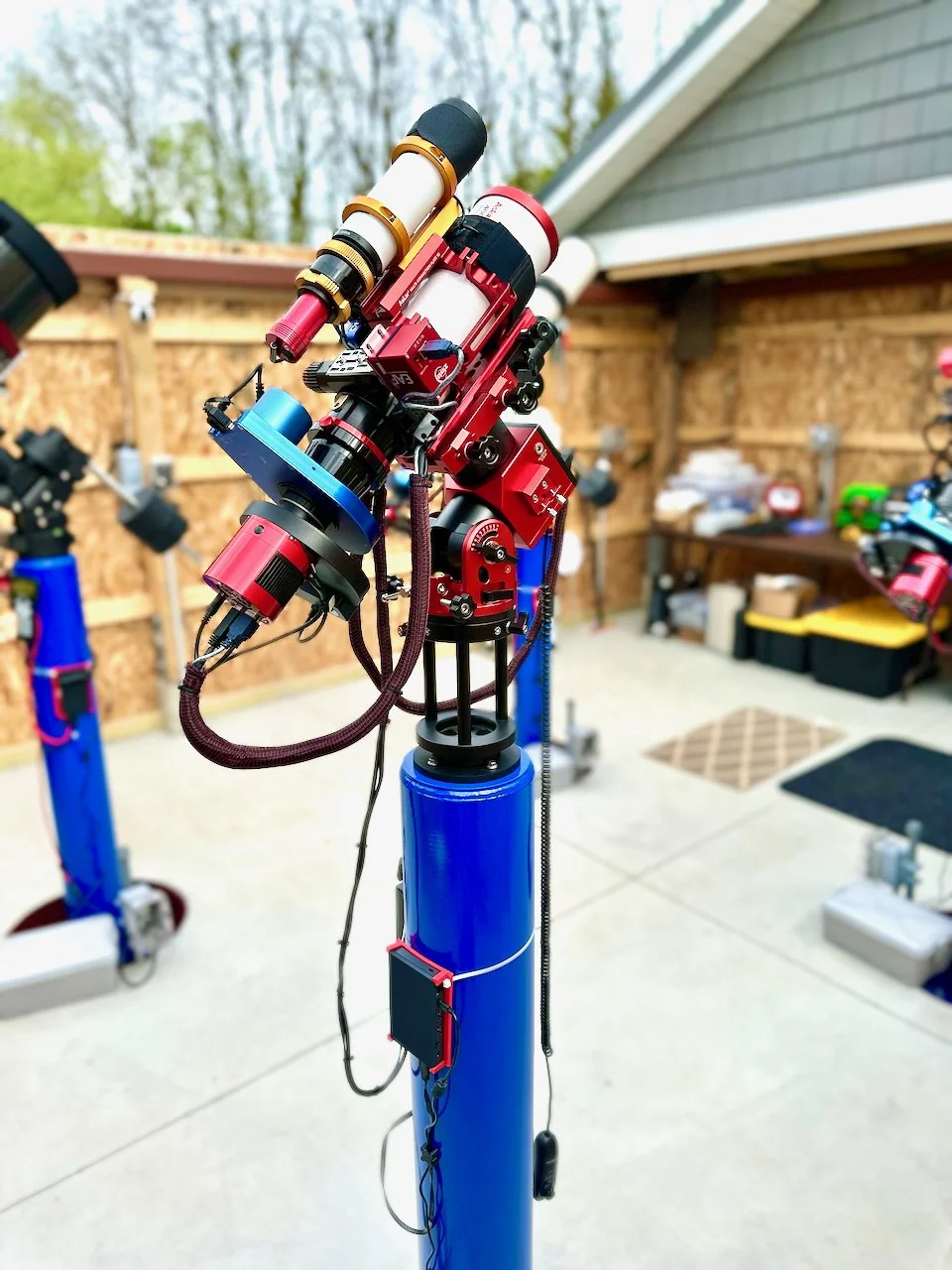
The FRA400 (click on image to go to the blog entry for this scope)
📸 Capture Details
Nights: July 11, 12, 22, and 23, 2026
| Channel / Filter | Frames × Exposure | Settings | Total |
|---|---|---|---|
| Ha — Astronomik 6 nm Hydrogen-alpha (36 mm unmounted) | 44 × 300 s | bin 1×1 • −10 °C • Gain 100 | 3 h 40 m |
| OIII — Astronomik 6 nm Oxygen III (36 mm unmounted) | 41 × 300 s | bin 1×1 • −10 °C • Gain 100 | 3 h 25 m |
| SII — Astronomik 6 nm Sulfur II (36 mm unmounted) | 46 × 300 s | bin 1×1 • −10 °C • Gain 100 | 3 h 50 m |
| R — ZWO Red (36 mm unmounted) | 37 × 60 s | bin 1×1 • −10 °C • Gain 0 | 37 m |
| G — ZWO Green (36 mm unmounted) | 37 × 60 s | bin 1×1 • −10 °C • Gain 0 | 37 m |
| B — ZWO Blue (36 mm unmounted) | 37 × 60 s | bin 1×1 • −10 °C • Gain 0 | 37 m |
| Total Integration (after culling): 12 h 46 m 00 s (SHO narrowband + RGB stars) | |||
Calibration Frames
- 25 × dark frames @ 300 s, bin 1×1, −10 °C, Gain 100
- 25 × dark frames @ 60 s, bin 1×1, −10 °C, Gain 0
- 30 × dark-flats @ each flat exposure time, bin 1×1, −10 °C, Gain 0 for RGB and Gain 100 for narrowband
- Flats: 15 each — Ha, OIII, SII, R, G, B
Table of Contents Show (Click on lines to navigate)
Annotated Image
This annotated image was created with the ImageSolver and FinderChart scripts in PixInsight.
The Location in the Sky
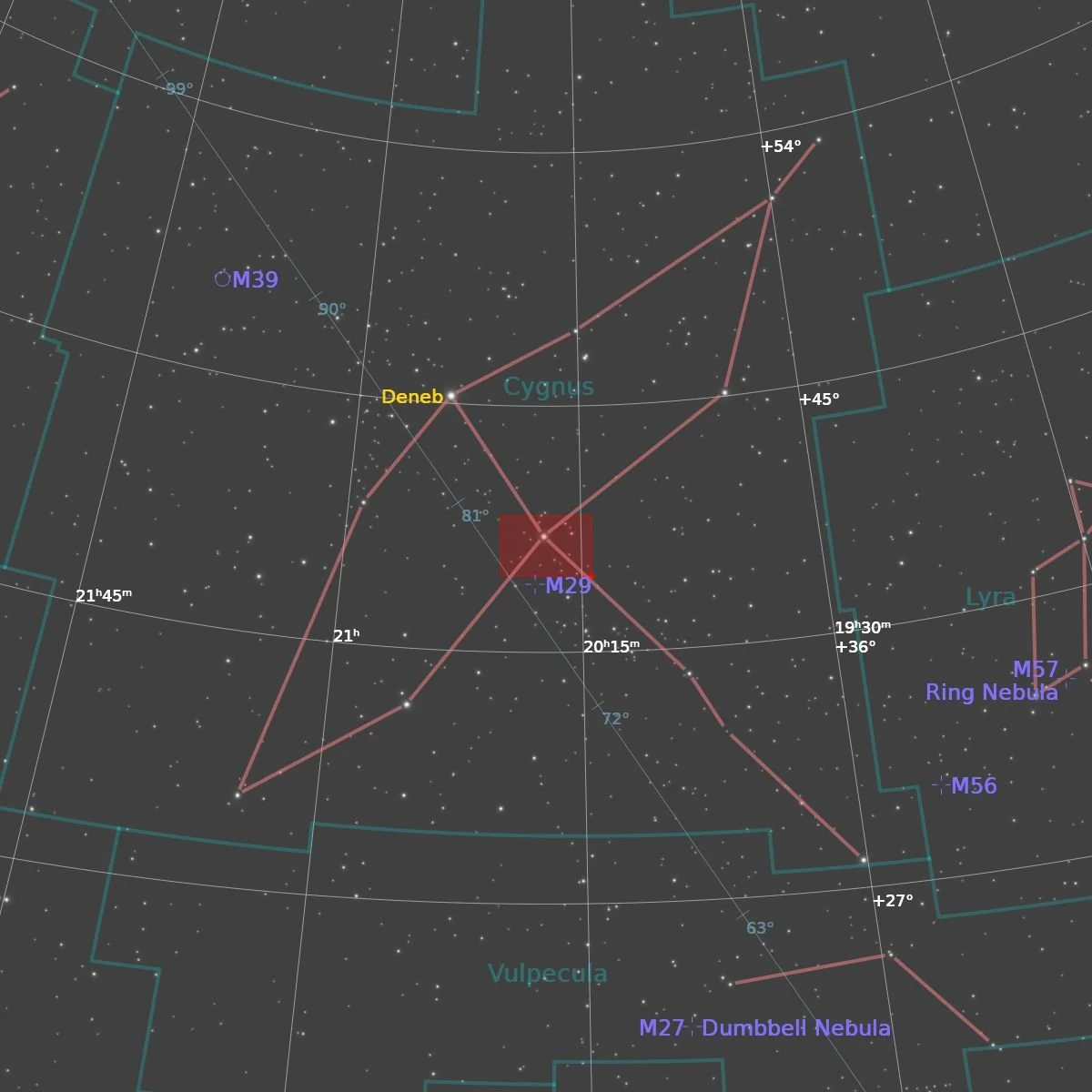
This finder chart image was created with the ImageSolver and FinderChart scripts in PixInsight.
About The Target
🔭 Overview
This image looks into the heart of Cygnus, near Sadr, the bright central star of the Northern Cross and the “chest” of Cygnus the Swan.
The field is part of the larger Gamma Cygni Nebula region, cataloged as IC 1318 and Sharpless 2-108, a vast complex of glowing hydrogen, sulfur, oxygen, dust, and young stars projected against one of the richest stretches of the Milky Way.
Although Sadr appears to sit within the nebulosity, it is actually a foreground yellow-white supergiant roughly 1,800 light-years away, while much of the surrounding nebular complex lies farther behind it, around 4,500–5,000 light-years distant.
★ Sadr
Sadr itself is one of the great anchor stars of the summer Milky Way. Also designated Gamma Cygni and 37 Cygni, it marks the chest of Cygnus the Swan and sits at the intersection of the Northern Cross, the familiar asterism formed by Deneb, Sadr, Albireo, Delta Cygni, and Epsilon Cygni. The name Sadr comes from the Arabic ṣadr, meaning “chest” or “breast”; older forms connect it with Al Sadr al Dajājah, “the hen’s breast,” a reference to its position in the bird-shaped constellation.
Physically, Sadr is a yellow-white F-type supergiant about 1,800 light-years away, shining at roughly magnitude 2.2 and radiating tens of thousands of times as much light as the Sun. It is massive, young, and already evolved, with an estimated mass of around 12 solar masses and an age of only about 12 million years.
In sky lore, Cygnus has long been associated with a swan or celestial bird, most famously in Greek tradition with stories connected to Zeus and Leda, Orpheus, or Cycnus, depending on the source. In this image, Sadr is both a visual landmark and a useful reminder that bright foreground stars, mythological constellations, and distant star-forming nebulae can all overlap in the same line of sight.
⌖ TheNeighborhood
The broad glowing structures are H II emission regions: clouds of interstellar gas energized by ultraviolet radiation from hot young stars. The dark, branching shapes cutting through the glow are dense dust clouds that block the light behind them. Several of these are cataloged as Lynds Dark Nebulae, including LDN 889, LDN 880, LDN 881, LDN 882, LDN 883, LDN 886, and others visible across the annotated field. The brighter emission patches are also cataloged in the Lynds Bright Nebula catalog, including LBN 245, LBN 249, and nearby LBN structures, while smaller dark knots appear in the Barnard catalog, such as B343, B344, and B347.
One especially interesting object in the field is NGC 6910, a young open star cluster near Sadr’s apparent position. This cluster is only a few million years old and lies at roughly 1.7 kiloparsecs, or about 5,600 light-years, placing it within the broader Cygnus X star-forming environment. Its massive young stars help illuminate and sculpt the surrounding gas, while stellar winds and radiation carve cavities, ridges, and filamentary boundaries into the nebula. What looks like a colorful celestial cloudscape is actually a dynamic region where stars are being born, clearing their surroundings, and reshaping the next generation of star-forming material.
📜 History & Science
Historically, this part of the sky became especially important with the rise of radio and infrared astronomy. In the 1950s, astronomers identified Cygnus X as a powerful and extended radio source, distinct from the famous radio galaxy Cygnus A. Later studies showed that Cygnus X is not just a visual nebula but one of the most active nearby massive star-forming complexes in our galaxy, rich in molecular gas, OB associations, young clusters, and embedded protostars. Infrared observatories such as Spitzer and Herschel revealed that much of the region hidden by dust in visible light is filled with warm dust, dense filaments, and newly forming stars.
This area also has a high-energy side. Observations from NASA’s Fermi Gamma-ray Space Telescope have shown that the Cygnus X region contains cavities filled with gamma-ray emission produced when energetic cosmic rays interact with gas and starlight. Nearby, the Gamma Cygni supernova remnant adds another layer to the story, showing that this region records both stellar birth and stellar death. In one field, we see bright nebulae, dark molecular clouds, young clusters, foreground stars, and the larger machinery of the Milky Way at work.
About the Project
Planning and Weather
2026 has been a very strange year weather-wise. We tend to have a wet spring, which settles down and dries out during June, July, and August. But this year the best term to describe the weather is unstable. We have had storm after storm come through - with unusually heavy rains and very high winds. The summer weather has not really stabilized. Instead, it's been cloudy with few nights suitable for imaging.
I would have to say this has been the worst year so far in terms of the number of nights I could collect data.
The last time I had a solid imaging run was back in galaxy season!
During July, I only had four clear moonless nights to shoot. These fell on July 11th and 12th and July 22nd and 23rd. These were NOT great nights either. The first two had thin clouds passing through; the last two came with Canadian wildfire smoke drifting through the region.
Galaxy Season is tough for the Askar FRA400. It is a wide-angle scope, and during galaxy season there are not many suitable targets for it. Cygnus was overhead, and this is one of my favorite parts of the sky to capture. After reviewing potential targets, I realized I had never pursued the Sadr region. This was a very large and rich part of the sky.
I decided to shoot narrowband, and over the last two nights I also added 60-second RGB exposures to capture natural stars.
Data Collection
July was very hot, and my observatory got so warm during the day that a cheap keyboard I had been using for the observatory computer melted and the keys all stuck together. Now, nothing else melted, but I did start using a couple of fans in my two south-facing windows to cool things off well before evening.
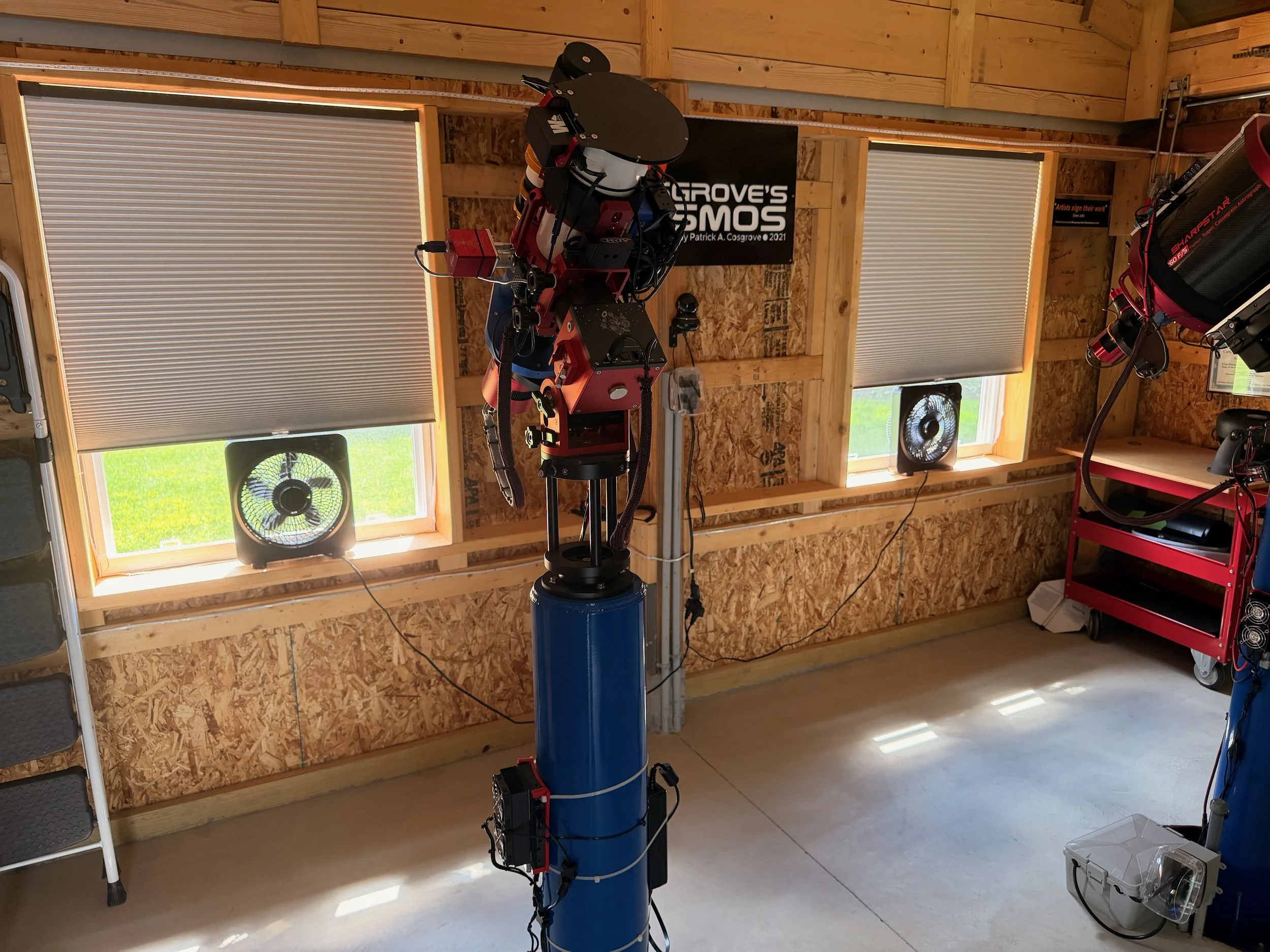
Fans in my north-facing windows cooling down the observatory prior to opening the roof.
I opened the roof around 7 pm, which also helped things cool down a bit.
I set the camera cooling target to −10 °C, as I knew the coolers would never reach -15 degrees C in this heat.
I did have one mystery. Once the scopes are working, I control them from within my den, and I typically nap on the sofa I have there. I'm a gadget hound, so I have my den all set up with smart switches, and so when I am ready to nap, I say “Alexa - turn off the devices in my den.” The lights go out, and I get some sleep.
Catastrophic Shutdown!
On the night of July 22, this is just what I did. I set an alarm to wake me around dawn so I could shut things down. The alarm went off, and I was shocked to see that ALL of my remote connections to the computer controlling all four piers were down. I could not reestablish them either. Hmmmm.
I went to the observatory, and everything was powered down! What? I must have blown a breaker!
Nope! The breakers were fine.
So I was puzzled about what happened, and I was concerned because I did not want it to ever happen again. I had no idea what had happened, but went back to bed, determined to get to the bottom of it.
The next day I looked up when the last sub was collected. Curiously, it was very close to when I went to sleep on my sofa. Hmmm. I thought about it a minute and realized that all of the power in my observatory was on smart plugs as well. Hmm.
So I went into my phone's Alexa app, and I looked at the activity log. When I decided to go to sleep, I remember saying, “ Alexa, turn off the devices in my den.” Guess what I found in the activity log: “Alexa, turn off my devices.”
Alexa had never heard the “In my den” part. Thus it shut down EVERYTHING. Since it was night and we were all sleeping, we never really noticed.
So once again I am doing a service to the broader astrophotography community - doing STUPID things so you don’t have to!
This resulted in the loss of about 2 hours of data collection on four scopes, so a total of 8 hours lost! Nothing stings more than losing good data!
Calibration Frames
After the fourth night, the Moon was beginning to dominate, so I took one evening to get all of my calibration frames. My SCA260 still uses a wall-mounted LED panel as the flat light source, but my other three scopes now sport a Wanderer Astro Motorized cover. This makes the collection of Flats and Dark Flats a breeze. After the flats, I ran a dark series, and my cal data was ready to go.
Processing Overview
Pre-processing
I took a while before I was ready to process this first image of the series. We had some family obligations, and my wife and I went away for a bit to celebrate our 45th wedding anniversary. Finally, I had to migrate my PixInsight installation to the latest version and then install all the scripts. These scripts include my Astro Color Mixer (ACM) and Astro Contrast Enhancer (ACE). This is the first new project where I could use ACE, so I was excited to give it a go.
As always, I blinked all of my image data and my cal data. As I did so, I saw that I had many frames to cull. A few were tracking glitches. I also had a series where the focus was off. This is strange, as I use Offset focus tied to a live Lum frame autofocus, and everything worked well before and after this series, so I don’t know what happened here.
But a bigger issue was thin clouds and smoke. At times you could see the bright star Sadr bloom into a huge halo and look like a cosmic dandelion!
In the end I rejected 25 5-minute subs for a total loss of about two hours. Two hours lost via the Alexa “kill” command and two hours lost to clouds, smoke, and operational issues. Ohhh - that hurts!
This left me with 12 hours and 46 minutes of useful data to work with.
Post-Processing
The processing plan for this image was pretty straightforward.
I used my typical Narrowband workflow with RGB Stars. From a high level, this looks like the diagram below:
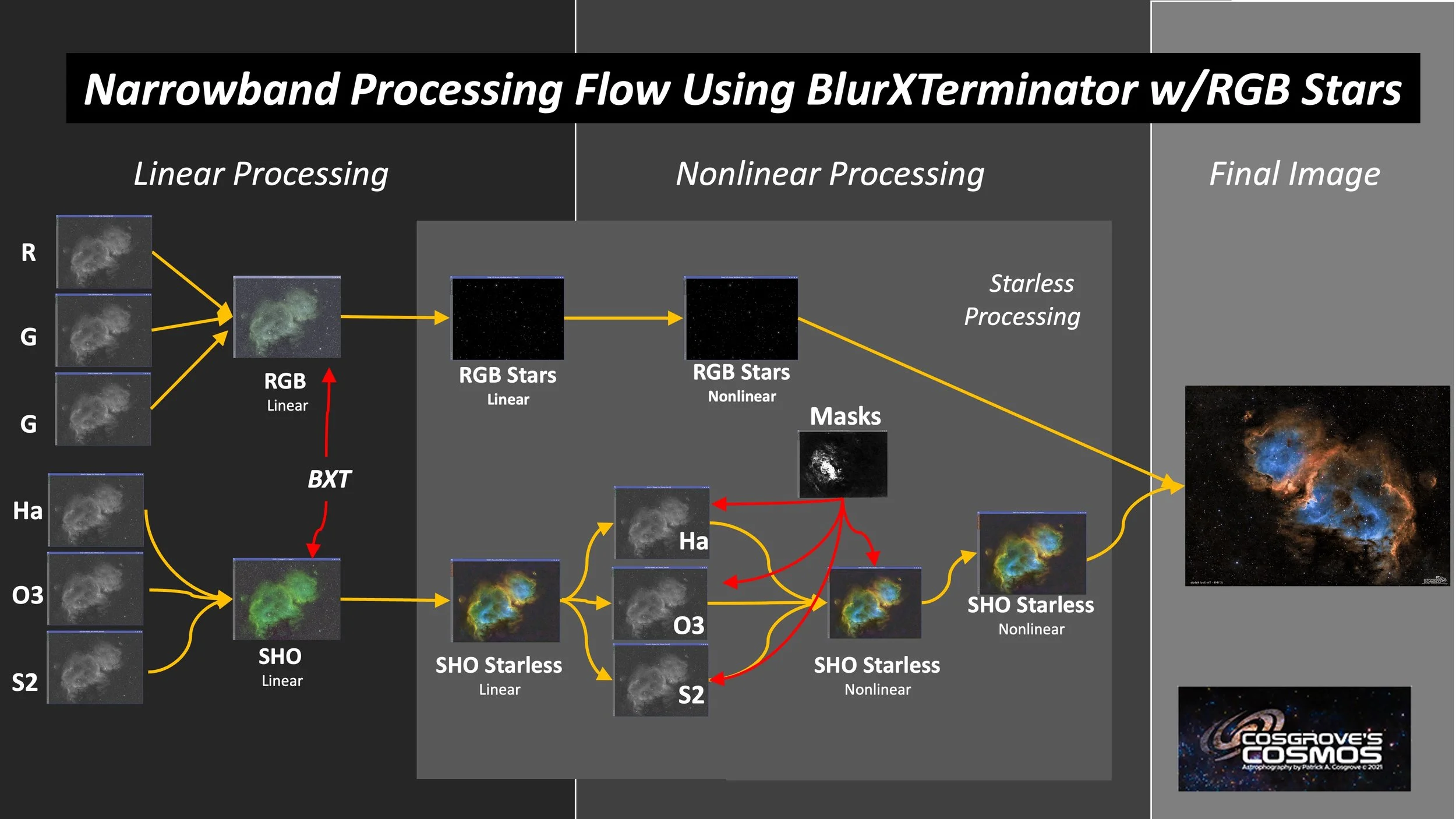
My typical SHO with RGB Stars Workflow.
The front end of the processing was pretty standard for the most part.
Linear processing produced an SHO starless image and an RGB star image.
I used Seti Astro’s StarStretch to move the stars to nonlinear space. I actually did two levels because sometimes images with lots of nebulosity look better with larger stars - so I created two star sizes to work from.
My SHO Starless image was processed a little differently this time. I used NarrowbandNormalization to take a first pass at the data, and then I used GeneralizedHyperbolicStretch to apply a nonlinear stretch to the image. This was a complex image, and I wanted to be careful to preserve the data as much as possible
Once I was nonlinear, I worked on color using my standard method: I created a Warm Color Mask and a Cool Color Mask. Then, using these masks, I adjusted the color and the contrast detail of the image.
To finish up the image, I used two of my own tools, as I mentioned before. ACM allowed me to dial in and tweak the colors the way I wanted them
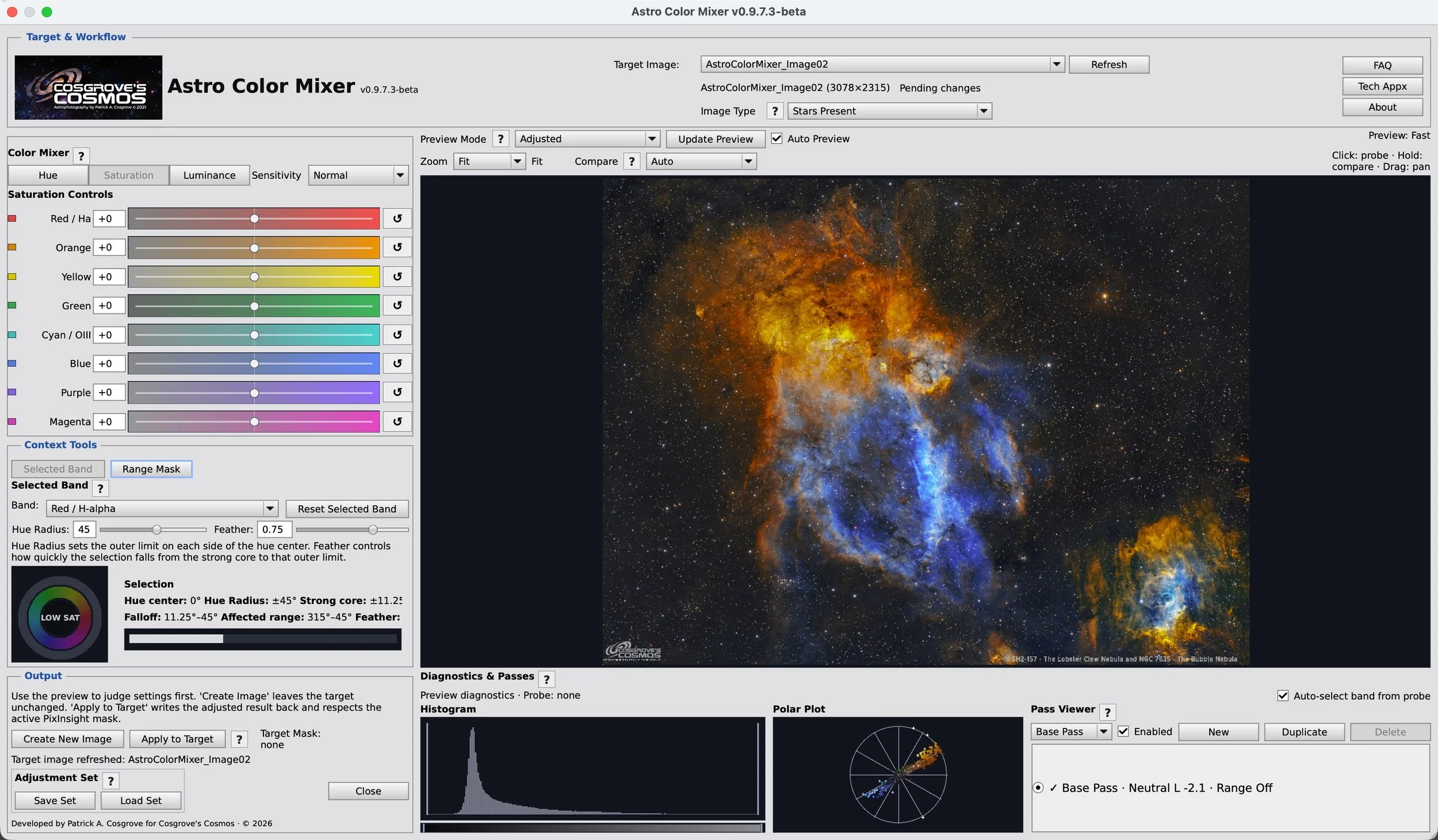
My New Astro Color Mixer PixInsight Script!
Then I used ACE to finalize the level of detail and contrast in the scene.
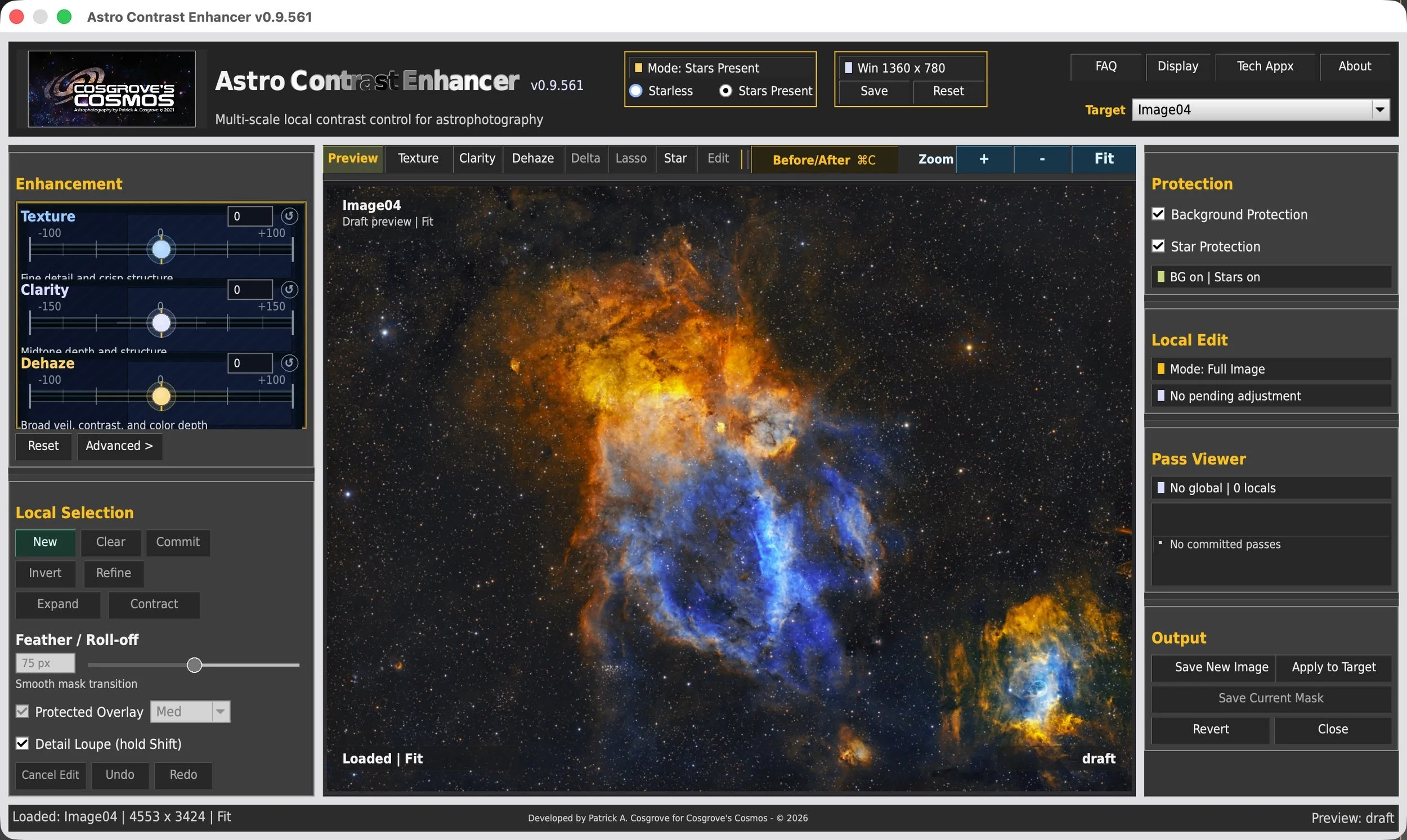
My new ACE tool: Astro Contrast Enhancer
Detailed and Annotated Image Processing Walkthrough
Typically, I conclude one of these imaging projects by documenting the processing steps I used on this image. But this section can make the overall post very large and, at times, slow to load.
I am now creating a secondary, standalone page to hold this information. You can access this page by clicking the link below. Returning to this page is as simple as clicking the back arrow in your browser or selecting a different menu option at the top of the page.
I hope you like this new format!
Use the link below to see the detailed image processing walkthrough for this imaging project.
Sadr Region Image Processing Detail
Final Results
I was pretty happy with the final result. The amount of detail in the bright nebulae and the incredible detail in the fine dust features was impressive. This image looks good full screen, but looks even better as you zoom in and pan around it; the delicate dust structures are just amazing!
More Info
🔭 Target Details
NASA Astronomy Picture of the Day — The Gamma Cygni Nebula — Accessible overview of the Sadr / Gamma Cygni field, including IC 1318, NGC 6910, and the relationship between Sadr and the surrounding nebula.
NASA/JPL — Star Formation in the Heart of the Swan — NASA WISE image feature describing Sadr, IC 1318, dark nebula LDN 889, and the larger star-forming environment in Cygnus.
BBC Sky at Night Magazine — IC 1318 / Gamma Cygni Nebula — Public-friendly guide to IC 1318, its relationship to Sadr, and why this region is popular with astrophotographers.
In-The-Sky.org — Gamma Cygni Nebula / IC 1318 — Observing-oriented entry with position, constellation, finder chart, alternate names, and sky visibility information.
CDS Aladin Lite — Interactive Sky Atlas — Web-based sky viewer; enter “Sadr,” “IC 1318,” “Sh2-108,” “NGC 6910,” or “LDN 889” to inspect survey imagery and catalog overlays.
SIMBAD Astronomical Database — Sadr / Gamma Cygni — Technical catalog reference for Sadr, useful for identifiers, measurements, coordinates, spectral type, and bibliography.
📜 History & Naming
IAU — Naming Stars — Official IAU background on star names and designations, including the modern process for formalizing traditional star names.
IAU — Formally Approved Star Names — IAU announcement describing the Working Group on Star Names and the formal approval process for traditional star names.
NASA Astronomy Picture of the Day — Supergiant Star Gamma Cygni — NASA APOD feature focused on Sadr, the Northern Cross, IC 1318, and NGC 6910.
Astronomy.com — Two Subtle Wonders Near Gamma Cygni — Observing article discussing Gamma Cygni, nearby bright and dark nebulae, and the visual context of the Great Rift.
🔬 Science & Observations
Harvard-Smithsonian CfA — What Is the Cygnus-X Region? — Research-oriented overview of Cygnus X as one of the richest known star-forming regions in the Milky Way.
NASA Scientific Visualization Studio — Gamma Rays in the Heart of Cygnus — NASA visualization and explanation of Fermi observations of Cygnus X and its cosmic-ray cocoon.
NASA Fermi — The Cygnus X Cocoon — Fermi mission science page explaining the gamma-ray cocoon and its relationship to energetic particles in Cygnus X.
ESA Herschel — Massive Stars Forming in Cygnus X — ESA far-infrared view of Cygnus X showing bubbles, filaments, pillars, and dense star-forming structures.
HEASARC — Lynds Catalog of Dark Nebulae — Professional catalog reference for Lynds Dark Nebulae, useful for understanding LDN designations in the annotated image.
HEASARC — Lynds Catalog of Bright Nebulae — Professional catalog reference for Lynds Bright Nebulae, useful for LBN designations across the Sadr field.
💡 Interesting Facts & Outreach
NASA Science — A Nebula by Any Other Name — General NASA explanation of Lynds Bright Nebula designations and how emission nebulae glow.
ESA — Cygnus-X: The Cool Swan Glowing in Flight — Outreach-friendly Herschel feature showing how infrared astronomy reveals hidden star formation in Cygnus X.
In-The-Sky.org — Barnard 347 / LDN 889 — Observing-oriented entry for a dark nebula in the Sadr region, useful for connecting the annotated labels to actual sky objects.
Imaging Platform Used
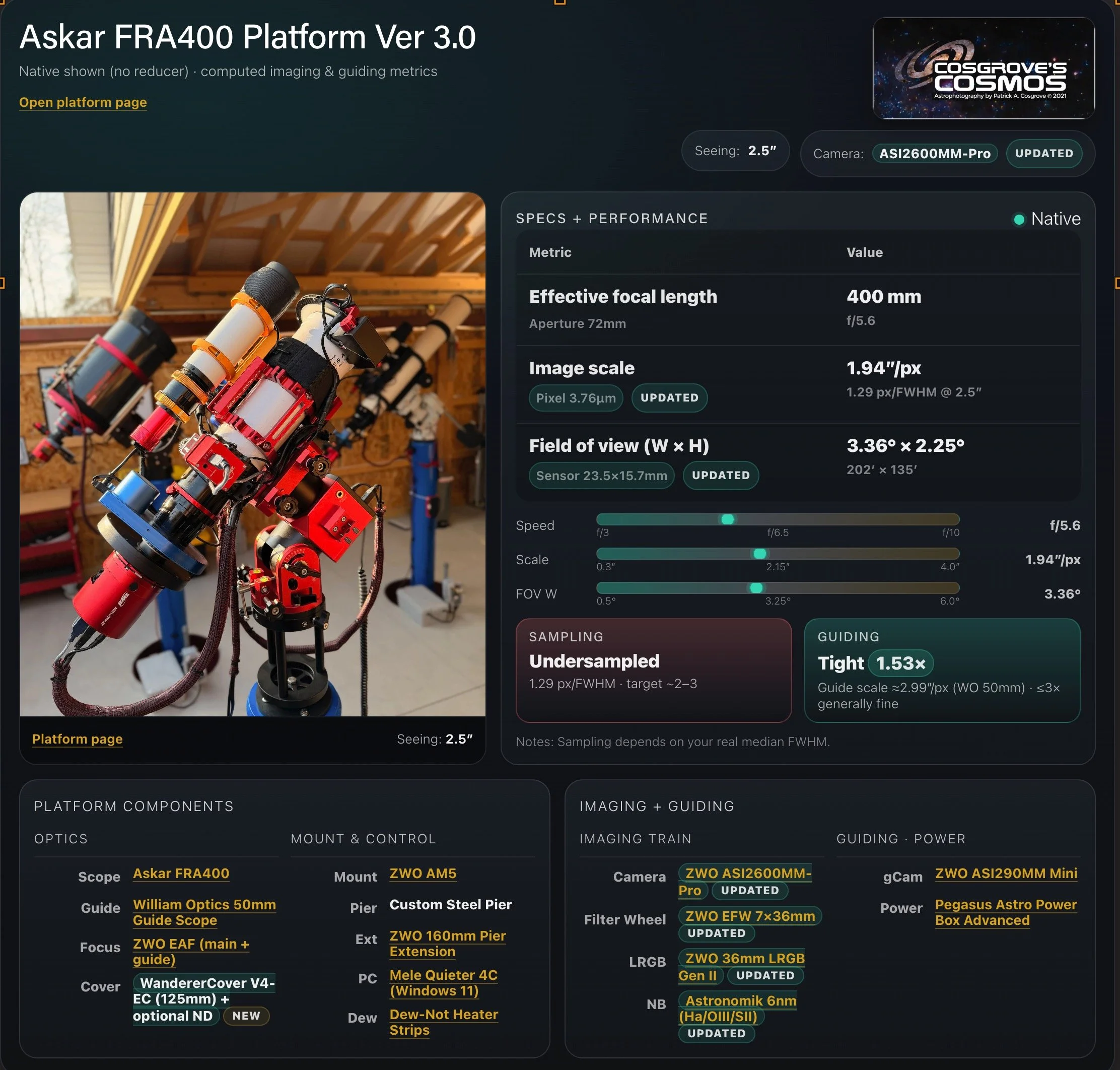
The details for the FRA400 Platform.
Platform used for this project
Software
Capture Software: PHD2 Guider, NINA
Image Processing: PixInsight, Photoshop - assisted by Coffee, extensive processing indecision and second-guessing, editor regret, and much swearing…