SH2-140 - The Hidden Nebula- 12.38 hours of SHO + RGB Stars
Date: Aug 10, 2026
Cosgrove’s Cosmos Catalog ➤#0165
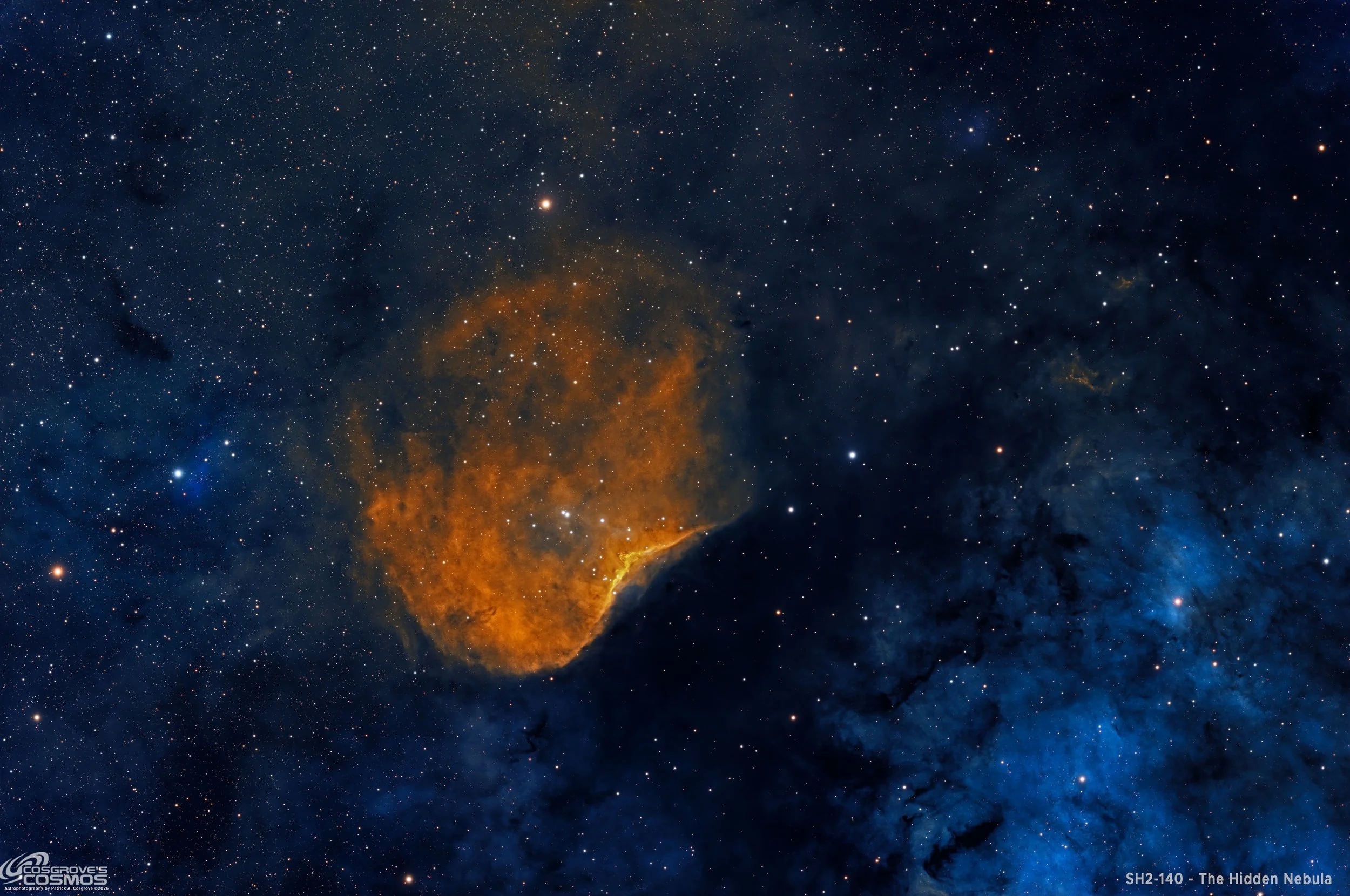
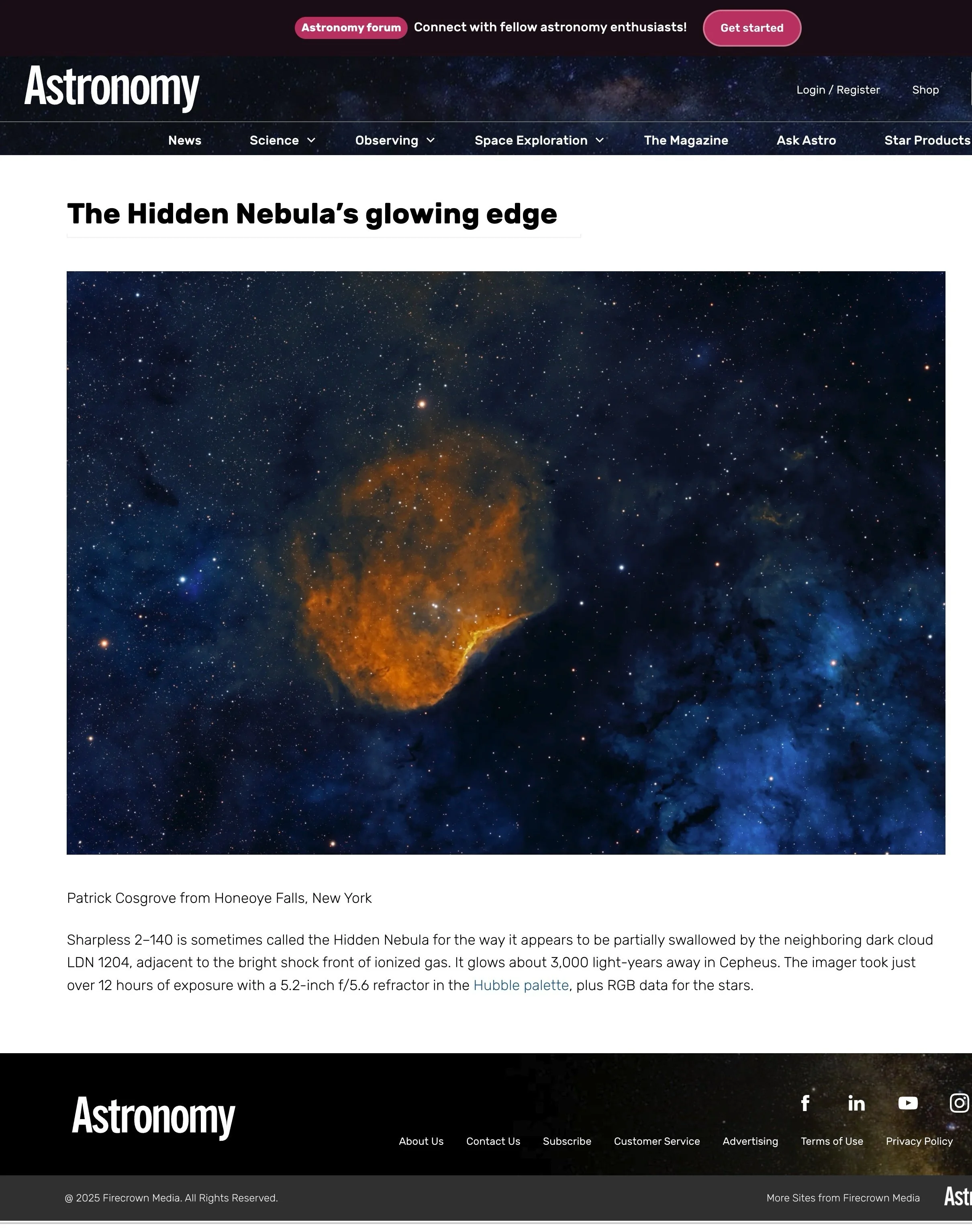
SH2-140, captured with my WO132 platform. (Click image for hi-res version via AstroBin.com.)
The Hidden Nebula — a bright ionization front emerging from the dark molecular clouds of Cepheus.
Published in Amateur Astronomy Magazine, Fall 2026, Issue #132
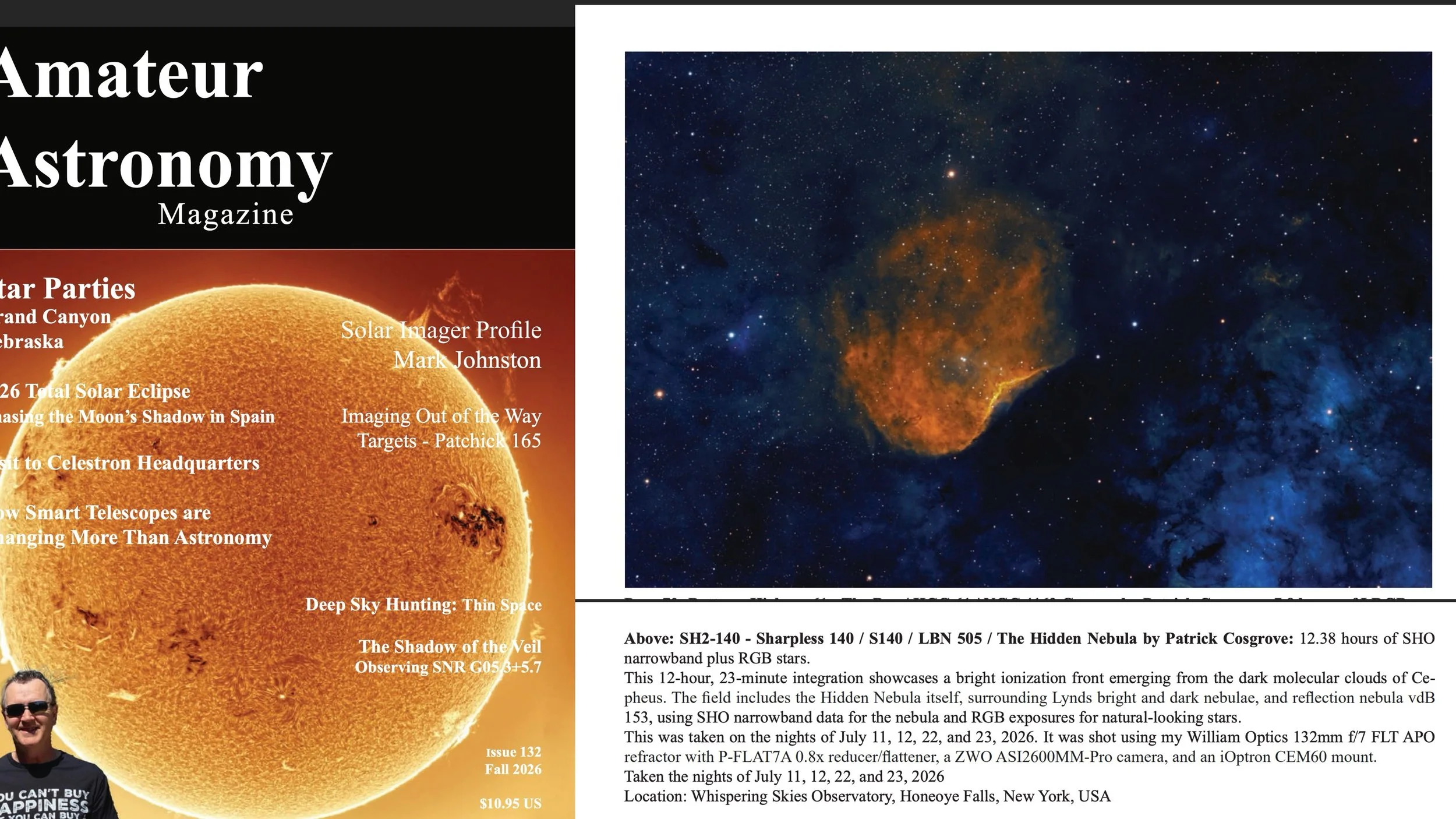
Named Astronomy Magazine’s “Picture of the Day” for September 10th, 2026!
Awarded “Explore” Status on Flick!

🔭 Project Summary
Target: SH2-140 — Sharpless 140 / S140 / LBN 505 / The Hidden Nebula
Capture Dates: July 11, 12, 22, and 23, 2026
Constellation: Cepheus • Distance: ≈ 2,500–3,000 light-years
Type: H II emission region and photodissociation region on the edge of the LDN 1204 molecular cloud
Imaging Period: July 11–23, 2026 • Total Integration: 12 h 23 m 00 s (SHO narrowband + RGB stars)
Filters: Ha · OIII · SII (Astronomik 36 mm 6 nm) + R · G · B (ZWO 36 mm LRGB Gen II)
Telescope: William Optics 132 mm f/7 FLT APO Refractor with P-FLAT7A 0.8× reducer/flattener
Camera: ZWO ASI2600MM-Pro (−10 °C; Gain 100 narrowband, Gain 0 RGB)
Mount: iOptron CEM60 on custom steel pier
Processing: PixInsight (SHO narrowband + RGB stars) & Photoshop
Location: Whispering Skies Observatory · Honeoye Falls, NY (USA)
Acquisition Notes: Ha: 49 × 300 s; OIII: 51 × 300 s; SII: 51 × 300 s; R: 36 × 60 s; G: 36 × 60 s; B: 36 × 60 s, all bin 1×1 at −10 °C; total 12 h 23 m 00 s after culling bad or questionable subs.
Image Note: This SHO narrowband image with RGB stars frames SH2-140, the bright ionization front of the Hidden Nebula, along with surrounding Lynds bright and dark nebulae including LBN 500, LBN 508, LDN 1201, LDN 1202, LDN 1203, LDN 1204, and reflection nebula vdB 153.
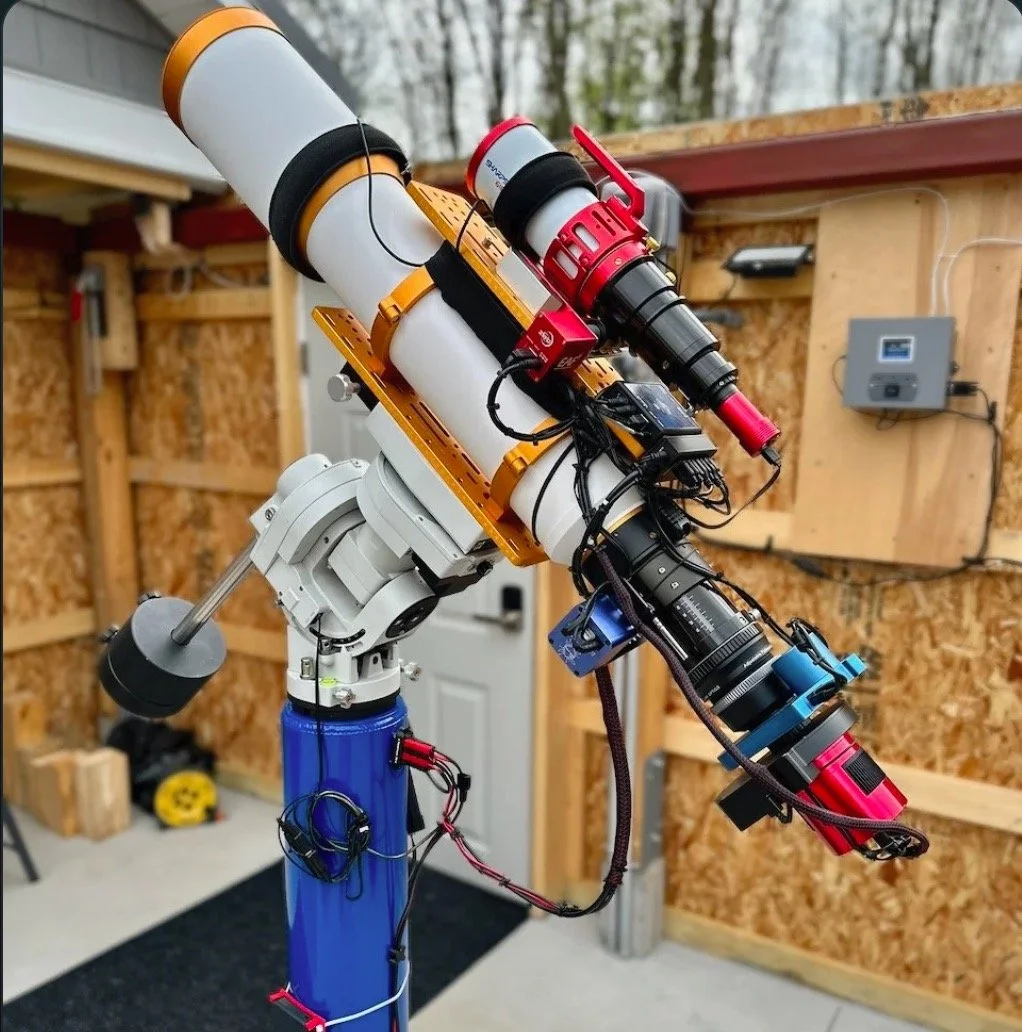
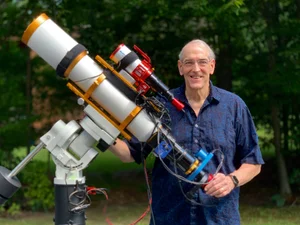
The WO132 Platform (click on image to go to the blog entry for this scope)
📸 Capture Details
Nights: July 11, 12, 22, and 23, 2026
| Channel / Filter | Frames × Exposure | Settings | Total |
|---|---|---|---|
| Ha — Astronomik 6 nm Hydrogen-alpha (36 mm unmounted) | 49 × 300 s | bin 1×1 • −10 °C • Gain 100 | 4 h 05 m |
| OIII — Astronomik 6 nm Oxygen III (36 mm unmounted) | 51 × 300 s | bin 1×1 • −10 °C • Gain 100 | 4 h 15 m |
| SII — Astronomik 6 nm Sulfur II (36 mm unmounted) | 51 × 300 s | bin 1×1 • −10 °C • Gain 100 | 4 h 40 m |
| R — ZWO Red (36 mm unmounted) | 36 × 60 s | bin 1×1 • −10 °C • Gain 0 | 36 m |
| G — ZWO Green (36 mm unmounted) | 36 × 60 s | bin 1×1 • −10 °C • Gain 0 | 36 m |
| B — ZWO Blue (36 mm unmounted) | 36 × 60 s | bin 1×1 • −10 °C • Gain 0 | 36 m |
| Total Integration (after culling): 12 h 23 m 00 s (SHO narrowband + RGB stars) | |||
Calibration Frames
- 25 × dark frames @ 300 s, bin 1×1, −10 °C, Gain 0
- 25 × dark frames @ 60 s, bin 1×1, −10 °C, Gain 0
- 30 × dark-flats @ each flat exposure time, bin 1×1, −10 °C, Gain 0 for RGB and Gain 100 for narrowband
- Flats: 15 each — Ha, OIII, SII, R, G, B
Table of Contents Show (Click on lines to navigate)
Annotated Image
This annotated image was created with the ImageSolver and FinderChart scripts in PixInsight.
The Location in the Sky
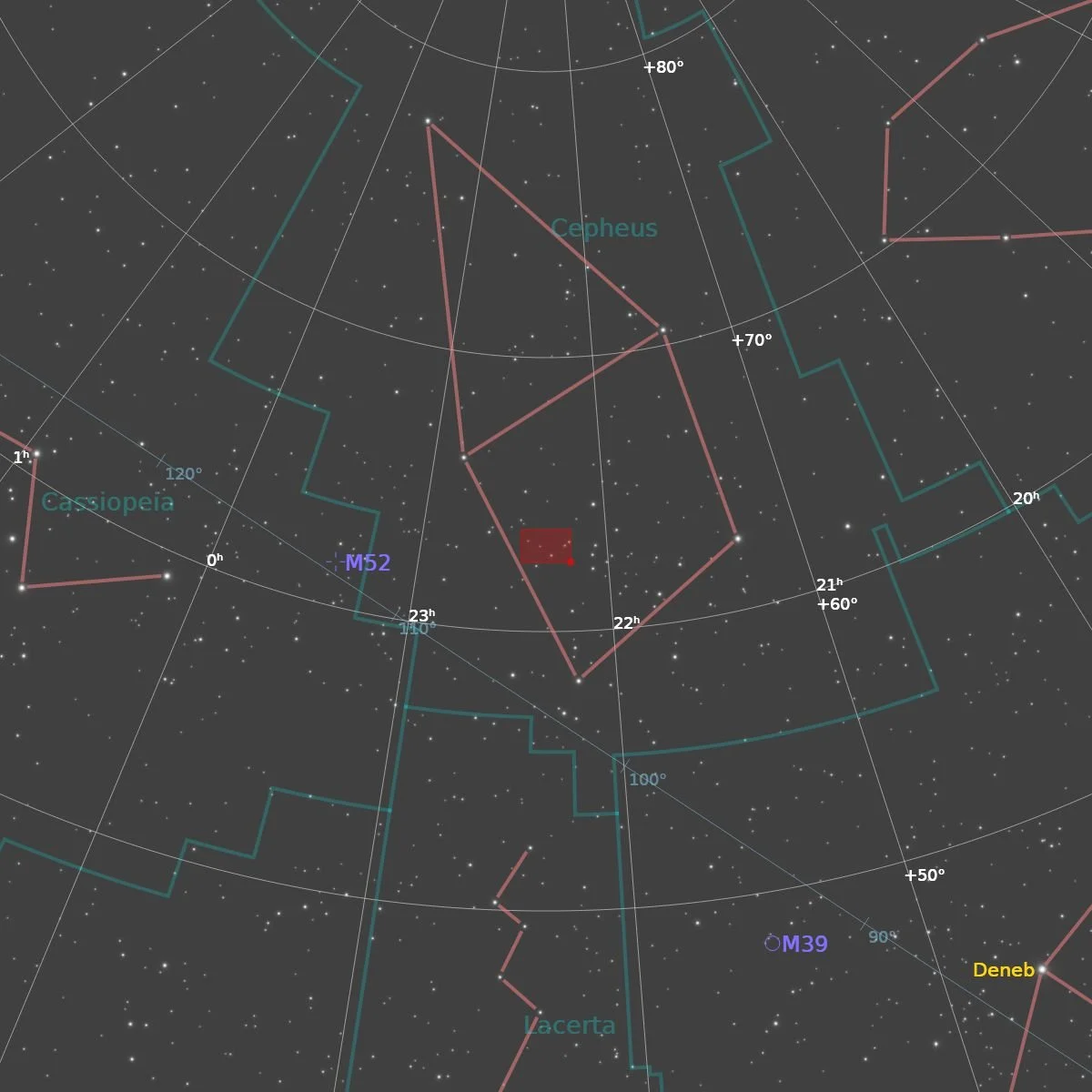
This finder chart image was created with the ImageSolver and FinderChart scripts in PixInsight.
About The Target
🌌 Overview
SH2-140, also cataloged as Sharpless 140, S140, and LBN 505, is a glowing H II emission region in the constellation Cepheus. Its popular nickname, “The Hidden Nebula,” fits it well: the bright ionized gas sits against a much larger, darker molecular cloud complex, so the nebula appears partly revealed and partly swallowed by dust.
The nickname is not unique; several nebulae are informally described as hidden.
SH2-140 lies roughly 2,500 to 3,000 light-years away, depending on which distance estimate is used for the surrounding L1204/Cepheus region. It is part of the rich Cepheus star-forming environment near the edge of the LDN 1204 dark cloud. In this image, the main SH2-140 emission front is the bright, curved nebular structure. The surrounding field also includes Lynds bright nebulae such as LBN 500 and LBN 508, the reflection nebula vdB 153, and several dark nebulae including LDN 1201, LDN 1202, LDN 1203, and LDN 1204.
📜 History
SH2-140 entered the modern astronomical catalogs through Stewart Sharpless’s 1959 catalog of H II regions, a survey of glowing hydrogen clouds in the northern Milky Way. The “Sh2” designation comes from the second Sharpless catalog, which listed 313 emission nebulae north of declination -27 degrees.
Later catalogs described other parts of the same complex from different perspectives. LBN 505 identifies the bright nebular component, while LDN 1204 identifies the dark molecular cloud beside it. Together, these overlapping catalog entries tell the real story of the region: SH2-140 is not an isolated nebula, but the illuminated edge of a dense star-forming cloud.
🔬 Science
SH2-140 is a classic example of an H II region and photodissociation region, or PDR, at the boundary between hot young stars and cold molecular gas. The visible nebula is produced where ultraviolet radiation strips electrons from hydrogen atoms, causing the gas to glow as it recombines. Just beyond that ionized layer, ultraviolet light is still strong enough to reshape molecules and heat dust, but not strong enough to fully ionize the gas. That transition zone is where much of the region’s interesting chemistry and structure occurs.
The nebula is associated with the L1204 molecular cloud. A hot B-type star, commonly identified as HD 211880, provides much of the ultraviolet radiation that lights and sculpts the ionization front. The bright rim in SH2-140 is the facing wall of the molecular cloud being eroded by radiation and stellar wind. This makes the nebula a useful natural laboratory for studying how massive stars affect their birth clouds.
Behind the bright rim, deeper inside the dust, is the S140 infrared cluster. It contains young embedded sources known as IRS 1, IRS 2, and IRS 3. These objects are still wrapped in gas and dust and are much easier to study in infrared, millimeter, and radio wavelengths than in visible light. IRS 1 in particular has been studied as a massive young stellar object with a dusty envelope, disk-like structure, ionized wind, and powerful outflow activity.
The region also contains molecular outflows and shock features, including Herbig-Haro objects and shocked molecular hydrogen emission. These are signs of very young stars actively ejecting material into their surroundings. In other words, SH2-140 is both a lit-up nebula and an active stellar nursery: radiation is carving one side of the cloud while new stars are forming within the dark material behind it.
✨ Interesting Notes
SH2-140 stands out because it combines several kinds of nebula in one field: bright emission nebulosity, dark obscuring dust, reflection nebulosity, and active embedded star formation.
Its “hidden” character is not just visual. Some of the most important objects in the region are nearly invisible in ordinary visible-light images because they are buried inside LDN 1204.
NASA featured Sharpless 140 in a 2004 Astronomy Picture of the Day using Spitzer Space Telescope infrared data, highlighting the young massive stars and complex molecules inside the region.
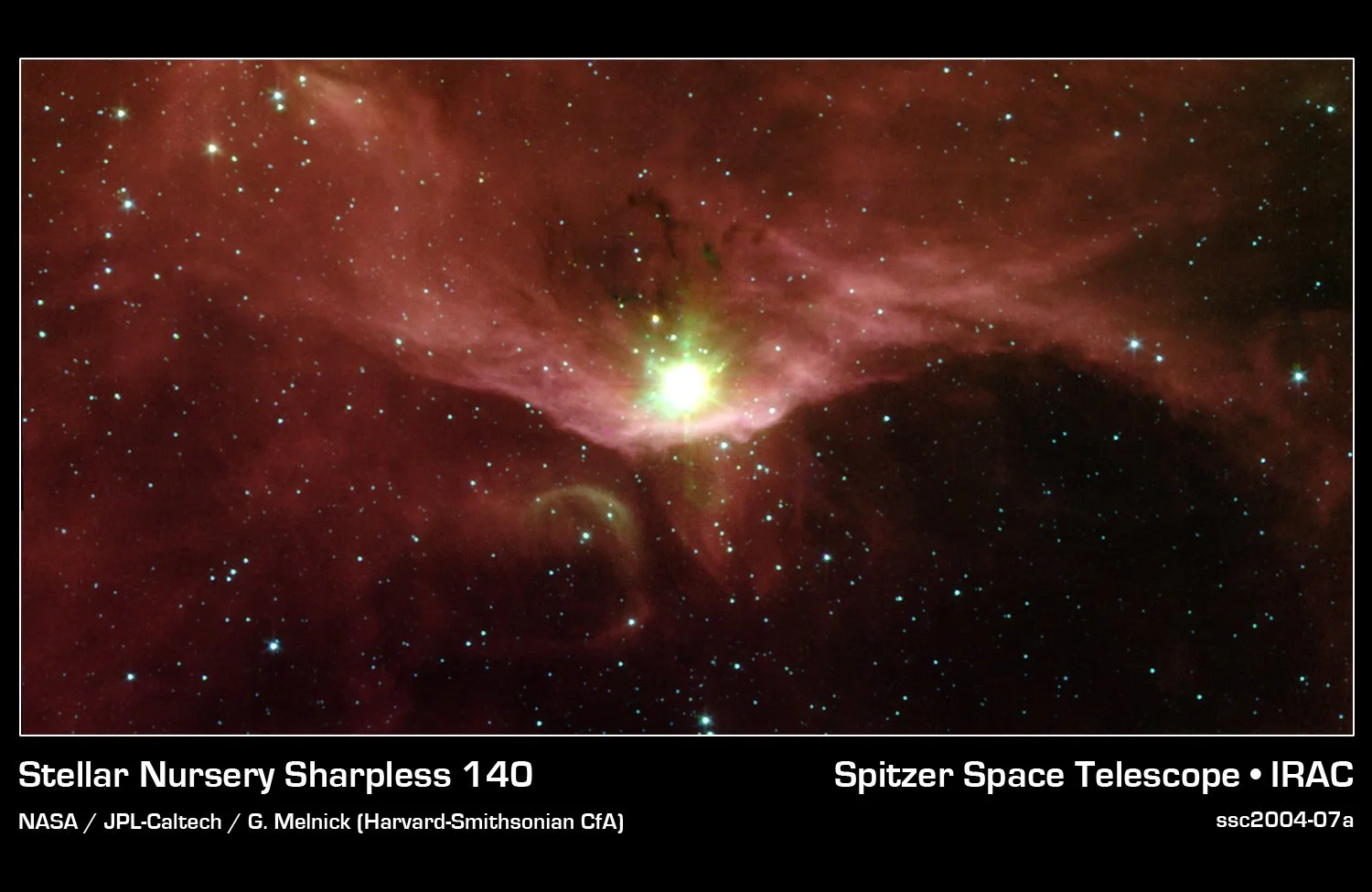
The dramatic curved edge is an ionization front: a real physical boundary where radiation from hot stars is eating into a colder molecular cloud.
SH2-140 is part of the broader Cepheus star-forming landscape, a region filled with dark clouds, bright rims, reflection nebulae, and young stars at different stages of formation.
Key references I used: Sharpless catalog/CDS, NASA APOD on Sharpless 140, and peer-reviewed studies of S140/L1204 star formation and outflows.
About the Project (Repeated from the Sadr Project)
Planning and Weather
2026 has been a very strange year weather-wise. We tend to have a wet spring, which settles down and dries out during June, July, and August. But this year the best term to describe the weather is unstable. We have had storm after storm come through - with unusually heavy rains and very high winds. The summer weather has not really stabilized. Instead, it's been cloudy with few nights suitable for imaging.
I would have to say this has been the worst year so far in terms of the number of nights I could collect data.
The last time I had a solid imaging run was back in galaxy season!
During July, I only had four clear moonless nights to shoot. These fell on July 11th and 12th and July 22nd and 23rd. These were NOT great nights either. The first two had thin clouds passing through; the last two came with Canadian wildfire smoke drifting through the region.
I was looking for a target that I had never shot before and one that was perhaps fainter and less known. I opted for SH2-140. It looked interesting and was sized well for my William Optics 132mm Platform.
I decided to shoot narrowband, and over the last two nights I also added 60-second RGB exposures to capture natural stars.
Data Collection
July was very hot, and my observatory got so warm during the day that a cheap keyboard I had been using for the observatory computer melted and the keys all stuck together. Now, nothing else melted, but I did start using a couple of fans in my two south-facing windows to cool things off well before evening.
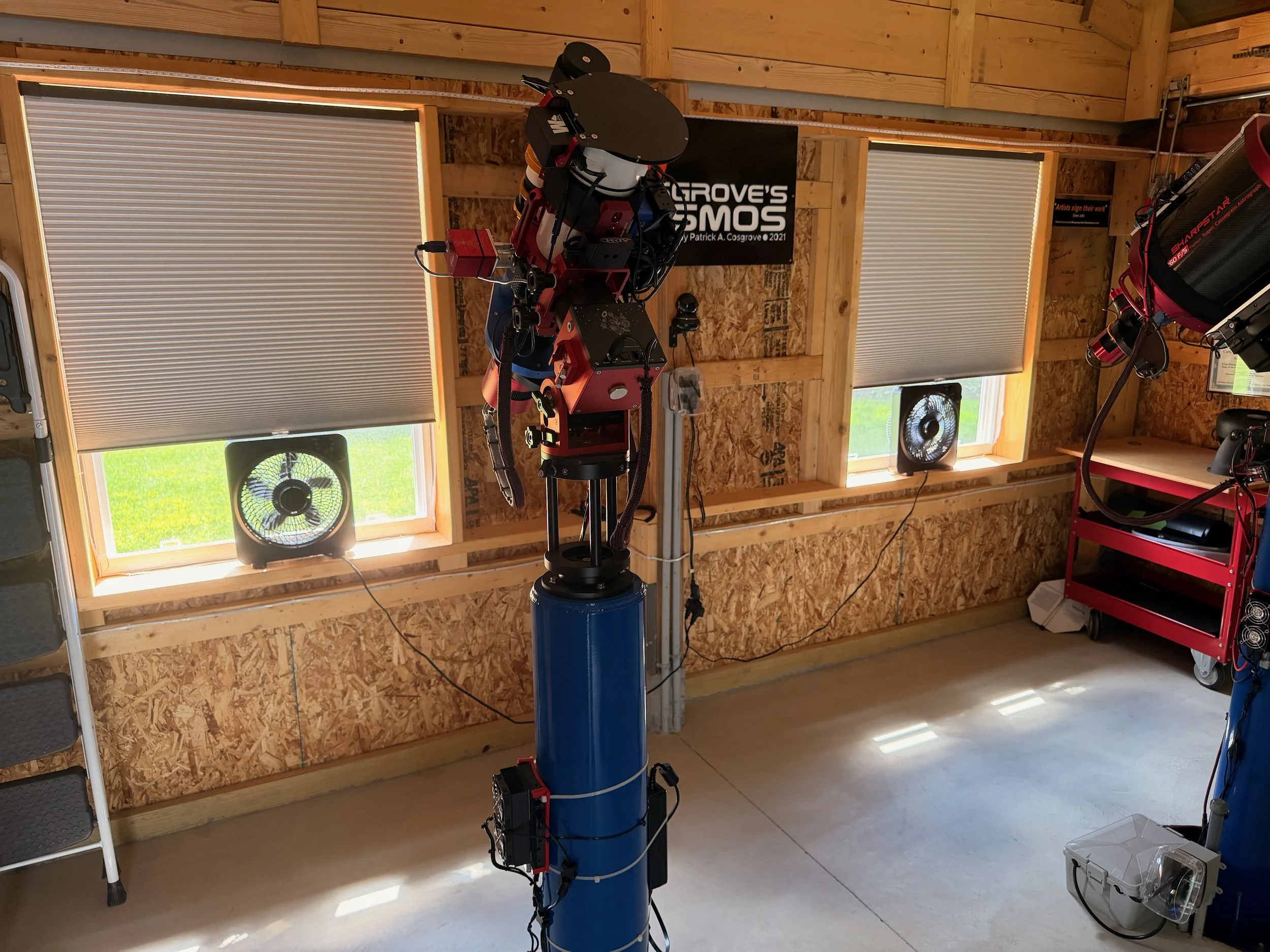
Fans in my south-facing windows cooling down the observatory prior to opening the roof.
I opened the roof around 7 pm, which also helped things cool down a bit.
I set the camera cooling target to −10 °C, as I knew the coolers would never reach- -15 °C in this heat.
I did have one mystery. Once the scopes are working, I control them from within my den, and I typically nap on the sofa I have there. I'm a gadget hound, so I have my den all set up with smart switches, and so when I am ready to nap, I say “Alexa, turn off the devices in my den.” The lights go out, and I get some sleep.
Catastrophic Shutdown!
On the night of July 22, this is just what I did. I set an alarm to wake me around dawn so I could shut things down. The alarm went off, and I was shocked to see that ALL of my remote connections to the computer controlling all four piers were down. I could not reestablish them either. Hmmmm.
I went to the observatory, and everything was powered down! What? I must have blown a breaker!
Nope! The breakers were fine.
So I was puzzled about what happened, and I was concerned because I did not want it to ever happen again. I had no idea what had happened, but went back to bed, determined to get to the bottom of it.
The next day I looked up when the last sub was collected. Curiously, it was very close to when I went to sleep on my sofa. Hmmm. I thought about it a minute and realized that all of the power in my observatory was on smart plugs as well. Hmm.
So I went into my phone's Alexa app, and I looked at the activity log. When I decided to go to sleep, I remember saying, “ Alexa, turn off the devices in my den.” Guess what I found in the activity log: “Alexa, turn off my devices.”
Alexa had never heard the “In my den” part. Thus it shut down EVERYTHING. Since it was night and we were all sleeping, we never really noticed.
So once again I am doing a service to the broader astrophotography community - doing STUPID things so you don’t have to!
This resulted in the loss of about 2 hours of data collection on four scopes, so a total of 8 hours lost! Nothing stings more than losing good data!
Calibration Frames
After the fourth night, the Moon was beginning to dominate, so I took one evening to get all of my calibration frames. My SCA260 still uses a wall-mounted LED panel as the flat light source, but my other three scopes now sport a Wanderer Astro Motorized cover. This makes the collection of flats and dark flats a breeze. After the flats, I ran a dark series, and my cal data was ready to go.
Processing Overview
Pre-processing
I took a while before I was ready to process this first image of the series. We had some family obligations, and my wife and I went away for a bit to celebrate our 45th wedding anniversary. Finally, I had to migrate my PixInsight installation to the latest version and then install all the scripts. These scripts include my Astro Color Mixer (ACM) and Astro Contrast Enhancer (ACE). This is the first new project where I could use ACE, so I was excited to give it a go.
As always, I blinked all of my image data and my cal data. In the first project I did in this session (The Sadr Region), I had many lost frames due to clouds and smoke. But that was a wide-angle scope and took in a relatively larger portion of the sky. With the WO132 platform, I saw a narrower chunk of sky, which must have helped, as I only had to remove five subs due to clouds or smoke.
This left me with 12 hours and 23 minutes of useful data to work with.
Post-Processing
The processing plan for this image was pretty straightforward and very similar to what I did on the previous project.
I used my typical Narrowband workflow with RGB Stars. From a high level, this looks like the diagram below:
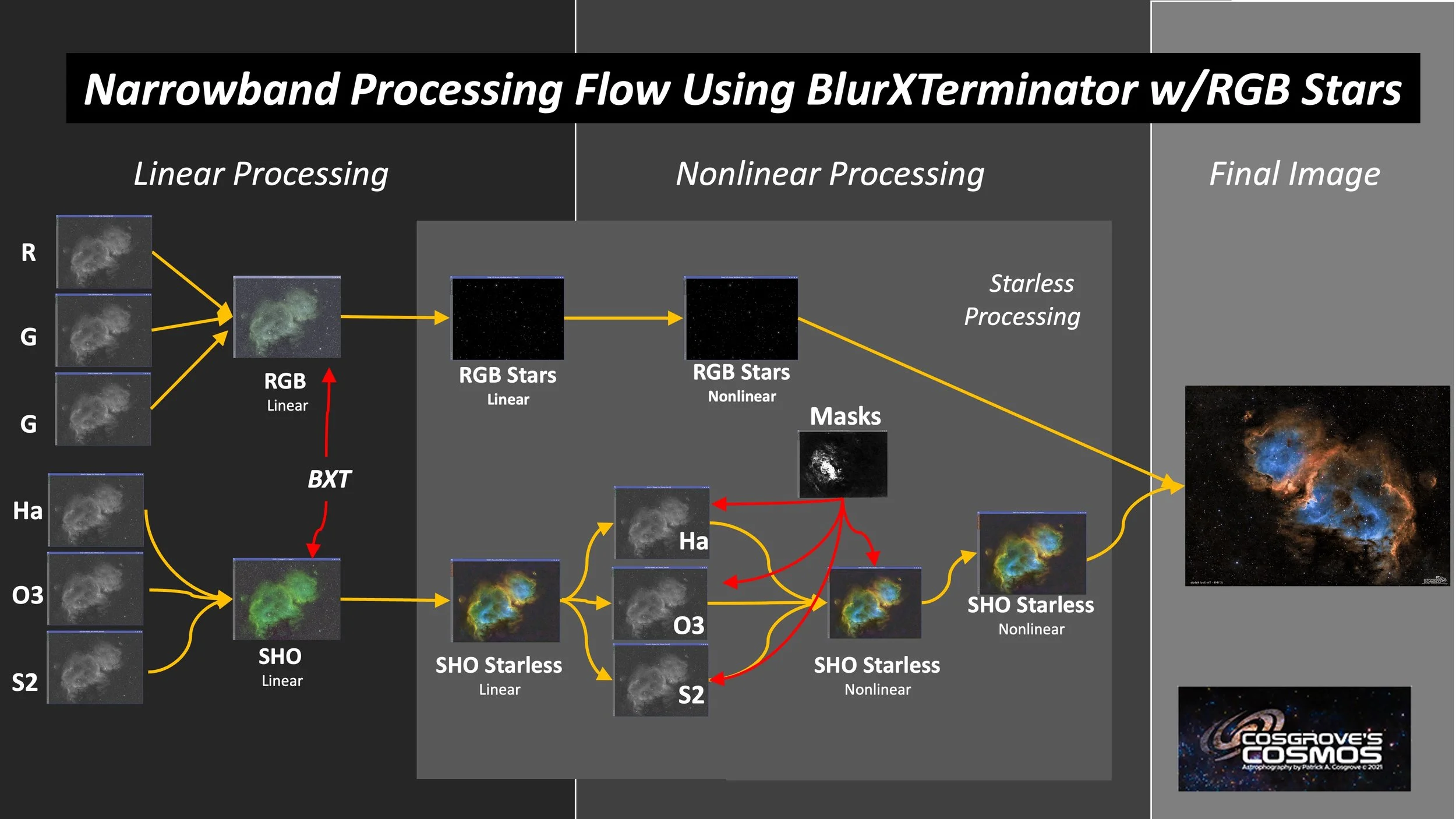
My typical SHO with RGB Stars Workflow.
The front end of the processing was pretty standard for the most part.
Linear processing produced an SHO starless image and an RGB star image.
I used Seti Astro’s StarStretch to move the stars to nonlinear space. I actually did four levels because sometimes images with lots of nebulosity look better with larger stars, so I created three star sizes to work from, and finally added a 4th that I thought hit the sweet spot.
I normally do my linear processing, go Starless, and then do NarrowbandNormalization. For some odd and unexplainable reason, I did Narrowband Normalization and then went Starless on this project. It worked out fine but its’s just not what I normally do.
Once I was nonlinear, I worked on color using my standard method: I created a Warm Color Mask and a Cool Color Mask. Then, using these masks, I adjusted the color and the contrast detail of the image.
To finish up the image, I used two of my own tools, as I mentioned before. ACM allowed me to dial in and tweak the colors the way I wanted them
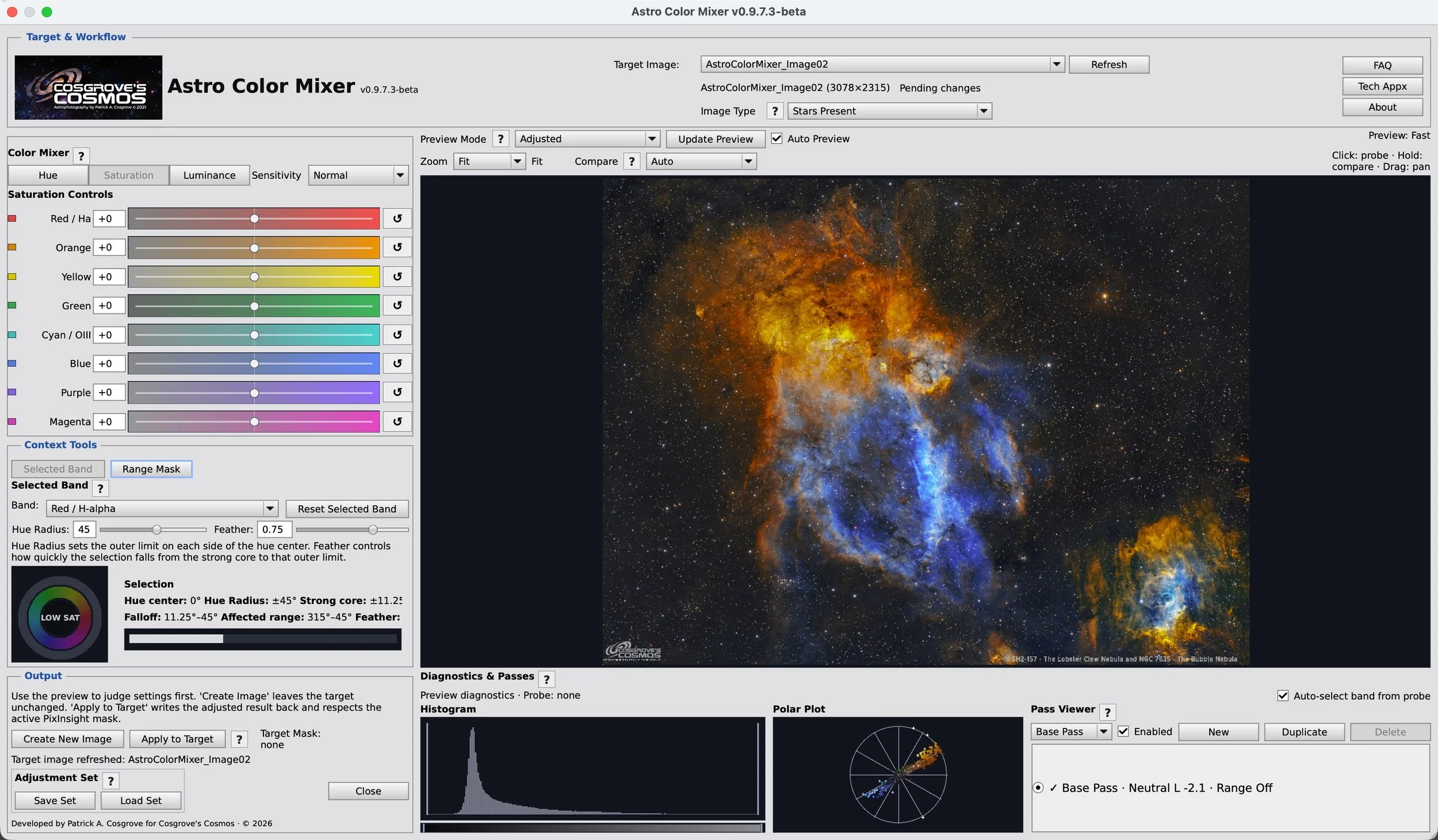
My New Astro Color Mixer PixInsight Script!
Then I used ACE to finalize the level of detail and contrast in the scene.
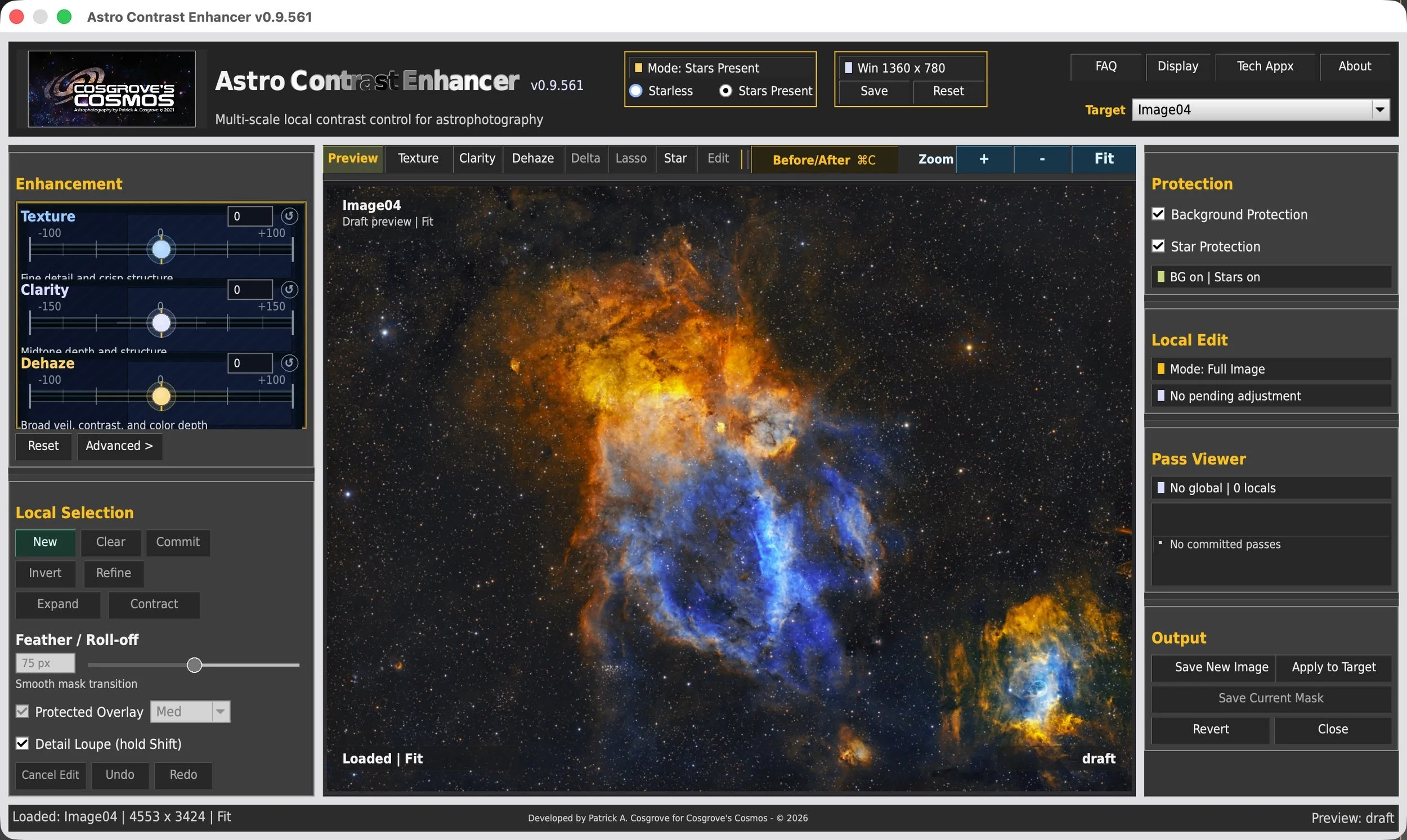
My new ACE tool: Astro Contrast Enhancer
Detailed and Annotated Image Processing Walkthrough
Typically, I conclude one of these imaging projects by documenting the processing steps I used on this image. But this section can make the overall post very large and, at times, slow to load.
I am now creating a secondary, standalone page to hold this information. You can access this page by clicking the link below. Returning to this page is as simple as clicking the back arrow in your browser or selecting a different menu option at the top of the page.
I hope you like this new format!
Use the link below to see the detailed image processing walkthrough for this imaging project.
SH2-140 2026 Image Processing Walkthrough
Final Results
Even with over 12 hours of integration on an f/5.6 system, I still needed a lot more exposure to really develop the fainter outer reaches of the main nebula. But even still, this is a new target for me, and since I am a ‘color’ guy, I like the final color position of the image. Others may prefer a lower saturation look, and that is OK - since it is narrowband, there is no wrong’ color here!
More Info
🔭 Target Details
NASA Astronomy Picture of the Day — Sharpless 140 — NASA’s 2004 APOD feature on SH2-140, describing the nebula, its embedded young stars, infrared view, distance, and location in Cepheus.
In-The-Sky.org — Sharpless 140 — Observing-oriented entry with position, constellation, angular size, finder chart, and visibility information.
In-The-Sky.org — VdB 153 — Entry for the nearby reflection nebula visible in the wider SH2-140 field.
CDS Aladin Lite — Sharpless 140 Field — Interactive sky atlas view for inspecting survey imagery and catalog overlays around SH2-140, LBN 505, LDN 1204, and nearby objects.
📜 History & Naming
CDS VizieR — Sharpless Catalogue of H II Regions — The catalog source behind the Sh2 designation, including the 1959 Sharpless list of northern H II regions.
NASA HEASARC — Sharpless H II Regions — NASA catalog documentation for Sharpless H II region entries and related parameters.
NASA HEASARC — Lynds Catalog of Bright Nebulae — Catalog reference for LBN designations such as LBN 505, LBN 500, and LBN 508 in the annotated field.
NASA HEASARC — Lynds Catalog of Dark Nebulae — Catalog reference for dark nebula designations including LDN 1201, LDN 1202, LDN 1203, and LDN 1204.
NASA HEASARC — Merged Catalog of Reflection Nebulae — Reference for reflection nebula cataloging, including van den Bergh-style VdB designations.
🔬 Science & Observations
MNRAS — High-Resolution Millimetre Observations of S140-IRS1 — Research paper on the embedded massive young stellar object S140-IRS1, its disk-like structure, envelope, and outflow environment.
Astronomy & Astrophysics — Outflow Activity of the Protostars in S140 IRS — Study of molecular hydrogen emission and outflow activity from embedded protostars in the S140/L1204 cloud.
The Astronomical Journal — The Fountains of Youth: Irradiated Breakout of Outflows in S140 — Technical study of Herbig-Haro objects and protostellar outflows breaking from the S140 molecular cloud into the H II region.
The Astrophysical Journal Letters — SOFIA/FORCAST Imaging of the S140 Cluster — Far-infrared observations resolving the embedded S140 IRS sources at 37 µm.
NAOJ VERA — Distance Measurement in the L1204 Region — Parallax-based distance work for the L1204 star-forming region, useful background for distance estimates around S140.
💡 Interesting Facts & Outreach
NASA/JPL — A Natal Microcosm — Spitzer image feature describing Sharpless 140 as a compact laboratory of stellar birth, dust, embedded stars, and glowing PAH-rich cloud surfaces.
NASA/JPL — NASA Spitzer Shares the Wealth — NASA release that included Sharpless 140 among early Spitzer public data highlights.
Imaging Platform Used
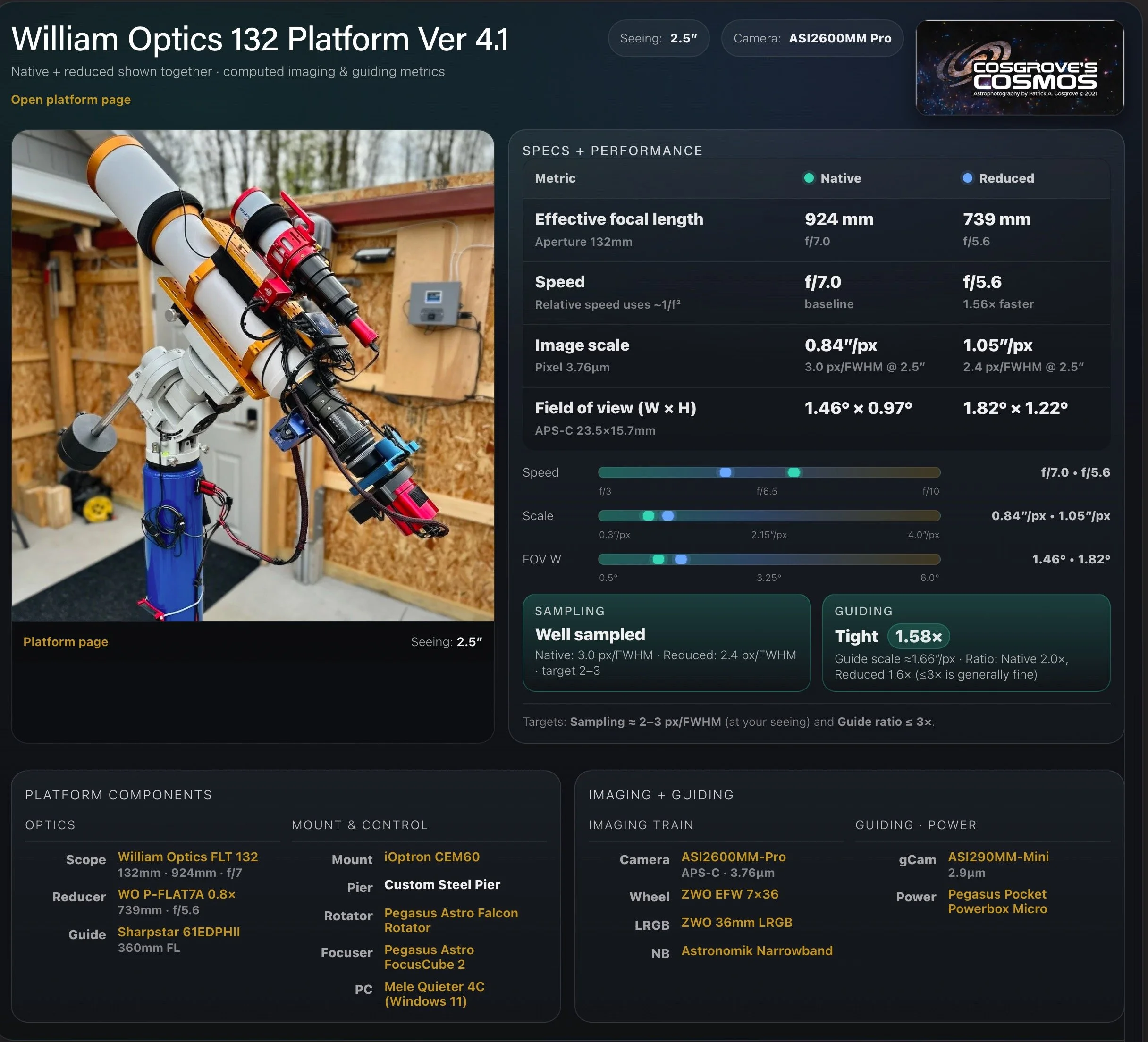
The details for the WO132 Platform.
Platform used for this project
Software
Capture Software: PHD2 Guider, NINA
Image Processing: PixInsight, Photoshop - assisted by Coffee, extensive processing indecision and second-guessing, editor regret, and much swearing…