NGC 7008 - The Fetus Nebula (10.5 hours of HOOrgb) - Pushing the Limits of my Gear & Sky!
Date: Aug 19, 2026
Cosgrove’s Cosmos Catalog ➤#0166
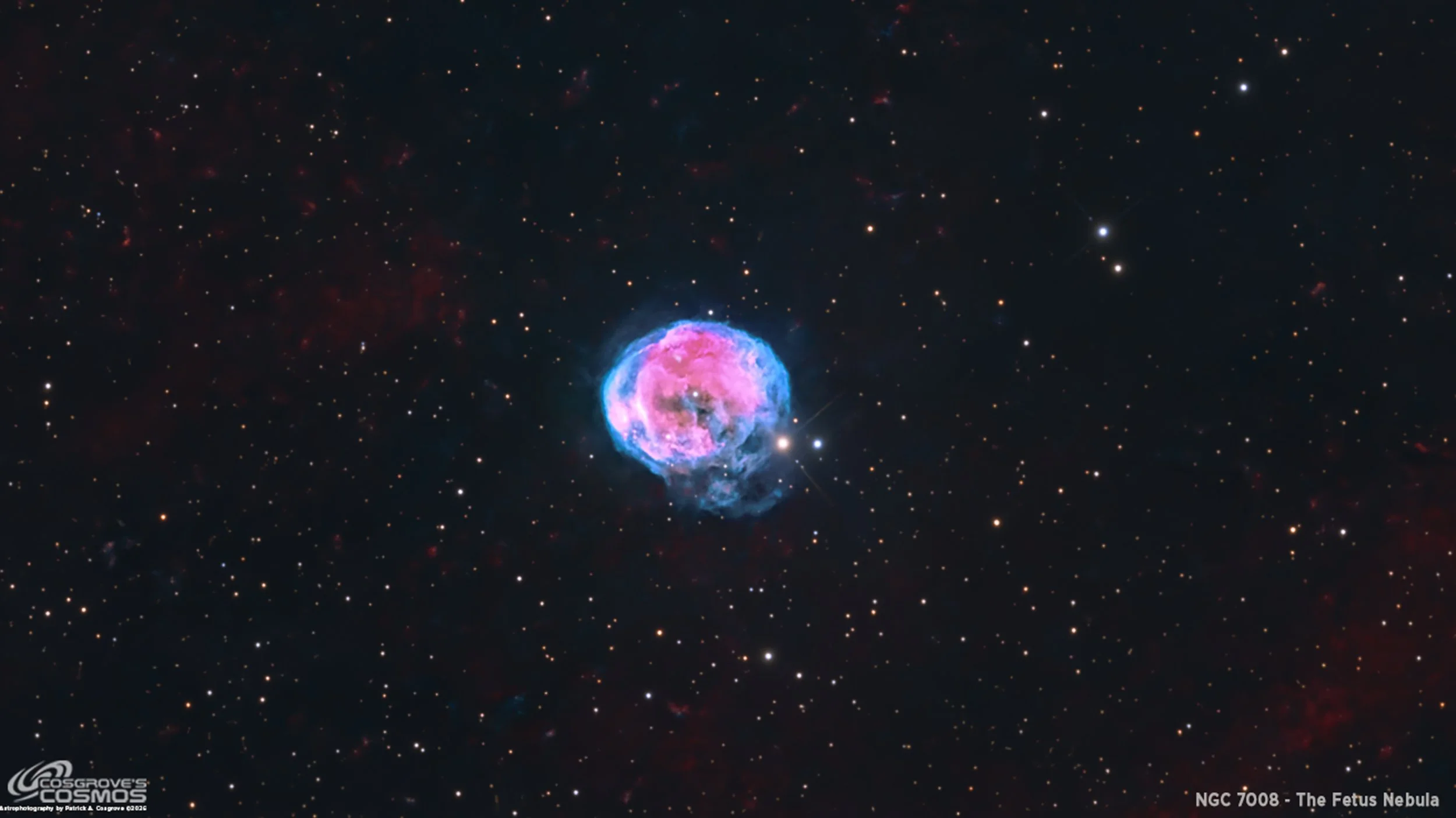
NGC 7008, captured with my SCA260 platform. (Click image for hi-res version via AstroBin.com.)
The Hidden Nebula — a bright ionization front emerging from the dark molecular clouds of Cepheus.
🔭 Project Summary
Target: NGC 7008 — The Fetus Nebula / PN G093.4+05.4 / PK 93+5.2
Capture Dates: July 11, 12, 22, and 23, 2026
Constellation: Cygnus • Distance: ≈ 2,800 light-years
Type: Planetary nebula — the glowing outer atmosphere of a dying Sun-like star
Angular Size: ≈ 1.4 arcminutes, or about 86 arcseconds across
Imaging Period: July 11–23, 2026 • Total Integration: 10 h 30 m 00 s (HOO narrowband + RGB stars)
Filters: Ha · OIII (Astronomik 36 mm 6 nm) + R · G · B (ZWO 36 mm LRGB Gen II)
Telescope: Sharpstar SCA260 V2 260 mm f/5.0 Special Cassegrain Astrograph
Camera: ZWO ASI2600MM-Pro (−10 °C; Gain 100 narrowband, Gain 0 RGB)
Mount: iOptron CEM70 on custom steel pier with modified iOptron top pier plate
Guiding: ZWO OAG-L with ZWO ASI174MM-Mini guide camera
Processing: PixInsight (HOO narrowband + RGB stars) & Photoshop
Location: Whispering Skies Observatory · Honeoye Falls, NY (USA)
Acquisition Notes: Ha: 52 × 300 s; OIII: 52 × 300 s; R: 36 × 60 s; G: 37 × 60 s; B: 37 × 60 s, all bin 1×1 at −10 °C; total 10 h 30 m 00 s after culling bad or questionable subs.
Calibration Notes: 25 darks at 300 s, bin 1×1, −10 °C, Gain 100; 25 darks at 60 s, bin 1×1, −10 °C, Gain 0; 30 dark flats at each flat exposure time; 15 flats each for Ha, OIII, R, G, and B.
Image Note: This HOO narrowband image with RGB stars frames NGC 7008, a compact and highly structured planetary nebula in Cygnus. The small apparent size of the target makes the field feel wide and star-rich, while the nebula itself shows a broken, knotted shell with the curled structure that gives the Fetus Nebula its informal name.
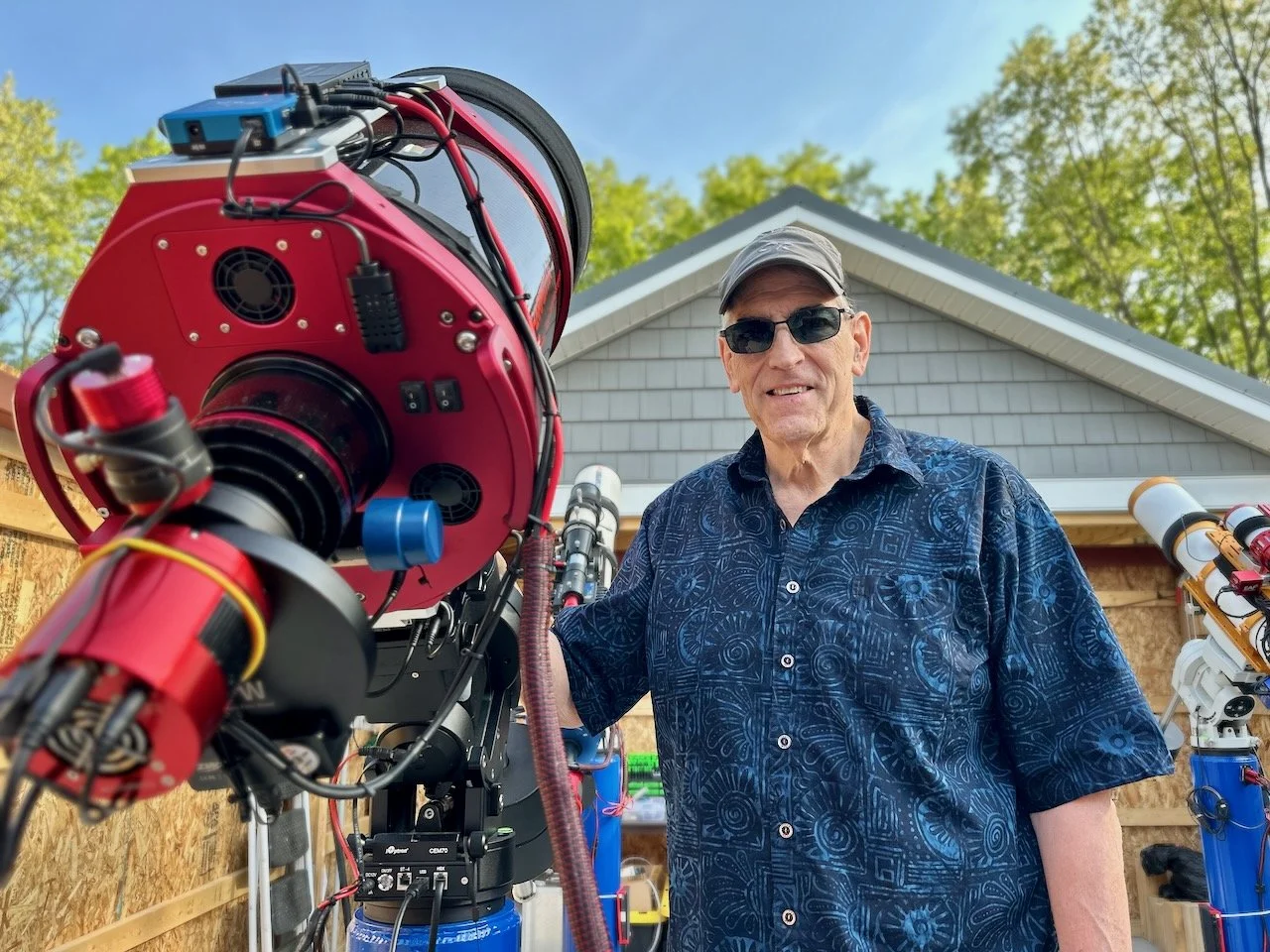
The SCA260 Platform (click on image to go to the blog entry for this scope)
📸 Capture Details
Nights: July 11, 12, 22, and 23, 2026
| Channel / Filter | Frames × Exposure | Settings | Total |
|---|---|---|---|
| Ha — Astronomik 6 nm Hydrogen-alpha (36 mm unmounted) | 52 × 300 s | bin 1×1 • −10 °C • Gain 100 | 4 h 20 m |
| OIII — Astronomik 6 nm Oxygen III (36 mm unmounted) | 52 × 300 s | bin 1×1 • −10 °C • Gain 100 | 4 h 20 m |
| R — ZWO Red (36 mm unmounted) | 36 × 60 s | bin 1×1 • −10 °C • Gain 0 | 36 m |
| G — ZWO Green (36 mm unmounted) | 37 × 60 s | bin 1×1 • −10 °C • Gain 0 | 37 m |
| B — ZWO Blue (36 mm unmounted) | 37 × 60 s | bin 1×1 • −10 °C • Gain 0 | 37 m |
| Total Integration (after culling): 10 h 30 m 00 s (HOO narrowband + RGB stars) | |||
Calibration Frames
- 25 × dark frames @ 300 s, bin 1×1, −10 °C, Gain 100
- 25 × dark frames @ 60 s, bin 1×1, −10 °C, Gain 0
- 30 × dark-flats @ each flat exposure time, bin 1×1, −10 °C, Gain 0 for RGB and Gain 100 for narrowband
- Flats: 15 each — Ha, OIII, R, G, B
Table of Contents Show (Click on lines to navigate)
Annotated Image
This annotated image was created with the ImageSolver and FinderChart scripts in PixInsight.
The Location in the Sky
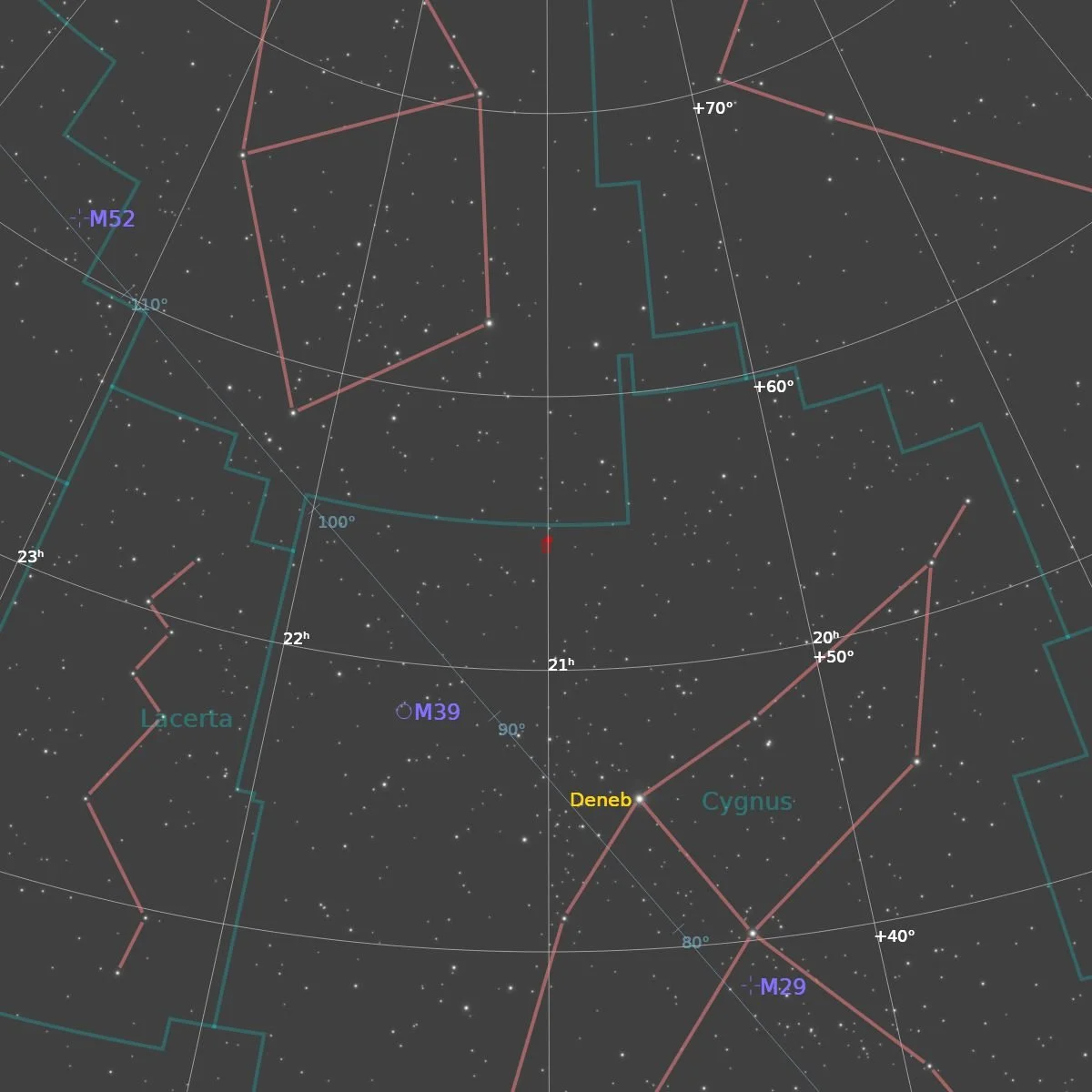
This finder chart image was created with the ImageSolver and FinderChart scripts in PixInsight.
About The Target
🌌 Overview
NGC 7008, better known as the Fetus Nebula, is a small but highly structured planetary nebula in northern Cygnus. It is also cataloged as PN G093.4+05.4 and PK 93+5.2, with additional designations including ARO 39, VV 258, and VV’ 540.
Despite the name “planetary nebula,” NGC 7008 has nothing to do with planets. It is the glowing outer atmosphere of a dying Sun-like star, expelled near the end of the star’s life and illuminated by the hot stellar remnant near its center.
The nebula lies roughly 2,800 light-years away and spans about 1.4 arcminutes on the sky, or roughly 86 arcseconds. At that distance, its visible shell is about one light-year across. It is not a large object in apparent size, but it rewards close inspection: its oval shell is broken, knotted, and uneven, with bright condensations and darker cavities that give it the curled, organic appearance behind its informal name.
📜 History
William Herschel discovered NGC 7008 on October 14, 1787, recording it as H I-192. John Louis Emil Dreyer later included it in the 1888 New General Catalogue as NGC 7008.
Early observers noted its irregular shape, and spectroscopy by William Huggins showed its gaseous nature. Francis Pease’s early 20th-century Mount Wilson work helped establish it clearly as a planetary nebula and described much of the structure still visible in modern images: an elliptical form, bright knots, dark gaps, and stars projected across or near the nebular face.
🔬 Science
NGC 7008 is interesting because it is not a simple round shell. Its asymmetry, internal knots, and disturbed outer form make it part of the broader puzzle of how planetary nebulae acquire their shapes.
The central star has also drawn attention. Hubble observations resolved it as a likely detached binary system, and later studies found evidence consistent with a cool companion and an X-ray source near the central star. That possible binary connection matters, because companion stars are one of the leading suspects in sculpting the complex shapes seen in many planetary nebulae.
✨ Interesting Field Detail
One of the most striking field details is the bright yellow-blue double star just south of the nebula. It looks visually tied to NGC 7008, but it is foreground scenery rather than part of the nebula itself.
That makes the field especially engaging: a dying star’s cast-off shell, a colorful unrelated double star, and faint surrounding hydrogen emission all layered into the same small patch of Cygnus.
About the Project (Much repeated from last two projects)
Planning and Weather
2026 has been a very strange year weather-wise. We tend to have a wet spring, which settles down and dries out during June, July, and August. But this year the best term to describe the weather is unstable. We have had storm after storm come through, with unusually heavy rains and very high winds. The summer weather hasn’t really stabilized. Instead, it's been cloudy with few nights suitable for imaging.
I would have to say this has been the worst year so far in terms of how many nights I could collect data.
The last time I had a solid imaging run was back in galaxy season!
During July, I only had four clear, moonless nights to shoot. These fell on July 11th and 12th and July 22nd and 23rd. These were NOT great nights either. The first two had thin clouds passing through; the last two came with Canadian wildfire smoke drifting through the region.
In this case, I was looking for a target for my Galaxy scope, the Sharpstar SCA260. I bought it to go after small objects, so I wanted something that would be a good test. I rarely shoot planetary nebulae due to their small size, so I decided that now was the time to try one. After a short search, I came across NGC 7008, and that sounded like a great idea.
Normally I do a lot more research on my target before shooting it, but I did not this time. I know that many planetary nebulae are often shot in HOO, but I hoped that if I also collected S2 data, I could get enough signal to make my image a little different. (As you will read, I was wrong about this!)
I should also note that over the last two nights I also added 60-second RGB exposures to capture natural stars.
Data Collection
July was very hot, and my observatory got so warm during the day that a cheap keyboard I had been using for the observatory computer melted, and the keys all stuck together. Now, nothing else melted, but I did start using a couple of fans in my two south-facing windows to cool things off well before evening.
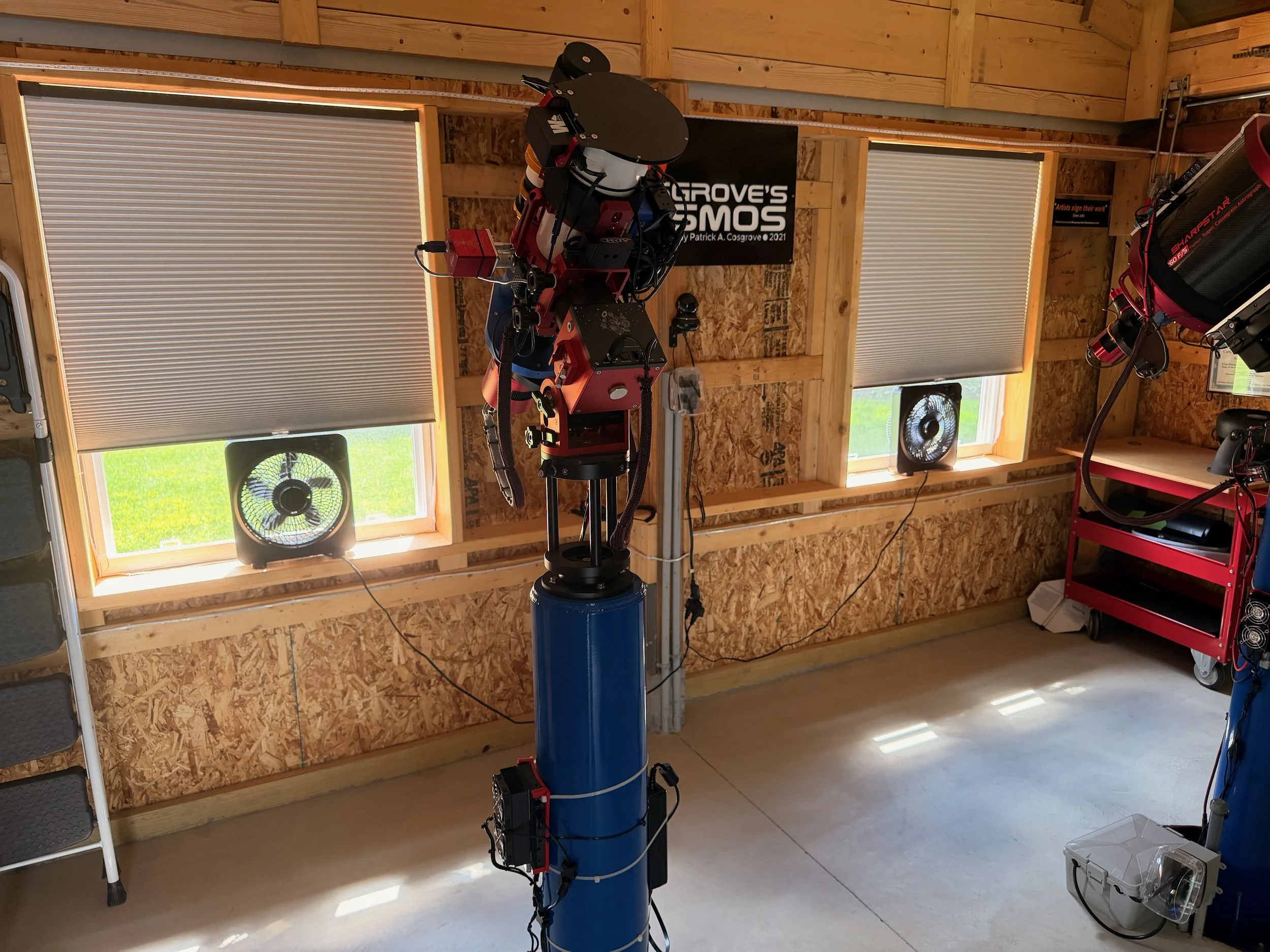
Fans in my south-facing windows cooling down the observatory prior to opening the roof.
I opened the roof around 7 pm, which helped cool things down a bit.
I set the camera cooling target to −10 °C, as I knew the coolers would never reach -15 °C in this heat.
I did have one mystery. Once the scopes are working, I control them from within my den, and I typically nap on the sofa I have there. I'm a gadget hound, so I have my den all set up with smart switches, and so when I am ready to nap, I say “Alexa, turn off the devices in my den.” The lights go out, and I get some sleep.
Catastrophic Shutdown!
On the night of July 22, this is just what I did. I set an alarm to wake me around dawn so I could shut things down. The alarm went off, and I was shocked to see that ALL of my remote connections to the computer controlling all four piers were down. I could not reestablish them either. Hmmmm.
I went to the observatory, and everything was powered down! What? I must have blown a breaker!
Nope! The breakers were fine.
So I was puzzled about what happened, and I was concerned because I didn't want it to happen again. I had no idea what had happened, but I went back to bed, determined to get to the bottom of it.
The next day I looked up when the last sub was collected. Curiously, it was very close to when I went to sleep on my sofa. Hmmm. I thought about it for a minute and realized all the power in my observatory was on smart plugs as well. Hmm.
So I opened my phone's Alexa app and looked at the activity log. When I went to sleep, I remember saying, “Alexa, turn off the devices in my den.” Guess what I found in the activity log: “Alexa, turn off my devices.”
Alexa had never heard the “In my den” part. Thus, it shut down EVERYTHING. Since it was night and we were all sleeping, we never really noticed.
So once again I am doing a service to the broader astrophotography community - doing STUPID things so you don’t have to!
This resulted in the loss of about 2 hours of data collection on four scopes, so a total of 8 hours lost! Nothing stings more than losing good data!
Calibration Frames
After the fourth night, the Moon was beginning to dominate, so I took one evening to get all of my calibration frames. My SCA260 still uses a wall-mounted LED panel as the flat light source, but my other three scopes now sport a Wanderer Astro Motorized cover. This makes the collection of flats and dark flats a breeze. After the flats, I ran a dark series, and my cal data was ready to go.
Processing Overview
Pre-processing
As always, I blinked all of my image data and my cal data. In the first project I did in this session (The Sadr Region), I had many lost frames due to clouds and smoke. But that was a wide-angle scope and took in a relatively larger portion of the sky. With the SCA260 platform, I saw a narrower chunk of sky, which must have helped, as I only had to remove six subs due to clouds or smoke.
This left me with 14 hours and 45 minutes of usable data.
I didn't see much detail in S2, but I hoped that would change once I integrated.
Post-Processing
The processing plan for this image was pretty straightforward and very similar to what I did on the previous project.
I used my typical Narrowband workflow with RGB Stars. At a high level, this looks like the diagram below:
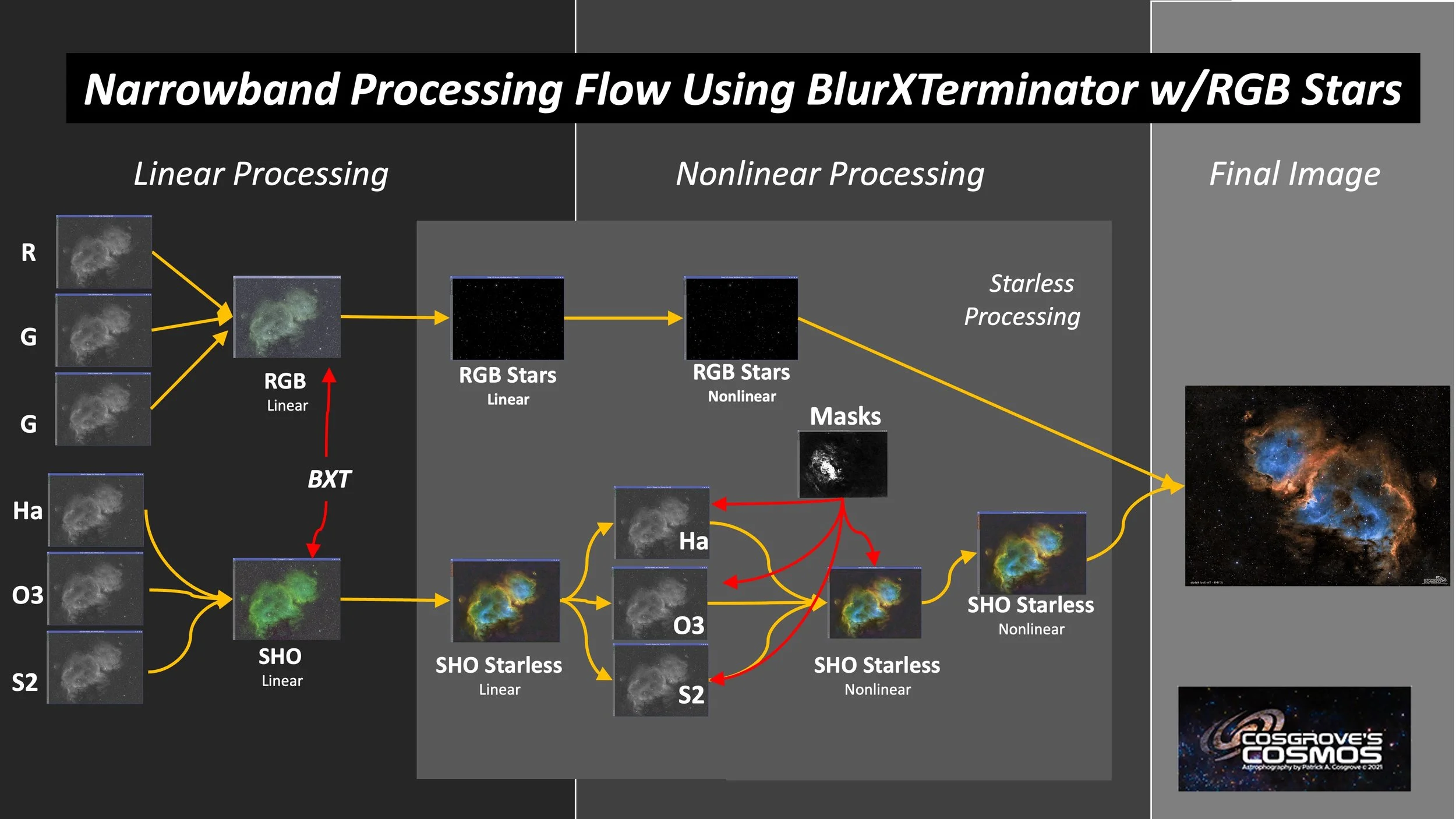
My typical SHO with RGB Stars Workflow.
However, the integrated S2 signal offered little useful detail. I still tried some SHO processing, but I did not like the results at all. This caused me to shift to an HOO approach.
This turn of events did not make me happy. I was betting the S2 signal would be useful, and I lost that bet. By saying "HOO," I was also saying I had wasted 4.25 hours of data-capture time! That always hurts!
So now I would go ahead with a HOO RGB approach that looks like the diagram below:
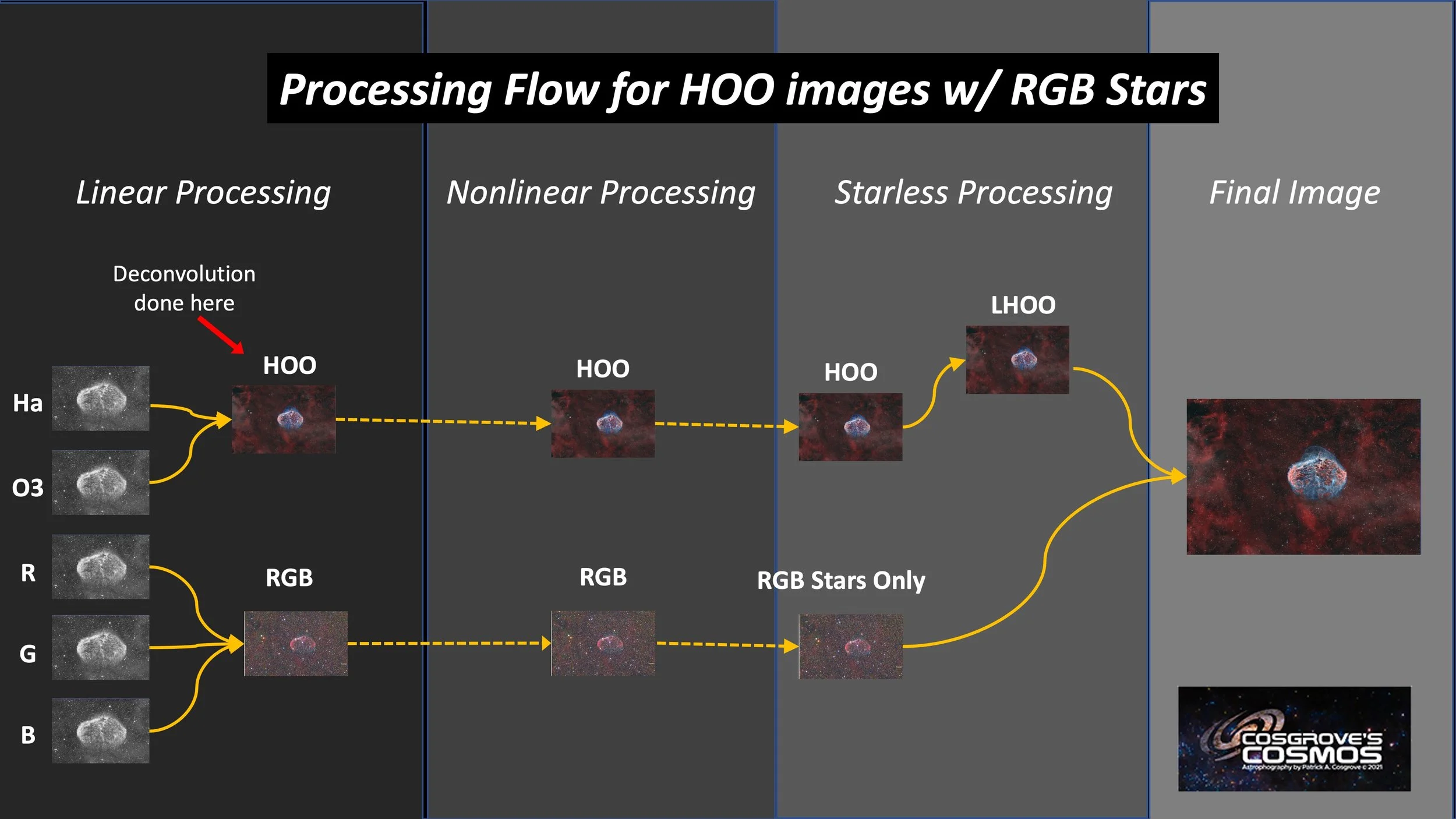
My HOO w/ RGB stars workflow.
This left me with 10.5 hours of useful data.
Linear processing produced an HOO starless image and an RGB star image.
I knew the target would appear in a pretty empty field and that it was small, so I needed to crop a lot. I used Seti Astro's StarStretch script for this with the default settings. Later, I found that at the extreme crop I was using, the stars looked too bloated. So I went back and experimented with BXT to get the smallest, tightest stars I could, and it really helped.
Much of the processing focused on pulling out detail from the small planetary nebula. To do this, I created a warm color Mask that targeted the red and magenta in the nebula's interior and a cool color mask that targeted the shell.
I used these masks for both color and contrast adjustments.
I also created a GAME script mask covering the planetary nebula so I could focus on it as a whole and then, by inverting it, the rest of the background sky.
In addition to the color masks, I used my own PixInsight software scripts: the Astro Color Mixer and the Astro Contrast Enhancer to fine-tune the look I wanted. Overall, I made only very light changes with these tools.
I knew that I was going to have to crop the image a lot. To give you a feel for that, here is the image as originally processed:
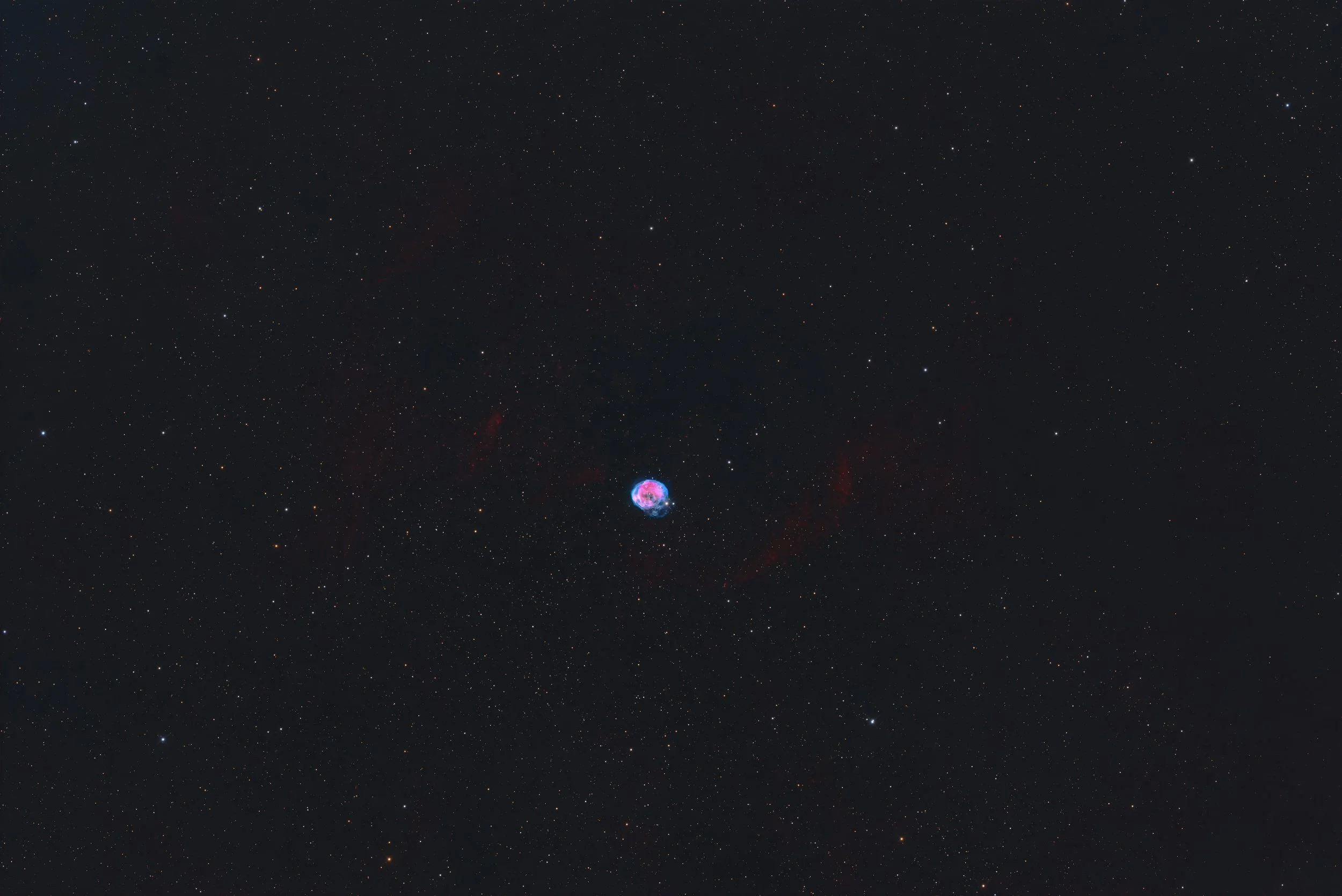
The full frame from the camera before cropping!
This is a pea lost in a sea of black. So I have to crop - but how much? Crop too much and you get a big, fuzzy image. Too little, and it’s still a pea lost in a sea of black. After some experimentation, I came up with this:
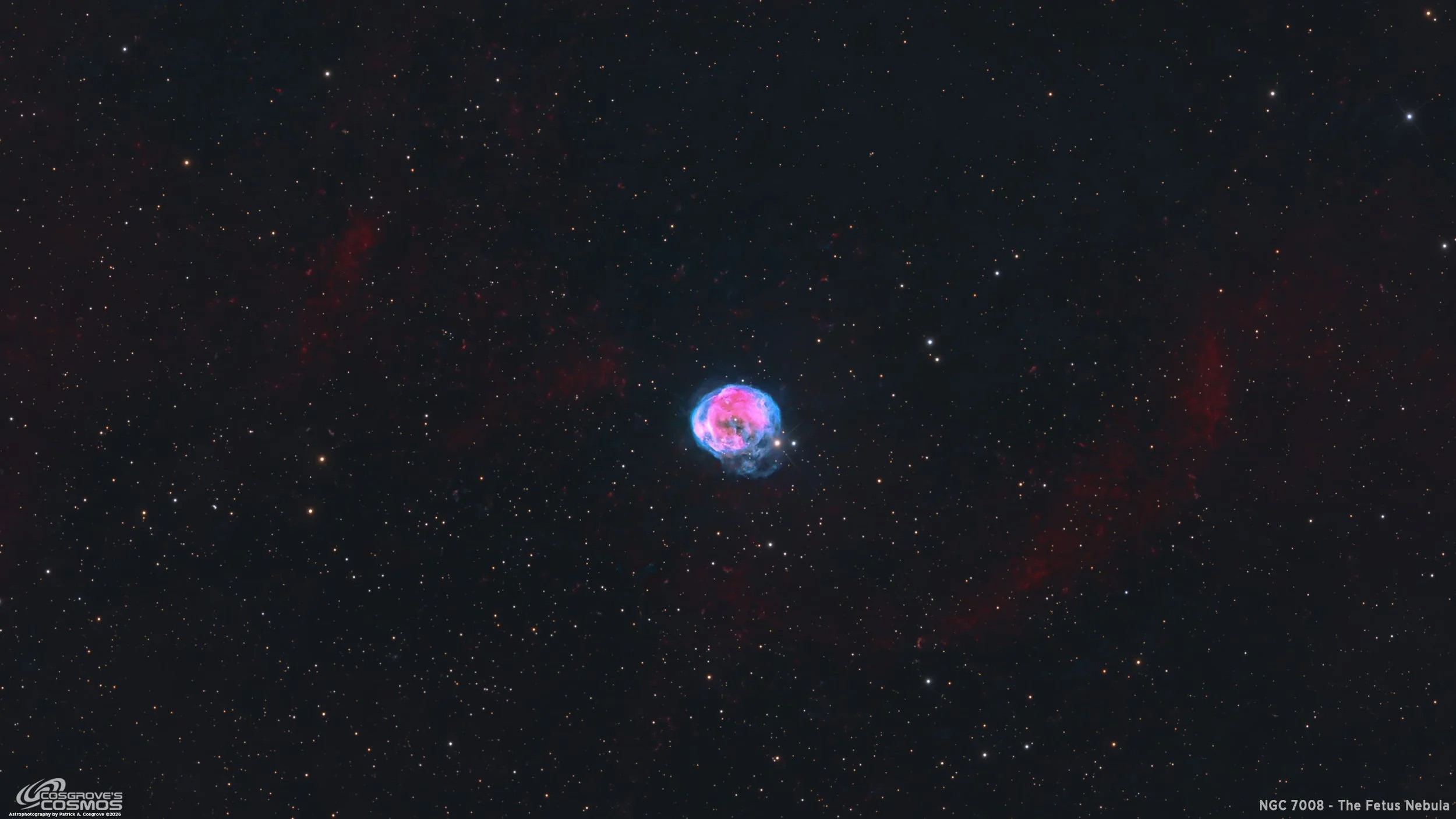
My first attempt at a cropped image.
I shared this with my local group of expert astrophotographers and the feedback I got was that the crop had to go further and I should probably tone down the saturation a bit.
So I did that. I cropped it much further. Using the Astro Color Mixer, I backed off the saturation on red and magenta hues. I used the Astro Contrast Enhancer to add just a touch of Texture and Clarity adjustment and that produced this final image:
The final crop and adjustments.
I would have to say that with my skies and equipment, this target has me sort of hanging out over the edge of my skis!
Detailed and Annotated Image Processing Walkthrough
Typically, I conclude one of these imaging projects by documenting the processing steps I used on this image. But this section can make the overall post very large and, at times, slow to load.
I am now creating a secondary, standalone page to hold this information. You can access this page by clicking the link below. To return to this page, click the back arrow in your browser or select a different menu option at the top of the page.
I hope you like this new format!
Use the link below to see the detailed image processing walkthrough for this imaging project.
NGC 7008 2026 Image Processing Walkthrough
Final Results
I’m happy with what I achieved, but this target also showed me my limits. To really do a target like this justice, I need longer integration and better seeing.
Perhaps my future “5th Pier project,” hosted at a remote dark site, will allow me to do this!
More Info
🔭 Target Details
NASA Astronomy Picture of the Day — NGC 7008: The Fetus Nebula — NASA’s APOD feature on NGC 7008, with a concise explanation of its distance, physical size, planetary nebula nature, central star, and the unrelated gold-blue double star in the field.
In-The-Sky.org — NGC 7008 — Observing-oriented entry with coordinates, constellation, magnitude, angular size, catalog names, finder chart, and visibility information.
Deep-Sky Corner — Fetus Nebula — Detailed amateur/deep-sky reference with designations, physical data, finder charts, observing notes, central star information, and the nearby foreground double star.
📜 History & Naming
Steve Gottlieb’s NGC Notes — NGC 7008 — Historical and visual observing notes, including William Herschel’s 1787 discovery record, John Herschel’s later description, and 19th-century observations from Birr Castle.
NASA HEASARC — NGC 2000.0 Catalog — NASA catalog documentation for the modern electronic version of Dreyer’s New General Catalogue and Index Catalogue entries.
NASA HEASARC — Galactic Planetary Nebulae Catalog — Catalog reference for planetary nebula designations, central star notes, angular sizes, velocities, and related identifiers such as PN G and PK entries.
🔬 Science & Observations
MNRAS — Binary Fraction of Planetary Nebula Central Stars — Research paper discussing NGC 7008’s central star, the Hubble-resolved detached binary candidate, infrared excess evidence, and the broader role of binary companions in shaping planetary nebulae.
The Astronomical Journal — Hubble Survey for Resolved Companions of Planetary Nebula Nuclei — HST snapshot survey that includes NGC 7008 among planetary nebulae with candidate resolved central-star companions.
The Astrophysical Journal — Chandra Planetary Nebula Survey III — X-ray study of central stars in planetary nebulae, including NGC 7008 as a point-like X-ray source associated with the nebular core.
💡 Interesting Facts & Outreach
Webb Deep-Sky Society — NGC 7008 — Accessible observing article describing the nebula’s “blob and curl” structure, central star, nearby double star, and why the object is rewarding at higher magnification.
Skyhound Observing Archive — NGC 7008 — Practical visual-observing account showing how NGC 7008 changes from a small C-shaped patch in modest aperture to a complex ring-like nebula in larger instruments.
NOIRLab / Wikimedia Commons — NGC 7008 Image — Public image page for a Kitt Peak Visitor Center view of NGC 7008, with useful captioning and image-credit context for the nebula’s appearance and nickname.
Imaging Platform Used
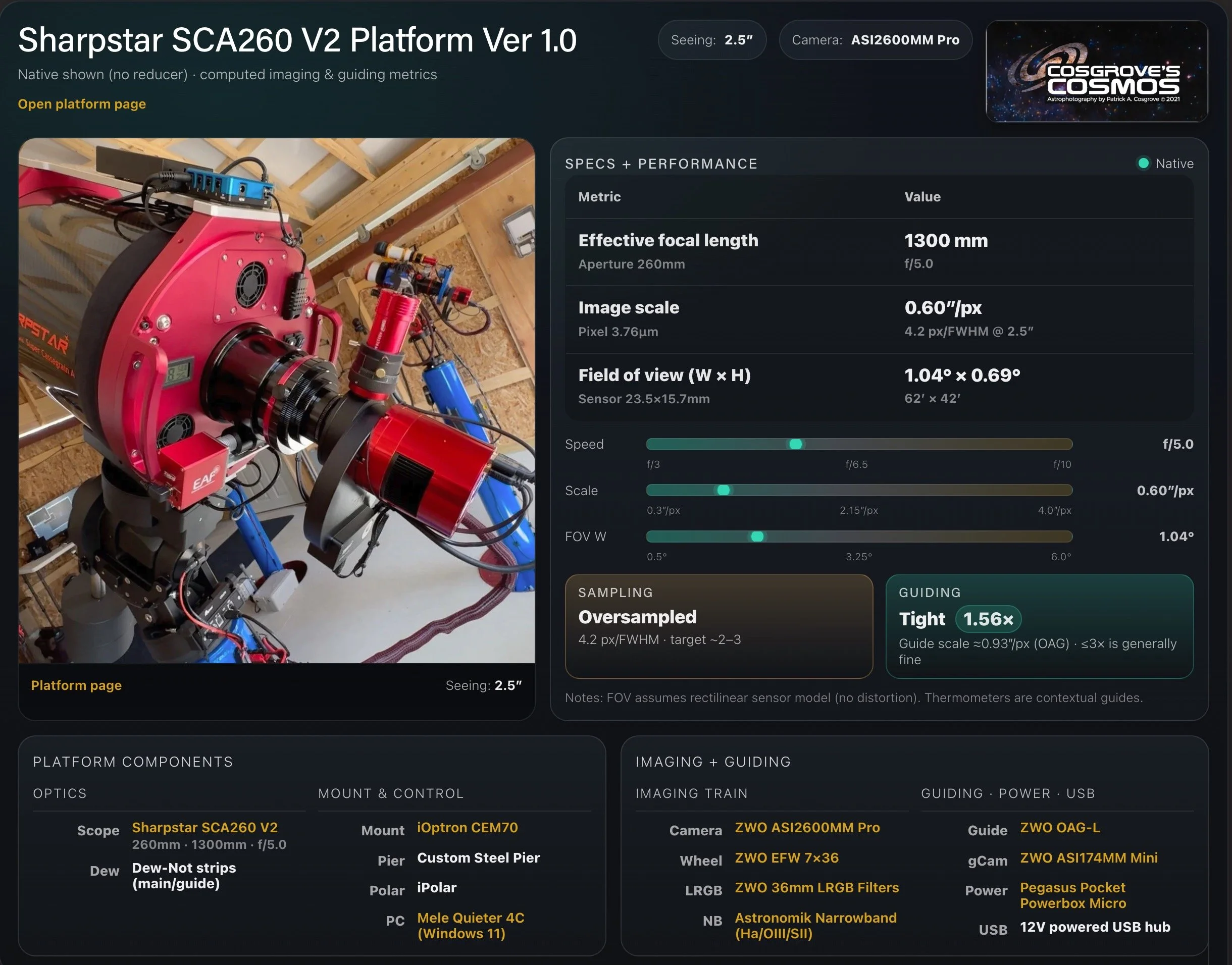
The details for the SCA260 Platform.
Platform used for this project
Software
Capture Software: PHD2 Guider, NINA
Image Processing: PixInsight, Photoshop - assisted by Coffee, extensive processing indecision and second-guessing, editor regret, and much swearing…