NGC 7129 - A Cosmic Rosebud! | ~14 hours of LRGB.
Date: August 23, 2026
Cosgrove’s Cosmos Catalog ➤#0167
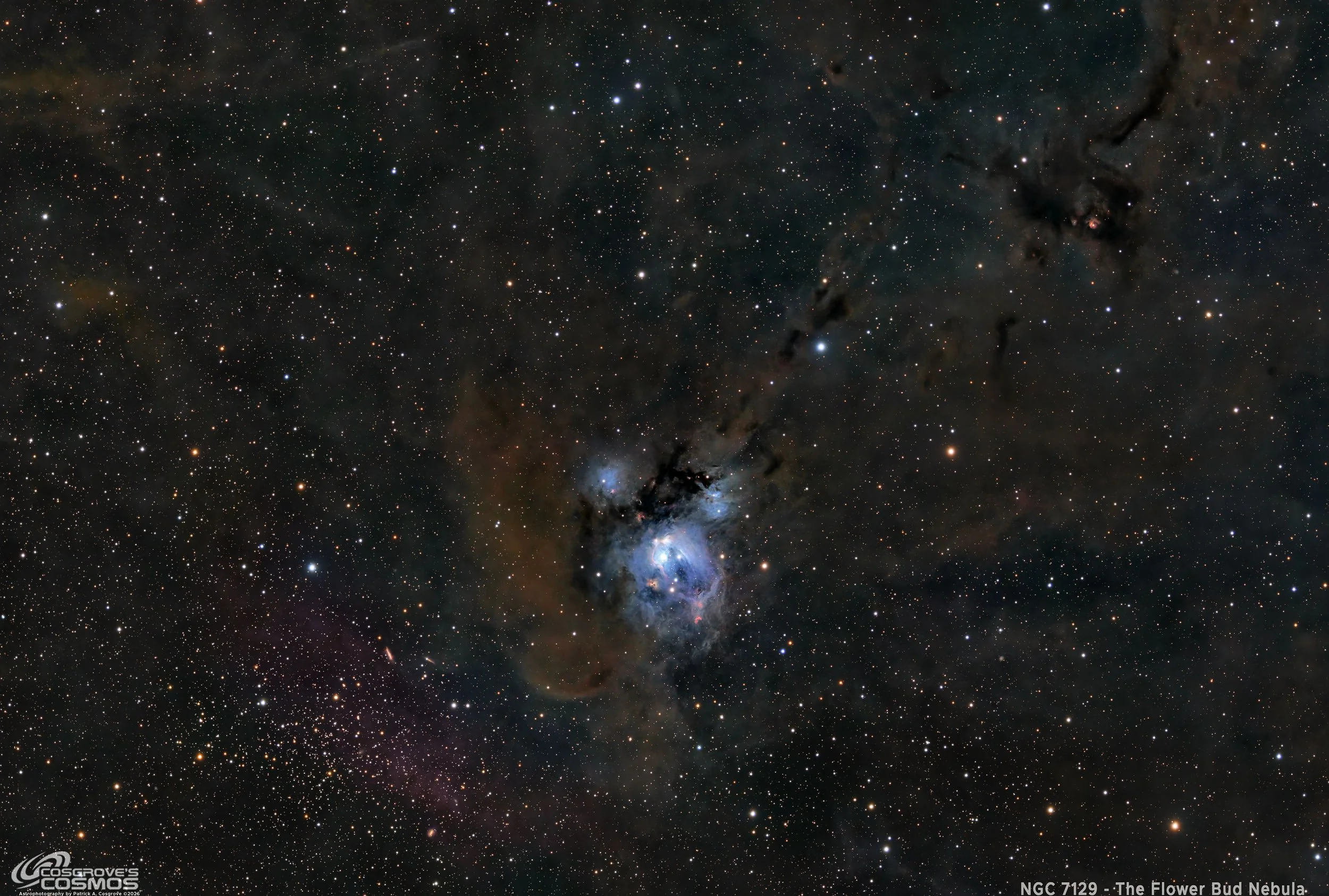
NGC 7129 - The Cosmic RoseBud (Click the image for a high-resolution version on AstroBin.com.)
NGC 7129 — the Flower Bud Nebula, where young stars, blue reflection light, and dark Cepheus dust reveal a stellar nursery still unfolding.
🔭 Project Summary
Target: NGC 7129 — The Flower Bud Nebula / Cosmic Rosebud Nebula / Rosebud Nebula
Associated Objects: IC 5134, vdB 146, Ced 196, Collinder 441, LDN 1181, LDN 1183, LBN 497, NGC 7133, and NGC 7142
Capture Dates: July 11, 12, 22, and 23, 2026
Constellation: Cepheus • Distance: ≈ 3,000–3,800 light-years
Type: Reflection nebula / young star-forming region embedded in a larger Cepheus molecular cloud complex
Imaging Period: July 11–23, 2026 • Total Integration: 13 h 54 m 00 s (LRGB)
Filters: L · R · G · B (ZWO 36 mm LRGB Gen II)
Telescope: Astro-Physics 155 mm Starfire EDFS f/5.3
Camera: ZWO ASI2600MM-Pro (−10 °C; Gain 0 LRGB)
Mount: iOptron Tri-Pier with column extension on custom steel pier
Processing: PixInsight (LRGB) & Photoshop
Location: Whispering Skies Observatory · Honeoye Falls, NY (USA)
Acquisition notes: L: 222 × 90 s; R: 111 × 90 s; G: 110 × 90 s; B: 113 × 90 s at −10 °C, Gain 0; total 13 h 54 m 00 s after culling bad or questionable subs.
Image note: This LRGB image captures NGC 7129, the Flower Bud Nebula, as a blue reflection nebula and young stellar nursery set within a wide field of dark Cepheus dust. The surrounding frame includes nearby reflection and dark nebula structures, along with the older open cluster NGC 7142, giving the scene a striking mix of newborn stars, obscuring molecular clouds, and older stellar populations.
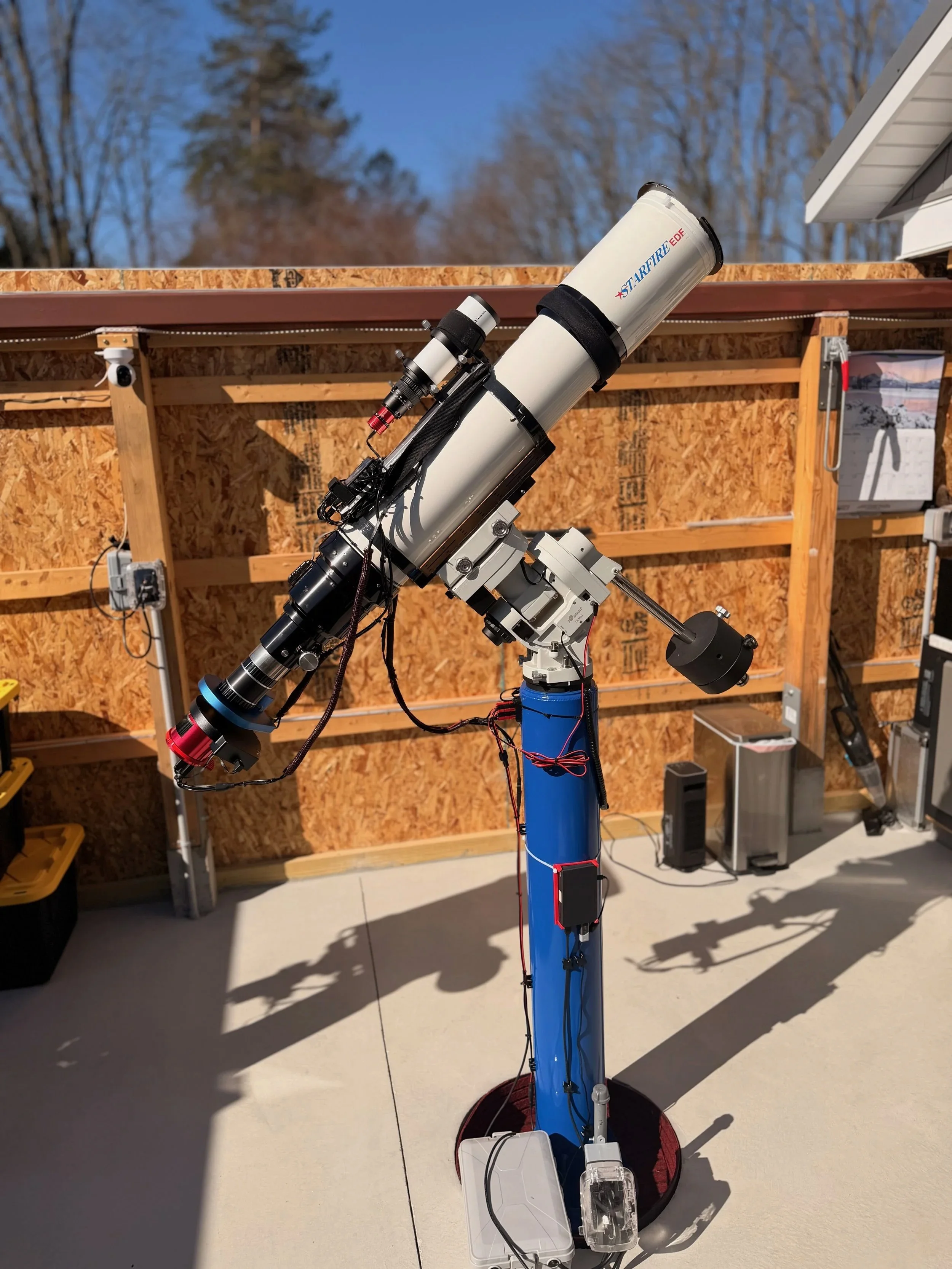
The AP155 platform used for this project.. (click on image to go to the blog entry for this scope)
📸 Capture Details
Nights: July 11, 12, 22, and 23, 2026
| Channel / Filter | Frames × Exposure | Settings | Total |
|---|---|---|---|
| L — ZWO Lum (36 mm unmounted) | 222 × 90 s | bin 1×1 • −10 °C • Gain 0 | 5 h 33 m |
| R — ZWO Red (36 mm unmounted) | 111 × 90 s | bin 1×1 • −10 °C • Gain 0 | 2 h 46 m 30 s |
| G — ZWO Green (36 mm unmounted) | 110 × 90 s | bin 1×1 • −10 °C • Gain 0 | 2 h 45 m |
| B — ZWO Blue (36 mm unmounted) | 113 × 90 s | bin 1×1 • −10 °C • Gain 0 | 2 h 49 m 30 s |
| Total Integration (after culling): 13 h 54 m 00 s (LRGB) | |||
Calibration Frames
- 25 × dark frames @ 90 s, bin 1×1, −10 °C, Gain 0
- 30 × dark-flats @ each flat exposure time, bin 1×1, −10 °C, Gain 0
- Flats: 15 each — L, R, G, B
Table of Contents Show (Click on lines to navigate)
Annotated Image
This annotated image began with PixInsight’s ImageSolver and FinderChart tools, then was enhanced to show additional features.
The Location in the Sky
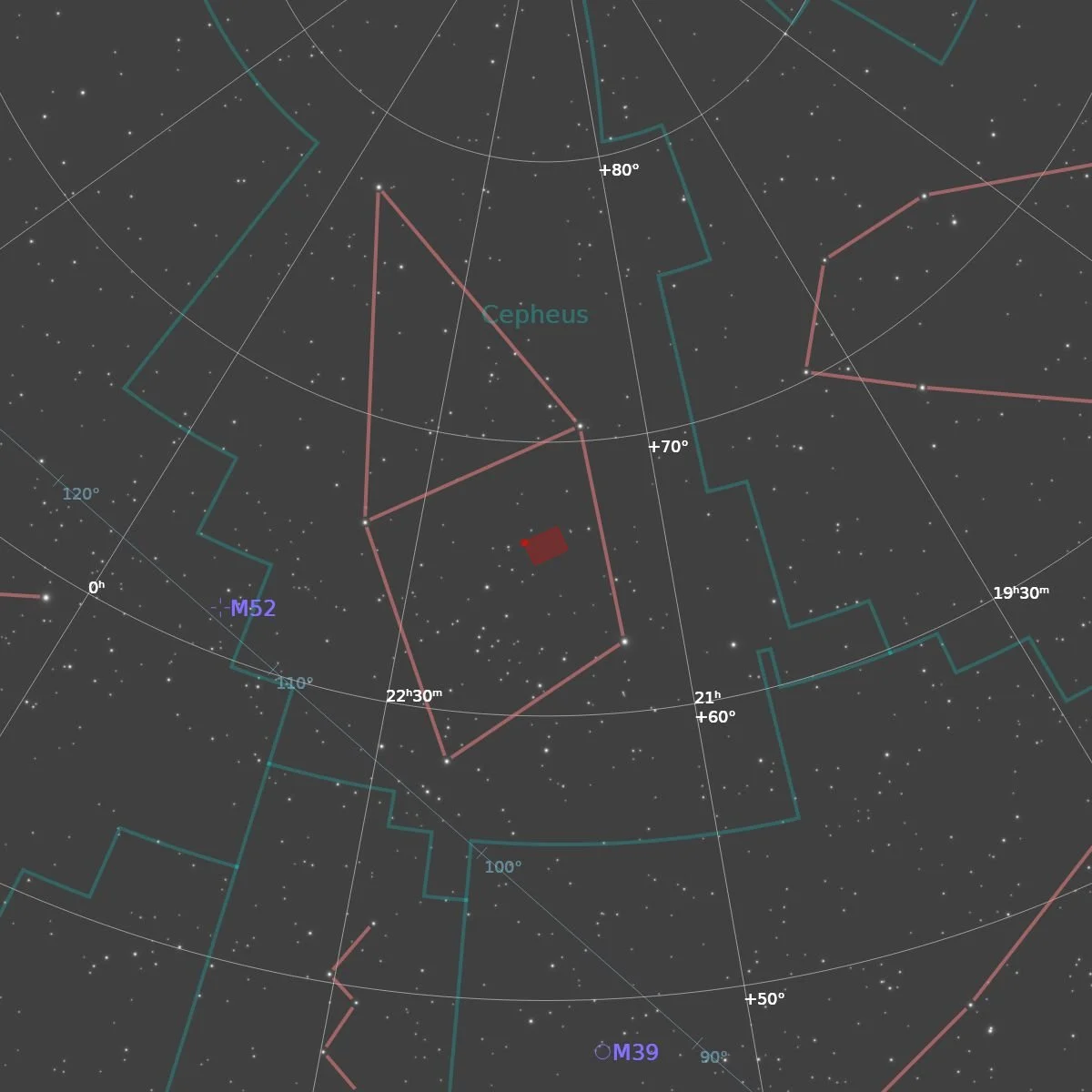
This finder chart shows the location of NGC 7129 in Cepheus. I was created with the ImageSolver and FinderChart scripts in PixInsight.
Introduction
This project frames NGC 7129, the Flower Bud Nebula, in a wider LRGB field that shows the object in context: a bright blue reflection nebula and young cluster emerging from a much larger landscape of Cepheus dust.
It is also popularly known as the Cosmic Rosebud or Rosebud Nebula, names inspired by the compact, flower-like glow around its young stars.
The main target is the glowing nebular complex near the lower-right portion of the image, but the surrounding frame adds a lot to the story: dark molecular clouds, smaller reflection nebulae, and the nearby open cluster NGC 7142 all share the scene.
About The Target
🌌 Overview
NGC 7129 is a young star-forming region in the constellation Cepheus. It is commonly associated with several overlapping catalog designations, including IC 5134, vdB 146, Ced 196, and Collinder 441. The naming gets a little messy because different catalogs emphasize different parts of the same region: the compact young cluster, the bright reflection nebula, or the broader dusty nebular complex around it.
In this image, the main visual feature is the blue-white reflection nebula surrounding the young stars of NGC 7129. That blue glow is starlight scattered by fine dust grains, much like the way Earth’s atmosphere scatters sunlight to make the daytime sky blue. The dark lanes and brownish structures around it are not empty space. They are dense molecular dust clouds that block the light behind them and still hold the raw material for new stars.
NGC 7129 lies roughly 3,000 to 3,800 light-years away, depending on the distance estimate used. A commonly cited modern value places the associated cloud and cluster at about 1.15 kiloparsecs, or roughly 3,750 light-years. The bright central nebula spans about 7 to 12 arcminutes across, corresponding to roughly 7 to 13 light-years at that distance. The wider dusty complex in this image is much larger.
📜 History
William Herschel first recorded NGC 7129 in 1794. His description was simple but still wonderfully accurate: a small group of stars involved in nebulosity. That is exactly what we see here, only now modern imaging reveals the surrounding dust, reflection glow, and embedded activity that Herschel could not see visually.
Later cataloging added more names. The New General Catalogue preserved the NGC 7129 designation. The surrounding nebulosity was later included in the Index Catalogue as IC 5134. Reflection nebula and cluster catalogs added designations such as vdB 146, Ced 196, and Collinder 441. This is why different references sometimes appear to disagree about what, exactly, NGC 7129 “is.” In practice, the region is both a young cluster and a reflection nebula embedded in a larger molecular cloud.
The region became especially interesting to astronomers studying young stars. George Herbig’s work on emission-line young stars helped establish objects like this as signposts of recent star formation. Later optical, infrared, radio, submillimeter, and X-ray studies showed that NGC 7129 is not just a pretty reflection nebula. It is an active stellar nursery.
🔬 Science
NGC 7129 is a laboratory for watching star formation in progress. The young stars inside the nebula illuminate the nearby dust, while their radiation, winds, and outflows reshape the cloud around them. Some of the stars are visible in ordinary light, but many of the most interesting objects are partly or completely hidden inside dust and are better studied in infrared, radio, and submillimeter wavelengths.
One important object in the region is LkHα 234, a young Herbig Ae/Be star associated with the bright central nebulosity. Nearby embedded sources, including IRS 6 and NGC 7129 FIRS 2, show that star formation is still underway. FIRS 2 is especially interesting because it is deeply embedded and has been studied through molecular chemistry. By measuring molecules in the surrounding gas, astronomers can infer temperature, density, shock activity, and evolutionary stage.
The small red knots and jet-like features in the region are signs of Herbig-Haro activity: fast streams of gas launched by young stars and protostars as they interact with the surrounding cloud. These features are short-lived on astronomical timescales, so they are excellent markers of very recent stellar birth.
✨ Interesting Facts
One of the best things about this field is the contrast between youth and age. NGC 7129 is a very young star-forming region, only a few million years old, while nearby NGC 7142 is an older open cluster that is a line-of-sight neighbor and is seen in the same wider field but is not physically associated with the main nebula. They are very different kinds of objects, but the image lets them share the same stage.
The dark nebulae around NGC 7129, including regions cataloged as LDN 1181 and LDN 1183, are a big part of what makes the scene so compelling. They give the image depth and structure, and they remind us that the dark areas are physical clouds, not empty gaps.
NGC 7129 is sometimes called the Flower Bud Nebula, Cosmic Rosebud Nebula, or Rosebud Nebula, and the nickname fits. The bright reflection nebula looks delicate and almost floral, but the science behind it is anything but quiet. This is a young cluster pushing its way out of the cloud that formed it, lighting the dust from within while new stars continue to form nearby.
About the Project (some overlap w/previous 3 projects)
Planning and Weather
2026 has been a very strange year weather-wise. We tend to have a wet spring, which settles down and dries out during June, July, and August. But this year the best term to describe the weather is unstable. We have had storm after storm come through, with unusually heavy rains and very high winds. The summer weather hasn’t really stabilized. Instead, it's been cloudy with few nights suitable for imaging.
I would have to say this has been the worst year so far in terms of how many nights I could collect data.
The last time I had a solid imaging run was back in galaxy season!
During July, I only had four clear, moonless nights to shoot. These fell on July 11th and 12th and July 22nd and 23rd. These were NOT great nights either. The first two had thin clouds passing through; the last two came with Canadian wildfire smoke drifting through the region.
Target Selection
For this project, I was looking for a target for my AP155 platform. This scope has my second-longest focal length at 810mm (using the focal reducer). Cepheus was now reachable, and this is a section of sky that is chock-full of interesting nebulae. So I began my hunt there for a good target option.
I stumbled across NGC 7129. I wasn't familiar with this target, and I was intrigued by its structure and the dark dust regions in the area. I also found that the close proximity to the rich open cluster NGC 7142 could make for some dramatic framing.
I decided to image this as an LRGB project because of the dust.
Using the NINA Framer, I set up the composition so that a line of features, starting with the open cluster, then NGC 7129, and finally the dark dust region, were lined up diagonally across the image from the lower left to upper right corners.
Data Collection
I opened the roof around 7 pm, which helped cool things down a bit.
I set the camera cooling target to −10 °C, as I knew the coolers would never reach -15 °C in this heat.
I did have one mystery. Once the scopes are working, I control them from within my den, and I typically nap on the sofa I have there. I'm a gadget hound, so I have my den all set up with smart switches, and so when I am ready to nap, I say “Alexa, turn off the devices in my den.” The lights go out, and I get some sleep.
Catastrophic Shutdown!
On the night of July 22, this is just what I did. I set an alarm to wake me around dawn so I could shut things down. The alarm went off, and I was shocked to see that ALL of my remote connections to the computer controlling all four piers were down. I could not reestablish them either. Hmmmm.
I went to the observatory, and everything was powered down! What? I must have blown a breaker!
Nope! The breakers were fine.
So I was puzzled about what happened, and I was concerned because I didn't want it to happen again. I had no idea what had happened, but I went back to bed, determined to get to the bottom of it.
The next day I looked up when the last sub was collected. Curiously, it was very close to when I went to sleep on my sofa. Hmmm. I thought about it for a minute and realized all the power in my observatory was on smart plugs as well. Hmm.
So I opened my phone's Alexa app and looked at the activity log. When I went to sleep, I remember saying, “Alexa, turn off the devices in my den.” Guess what I found in the activity log: “Alexa, turn off my devices.”
Alexa had never heard the “In my den” part. Thus, it shut down EVERYTHING. Since it was night and we were all sleeping, we never really noticed.
So once again I am doing a service to the broader astrophotography community - doing dumb things so you don’t have to!!
This resulted in the loss of about 2 hours of data collection on four scopes, so a total of 8 hours lost! Nothing stings more than losing good data!
Calibration Frames
After the fourth night, the Moon was beginning to dominate, so I took one evening to get all of my calibration frames. My SCA260 still uses a wall-mounted LED panel as the flat light source, but my other three scopes now sport a Wanderer Astro Motorized cover. This makes the collection of flats and dark flats a breeze. After the flats, I ran a dark series, and my cal data was ready to go.
Post-Processing
The processing plan for this image was pretty straightforward.
I used my typical LRGB workflow that looks something like this:
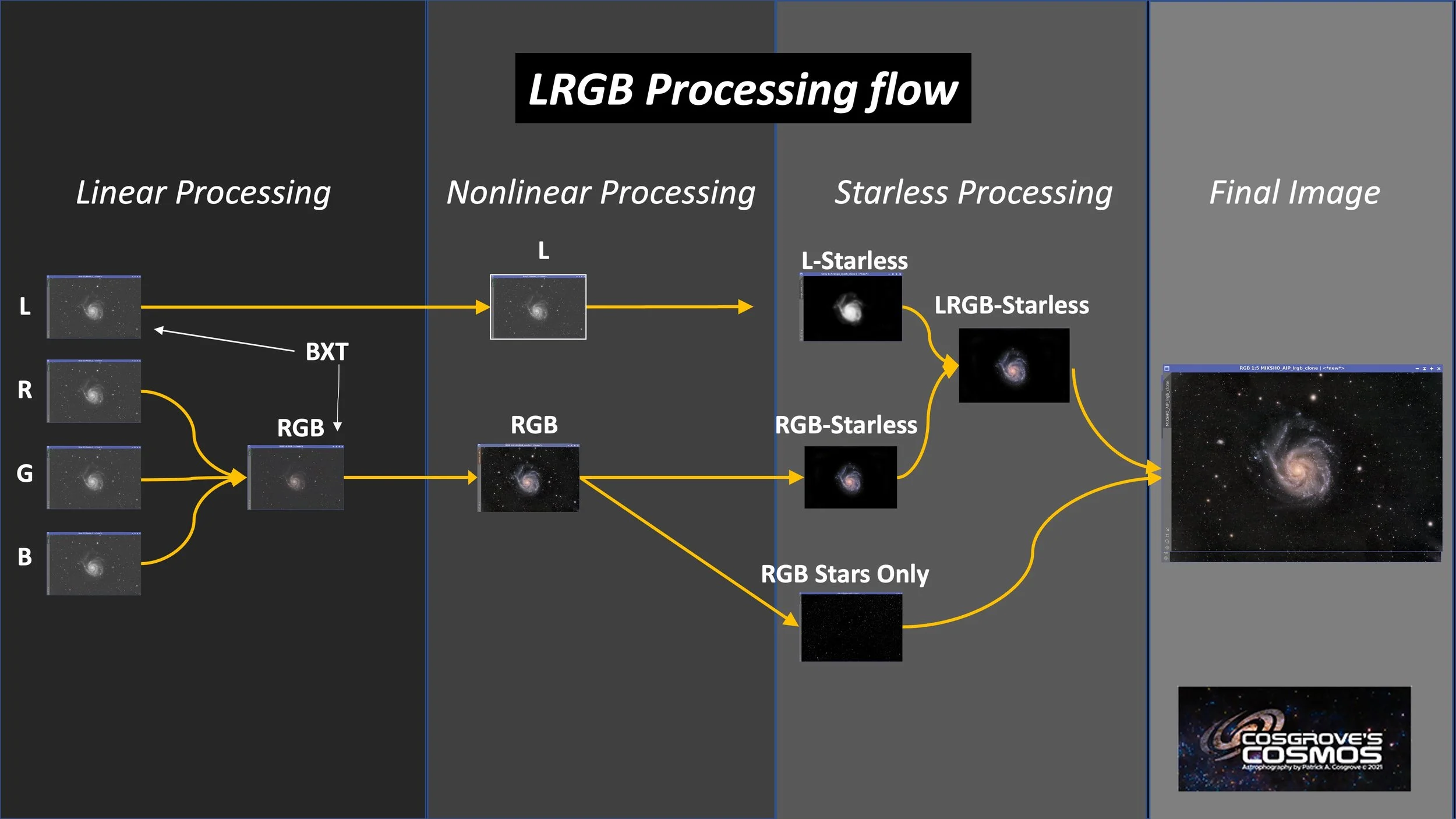
My typical LRGB Starless Workflow.
Processing was pretty straightforward.
For this image, I found it worked best to do the work on the final RGB color image after folding in the Lum image. So the processing I did on the lum image was fairly simple. I worked to minimize bright-area blowouts and enhance the large, faint dust regions, but not much else.
With the RGB image, I used Warm and Cool color masks to selectively work on those aspects. I also did something that is not recommended but seems to work. I used BXT late in the process with very low values to act as a kind of sharpener. Used modestly, this seems to help.
As I have been doing recently, I created a couple of versions of the star images, each with a more aggressive stretch. Then, when I could add the stars back in, I tried it with the star flavors and picked the one I thought best balanced the starless features and the stars. In this case, I chose the one with the most stretch involved. I thought it really helped bring out the star cluster in the lower left corner and made the image more dramatic.
I am kind of surprised that lately I have been going for more star stretch and larger stars. For years, I have been fighting star bloat, but now I am finding that bigger stars with good color can balance a busy image and make it much more dramatic.
Detailed and Annotated Image Processing Walkthrough
Typically, I conclude one of these imaging projects by documenting the processing steps I used on this image. But this section can make the overall post very large and, at times, slow to load.
I am now creating a secondary, standalone page to hold this information. You can access this page by clicking the link below. To return to this page, click the back arrow in your browser or select a different menu option at the top of the page.
I hope you like this new format!
Use the link below to see the detailed image processing walkthrough for this imaging project.
NGC 7129 Detail Processing Page
Final Results
I am pretty happy with how this came out.
It may not be the loudest image in the gallery, but I think it rewards a closer look: blue reflection light, dark dust, a rich open cluster, and the rosebud itself all sharing one field.
I did a slight crop to emphasize the main diagonal, and I think it helped a lot.
I am not sure this is a hugely dramatic image that grabs the eye, but I found it to be facinating, and I feel good about the final result.
More Info
🔭 Target Details
SIMBAD Astronomical Database — NGC 7129
Core professional database entry for NGC 7129, including coordinates, object type, alternate identifiers, measurements, bibliography, and linked catalog data.
In-The-Sky.org — The Small Cluster Nebula
Observer-friendly reference for NGC 7129 with position, magnitude, angular size, alternate names, and a finder chart.
In-The-Sky.org — Van den Bergh Reflection Nebula Catalogue
Catalog reference showing vdB 146 in Cepheus and its relationship to NGC 7129, the Small Cluster Nebula, Cr 441, and LBN 497.
📜 History & Naming
New General Catalog Objects: NGC 7100–7149 — Cseligman
Historical NGC notes for this region, including William Herschel’s discovery of NGC 7129 and the original descriptive language used for the object.
NGC 7129, vdB 146, HH 167 — Irida Observatory
Detailed annotated-field discussion of the catalog confusion around NGC 7129, IC 5134, vdB 146, Ced 196, Collinder 441, and related Herbig-Haro objects.
Rosebud Nebula / NGC 7129 — Constellation Guide
Accessible overview of NGC 7129’s common names, location in Cepheus, discovery by William Herschel, distance, size, and visual appearance.
🔬 Science & Observations
Spitzer Telescope Sends Rose for Valentine’s Day — NASA Science
NASA/JPL release explaining the infrared Spitzer view of NGC 7129, its rosebud appearance, young stars, dust bubble, and star-forming activity.
An Optical Survey of the Partially Embedded Young Cluster in NGC 7129 — CaltechAUTHORS
Research reference by Dahm and Hillenbrand covering the young cluster, H-alpha emission sources, pre-main-sequence stars, and optical spectroscopy.
The Distance to the Young Cluster NGC 7129 and Its Age — MNRAS
Scientific paper estimating the distance to the NGC 7129 cloud and cluster at about 1.15 kpc and discussing an age of up to roughly 3 million years.
A Chandra and Spitzer Census of the Young Star Cluster in NGC 7129
Study using Chandra, Spitzer, and 2MASS data to identify young stellar objects and pre-main-sequence stars in the NGC 7129 region.
Chemical Evolution Around NGC 7129 FIRS 2 and LkHα 234
Research on the molecular chemistry around the embedded protostar FIRS 2 and the Herbig Be star LkHα 234, two important young objects in the nebula.
💡 Interesting Facts & Outreach
APOD: NGC 7129 and NGC 7142 — Astronomy Picture of the Day
NASA APOD feature showing the visual pairing of NGC 7129 and NGC 7142, with notes on their different distances, ages, and the dusty foreground.
The Small Cluster Nebula — AstroBin
Amateur imaging example of the NGC 7129 field with object annotations including NGC 7133, NGC 7142, IC 5134, LDN 1181, LDN 1183, LBN 497, and vdB 146.
vdB 146 Area in Cepheus — AstroBin
Wider-field amateur image showing NGC 7129/vdB 146 in the broader Cepheus dust complex, with nearby dark nebulae, emission regions, and faint surrounding structures.
NGC 7129, A Space Rosebud in Cepheus — Cloudy Nights
Amateur imaging discussion focused on the practical challenges of capturing the faint reflection nebulosity and dusty surroundings of NGC 7129.
Imaging Platform Used
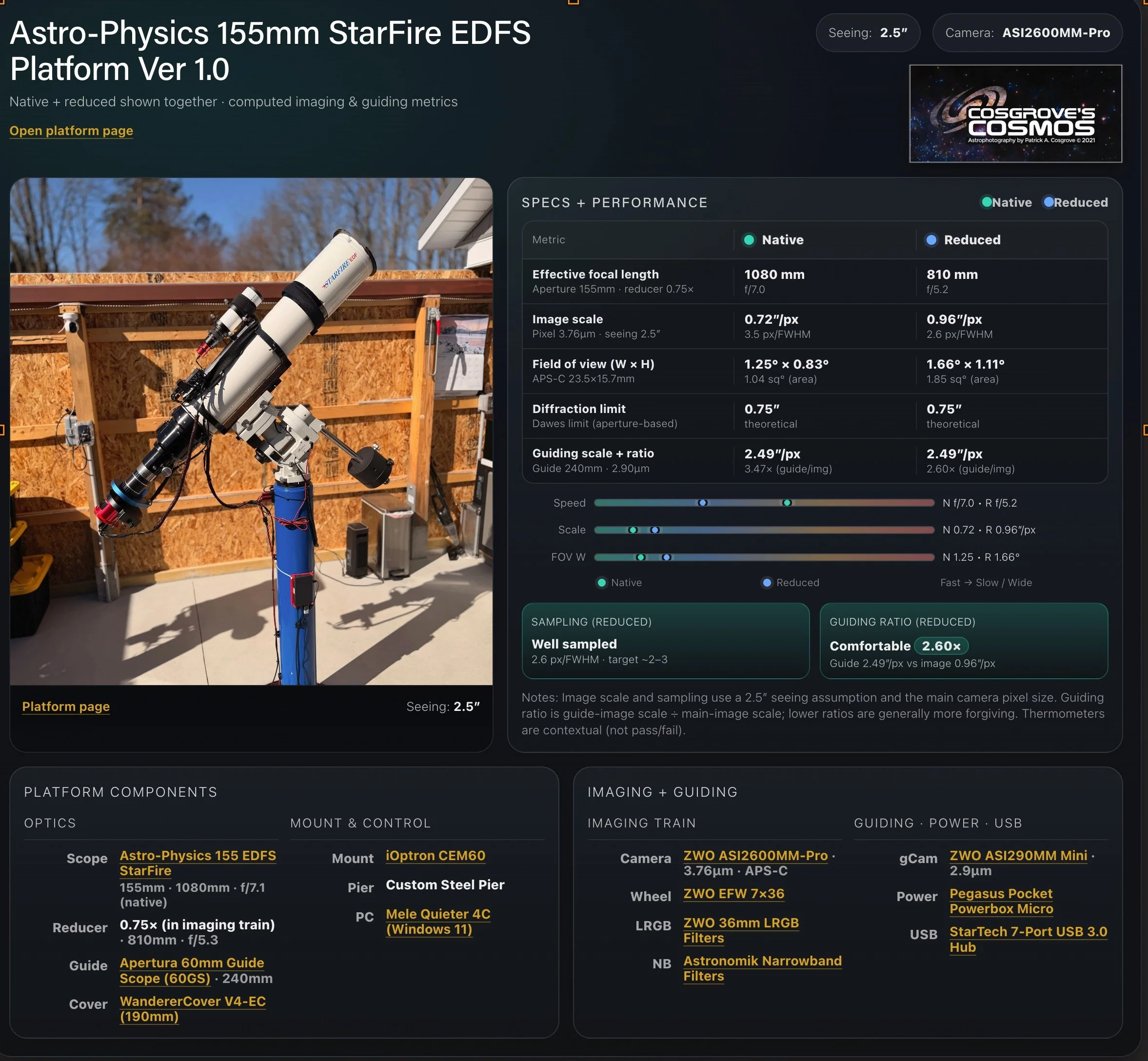
The details for the AP155 Platform.
Platform used for this project
Software
Capture Software: PHD2 Guider, NINA
Image Processing: PixInsight, Photoshop - assisted by Coffee, extensive processing indecision and second-guessing, editor regret, and much swearing…