SH2-88 - A Tulip-Style Nebula in Vulpecula - 12.37 hours of SHO + RGB Stars
Date: Sept 25, 2026
Cosgrove’s Cosmos Catalog ➤#0168
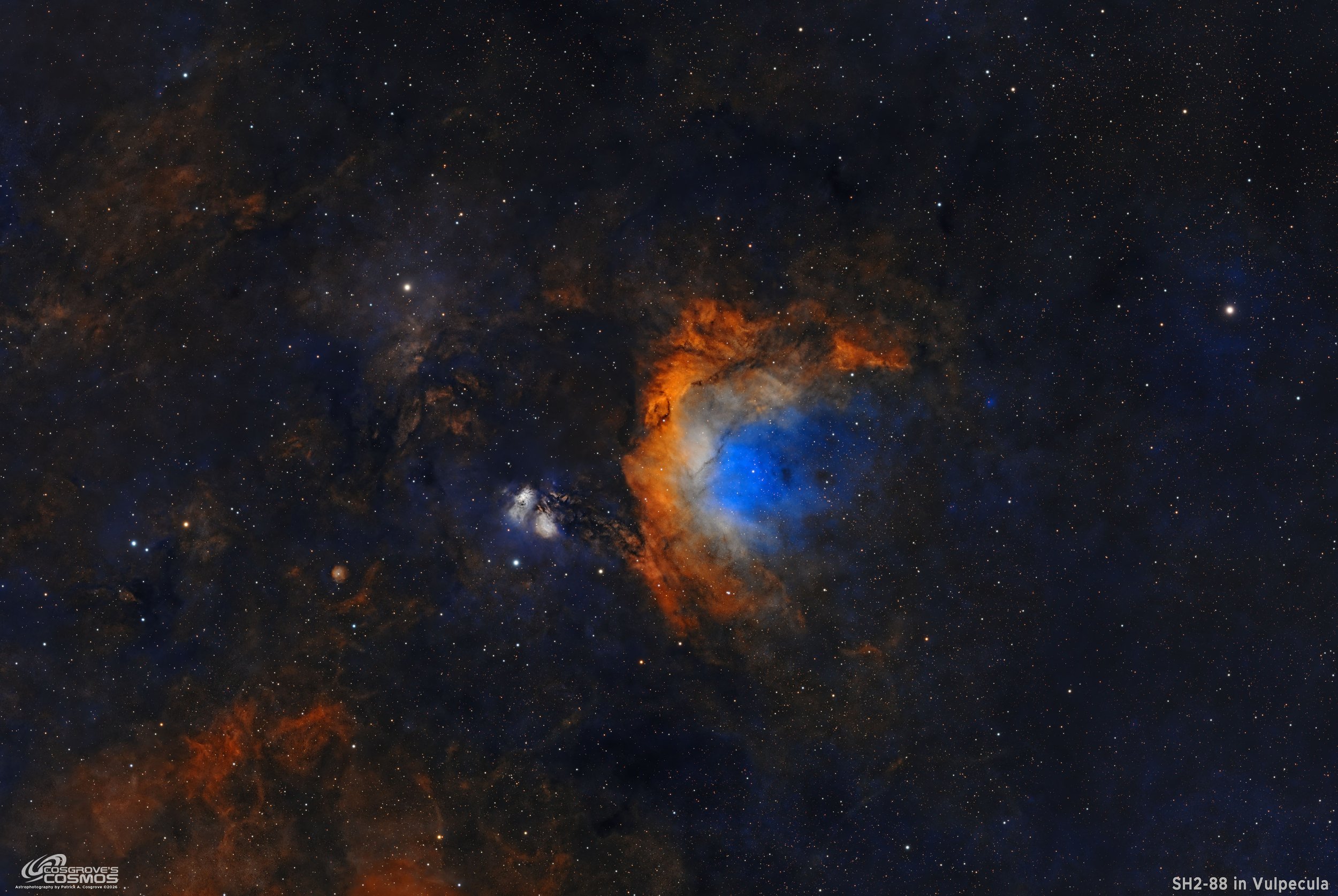
SH2-88, captured with my WO132 platform. This is a false-color SHO rendering: sulfur is mapped to red, hydrogen to green and oxygen to blue. RGB data were used for the stars. (Click image for hi-res version via AstroBin.com.)
SH2-88 — diffuse, compact, and ultracompact stellar nurseries sharing one remarkable field in Vulpecula.
Awarded Flickr Explore Status!

🔭 Project Summary
Target: SH2-88 — Sharpless 88 / LBN 139 / LBN 061.50+00.29 / [TP72] 67
Capture Dates: September 6, 11, and 14, 2026
Constellation: Vulpecula • Distance: ≈ 7,500–7,800 light-years
Type: H II emission complex containing diffuse, compact, and ultracompact star-forming regions
Imaging Period: September 6–14, 2026 • Total Integration: 12 h 22 m 00 s (SHO narrowband + RGB stars)
Filters: Ha · OIII · SII (Astronomik 36 mm 6 nm) + R · G · B (ZWO 36 mm LRGB Gen II)
Telescope: William Optics 132 mm f/7 FLT APO Refractor with P-FLAT7A 0.8× reducer/flattener
Camera: ZWO ASI2600MM-Pro (−15 °C; Gain 100 narrowband, Gain 0 RGB)
Mount: iOptron CEM60 on custom steel pier
Processing: PixInsight (SHO narrowband + RGB stars) & Photoshop
Location: Whispering Skies Observatory · Honeoye Falls, NY (USA)
Acquisition Notes: Ha: 48 × 300 s; OIII: 47 × 300 s; SII: 49 × 300 s; R: 14 × 30 s; G: 15 × 30 s; B: 15 × 30 s. All frames were captured bin 1×1 at −15 °C; total integration is 12 h 22 m 00 s after culling bad or questionable subs.
Image Note: This SHO narrowband image with RGB stars frames the SH2-88 complex in Vulpecula. The field includes the large diffuse nebula SH2-88A, the compact cometary H II region SH2-88B1, and the deeply embedded ultracompact H II region SH2-88B2—three distinct stages of massive-star formation visible within one remarkable region.
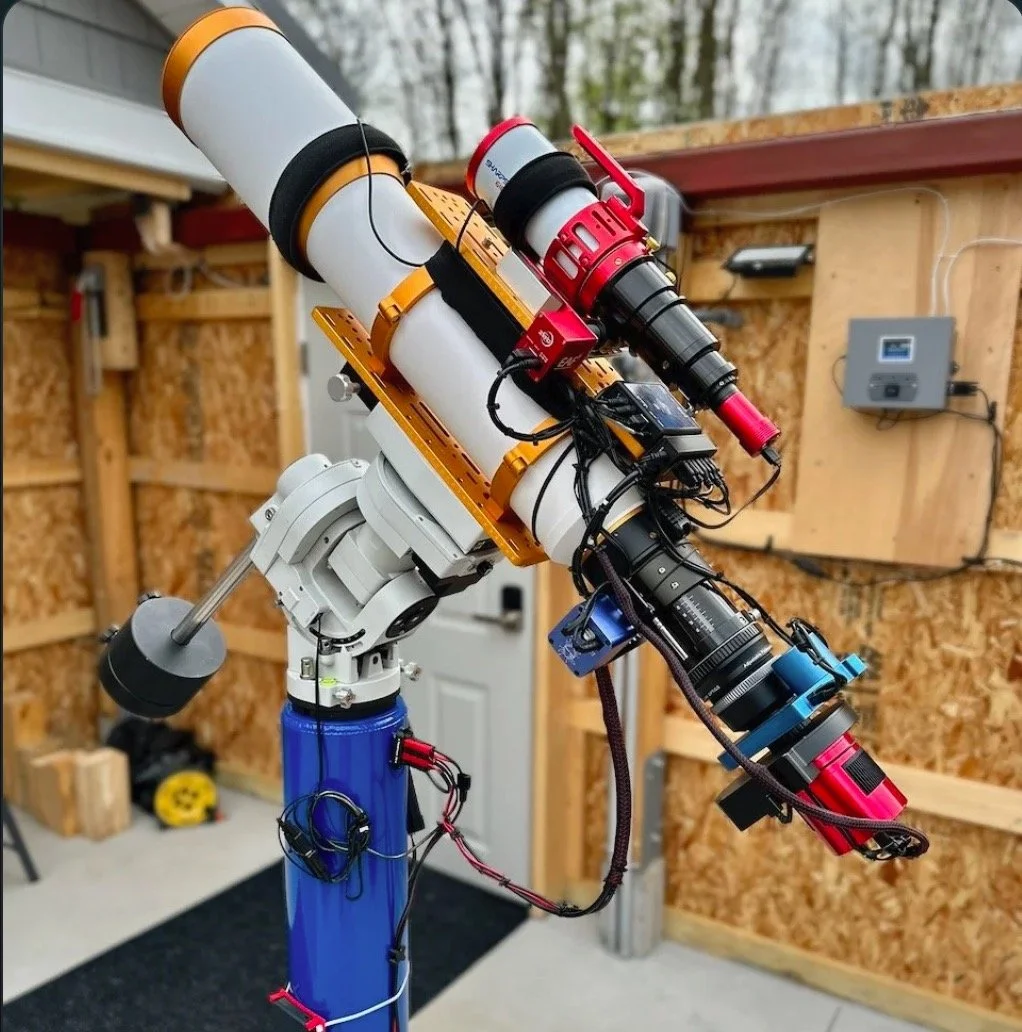
The WO132 Platform (click on image to go to the blog entry for this scope)
📸 Capture Details
Nights: September 6, 11, and 14, 2026
Frame counts shown are after bad or questionable exposures were culled.
| Channel / Filter | Frames × Exposure | Settings | Total |
|---|---|---|---|
| Ha — Astronomik 6 nm Hydrogen-alpha (36 mm unmounted) | 48 × 300 s | bin 1×1 • −15 °C • Gain 100 | 4 h 00 m |
| OIII — Astronomik 6 nm Oxygen III (36 mm unmounted) | 47 × 300 s | bin 1×1 • −15 °C • Gain 100 | 3 h 55 m |
| SII — Astronomik 6 nm Sulfur II (36 mm unmounted) | 49 × 300 s | bin 1×1 • −15 °C • Gain 100 | 4 h 05 m |
| R — ZWO Red (36 mm unmounted) | 14 × 30 s | bin 1×1 • −15 °C • Gain 0 | 7 m |
| G — ZWO Green (36 mm unmounted) | 15 × 30 s | bin 1×1 • −15 °C • Gain 0 | 7 m 30 s |
| B — ZWO Blue (36 mm unmounted) | 15 × 30 s | bin 1×1 • −15 °C • Gain 0 | 7 m 30 s |
| Total Integration (after culling): 12 h 22 m 00 s (SHO narrowband + RGB stars) | |||
🎛️ Calibration Frames
- 25 × dark frames @ 300 s, bin 1×1, −15 °C, Gain 100
- 25 × dark frames @ 30 s, bin 1×1, −15 °C, Gain 0
- 30 × dark-flats @ each flat exposure time, bin 1×1, −15 °C, Gain 0 for RGB and Gain 100 for narrowband
- Flats: 15 each — Ha, OIII, SII, R, G, B
Table of Contents Show (Click on lines to navigate)
Annotated Image
This annotated image was created with the ImageSolver and FinderChart scripts in PixInsight.
Location in the Sky
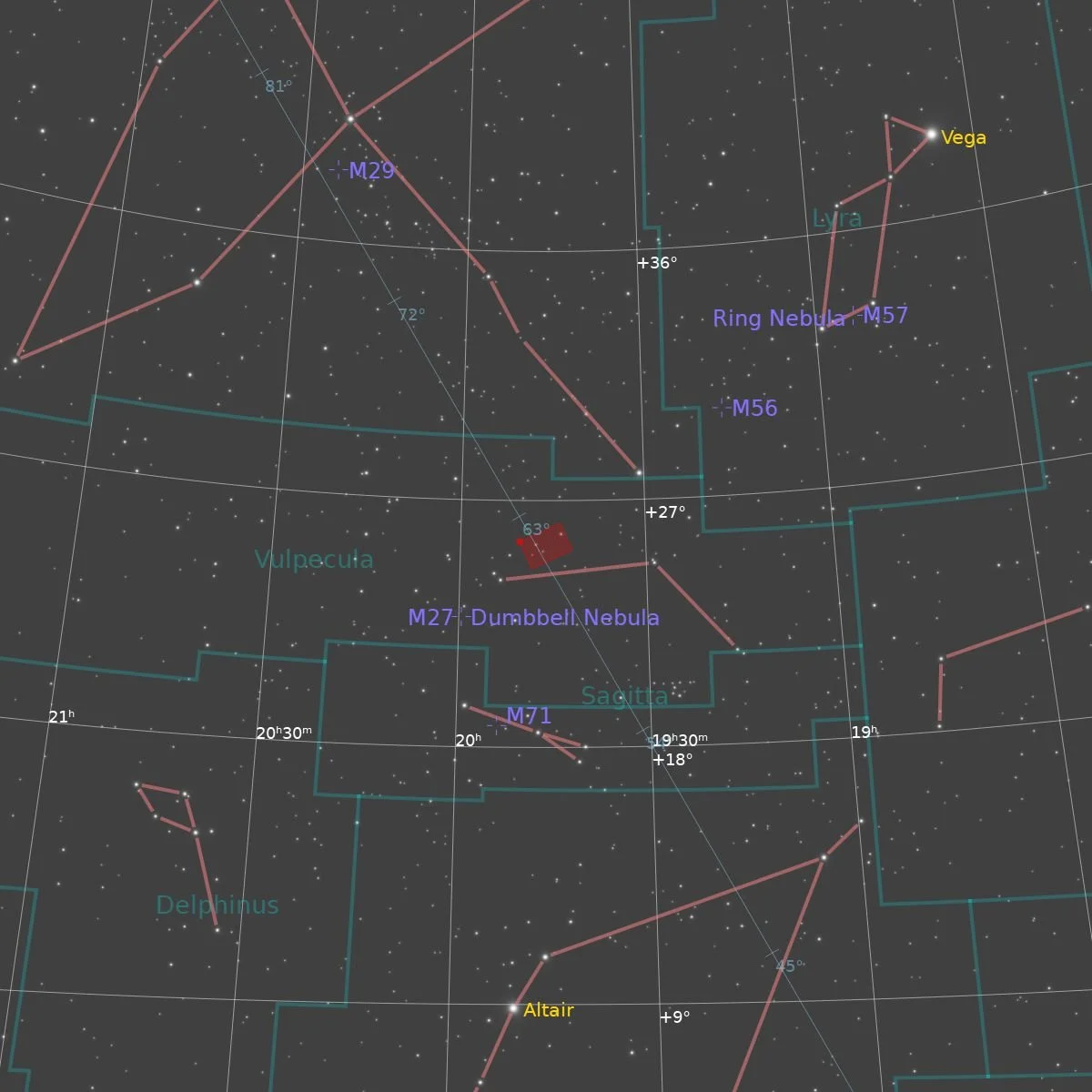
This finder chart image was created with the ImageSolver and FinderChart scripts in PixInsight.
About The Target
🌌 Introduction
This project presents SH2-88, a complex and relatively overlooked stellar nursery in Vulpecula. I captured roughly 12.37 hours of SHO narrowband data with RGB stars using my William Optics 132 platform.
SH2-88 is not a single, uniform cloud. It combines a large, evolved emission nebula with much smaller compact regions where massive stars are still forming behind dense curtains of dust. That contrast—an older nebula beside deeply embedded stellar newborns—is what makes this region particularly interesting.
🌠 Overview
SH2-88 is an H II region: a cloud of hydrogen gas ionized by intense ultraviolet radiation from hot, young stars. As electrons recombine with hydrogen atoms, the gas emits light—most strongly in hydrogen-alpha—creating the glow recorded in long-exposure and narrowband images.
The nebula lies in the small northern constellation Vulpecula, close to the plane of the Milky Way. It is part of the much larger Vulpecula OB1 star-forming complex located approximately 6,700–7,800 light-years away, depending on the distance determination; a recent Gaia EDR3-based estimate places SH2-88 at about 6,720 light-years.
The designation SH2-88 comes from Stewart Sharpless’s second catalog of Galactic H II regions. Other catalog names include Sharpless 88, LBN 139, LBN 061.50+00.29, and [TP72] 67. It is also occasionally called the “Face of God Nebula,” although that is an informal photographic nickname rather than an official astronomical designation.
Astronomers generally divide the region into three principal components:
SH2-88A — the large, diffuse, evolved H II region.
SH2-88B1 — a compact, comet-shaped H II region containing a small cluster of massive young stars.
SH2-88B2 — an ultracompact H II region representing an even earlier and more deeply embedded stage of massive-star formation.
Together, these components provide a view of several stages of stellar birth within the same cloud complex.
This breakdown is not shown in the annotated image, so let me show that breakdown here:
The break down of the diffuse SH2-88 region and the compact SH2-88A, SH2-88B1 and SH2-88B2 regions. (Click to enlarge)
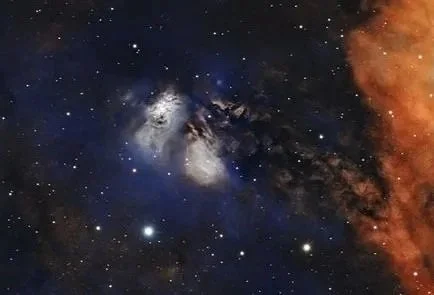
The B1/B2 region contains especially intricate and highly structured nebulosity.
📜 History
There does not appear to be a well-documented visual “discovery” of SH2-88 in the traditional sense.
It is faint, extended, and difficult to see through a telescope, so its history is tied more to photographic sky surveys than to a single eyepiece observation.
American astronomer Stewart Sharpless identified and cataloged the region while examining photographic plates from the Palomar Observatory Sky Survey. He listed it as object 88 in his second and final catalog of H II regions, published in 1959.
Sharpless created the catalog to map glowing hydrogen clouds along the Milky Way. Many of its objects have since become familiar astrophotography targets, but SH2-88 remains considerably less photographed than its better-known neighbors in Cygnus and Vulpecula.
The nebula was later included in Beverly Lynds’s 1965 catalog of bright nebulae as LBN 139. Radio, infrared, and molecular-line observations eventually showed that what appears optically as a faint patch of emission is actually a complicated star-forming system containing ionized gas, neutral hydrogen, molecular material, dust, and deeply embedded young stars.
🔬 Science
The broad SH2-88A nebula is primarily ionized by the hot O-type star BD+25°3952. Radiation and stellar winds from this star—and from other massive members of Vulpecula OB1—have heated, ionized, and reshaped the surrounding interstellar material.
Radio observations show that SH2-88 is interacting with an expanding shell of neutral hydrogen. The shell, shaped primarily by the winds of BD+24°3866 and BD+25°3952, has an estimated dynamical age of about 1.5 million years and contains roughly 1,300 solar masses of swept-up material.
The smaller SH2-88B complex reveals an earlier stage of the story. B1 is a compact, comet-shaped H II region associated with a cluster of massive stars. Its primary ionizing source is likely an O8.5–O9.5 main-sequence star. Dense molecular material surrounds the region, producing an estimated 30–42 magnitudes of visual extinction.
B2 is even more deeply buried. It is classified as an ultracompact H II region—one of the short-lived early phases in the formation of a massive star. Its exciting star is hidden behind more than 60 magnitudes of visual extinction and cannot be detected directly at visible wavelengths.
Near-infrared observations identify the embedded stellar cluster, while mid-infrared measurements trace warm dust and the photodissociation region where ultraviolet radiation breaks molecules apart. Radio observations penetrate the dust and map the ionized gas, while hydrogen and carbon-monoxide surveys show how the nebula interacts with the surrounding atomic and molecular clouds.
SH2-88 is also part of the roughly 100-parsec-long Vulpecula OB1 complex. A Spitzer-based study identified 856 candidate young stellar objects across Vulpecula OB1. Although the study did not support a simple wave of star formation moving sequentially across the entire complex, it did find evidence that radiation and stellar winds may trigger new stars on smaller scales—particularly around compressed clouds and pillar-like structures.
✨ Interesting Facts
SH2-88 contains diffuse, compact, and ultracompact H II regions in the same complex, letting astronomers compare different stages in massive-star evolution.
The visible nebula is only part of the story. Some of the youngest stars are concealed by so much dust that optical light is reduced by factors of trillions—or more—before it can escape.
The comet-like appearance of SH2-88B1 is not simply decorative. Its shape records the interaction between a newly formed massive star, the surrounding molecular cloud, and radiation moving through the region.
At a distance of roughly 7,800 light-years, the light captured in this project began its journey toward Earth thousands of years before the first recorded human civilizations.
Narrowband imaging separates emission from ionized sulfur, hydrogen, and oxygen. The resulting SHO palette is not natural color, but it powerfully reveals differences in the nebula’s chemistry, excitation, and structure.
SH2-88 may not have the immediate name recognition of the North America, Rosette, or Heart Nebulae, but scientifically it is a rich target. It is a layered portrait of massive-star formation: an evolved nebula being reshaped by stellar winds, a compact young cluster emerging from its cloud, and an ultracompact region still hiding a newborn star from visible light.
About The Project
Planning and Weather
I’ve been doing astrophotography now for about 7 years, and I would have to say that 2026 has been the worst year weather-wise by far!
August is typically a very hot, dry month for us, and that can lead to clear, dark nights. However, these nights have relatively few hours of true darkness. Then September comes along and the nights get longer, and we often have some really nice stable periods. These long, clear nights are outstanding for capturing data.
But this year, August was very stormy, unsettled, and cloudy! We also had smoke from forest fires drifting our way. September was just as unsettled.
Despite this, I found three nights where I could catch photons. The weather apps predicted marginal conditions for each night, but beggars cannot be choosers, so I fired up the gear each night expecting to be shut down after a few hours. I lucked out and had clear skies all night.
I say clear skies, but in fact we did have some thin clouds coming through, some light smoke, and the heaviest dew I have seen in many years. So things were not ideal!
Picking Targets
I have recently started using ChatGPT to help with target selection. It knows my location, treeline, the scopes I use, and of course the time of year. With this information, it selects some lists of potential targets for each scope.
From there, I delved into those objects further and made my selection.
I chose SH2-88 because:
I was completely unfamiliar with it
It looked very similar to SH2-101, the Tulip Nebula, so I thought it would be interesting to shoot it and compare.
It seems well-sized for my WO132 platform.
I decided to shoot this as a narrowband target with 300-second exposures and also capture some 30-second exposures in RGB so I could have natural-looking stars.
As the nights became cooler, I lowered my usual camera-cooling target from −10 °C to −15 °C.
Data Collection
I opened the roof around 7 pm, which also helped things cool down a bit.
On the nights in question, the gear performed flawlessly. The WO132 platform was once again completely reliable and performed flawlessly on all three nights.
I did see some very thin clouds come through, but nothing that was concerning.
Tracking ran very well each night.
We did have some of the heaviest dew I have seen. While water was dripping from all surfaces in the observatory, the WO132 dew straps kept the optics clear.
Good data collection with no drama! Just the way I like it!
Calibration Frames
A few nights after collecting the last data, I decided to grab a complete set of calibration data.
With the Wanderer Astro cover, I could easily do the entire process remotely. Talk about convenience!
I collected a complete set of darks, dark flats, and flats for this project.
Processing Overview
Pre-processing
To prepare to process this image, I migrated to PixInsight version 1.9.5. This required some work to ensure all my scripts and plugins were working.
As always, I blinked all of my image data and my calibration data. To my shock, only one blue subframe had to be removed! Somehow I had dodged the thin clouds and smoke!
This left me with 12 hours and 22 minutes of usable data.
Post-Processing
The processing plan for this image was pretty straightforward and very similar to what I did on the previous project.
I used my typical narrowband workflow with RGB Stars. At a high level, this looks like the diagram below:
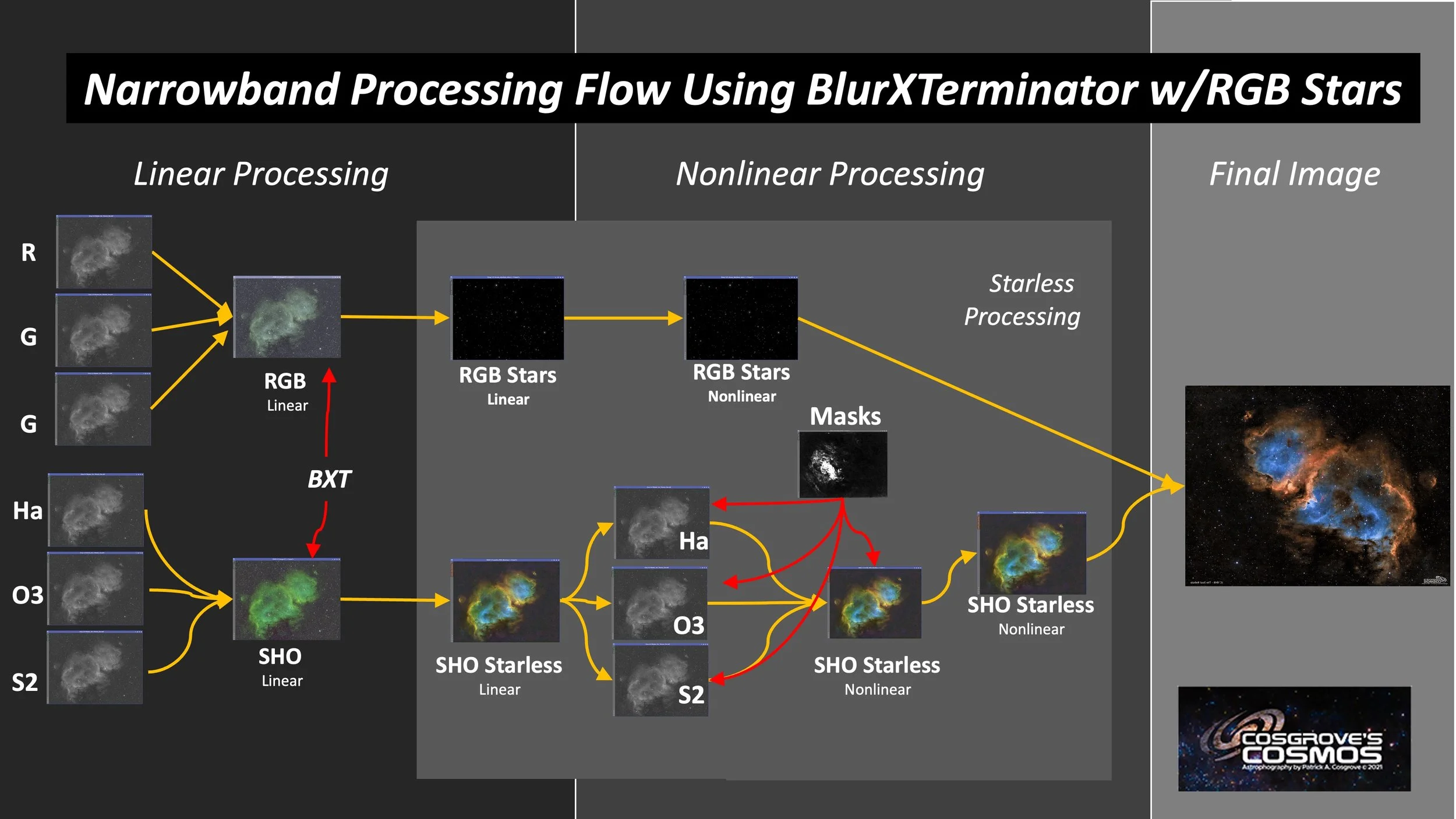
My typical SHO with RGB Stars Workflow.
The front end of the processing was pretty standard.
Linear processing produced an SHO starless image and an RGB star image.
In the past, I had used another tool to transform my linear star image into the nonlinear domain. But for a while now, I have been developing my own tool, which I am tentatively calling the Astro Star Crafter.
The tool analyzes the star data and adaptively calculates an initial stretch. Star Presence and Color Boost controls then let you refine the initial result. It then provides a rich set of tools that let you compare the new position with the baseline so you know what you are getting.
The Layout of the current tool. (click to enlarge)
One of the way you can visualize changes from the baseline. (click to enlarge)
The tool works well, but I found some computationally intensive operations introduced noticeable delays into the workflow, so I will need to optimize the code before I release this more broadly.
As is my usual, I did my linear processing, removed the stars, and then did NarrowbandNormalization.
Once I was nonlinear, I worked on color using my standard method: I created a Warm Color Mask and a Cool Color Mask. Then, using these masks, I adjusted the color and the contrast detail of the image.
To finish up the image, I used two of my own tools, as I mentioned before. ACM let me dial in and tweak the colors the way I wanted.
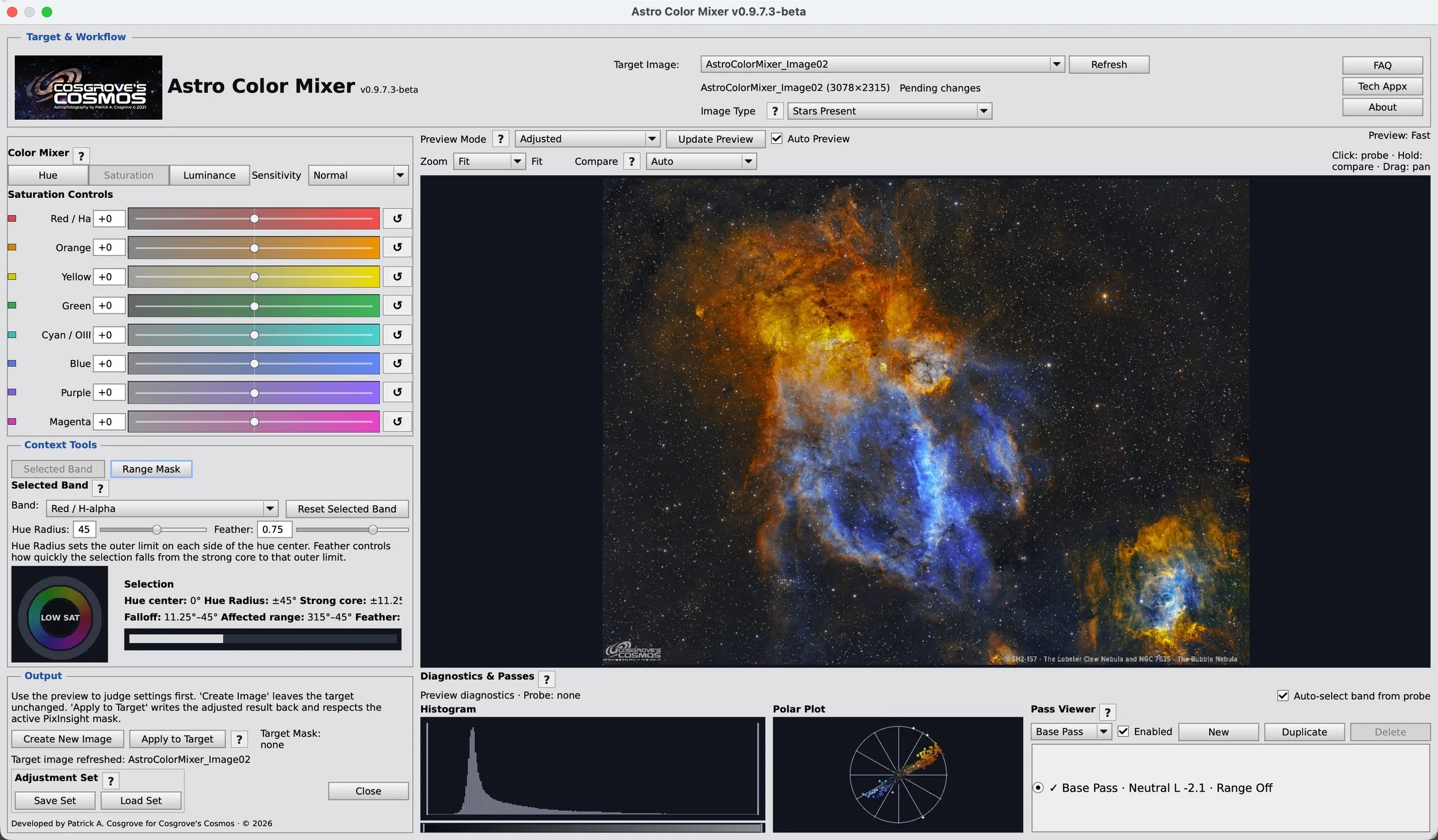
My New Astro Color Mixer PixInsight Script!
Then I used ACE to finalize the local contrast and fine detail in the image.
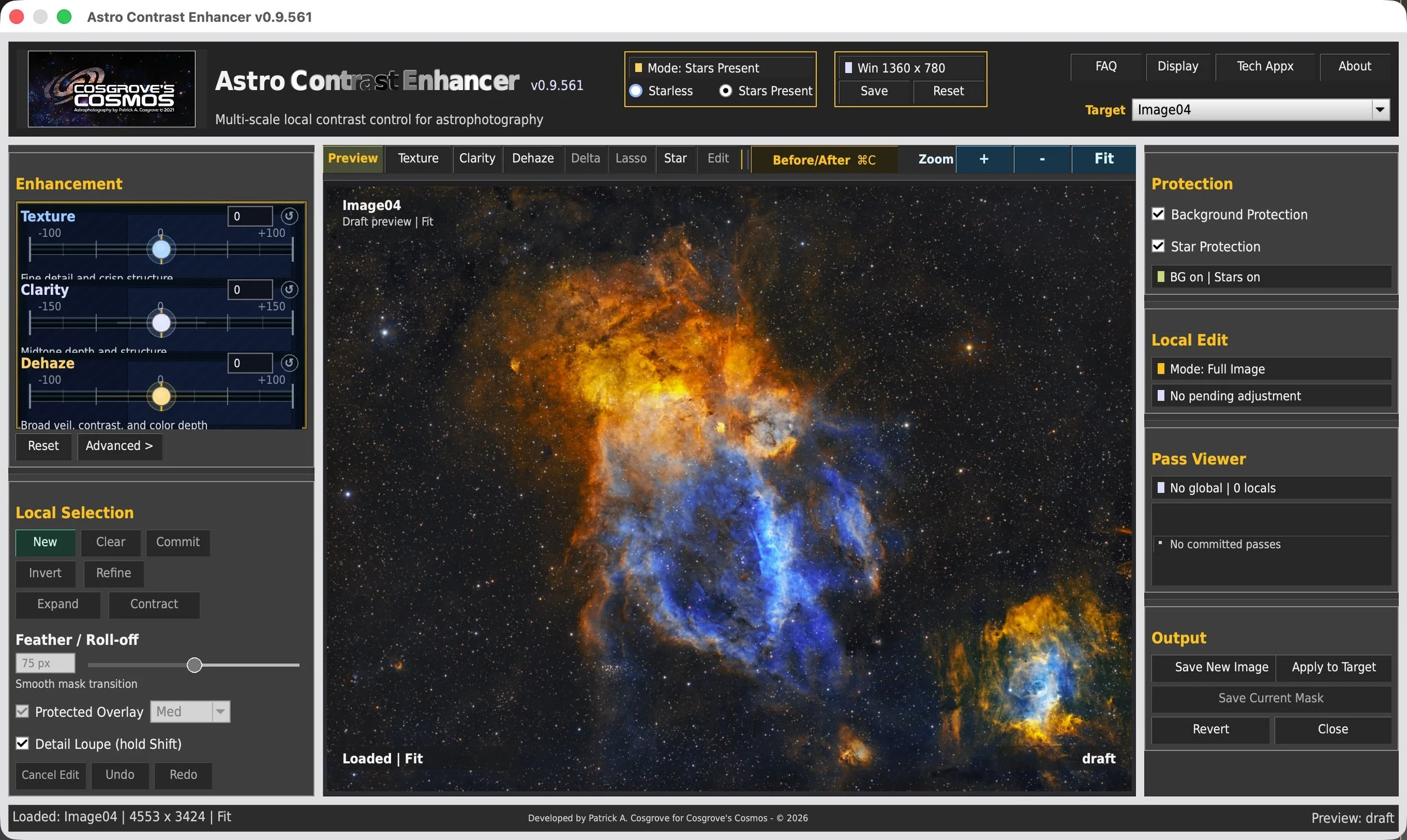
My new ACE tool: Astro Contrast Enhancer
Detailed and Annotated Image Processing Walkthrough
Typically, I conclude one of these imaging projects by documenting the processing steps I used on this image. But this section can make the overall post very large and, at times, slow to load.
I am now creating a secondary, standalone page to hold this information. You can access this page by clicking the link below. Returning to this page is as simple as clicking the back arrow in your browser or selecting a different menu option at the top of the page.
I hope you like this new format!
Use the link below to see the detailed image processing walkthrough for this imaging project.
SH2-88 2026 Image Processing Walkthrough
Final Results
In the master images, I had good data in Ha, but the OIII and SII data were very weak. Narrowband normalization really boosted the scale of those images, and this made their noise evident. NoiseXterminator helped, but it can only do so much.
Even with over 12 hours of integration on an f/5.6 system, I still needed much more exposure on the O3 and S2 filters to get the best result, and the weather window didn't allow time for that.
Given that limitation, I think the image came out well.
My first image was very color-saturated. I backed off from my starting position as I went further; I felt the drama was leaving the image. So I found a compromise: I dialed back the orange hues to keep the strong color without making it too saturated. I adjusted the blue hues by a much smaller amount.
I think the final image hits the right balance for me.
More Info
🔭 Target Details
SIMBAD — SH2-88 — Professional astronomical database entry with coordinates, object classification, alternate identifiers, measurements, and a bibliography of published research concerning SH2-88.
CDS Aladin Lite — SH2-88 Field — Interactive sky atlas for examining optical, infrared, radio, and other survey imagery around SH2-88 and the surrounding Vulpecula OB1 complex.
NASA/IPAC IRSA Finder Chart — SH2-88 — Multi-survey comparison tool providing imagery from DSS, 2MASS, WISE, IRAS, and other astronomical archives.
📜 History & Naming
Stewart Sharpless — A Catalogue of H II Regions — The original 1959 publication containing the second Sharpless catalog and the source of the SH2-88 designation.
NASA HEASARC — Sharpless H II Region Catalog — Technical documentation for the machine-readable Sharpless catalog, including positions, angular dimensions, morphology, structure, brightness, and associated-star information.
NASA HEASARC — Lynds Catalog of Bright Nebulae — Catalog documentation for the LBN designations associated with SH2-88, including LBN 139 and LBN 061.50+00.29.
🔬 Science & Observations
Astronomy & Astrophysics — The Stellar Content of the Compact H II Region SH2-88B — Near-infrared study of SH2-88B and its embedded cluster, including the compact cometary region B1, the ultracompact region B2, their exciting stars, and the extreme extinction across the cloud.
CDS VizieR — JHK Photometry in SH2-88B — Machine-readable photometric measurements for 125 stars in the embedded SH2-88B cluster, published with the Deharveng study.
Astronomy & Astrophysics — An H I Interstellar Bubble Linked to SH2-88 — Radio-continuum, neutral-hydrogen, and infrared investigation of the expanding shell interacting with SH2-88 and the massive stars shaping the surrounding interstellar medium.
The Astrophysical Journal — Young Stellar Objects in Vulpecula OB1 — Spitzer-based census of 856 candidate young stellar objects across Vulpecula OB1, examining its star-formation history and evidence for small-scale triggering.
💡 Interesting Facts & Outreach
NASA HEASARC SkyView — SH2-88 — Virtual-observatory access to survey imagery across the electromagnetic spectrum, allowing the visible nebula to be compared with infrared and radio views of its obscured structures.
CDS VizieR — Vulpecula OB1 Young-Stellar-Object Catalog — Research table containing the candidate young stars identified from Spitzer observations throughout the larger Vulpecula OB1 star-forming complex.
Imaging Platform Used
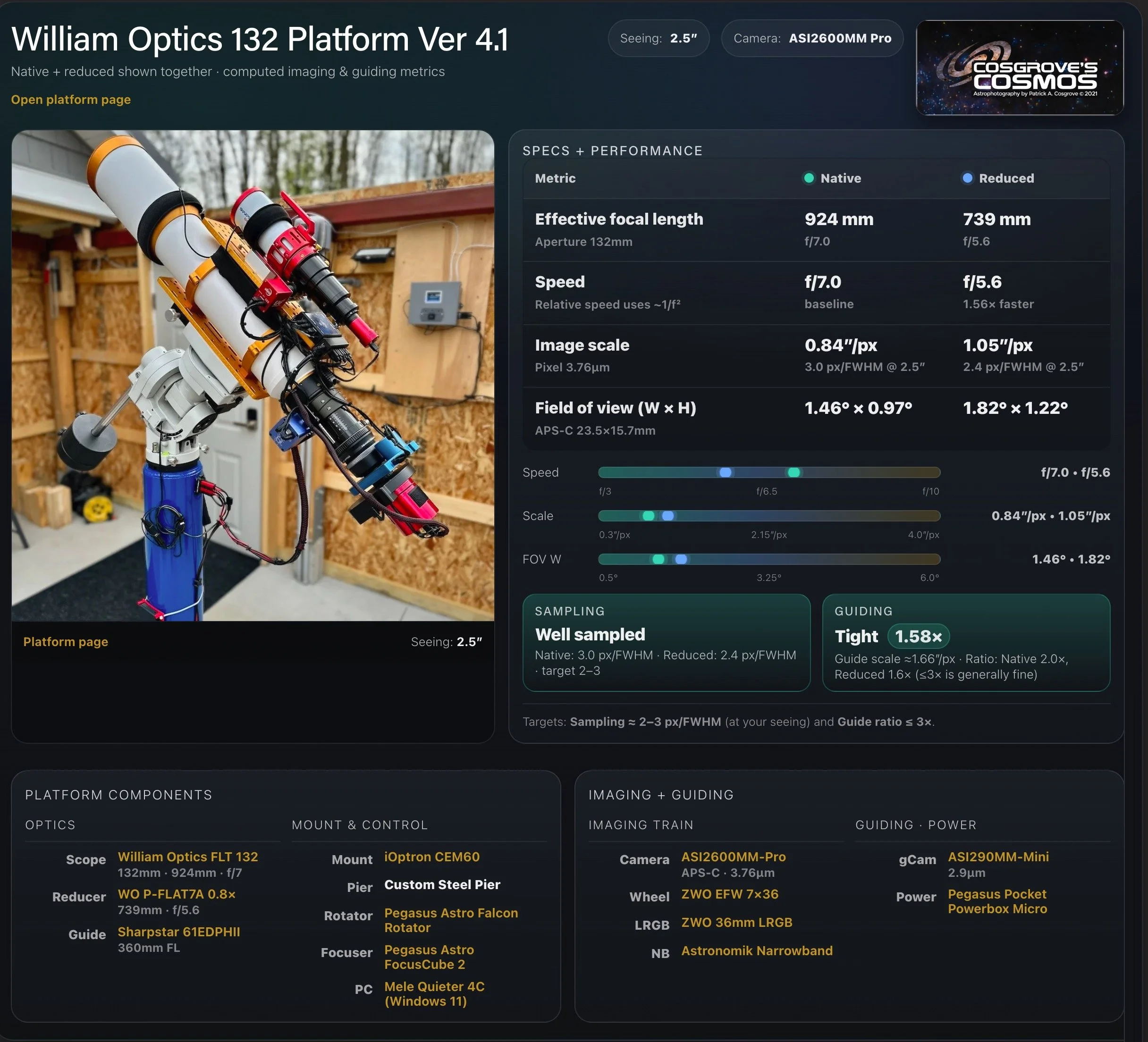
The details for the WO132 Platform.
Platform used for this project
Software
Capture Software: PHD2 Guider, NINA
Image Processing: PixInsight, Photoshop - assisted by Coffee, extensive processing indecision and second-guessing, editor regret, and much swearing…