Hickson 61 — “The Box” | Tiny Galaxies, Tough Data! - 7.8h LRGB
Date: June 5, 2026
Cosgrove’s Cosmos Catalog ➤#0163
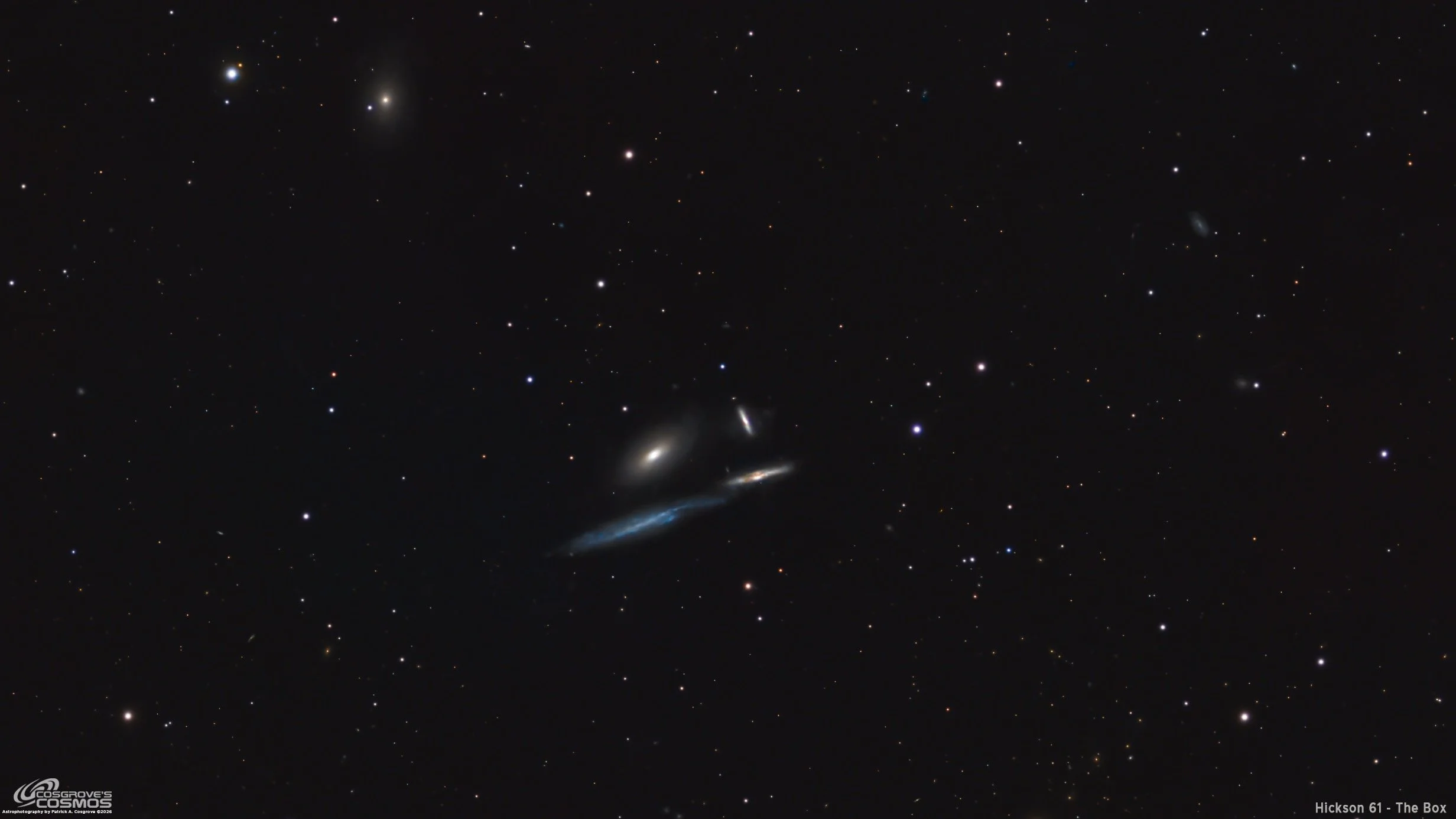
The Box: A tiny and distant set of galaxies! (Click image for hi-res version via AstroBin.com.)
Hickson 61 — a tiny box of faint galaxies, where distance, perspective, and deep exposure turn a small patch of sky into something remarkable.
Awarded Flickr Explore Status!

Published in Amateur Astronomy Magazine, Fall 2026, Issue# 132
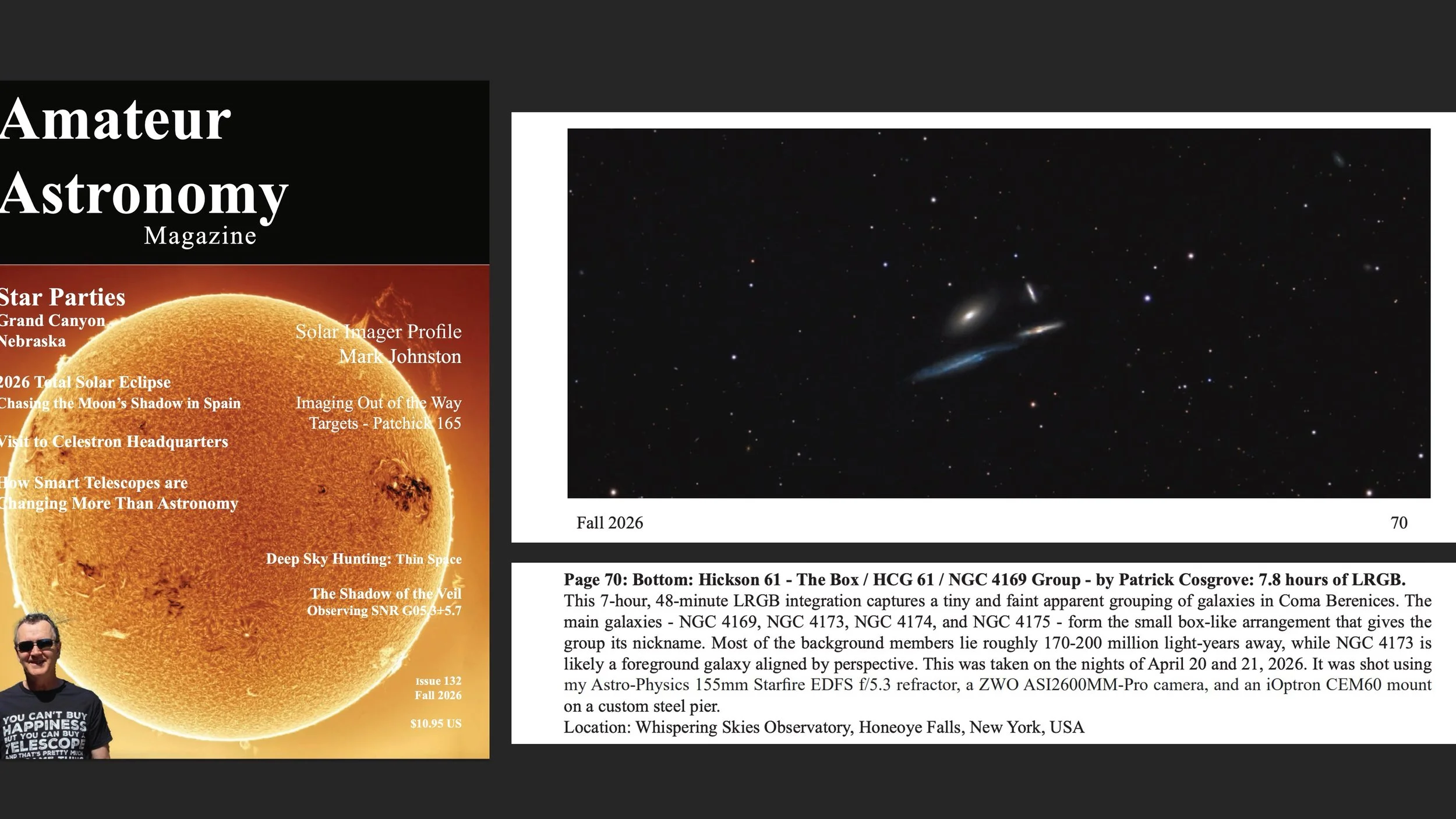
Thanks, Amatuer Astronomy Magazine!
🔭 Project Summary
Target: Hickson 61 — “The Box” / HCG 61 / NGC 4169 Group
Main Galaxies: NGC 4169, NGC 4173, NGC 4174, and NGC 4175
Capture Dates: April 20 and 21, 2026
Constellation: Coma Berenices • Distance: ≈ 170–200 million light-years for the main background members; NGC 4173 is likely foreground
Type: Compact galaxy group / apparent galaxy alignment featuring small, faint, distant galaxies arranged in a box-like pattern
Imaging Period: April 20–21, 2026 • Total Integration: 7 h 48 m 00 s (LRGB)
Filters: L · R · G · B (ZWO 36 mm LRGB Gen II)
Telescope: Astro-Physics 155 mm Starfire EDFS f/5.3
Camera: ZWO ASI2600MM-Pro (−15 °C; Gain 0 LRGB)
Mount: iOptron Tri-Pier with column extension on custom steel pier
Processing: PixInsight (LRGB) & Photoshop
Location: Whispering Skies Observatory · Honeoye Falls, NY (USA)
Acquisition notes: L: 128 × 90 s; R: 62 × 90 s; G: 60 × 90 s; B: 62 × 90 s at −15 °C, Gain 0; total 7 h 48 m 00 s after culling bad or questionable subs.
Image note: This LRGB image captures the compact apparent galaxy group Hickson 61, known as “The Box,” a tiny and faint arrangement of galaxies in Coma Berenices. The small angular size, faint surface brightness, and great distance of the background members make this a challenging but rewarding deep-sky target.
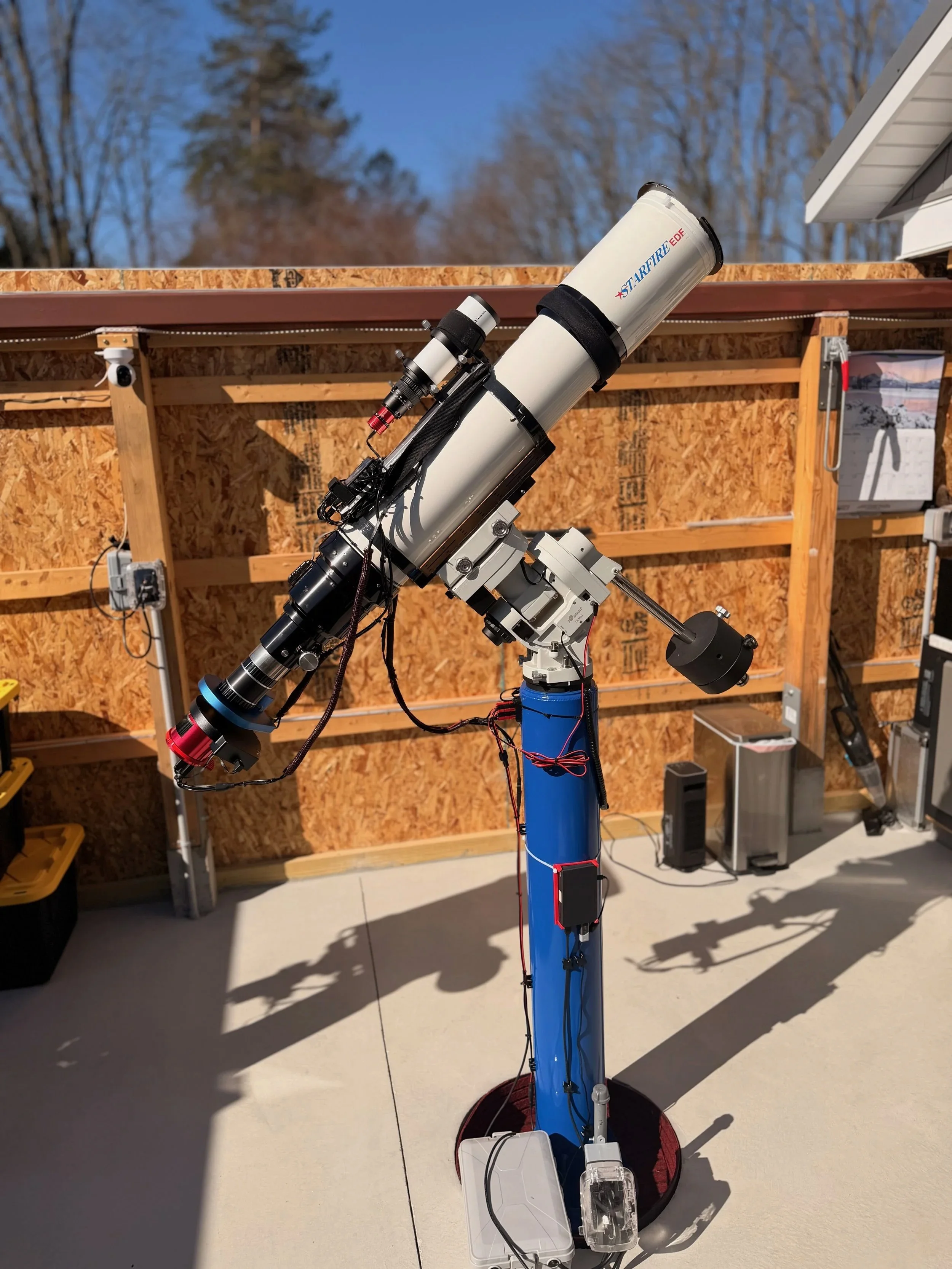
The AP155 (click on image to go to the blog entry for this scope)
📸 Capture Details
Nights: April 20 and 21, 2026
| Channel / Filter | Frames × Exposure | Settings | Total |
|---|---|---|---|
| L — ZWO Lum (36 mm unmounted) | 128 × 90 s | bin 1×1 • −15 °C • Gain 0 | 3 h 12 m |
| R — ZWO Red (36 mm unmounted) | 62 × 90 s | bin 1×1 • −15 °C • Gain 0 | 1 h 33 m |
| G — ZWO Green (36 mm unmounted) | 60 × 90 s | bin 1×1 • −15 °C • Gain 0 | 1 h 30 m |
| B — ZWO Blue (36 mm unmounted) | 62 × 90 s | bin 1×1 • −15 °C • Gain 0 | 1 h 33 m |
| Total Integration (after culling): 7 h 48 m 00 s (LRGB) | |||
Calibration Frames
- 30 × dark frames @ 90 s, bin 1×1, −15 °C, Gain 0
- 30 × dark-flats @ each flat exposure time, bin 1×1, −15 °C, Gain 0
- Flats: 15 each — L, R, G, B
Table of Contents Show (Click on lines to navigate)
Annotated Image
This annotated image was created with the ImageSolver and FinderChart scripts in PixInsight.
The Location in the Sky
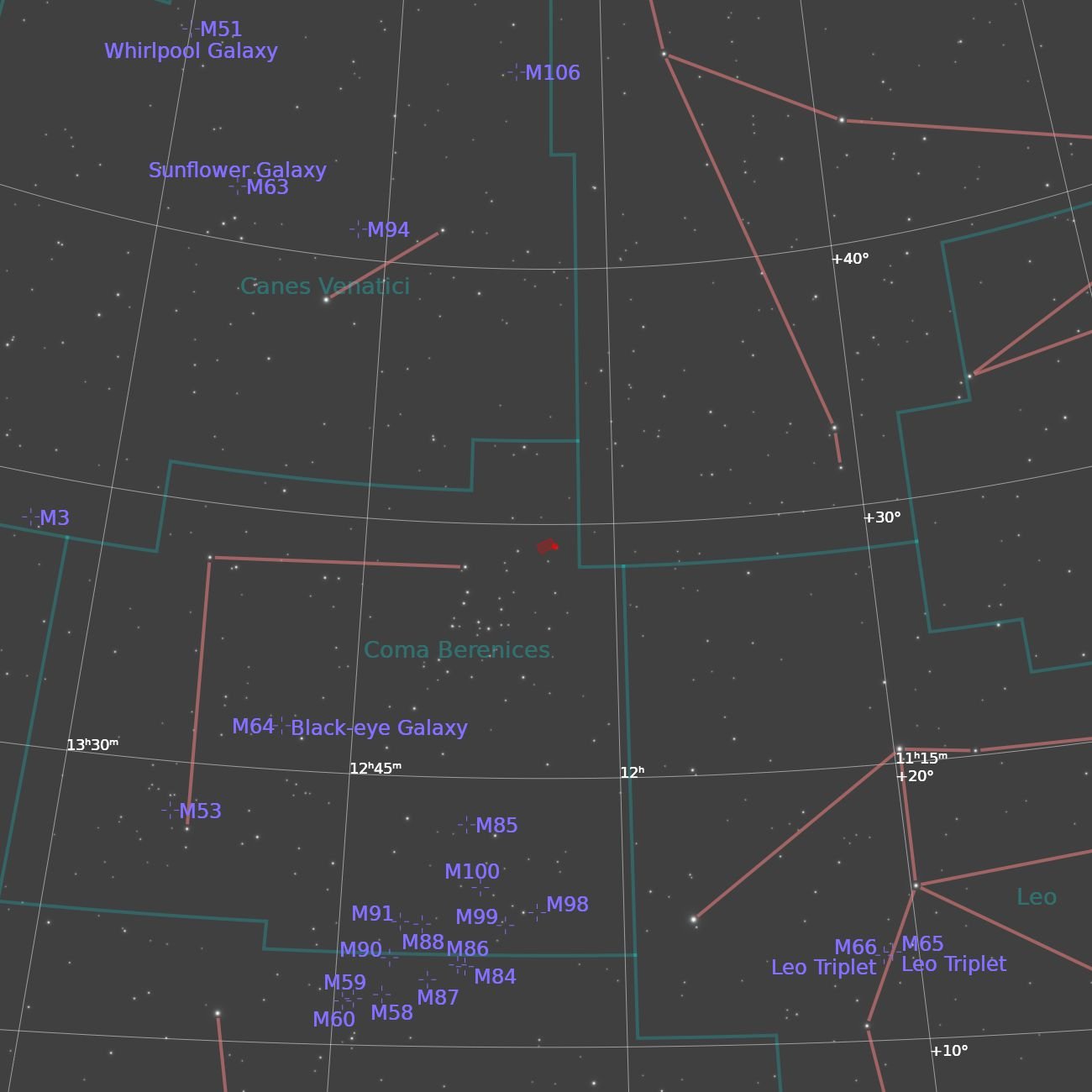
This annotated image was created with the ImageSolver and FinderChart scripts in PixInsight.
About The Target
🔭 Overview
Hickson 61, commonly known as “The Box,” is a compact apparent grouping of four small galaxies in Coma Berenices: NGC 4169, NGC 4173, NGC 4174, and NGC 4175. The nickname comes from the way these galaxies form a nearly rectangular pattern on the sky, with the elongated shapes of the edge-on members strengthening the illusion of a little cosmic box.
The entire group fits into an extremely small apparent field — roughly 3.8 arcminutes across — so it occupies only about one-eighth the apparent diameter of the full Moon. That small angular size is part of what makes this object so compelling: the galaxies are not large showpieces in the frame, but faint, distant systems that must be pulled out of the background with long exposure and careful processing.
Three of the galaxies — NGC 4169, NGC 4174, and NGC 4175 — are generally placed at roughly 170–200 million light-years away, while NGC 4173 appears to be a foreground galaxy, often cited at roughly 40–65 million light-years depending on the distance method used. So “The Box” is partly a real compact group and partly a line-of-sight alignment, which makes it visually neat but scientifically more subtle than it first appears.
Member Galaxies
Although Hickson 61 is visually known as “The Box,” the four galaxies are not all the same type, brightness, or distance. The group is a good example of how a small patch of sky can contain both physically related galaxies and a foreground object projected into the same line of sight.
NGC 4169
NGC 4169 is the brightest and most visually dominant member of Hickson 61. It sits at one corner of the box and is generally classified as a lenticular galaxy, or S0 type — a system with a smooth disk-like structure but little obvious spiral arm detail. Its apparent size is roughly 1.6 × 0.8 arcminutes, making it small in the image but still one of the easier members to detect. NGC 4169 has a brighter central region surrounded by a fainter elongated halo, and it is one of the three galaxies in Hickson 61 that appear to lie at roughly the same greater distance, around 170–200 million light-years. In the image, it is important because it anchors the group visually: a compact, pale galaxy that helps define one corner of the “box.”
NGC 4173
NGC 4173 is the long, thin galaxy that often gives Hickson 61 much of its visual drama. It is classified as a barred spiral galaxy, with a cataloged apparent size of about 2.3 × 0.5 arcminutes, though some catalogs and observing notes list a larger visual extent because its low-surface-brightness disk is diffuse and difficult to define cleanly. Despite appearing to be one of the largest members of the box, NGC 4173 is probably not a true physical member of the distant group. Its recession velocity is much lower than the other three galaxies, and it is usually treated as a foreground galaxy, perhaps roughly 40–65 million light-years away rather than 170–200 million light-years. That makes it a striking example of perspective: it looks like part of the box, but it is likely much closer to us.
NGC 4174
NGC 4174 is the smallest and faintest-looking of the main members, but it is an important part of the geometry of the group. It is commonly listed as a lenticular or very early-type disk galaxy, with an apparent size of about 0.9 × 0.4 arcminutes. Visually, this makes it a tiny target — less than one arcminute long — so in amateur deep-sky images it can appear as a small, bright-centered streak or compact smudge rather than a detailed galaxy. It is one of the background galaxies associated with the more distant part of Hickson 61, likely around 170–200 million light-years away. Its small angular size and faintness help illustrate the challenge of the target: this is not a large, showpiece spiral, but a very small extragalactic object pulled out of a dark field.
NGC 4175
NGC 4175 is a narrow, edge-on-looking barred spiral galaxy, cataloged at roughly 1.6 × 0.3 arcminutes. Its thin profile is one of the features that helps create the rectangular “box” impression. Observing descriptions often note it as an elongated haze, and it has been described as showing signs of interaction with a neighboring galaxy. Like NGC 4169 and NGC 4174, it appears to belong to the more distant background system at roughly 170–200 million light-years. Its slim, faint form makes it easy to underestimate, but in physical terms, it is a substantial galaxy seen from a great distance and at a steep viewing angle.
Hickson 61 Member Galaxies
| Galaxy | Common Role in “The Box” | Classification | Approx. Angular Size | Distance Context | Noted Features |
|---|---|---|---|---|---|
| NGC 4169 | Brightest member; anchors one corner of the box | Lenticular galaxy — S0 | ~1.6′ × 0.8′ | ~170–200 million light-years | Bright central region with a smoother elongated halo; visually one of the easiest members to identify. |
| NGC 4173 | Long, thin side of the apparent box | Barred spiral / low-surface-brightness disk galaxy | ~2.3′ × 0.5′ | Likely foreground galaxy, roughly ~40–65 million light-years | Diffuse, faint, and elongated. It appears to belong to the box visually, but is probably much closer than the other three galaxies. |
| NGC 4174 | Small, compact member forming one side of the box | Small, nearly edge-on disk galaxy | ~0.9′ × 0.4′ | ~170–200 million light-years | Very small and faint in apparent size; appears as a compact, bright-centered streak or smudge in deep images. |
| NGC 4175 | Thin edge-on-looking member completing the box pattern | Barred spiral galaxy | ~1.6′ × 0.3′ | ~170–200 million light-years | Narrow, elongated profile; helps create the rectangular “box” appearance. May show signs of interaction. |
📜 History
The four galaxies were first recorded by William Herschel on April 11, 1785, long before their true nature as separate galaxies was understood. Herschel cataloged them as faint or very faint nebulae, noting that they were small, faint, and closely grouped within only a few arcminutes. More than a century later, they entered the New General Catalog as NGC 4169, NGC 4173, NGC 4174, and NGC 4175. Their modern identity as Hickson Compact Group 61 comes from Paul Hickson’s 1982 catalog of 100 compact galaxy groups, selected from Palomar Observatory Sky Survey plates using criteria involving number of galaxies, compactness, surface brightness, and isolation.
🔬 Science and Structure
Hickson compact groups are important because they place several galaxies into a very small projected region of space, making them natural laboratories for studying galaxy interactions, tidal effects, gas stripping, star formation, and long-term galaxy evolution. In many compact groups, galaxies are close enough that gravity can distort their shapes, remove gas, or eventually drive mergers. Hickson 61 is especially interesting because it demonstrates one of the complications of astronomy: objects that look physically close on the sky may not all be at the same distance. NGC 4169, NGC 4174, and NGC 4175 appear to be the more physically related background members, while NGC 4173 is likely a nearer foreground galaxy projected into the same line of sight. That makes the “box” shape a striking visual arrangement, but not a simple four-galaxy family sitting at one distance. This is a good reminder that deep-sky images are two-dimensional projections of a three-dimensional universe.
💡 Interesting Notes
The most impressive thing about Hickson 61 is not that it is bright or large — it is neither. It is impressive because it is small, faint, and remote. The whole arrangement spans only a few arcminutes, and the individual galaxies are modest, low-brightness targets rather than grand Messier-style spirals. The brightest member, NGC 4169, is still only around magnitude 13, and the other members are fainter still, making this a demanding target for visual observers and a rewarding one for deep imaging. The “box” pattern is also somewhat deceptive: the eye immediately sees a tidy geometric group, but the distance data show that one side of the box is probably much closer to us than the others. In other words, this image captures both a real distant galaxy grouping and a fortunate foreground alignment — a small patch of sky where perspective turns scattered galaxies into a memorable shape.
About the Project
Planning and Weather
This is the fourth and final image processed from my broader April 11, 20, and 21 capture batch. The Hickson 61 data itself came from April 20 and 21. This was also the second image taken with my AP155 platform.
I was looking for a challenging galaxy-season target and wanted something a little different. I came across Hickson 61, “The Box,” a small compact group I had never imaged before, and I was immediately intrigued.
In the full field, Hickson 61 is easy to overlook. The point of this image is not scale or spectacle, but the challenge of resolving a tiny, faint galaxy arrangement where three distant galaxies and one foreground interloper happen to form a memorable box on the sky.
The first challenge was its size. The main box-like arrangement spans only about 3.8 arcminutes, making it a better match for my SCA260 platform at 1300 mm. But that platform already had another target assigned, so the next best choice was the AP155 at about 840 mm.
After doing an analysis with my Astro Systems Comparison Tool, the results suggested that the difference under my skies using the shorter focal length would not be severe.
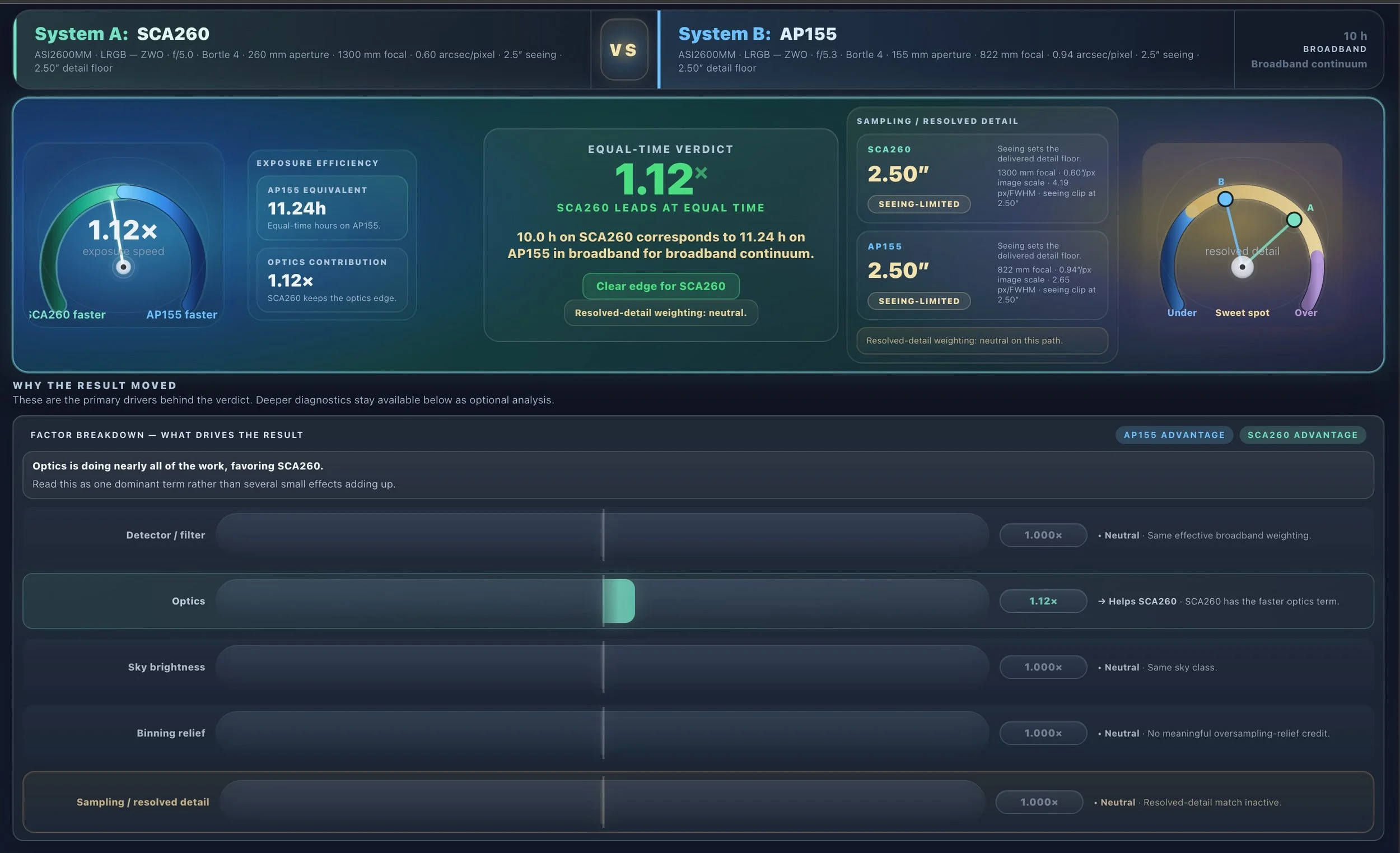
I suspected that the real driver here would be the sky. With an average seeing of 2.5 arcseconds, the sky would likely dominate the final sharpness and detail.
The other issue was balance.
The AP155 platform has a heavy scope and load, and after installing the powered cover, I found I was having real issues with off-axis balance. I just had not dialed that in yet. As a result, in certain positions, the system was not tracking well.
So - a distant, tiny, and faint target to be shot with a large scope with serious balance problems. What could go wrong?
Data Collection
In order to determine my exposure strategy, I used a new tool I created to make exposure recommendations. This tool is the Astro Exposure Explorer. In the past, based on what seemed to be a popular recommendation for this camera, I had used an exposure of 90 seconds with a gain of 0.
One of these tools focuses on determining a practical sub-exposure range. The exposure has to be long enough to overcome read noise and operational workflow losses, but not so long that too many stars saturate or the background sky brightness consumes too much usable well depth. The tool uses the camera's physics, the filter, the workflow, and sky brightness to estimate a safe exposure range.
This tool is called the Astro Exposure Explorer Tool, and is free.
You can see its recommendations for this situation below:
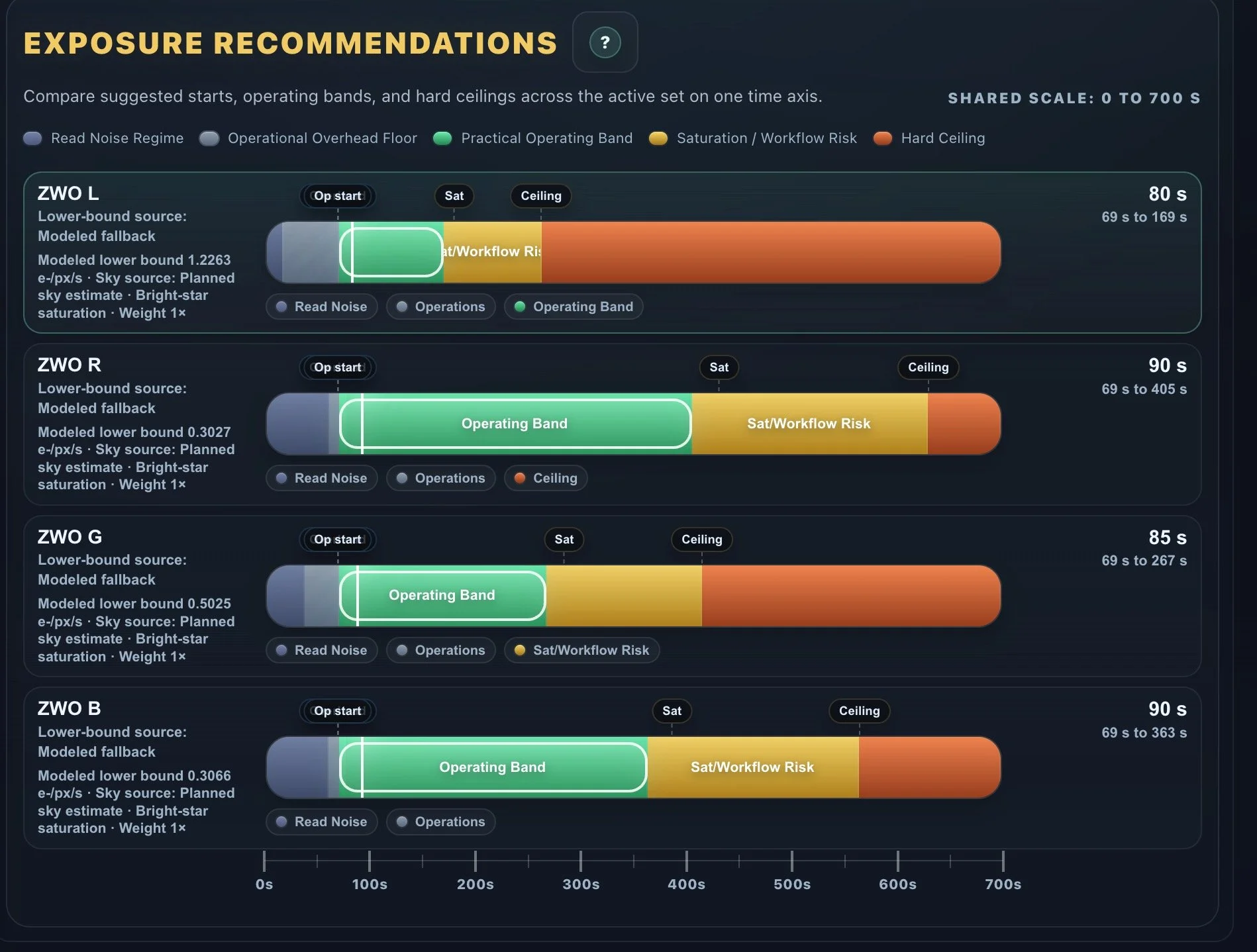
This tended to validate my sub-exposure selection. It looks like I could have reduced the exposure a bit, but I am well into the practical operating zone, and I feel good about that. I used a camera temperature setpoint of −15 °C.
And, as I have been doing recently, I am collecting two L subframes and one subframe for R, G, and B.
Data collection was awful! This was not one of those projects where the data simply fell into place.
During this period of time, we had three clear nights. The first night was a complete loss. Tracking was terrible, and I had a lot of trailing stars. It was so bad, I killed the session and gave up in disgust!
The next day, I tried again to solve my balance issues, and the next night, I tried again. Tracking was still not optimal. I stopped and ran PHD2’s Guiding Assistant for 10 minutes, then accepted the settings it recommended. After this, things were better - but not great.
I collected about 8 hours of subs over two evenings, on April 20 and 21.
I used PixInsight’s Blink to identify and remove bad frames, but I only needed to remove 14, and WBPP did not remove any more.
The resulting Master images showed egg-shaped stars and effects of a local light pollution source near one corner of the frame.
Clearly, my image processing would be a challenge with this project!
Post-Processing
The processing plan for this image was pretty straightforward.
I used my typical LRGB workflow that looks something like this:
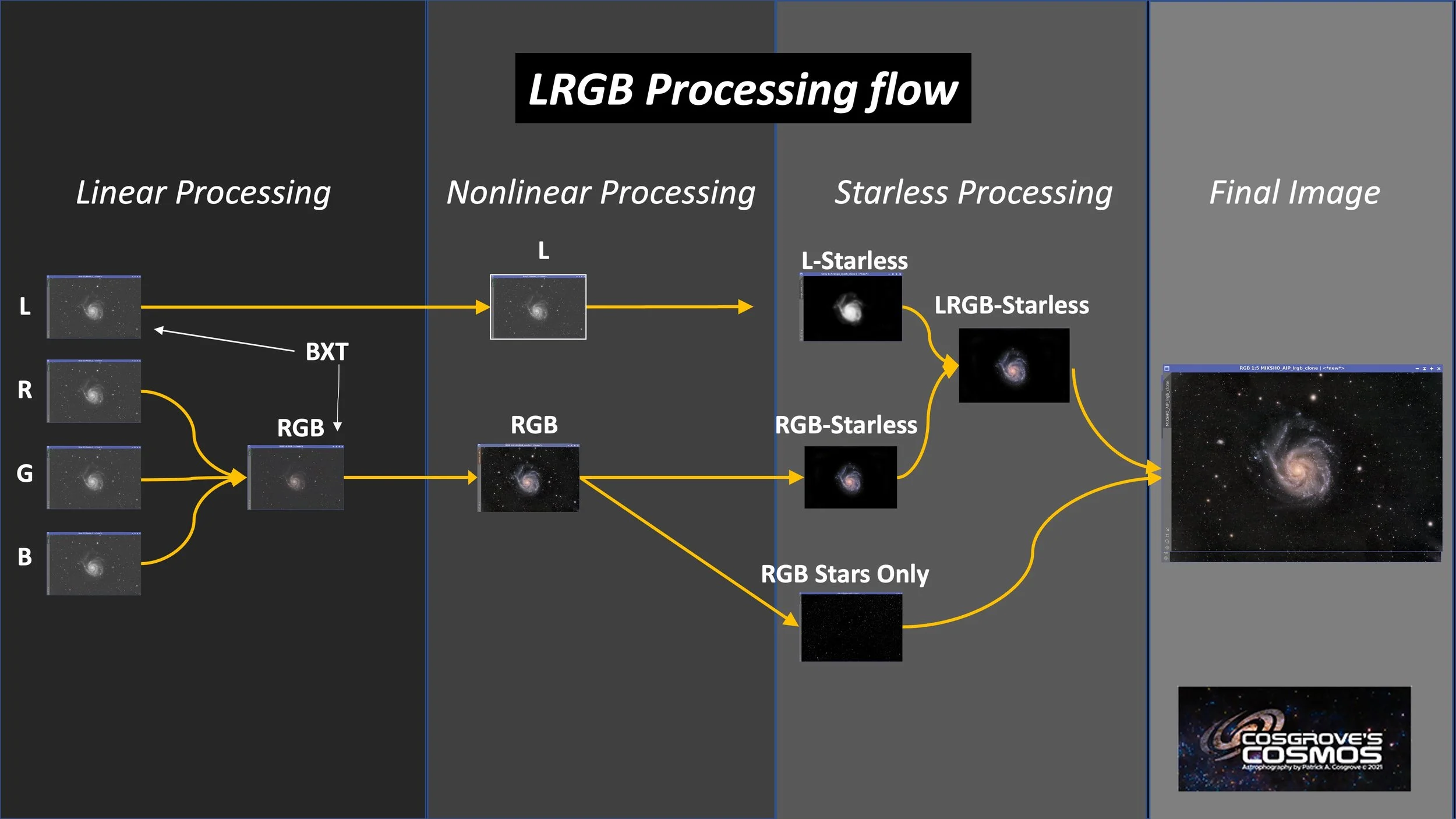
My typical LRGB Starless Workflow.
Processing was pretty straightforward. With these tiny galaxies, there is only so much that can be done.
My initial concern was the egg-shaped stars. However, I was very impressed with the results from the BlurXTerminator running in Correct-Only mode. The stars were nicely corrected, and this tool - in my mind - saved this image.
I created a series of GAME masks covering various galaxies or galaxy groups in the image, then worked on them one at a time.
The other issue I had was cropping. This galaxy group was super small in the frame, and to get a decent view of them, I had to aggressively crop in tight. This eliminated several interesting galaxies from the FOV, which makes me think there might be a second image I could still crop out of the master frame!
Detailed and Annotated Image Processing Walkthrough
Typically, I conclude one of these imaging projects by documenting the processing steps I used on this image. But this section can make the overall post very large and, at times, slow to load.
I am now creating a secondary, standalone page to hold this information. You can access this page by clicking the link below. Returning to this page is as simple as clicking the back arrow in your browser or selecting a different menu option at the top of the page.
I hope you like this new format!
Use the link below to see the detailed image processing walkthrough for this imaging project.
Hickson 61 Detail Processing Page
Final Results
This was a very tiny galaxy group captured at a shorter focal length than ideal for the target. In the full frame, the group is easy to lose, so I had to crop aggressively to make the “box” visible and interesting.
Add in the tracking problems and the local light-pollution issue, and the chances of producing a great image were limited from the start.
But given all of that, the final result is a respectable capture of a small, faint, and interesting group of galaxies. If anything, it also confirms that the optics in the AP155 are excellent.
In the full field, Hickson 61 is easy to overlook. The point of this image is not scale or spectacle, but the challenge of resolving a tiny, faint galaxy arrangement where three distant galaxies and one foreground interloper happen to form a memorable box on the sky.
More Info
🔭 Target Details
SIMBAD Astronomical Database — NGC 4169
Core reference entry for the brightest member of Hickson 61, including identifiers, object type, measurements, radial velocity, bibliography, and database links.
SIMBAD Astronomical Database — NGC 4173
Core reference entry for the long, low-surface-brightness foreground galaxy that visually forms one side of “The Box.”
SIMBAD Astronomical Database — NGC 4174
Core reference entry for the small, faint galaxy that helps define the compact box-like geometry of HCG 61.
SIMBAD Astronomical Database — NGC 4175
Core reference entry for the narrow, elongated galaxy completing the apparent rectangle of Hickson 61.
NASA/IPAC Extragalactic Database — HCG 61
Professional extragalactic database entry for Hickson 61, useful for redshift, photometry, cross-identifications, literature references, and follow-up research.
CDS Aladin Lite — Hickson 61 Interactive Sky Atlas
Web-based sky viewer centered directly on HCG 61, with survey imagery and catalog overlays for exploring the surrounding field.
📜 History & Naming
New General Catalog Objects: NGC 4150–4199 — Cseligman
Historical and catalog-oriented notes for this NGC region, including entries for the galaxies in Hickson 61 and discussion of the likely foreground nature of NGC 4173.
Systematic Properties of Compact Groups of Galaxies — Paul Hickson, 1982
Original scientific paper that defined the Hickson Compact Group catalog, including the selection criteria behind groups such as HCG 61.
Hickson Compact Groups of Galaxies Catalog — HEASARC
NASA/HEASARC catalog description for the Hickson Compact Groups, summarizing the source catalog and related data tables.
Hickson Compact Groups Catalog — Data.gov
Public catalog reference describing the Hickson Compact Groups data set and its connection to the original Hickson catalog papers.
🔬 Science & Observations
The Infrared Properties of Hickson Compact Groups — arXiv
Open-access research paper using 2MASS and Spitzer observations of Hickson Compact Groups, including HCG 61, to study star formation, dust, and infrared galaxy properties.
The Infrared Properties of Hickson Compact Groups — ADS
ADS record for the published version of the infrared Hickson Compact Group study.
A ROSAT Survey of Hickson’s Compact Galaxy Groups — arXiv
X-ray survey of Hickson Compact Groups, providing broader context on hot intragroup gas and the physical nature of compact galaxy systems.
X-Ray Emission from Hickson’s Compact Groups of Galaxies — ADS
Research reference on X-ray emission from compact groups, useful for understanding how these dense galaxy environments are studied beyond visible light.
Compact Groups in Theory and Practice — SDSS Compact Group Study
Broader research context on compact galaxy groups, projection effects, interlopers, and how compact groups are identified in modern survey data.
Low-Luminosity Activity in Hickson Compact Groups — arXiv
Scientific context on nuclear activity in compact-group galaxies and how dense environments may influence galaxy evolution.
💡 Interesting Facts & Outreach
Hickson 61 — The Box — Skyhound Observing Guide
Observing-oriented overview emphasizing the tiny 3.8 arcminute field, the box-like arrangement, and the difficulty of seeing these faint galaxies visually.
HCG 61 — Mantrap Skies Astronomical Image Catalog
Amateur imaging reference for Hickson 61 with useful notes on the four galaxies and their different distance interpretations.
Hickson 61, The Box Galaxies in Coma Berenices — Cloudy Nights
Detailed observing discussion highlighting the faintness, apparent geometry, and foreground/background nature of the group.
The Box Galaxies — Hickson 61 — Stargazers Lounge
Amateur imaging and observing discussion with practical comments on the group’s faintness and individual galaxy magnitudes.
NGC 4169 / Hickson 61 Finder Chart — J. W. Inman
Finder-chart style reference for locating NGC 4169 and the other galaxies in the Hickson 61 field.
The Box, Galaxy Group Hickson 61 — AstroBin
Example deep image of Hickson 61 showing how the small galaxies form the recognizable “Box” pattern.
Imaging Platform Used
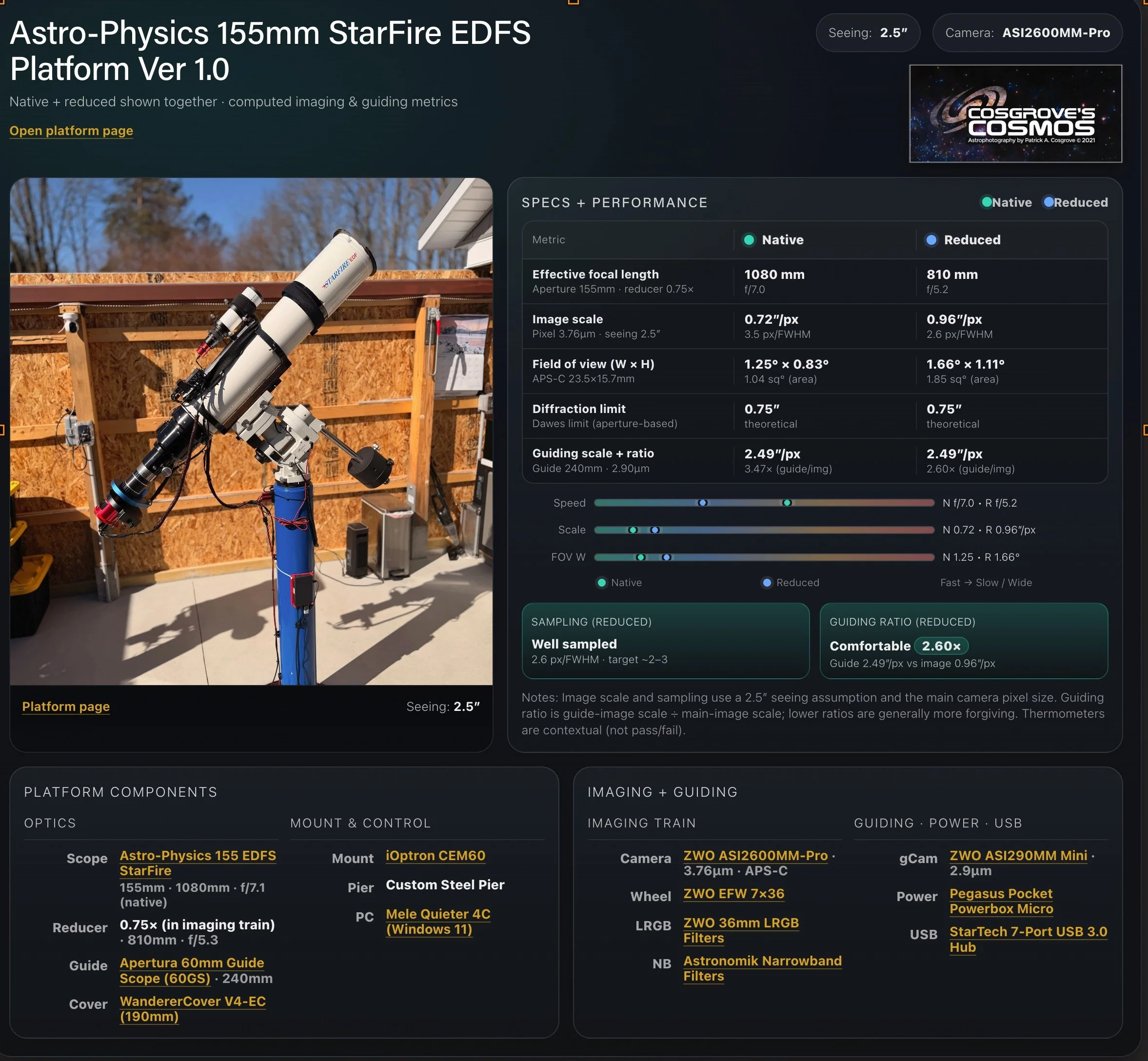
The details for the AP155 Platform.
Platform used for this project
Software
Capture Software: PHD2 Guider, NINA
Image Processing: PixInsight, Photoshop - assisted by Coffee, extensive processing indecision and second-guessing, editor regret, and much swearing…