
The Leo Triplet: M65, M66, and NGC 3628 - 12.6 hours of LRGB - First Light for the FRA400’s New Camera!
Date: May 28, 2026
Cosgrove’s Cosmos Catalog ➤#0162
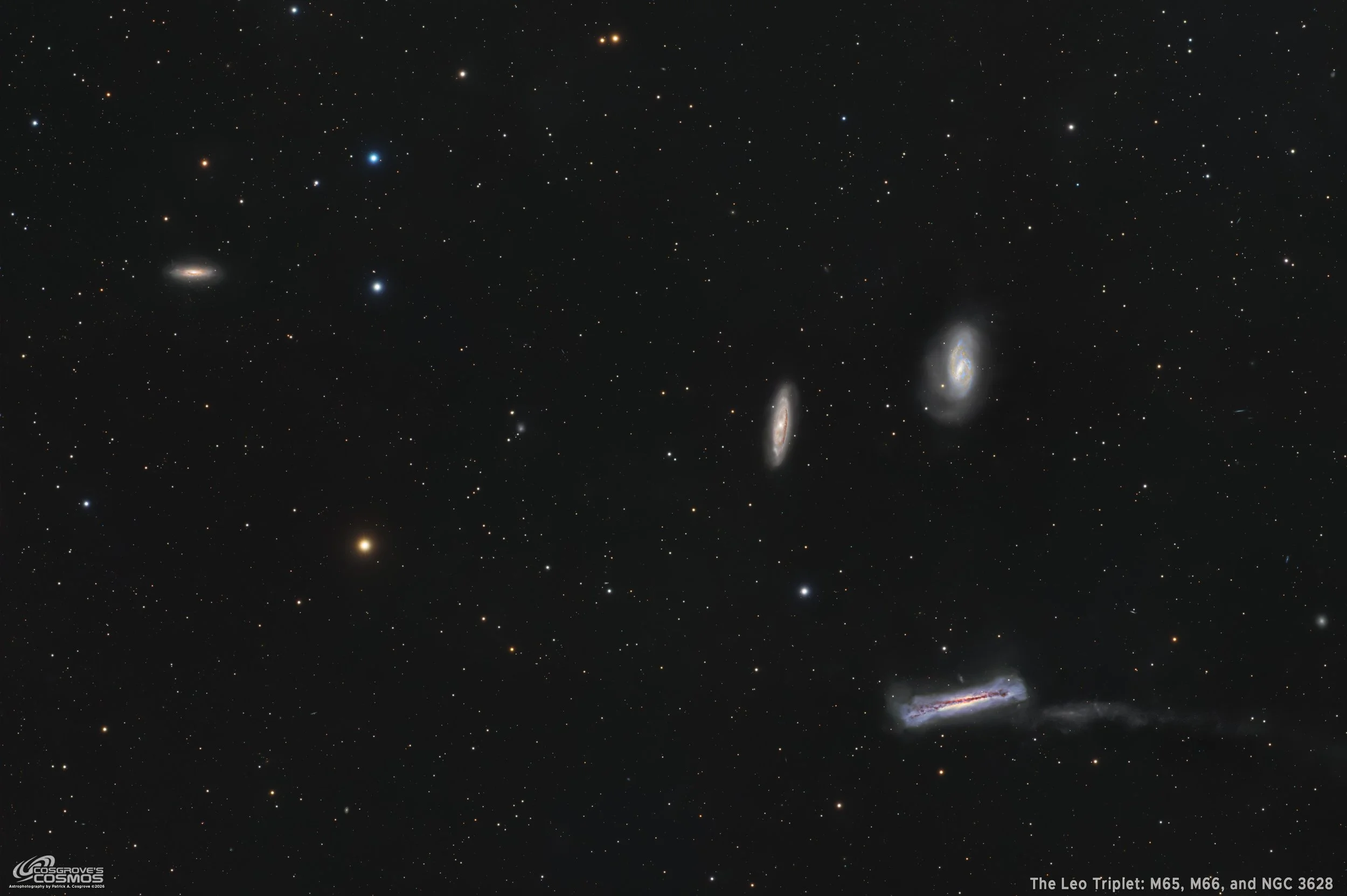
The Leo Triplet — first light with the new ASI2600MM-Pro camera on my FRA400 platform (Click image for hi-res version via AstroBin.com.)
The Leo Triplet — interacting galaxies, tidal debris, and a wider galactic neighborhood in Leo.
🔭 Project Summary
Target: Leo Triplet — M65 / M66 / NGC 3628, with NGC 3593
Capture Dates: April 11, 20, and 21, 2026
Constellation: Leo • Distance: ≈ 30–35 million light-years
Type: Interacting galaxy group featuring two inclined spiral galaxies, one edge-on spiral galaxy, faint tidal debris, and nearby NGC 3593
Imaging Period: April 11–21, 2026 • Total Integration: 12 h 39 m 00 s (LRGB)
Filters: L · R · G · B (ZWO 36 mm LRGB Gen II)
Telescope: Askar FRA400 72 mm f/5.6 Quintuplet Air-Spaced Astrograph
Camera: ZWO ASI2600MM-Pro (−15 °C; Gain 0 LRGB)
Mount: ZWO AM5 on custom steel pier
Processing: PixInsight (LRGB) & Photoshop
Location: Whispering Skies Observatory · Honeoye Falls, NY (USA)
Acquisition notes: L: 128 × 90 s; R: 128 × 90 s; G: 125 × 90 s; B: 125 × 90 s at −15 °C, Gain 0; total 12 h 39 m 00 s after culling bad or questionable subs.
Image note: This wide-field LRGB image captures the main Leo Triplet galaxies, nearby NGC 3593, and the faint tidal tail extending from NGC 3628.
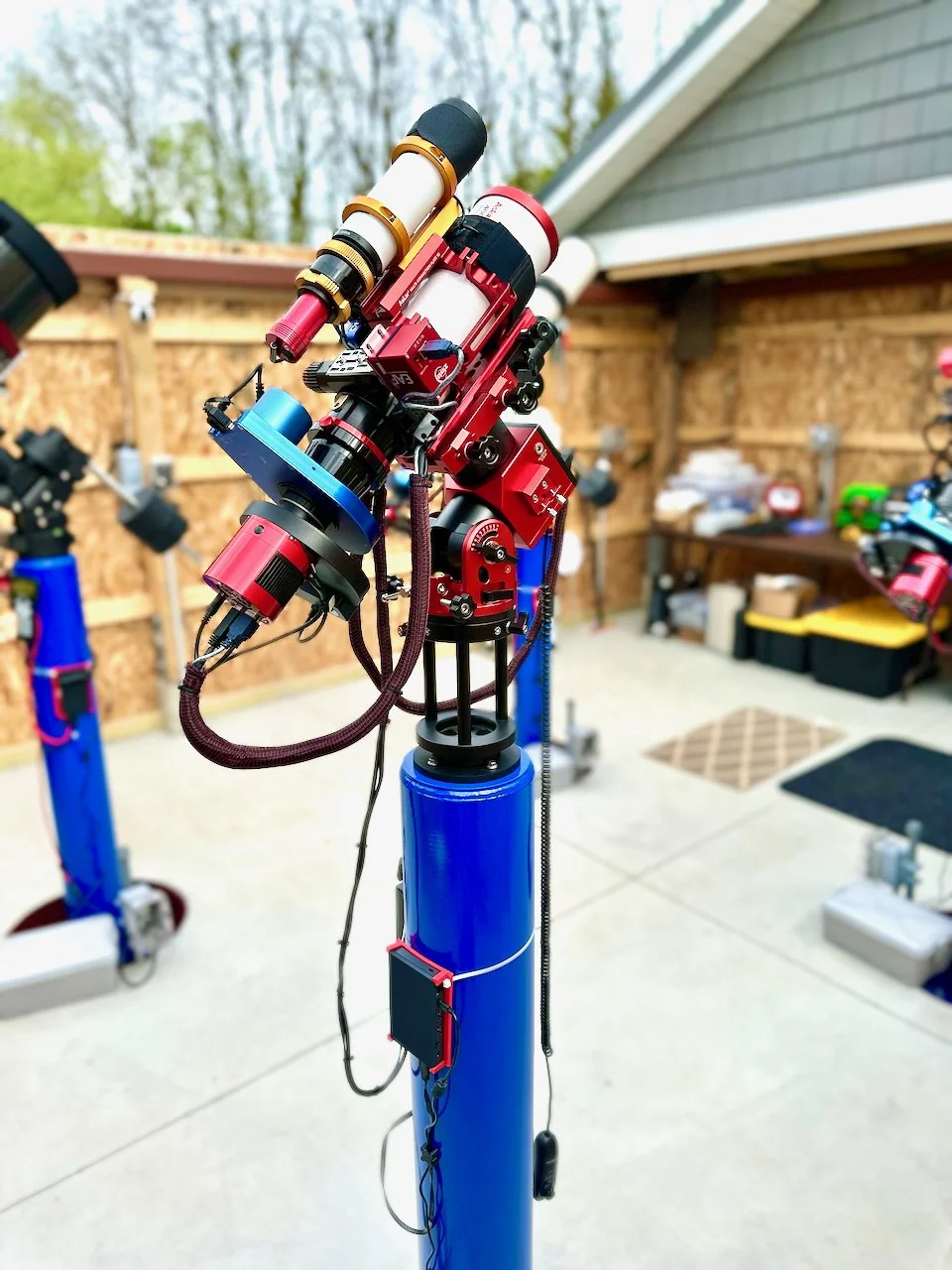
The FRA400 (click on image to go to the blog entry for this scope)
📸 Capture Details
Nights: April 11, 20, and 21, 2026
| Channel / Filter | Frames × Exposure | Settings | Total |
|---|---|---|---|
| L — ZWO Lum (36 mm unmounted) | 128 × 90 s | bin 1×1 • −15 °C • Gain 0 | 3 h 12 m |
| R — ZWO Red (36 mm unmounted) | 128 × 90 s | bin 1×1 • −15 °C • Gain 0 | 3 h 12 m |
| G — ZWO Green (36 mm unmounted) | 125 × 90 s | bin 1×1 • −15 °C • Gain 0 | 3 h 07 m 30 s |
| B — ZWO Blue (36 mm unmounted) | 125 × 90 s | bin 1×1 • −15 °C • Gain 0 | 3 h 07 m 30 s |
| Total Integration (after culling): 12 h 39 m 00 s (LRGB) | |||
Calibration Frames
- 30 × dark frames @ 90 s, bin 1×1, −15 °C, Gain 0
- 30 × dark-flats @ each flat exposure time, bin 1×1, −15 °C, Gain 0
- Flats: 15 each — L, R, G, B
Table of Contents Show (Click on lines to navigate)
Annotated Image
This annotated image was created with the ImageSolver and FinderChart scripts in PixInsight.
The Location in the Sky
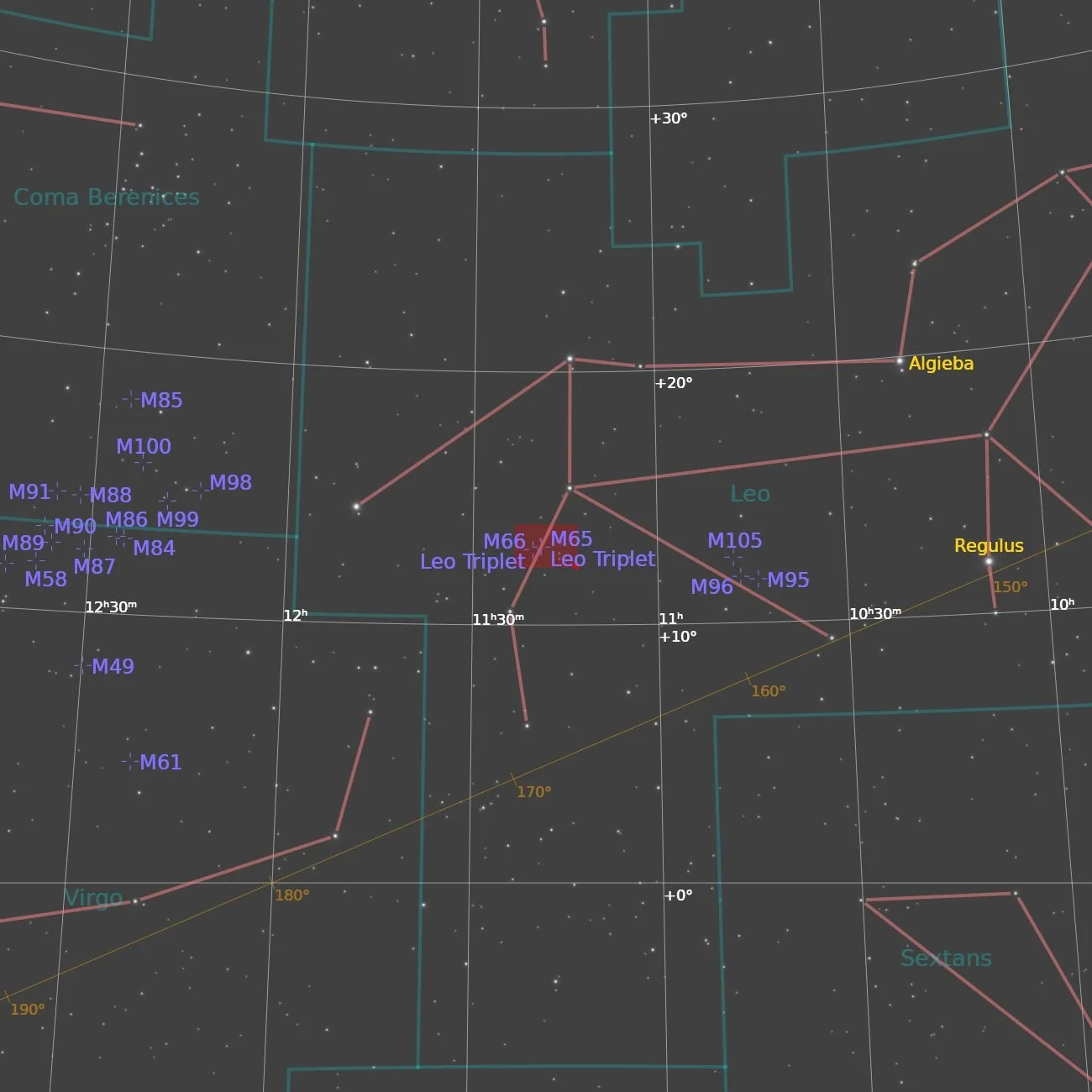
This annotated image was created with the ImageSolver and FinderChart scripts in PixInsight.
About The Target
🔭 Overview
The Leo Triplet, also known as the M66 Group, is a compact grouping of three bright spiral galaxies in the constellation Leo: Messier 65 / M66 / NGC 3627, and NGC 3628.
The group lies roughly 30–35 million light-years from Earth, which means the light recorded in this image left these galaxies long before humans existed.
By galactic standards, this is a relatively nearby group, close enough that the three main galaxies show clear signs of mutual gravitational influence. NGC 3628 is especially interesting because we see it nearly edge-on, with a dark dust lane cutting across the middle. This appearance has earned it the nickname the Hamburger Galaxy.
This image also includes NGC 3593, a fainter nearby galaxy in Leo that is sometimes, though not always, listed as part of the broader M66 / Leo Triplet group. This project is a 12.6-hour LRGB exposure, deep enough to show not only the three main galaxies, but also the faint tidal material extending from NGC 3628.
📜 History
M65 and M66 were discovered in 1780 and later included in Charles Messier’s catalog of comet-like deep-sky objects. Both are relatively bright galaxies and are the easiest members of the group to see visually under good skies. NGC 3628, despite being a major member of the group, was not included in Messier’s catalog and was later discovered by William Herschel in 1784. That is not surprising: NGC 3628 is more diffuse, more edge-on, and visually less obvious than M65 and M66. NGC 3593 is a separate New General Catalogue object in the same region of Leo. Its inclusion in wide-field images of the Leo Triplet helps show that this part of the sky is not just a trio of galaxies, but part of a richer nearby galaxy environment.
🔬 Science and Structure
Each of the main galaxies has a distinct appearance.
M65 is a tilted spiral galaxy with a bright central region, tightly wound arms, and dust structure that hints at past gravitational disturbance.
M65.
M66 is larger and more obviously distorted, with an asymmetric spiral pattern and a bright, off-center-looking core; it appears to have been strongly affected by past interaction with its neighbors.
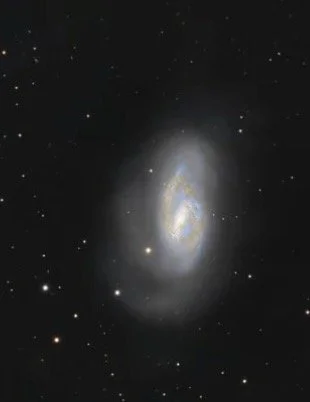
M66.
NGC 3628 is the most visually unusual of the three. Seen almost edge-on, it shows a broad dark dust lane, a faint outer halo, and a long tidal stream extending away from the galaxy. That stream is material pulled out by gravitational interaction within the group, and it is often described as extending roughly 300,000 light-years. NGC 3593 is different again: it is usually classified as a lenticular or early-type spiral galaxy and is notable for containing gas, dust, active star formation, and counter-rotating stellar populations, meaning part of its stellar system rotates in the opposite direction from another component.
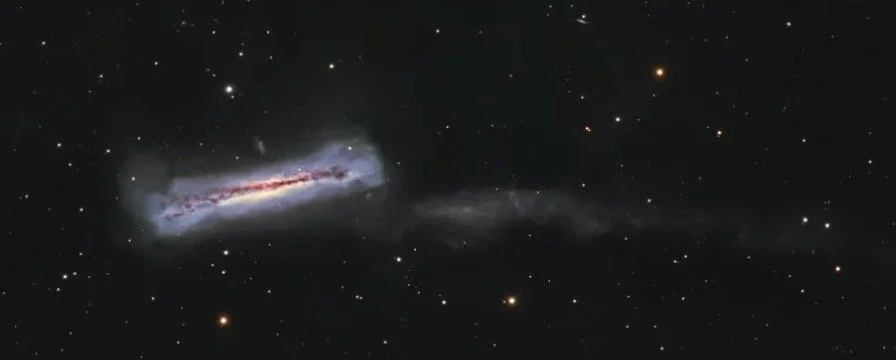
NGC 3628
💡 Interesting Notes
What makes this field especially satisfying to image is that it works on several levels. For beginners, the Leo Triplet is a clear example of how galaxies are not isolated objects floating peacefully in space; they interact, distort one another, and leave behind visible evidence. For more experienced observers and imagers, the challenge is going deep enough to bring out the faint tidal tail of NGC 3628 without overwhelming the brighter cores of M65 and M66. That tail is often described as extending hundreds of thousands of light-years and is one of the best visual clues that this group has had a violent gravitational past. NGC 3593 adds another layer of interest because it is not usually the headline object in Leo Triplet images, yet it has unusual internal dynamics and star-forming activity of its own. In a single field, this image captures bright Messier spirals, an edge-on disturbed galaxy, faint tidal debris, and a smaller galaxy with its own complex history.
About the Project
Planning and Weather
This is the third image processed from the batch of images captured on April 11, 20, and 21. Being smack-dab in the middle of galaxy season, I was looking for - you guessed it - galaxies!
I had just finished upgrading my FRA400 telescope platform with a new-generation camera (ASI2600MM-Pro) and a new motorized scope cover, and I was looking for the first project to test this new configuration.
It is usually a challenge to find good galaxy targets for the FRA400 because most galaxies are small at this focal length.
But the Leo Triplet is one of those classic targets that I had shot years before and had never revisited. I thought this would be a good test for the new platform configuration.
This earlier project can be seen here:
Here is the image captured then:
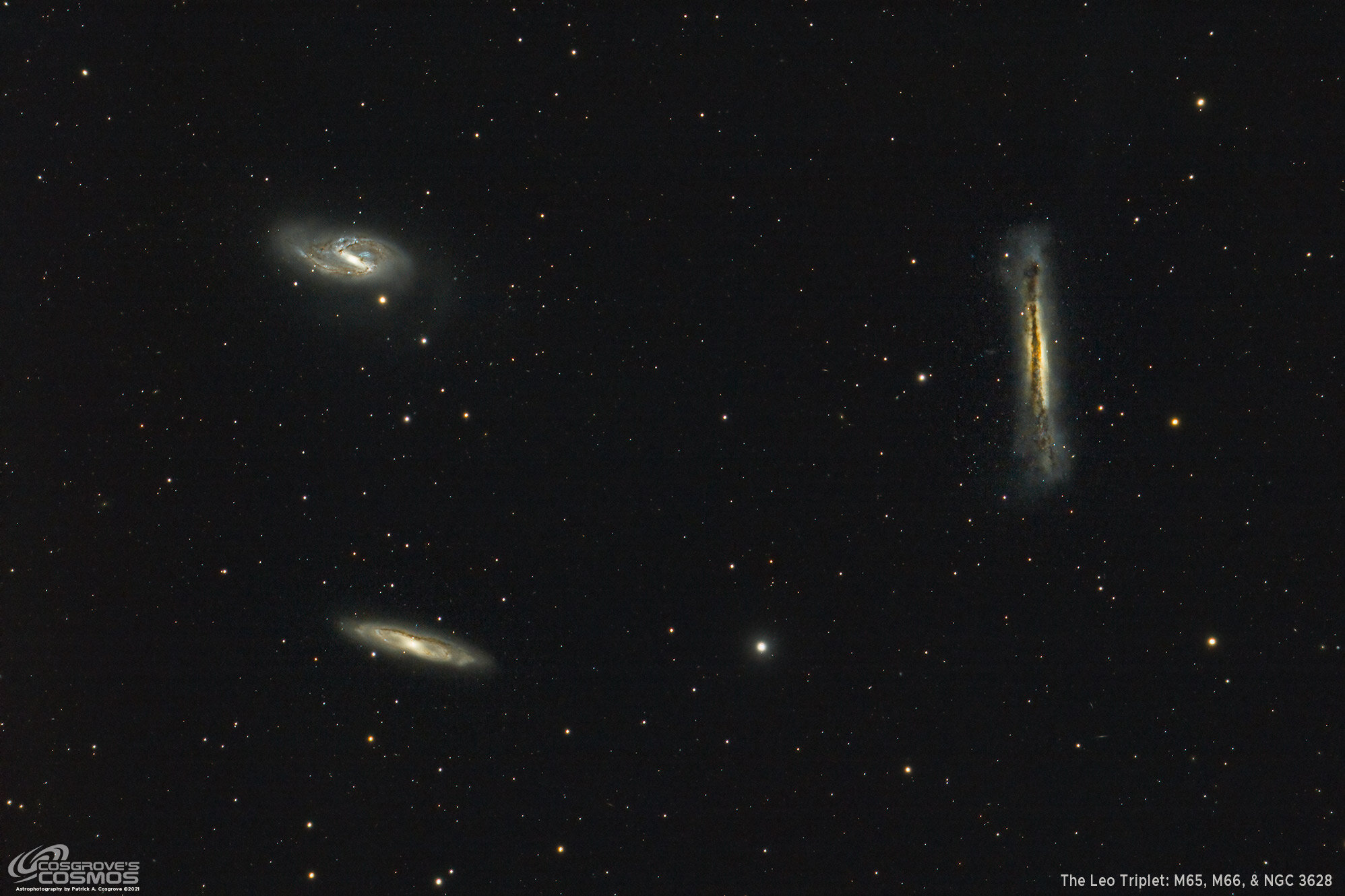
The June 2021 version of the Leo Triplet.
This was a 2.9-hour exposure on an OSC camera on WO132 scope - a much larger scope with 2.3X in focal length and almost twice the aperture! This would be tough to beat with a much smaller scope. So the comparison should be interesting!
Data Collection
In order to determine my exposure strategy, I used a new tool I created to make exposure recommendations. This tool is the Astro Exposure Explorer. In the past, based on what seemed to be a popular recommendation for this camera, I had used an exposure of 90 seconds with a gain of 0.
One of these tools focuses on determining a practical sub-exposure range. The exposure has to be long enough to overcome read noise and operational workflow losses, but not so long that too many stars saturate or the background sky brightness consumes too much usable well depth. The tool uses the camera's physics, the filter, the workflow, and sky brightness to estimate a safe exposure range.
This tool is called the Astro Exposure Explorer Tool, and is free.
You can see its recommendations for this situation below:
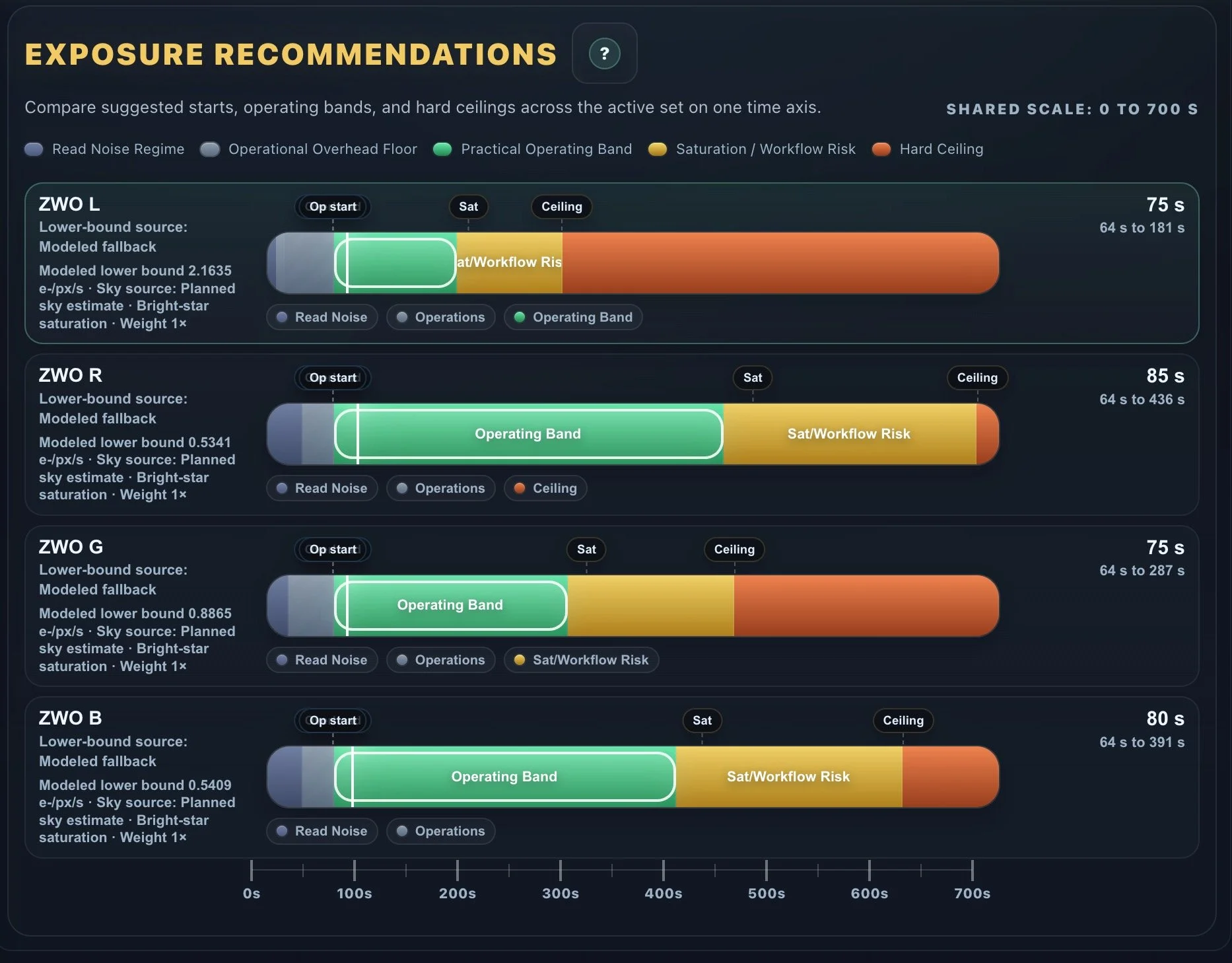
This tended to validate my sub-exposure selection. It looks like I could have reduced the exposure a bit, but I am well into the operational zone, and I feel good about that. I used a camera temperature setpoint of −15 °C.
Data collection was uneventful.
Tracking seemed to be going well, so no concerns here.
I used PixInsight’s Blink to identify and remove bad frames, but I only needed to remove 7, and WBPP did not remove any more.
So, how would this capture session compare to my 2021 capture? Strictly on a time basis, the 2021 exposure accounts for only 23% of the hours captured on this current project. But you have to go deeper than that to understand the real differences.
To compare these two systems, I used another new tool that I developed - the Astro Systems Comparison Tool - to compare the two systems, and here were the results:
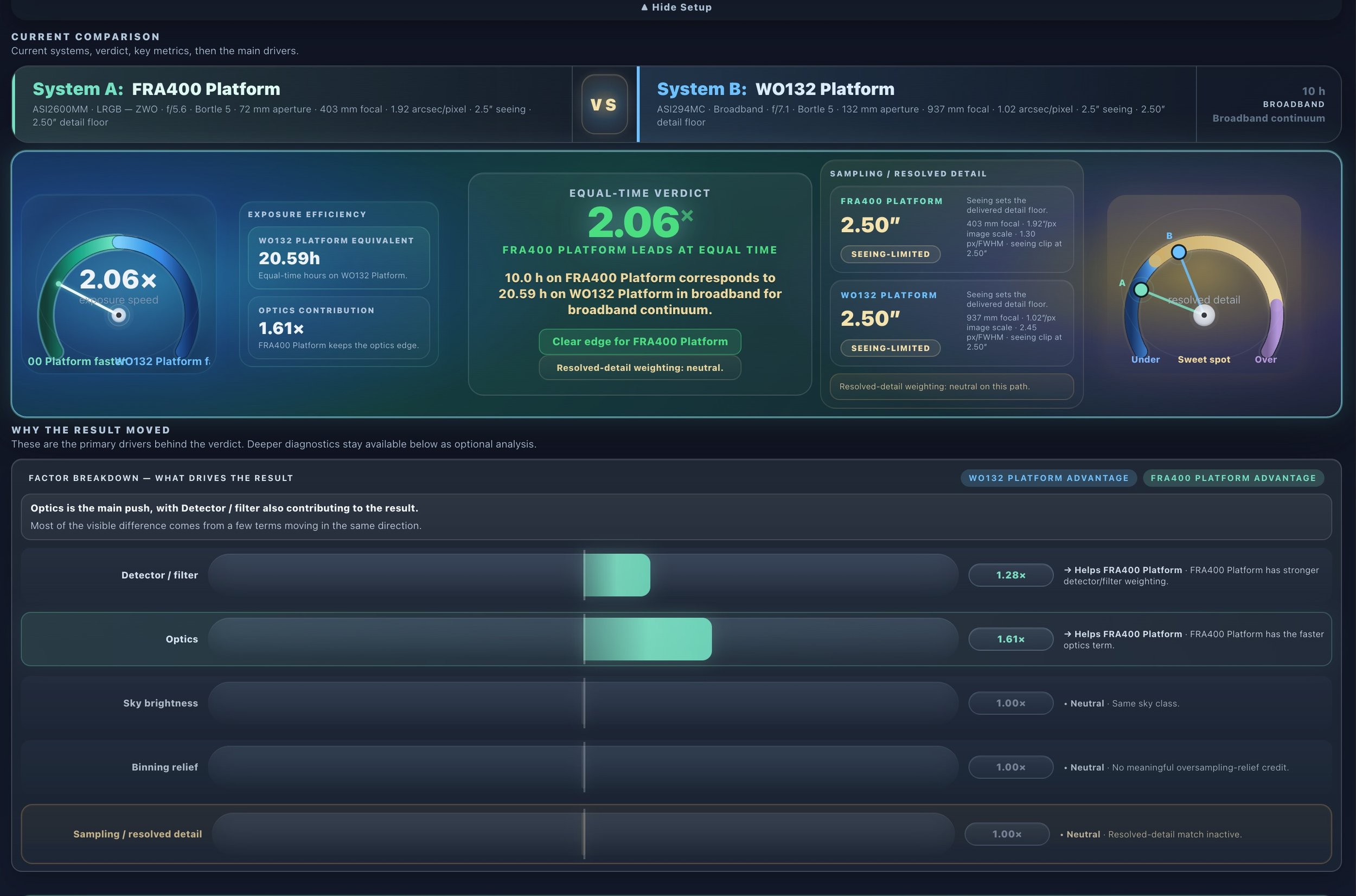
Results from the Astro Systems Comparison Tool.
According to this result, the 12.6 hours of integration I achieved on the current FRA400 platform would be equivalent to roughly 26 hours on the older WO132 platform as it existed back in 2021.
Since the earlier image had only 2.9 hours of integration, there should be a clear step up in signal-to-noise ratio. Another thing that stood out was that, despite the difference in image scale, both systems were still limited by the local seeing.
Another thing that was evident was that, despite differences in image scale, both were limited by the local seeing!
This is a fun tool to play with, and I find myself using it more and more to compare systems and changes I could make to improve their efficiency. It's free, so check it out!
So I should be able to have a much richer signal set in the new image. But will this improve the quality that much? We shall see.
Processing Overview
Pre-processing
As noted above, I spent a lot of time in Blink culling subs.
This left me with just over 500 frames to preprocess, and this took about 90 minutes to run on my image processing workhorse.
Post-Processing
The processing plan for this image was pretty straightforward.
I used my typical LRGB workflow that looks something like this:
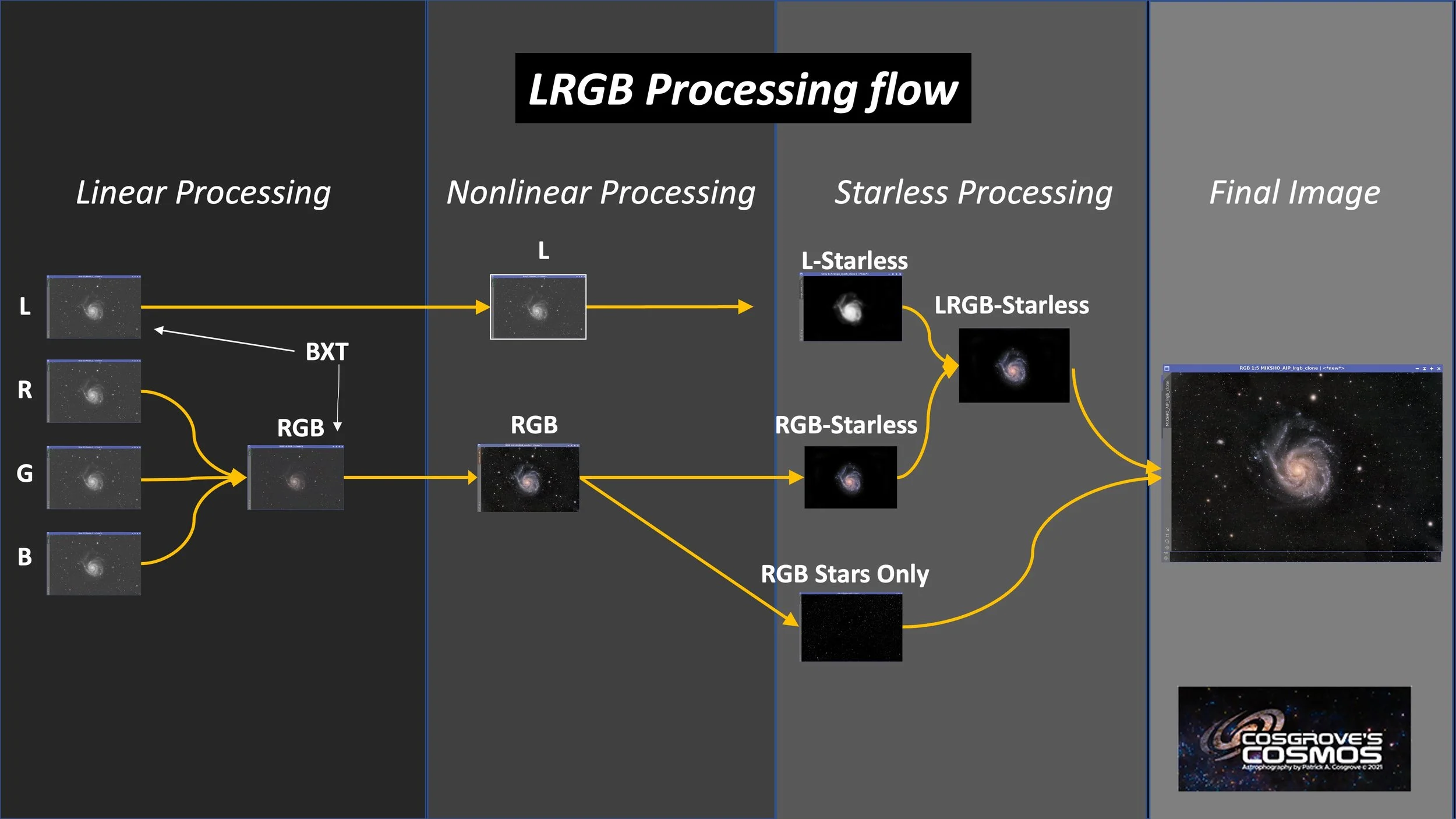
My typical LRGB Starless Workflow.
Processing was pretty straightforward. The key here was to create good masks for each galaxy and use them to separately enhance each galaxy.
These masks turned out to be simple to create. First, I used the starless version of the image with the RangeSelection process in PixInsight to separate the galaxies from the background. I added some softness to this mask.
This was the foundation.
Next, I made four copies of this and then used the DynamicPaintBrush to erase the three unwanted galaxies from each mask.
Then, using these masks, I could fine-tune the color, contrast, and sharpness of the galaxies, being careful not to overdo it.
I used one of my other new tools to fine-tune the color position of each galaxy.
This tool will be called the Astro Color Mixer. I first created a working prototype that is browser-based, and you can see that here:
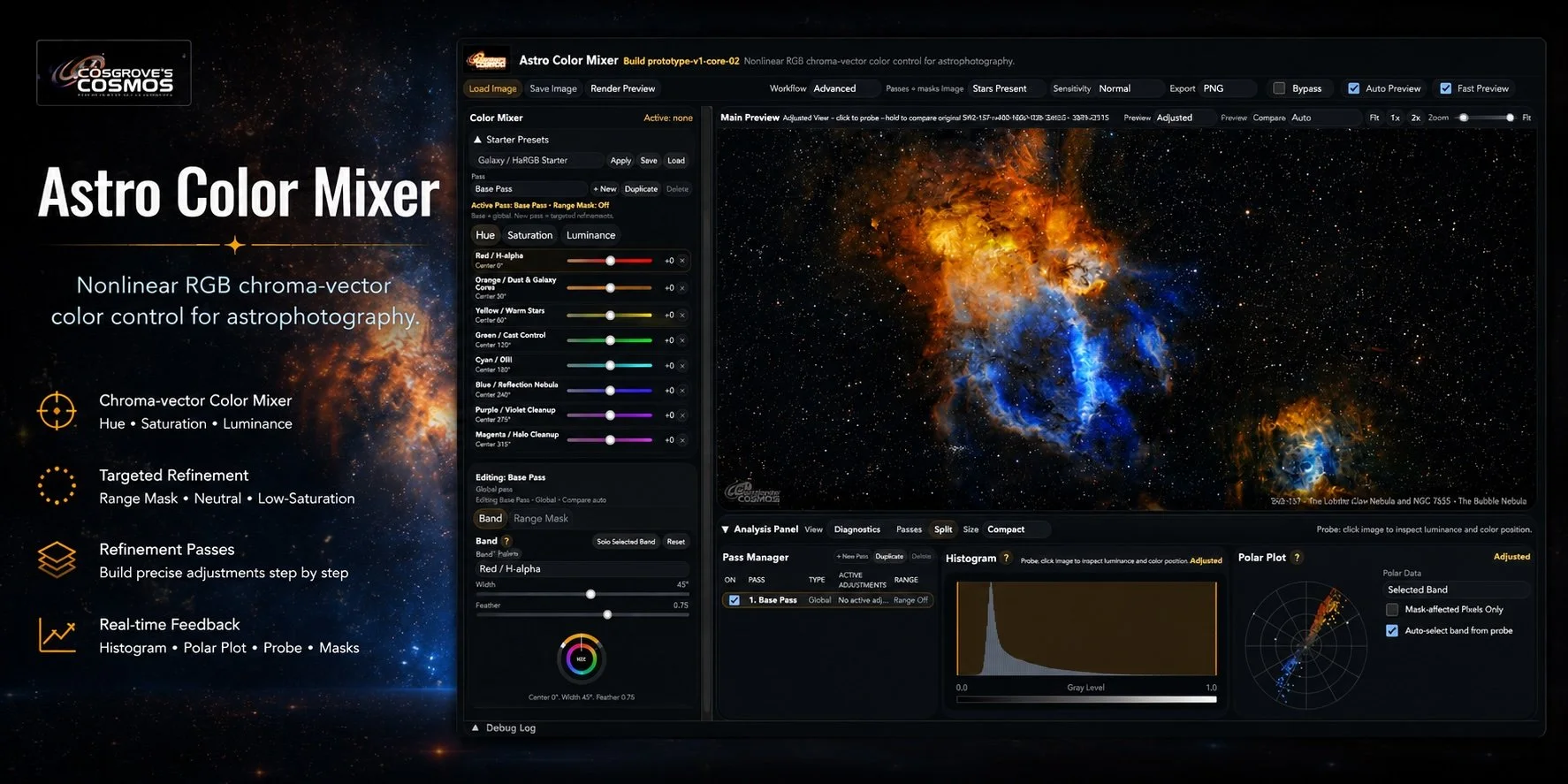
The browser-based prototype for my new Astro Color Mixer PixInsight Script;
I found porting it to PixInsight challenging, as you have to create the user interface within the PixInsight environment, which has a learning curve. But I had an initial version, and this is the second project I have used it on.
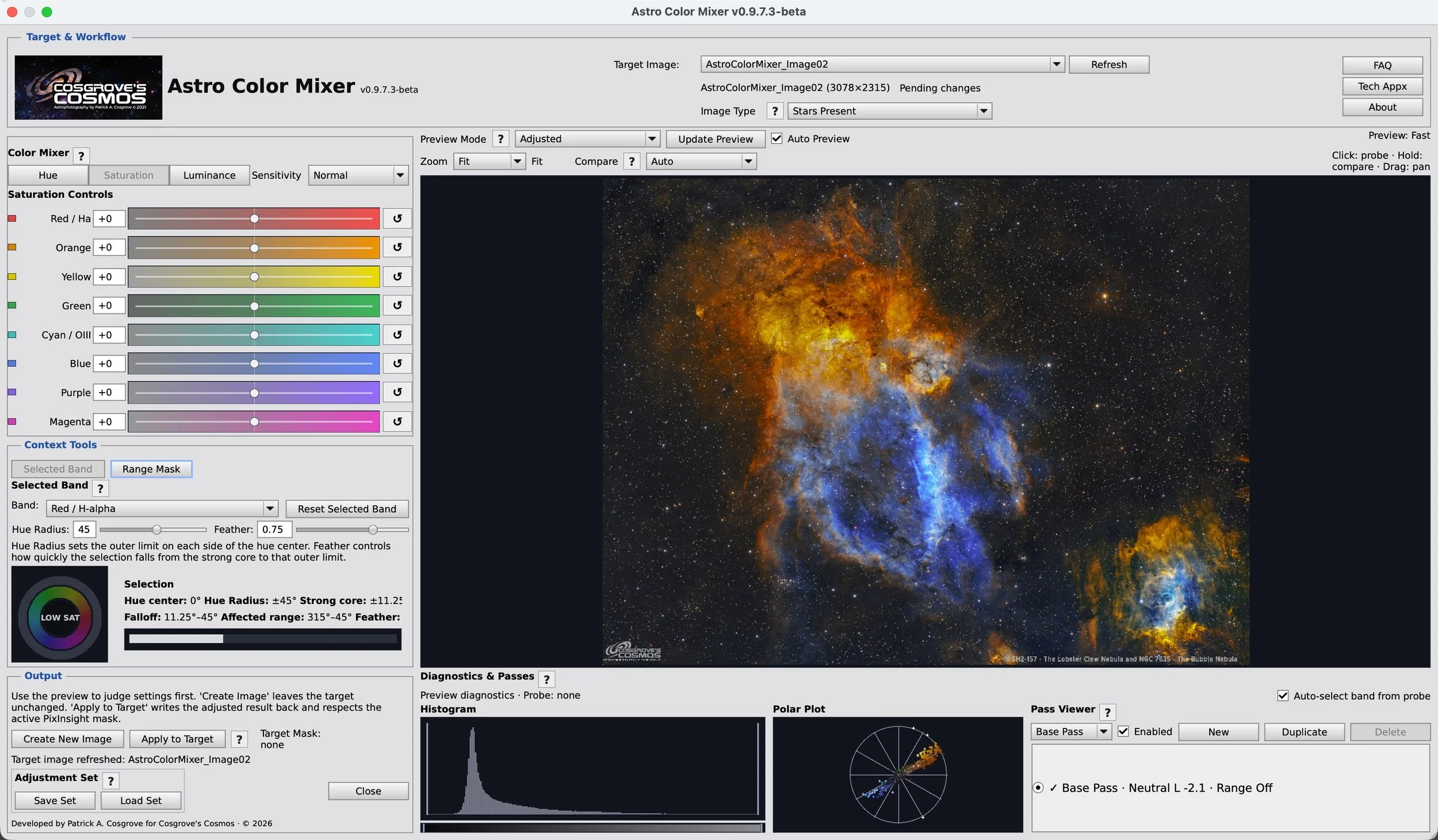
My New Astro Color Mixer PixInsight Script!
Another issue I had to deal with was the final crop. In the capture frame, the galaxies are small. I want to emphasize them more. Below is a crop that I ended up with:
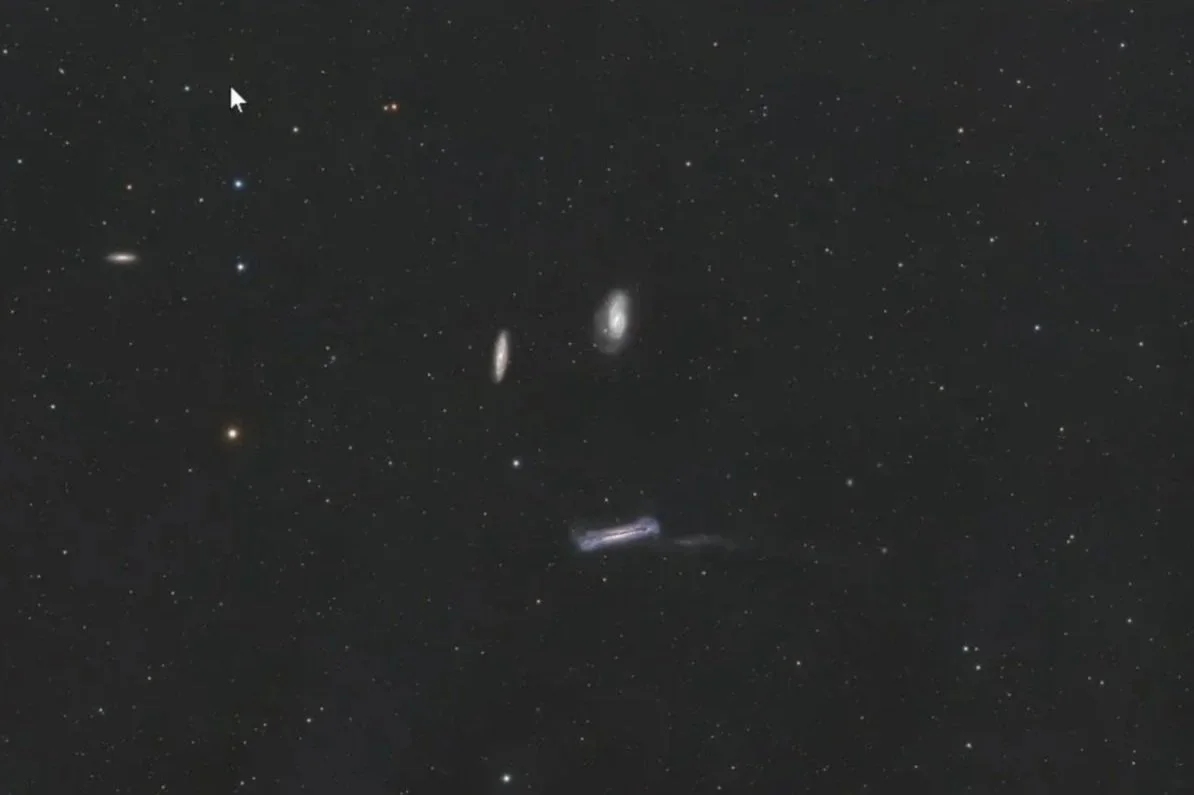
Full Frame.
The Final Crop.
Of course, my friend, Rick Albrecht, pointed out that the M66 group now looked like a face! I did not see if before, but now I can’t unsee it!
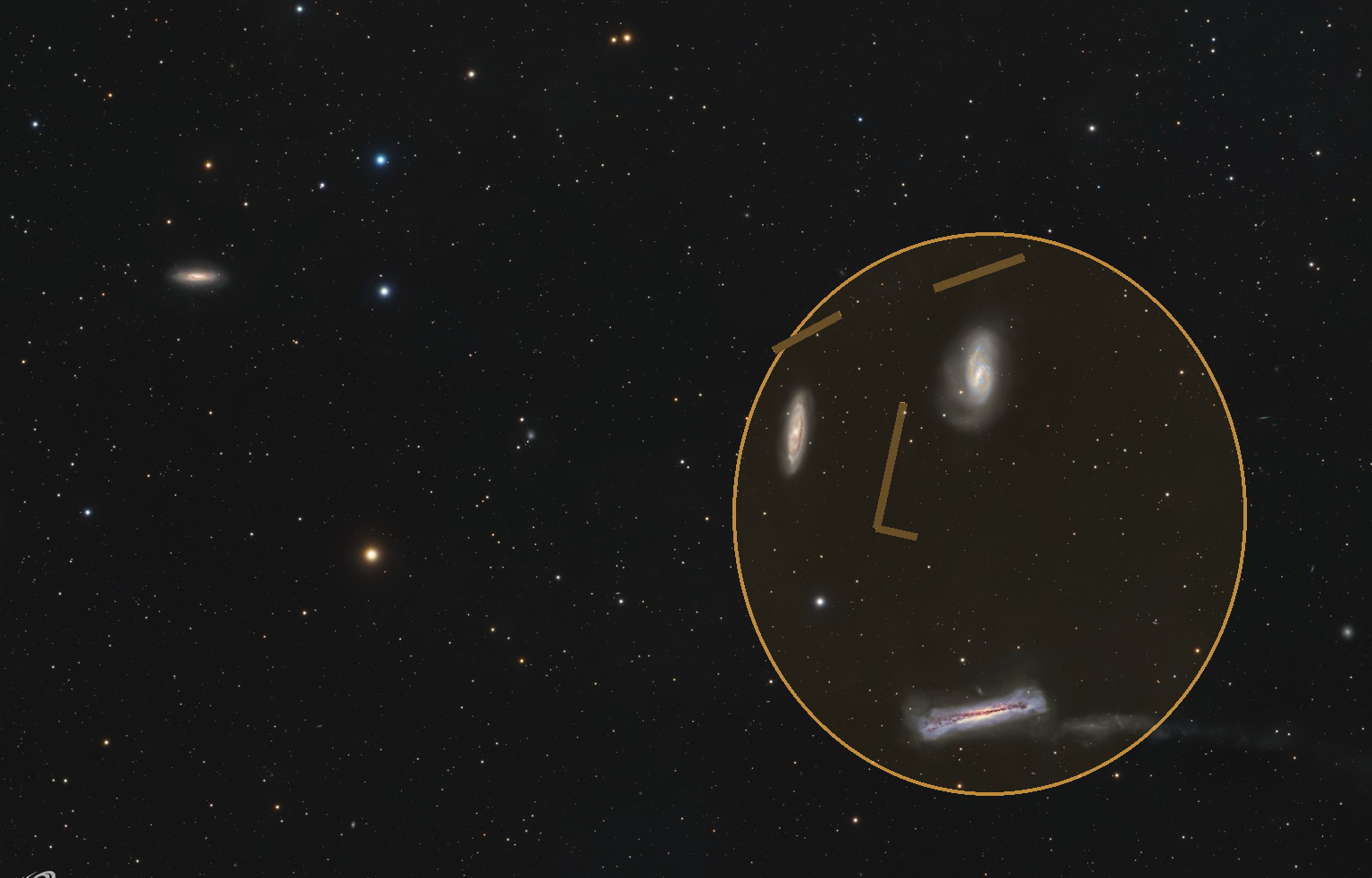
The “face”
Detailed and Annotated Image Processing Walkthrough
Typically, I conclude one of these imaging projects by documenting the processing steps I used on this image. But this section can make the overall post very large and, at times, slow to load.
I am now creating a secondary, standalone page to hold this information. You can access this page by clicking the link below. Returning to this page is as simple as clicking the back arrow in your browser or selecting a different menu option at the top of the page.
I hope you like this new format!
Use the link below to see the detailed image processing walkthrough for this imaging project.
Leo Triplet Processing Detail Page
Final Results
I was surprised to see that, despite the difference in image scale between the current scope and the one I used in 2021, the delivered detail levels were similar.
I delivered a credible job on the 2021 project, given that I had only 2.9 hours of integration. But the current effort is clearly better at managing noise and showing faint details, especially the gravitationally distorted tidal tail extending from NGC 3628. That detail is not visible in the older effort.
So, all in all, I am pleased with the final result.
More Info
🔭 Target Details
SIMBAD Astronomical Database — Messier 65 / NGC 3623 — Core reference entry for M65, including identifiers, object type, measurements, radial velocity, bibliography, and related database links.
SIMBAD Astronomical Database — Messier 66 / NGC 3627 — Core reference entry for M66, including cross-identifications, measurements, bibliography, and database links for one of the main Leo Triplet galaxies.
SIMBAD Astronomical Database — NGC 3628 — Core reference entry for the edge-on member of the Leo Triplet, including identifiers such as UGC 6350, PGC 34697, and Arp 317C.
SIMBAD Astronomical Database — NGC 3593 — Core reference entry for NGC 3593, the additional galaxy captured in this wider Leo field.
CDS Aladin Lite — Interactive Sky Atlas — Web-based sky viewer; enter “M65,” “M66,” “NGC 3628,” or “NGC 3593” to pull up survey imagery, overlay catalogs, and explore the surrounding Leo field.
Leo Triplet — NOIRLab — Wide-field professional image and overview showing M65, M66, and NGC 3628 as a compact galaxy group in Leo.
📜 History & Naming
Messier 65 — NASA Hubble Messier Catalog — NASA/Hubble overview of M65, including its discovery by Charles Messier, location in Leo, distance, brightness, and membership in the Leo Triplet.
Messier 66 — NASA Hubble Messier Catalog — NASA/Hubble overview of M66, including its Messier designation, physical properties, location, and relationship to M65 and NGC 3628.
Leo Triplet — Messier-Objects.com — Accessible overview of the Leo Triplet, including designations, discovery history, observing notes, and the different viewing angles of the three main galaxies.
Messier 65, 66, and NGC 3628 — Cosgrove’s Cosmos — Earlier Cosgrove’s Cosmos Leo Triplet project page, useful as an internal comparison point for this newer wider-field image, deeper exposure, equipment configuration, and processing approach.
🔬 Science & Observations
The Tidal Tail of NGC 3628 — NASA Astronomy Picture of the Day — NASA APOD feature focused on the long tidal tail extending from NGC 3628, one of the most important faint structures captured in deep Leo Triplet images.
Wide-field View of Messier 66 — ESA/Hubble — Wide-field view around M66 showing its position in the Leo region and giving broader visual context for the surrounding field.
Messier 65 through the Years — ESA/Hubble — Hubble image feature showing M65’s spiral structure, central region, and dust lanes in much greater detail than a ground-based wide-field image can resolve.
Spectroscopic Evidence of Distinct Stellar Populations in NGC 3593 and NGC 4550 — Astronomy & Astrophysics — Research paper discussing counter-rotating stellar populations in NGC 3593, one of the reasons this smaller galaxy is scientifically interesting.
NGC 3593 Counter-Rotation Reference — NASA ADS — ADS abstract page for the NGC 3593 stellar-population study, useful for citations and follow-up literature.
High-Resolution CO Observations of NGC 3627 — NED Reference Lookup — Research reference on molecular gas in M66 / NGC 3627, including evidence that its gas structure is affected by interaction within the Leo group.
💡 Interesting Facts & Outreach
The Leo Triplet — In-The-Sky.org — Observing-oriented entry for M66 / NGC 3627 with visibility information, constellation location, magnitude, and practical sky-viewing context.
The Leo Triplet — Vanderbilt Dyer Observatory — Outreach-friendly description of the Leo Trio, emphasizing that all three main galaxies can be viewed together in a small-telescope field.
Galaxy Season: Spring Brings Deep Space Wonder — Space.com — Broad-audience observing article placing the Leo Triplet in the larger context of northern-hemisphere spring galaxy season.
NGC 3628 and Its Tidal Tail — Friends of NASA — Public-facing feature on NGC 3628, its “Hamburger Galaxy” nickname, and the large tidal tail produced by gravitational interaction.
Counter-Rotating Molecular Disk in NGC 3593 — Springer — Short research summary describing counter-rotating molecular gas in NGC 3593 and its connection to nuclear star formation.
NASA/IPAC Extragalactic Database — NED — Professional extragalactic database for deeper follow-up on all four galaxies, including redshifts, photometry, literature references, and cross-identifications.
Imaging Platform Used
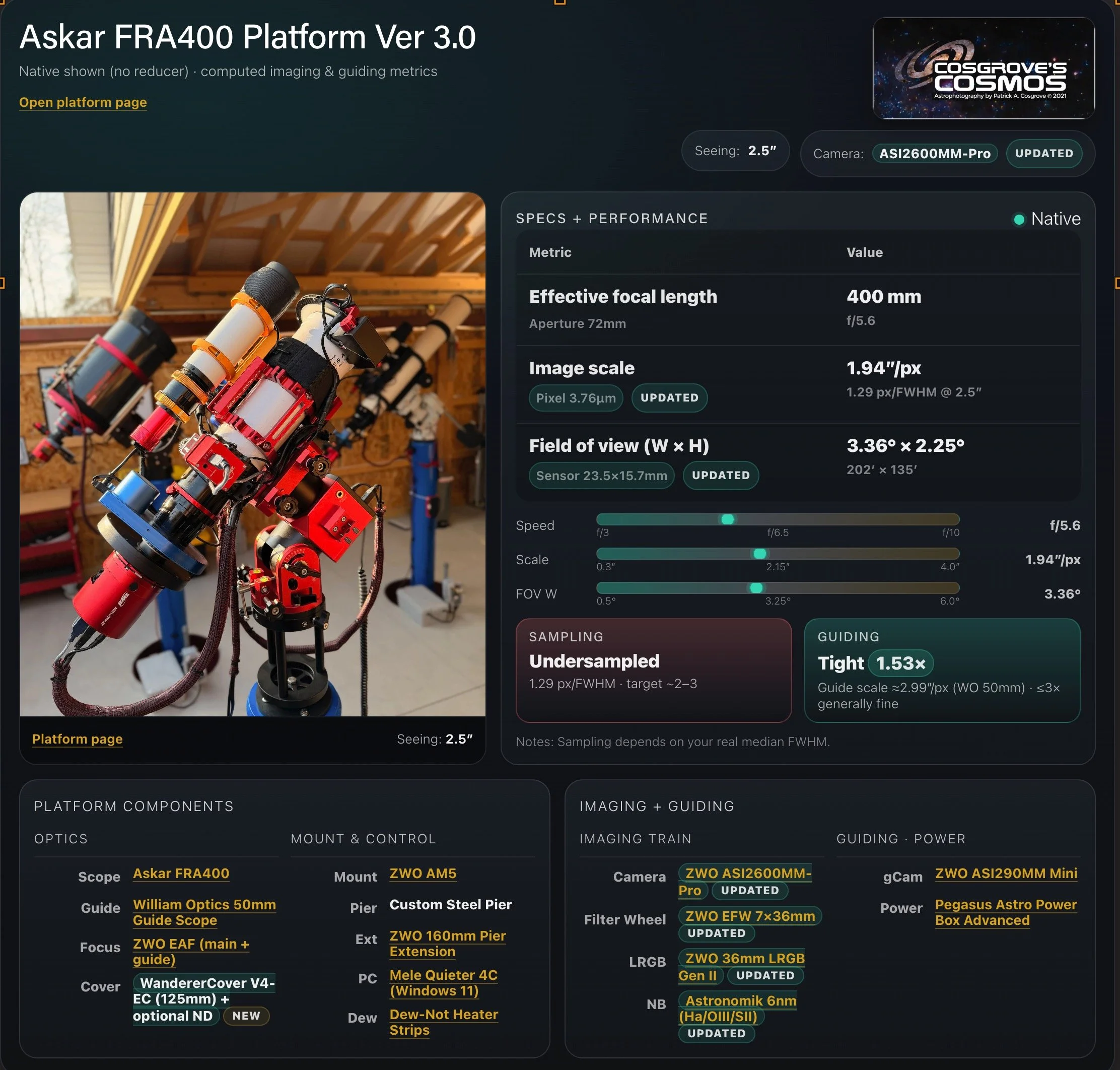
The details for the FRA400 Platform.
Platform used for this project
Software
Capture Software: PHD2 Guider, NINA
Image Processing: PixInsight, Photoshop - assisted by Coffee, extensive processing indecision and second-guessing, editor regret, and much swearing…