Imaging Projects
In this blog, I will share the results of all of my imaging projects. The newest will be at the top and the oldest will be further down the stack. Going back in time here is interesting - some of my early stuff was pretty rough - but I did not see it that way at the time - I was thrilled to get anything back that looked like an image! Hopefully, you will see how my work has progressed with time!
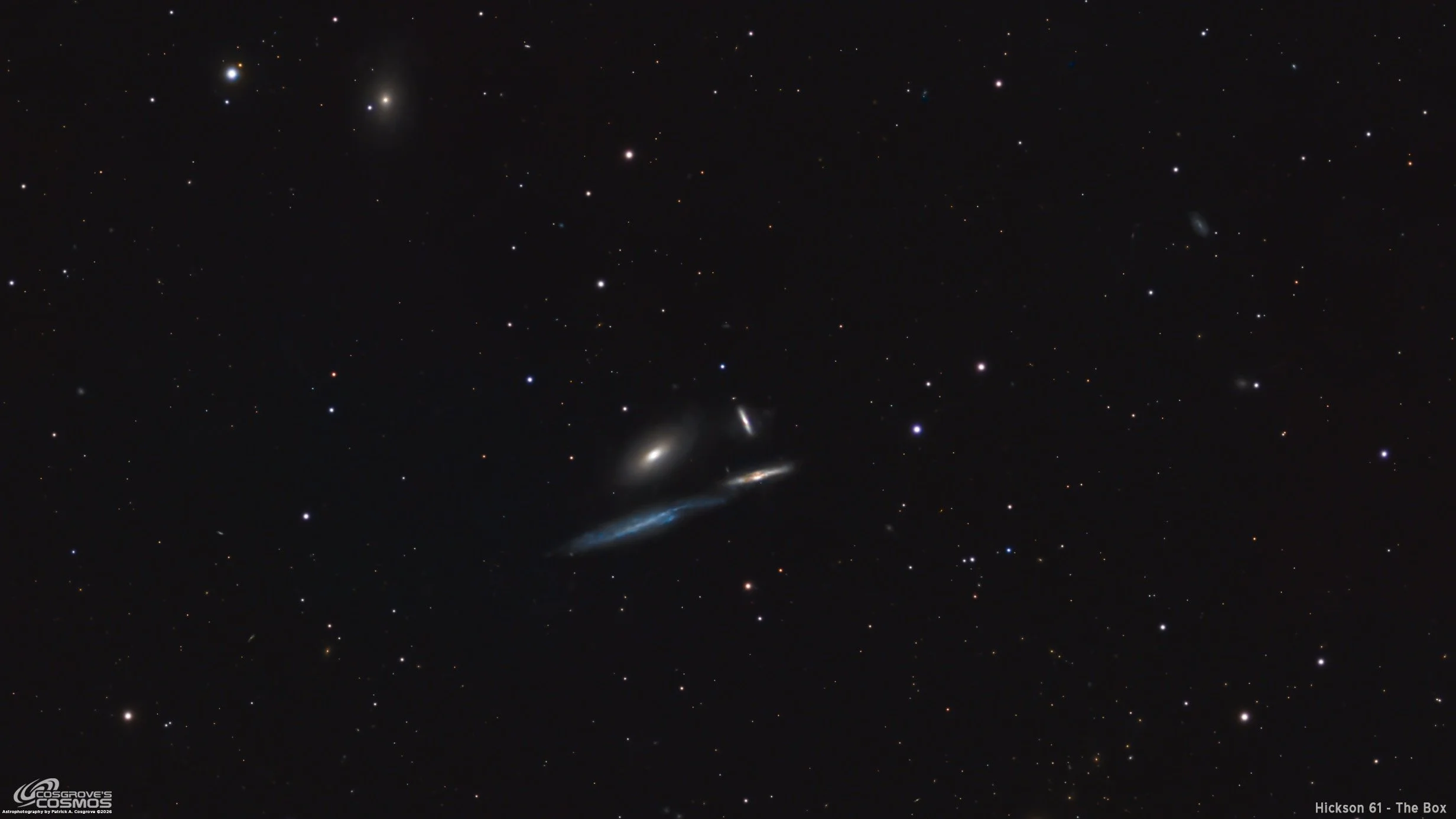
Hickson 61 — “The Box” | Tiny Galaxies, Tough Data! - 7.8h LRGB
Hickson 61, better known as “The Box,” is a tiny apparent grouping of faint galaxies in Coma Berenices. This LRGB image captures NGC 4169, NGC 4173, NGC 4174, and NGC 4175 — four small galaxies arranged in a striking box-like pattern. Most of the group lies roughly 170–200 million light-years away, while NGC 4173 is likely a closer foreground galaxy that happens to line up with the others. Captured from Whispering Skies Observatory over two April nights, this 7-hour 48-minute project highlights the challenge and reward of imaging small, distant galaxy groups where scale, faintness, and perspective all matter.
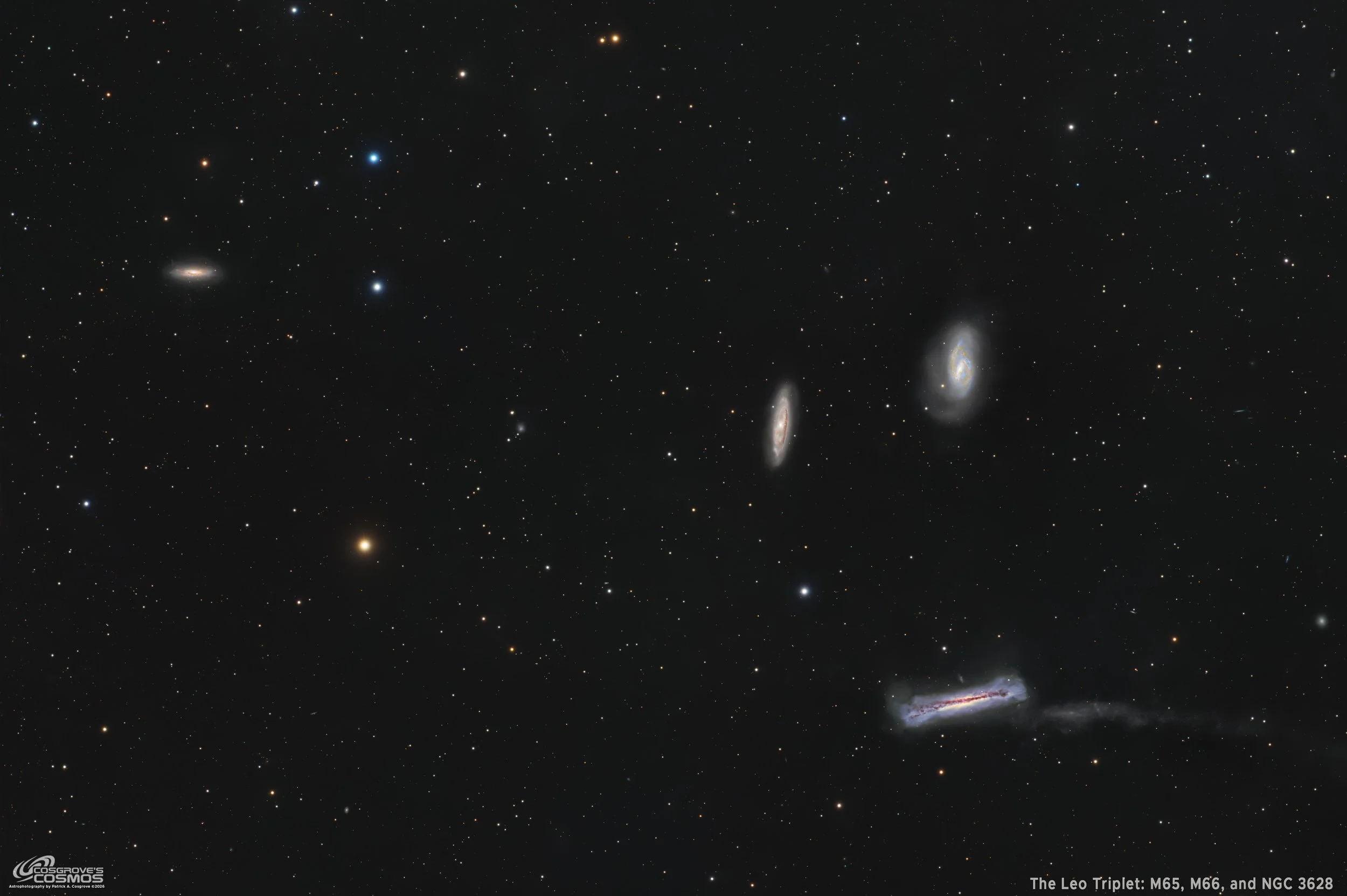
The Leo Triplet: M65, M66, and NGC 3628 - 12.6 hours of LRGB - First Light for the FRA400’s New Camera!
This image captures the Leo Triplet — M65, M66, and NGC 3628 — along with nearby NGC 3593 in a wide-field LRGB view from Whispering Skies Observatory. With 12.6 hours of integration, the image reveals the three main galaxies, the smaller surrounding galaxy field, and the faint tidal tail extending from NGC 3628. This project also served as first light for the new ASI2600MM-Pro camera on my FRA400 platform.

Stephan’s Quintet – HCG 92 / Arp 319 Compact Galaxy Group - 24 Hours of LRGB!
Stephan’s Quintet is a compact group of galaxies in Pegasus caught in the middle of a slow-motion cosmic collision – four true members being stretched, stripped, and reshaped by gravity while a fifth foreground spiral simply photobombs the scene. This deep LRGB image reveals distorted spiral arms, long tidal tails, and the bright cores of galaxies that are gradually merging into a single massive system hundreds of millions of light-years away.
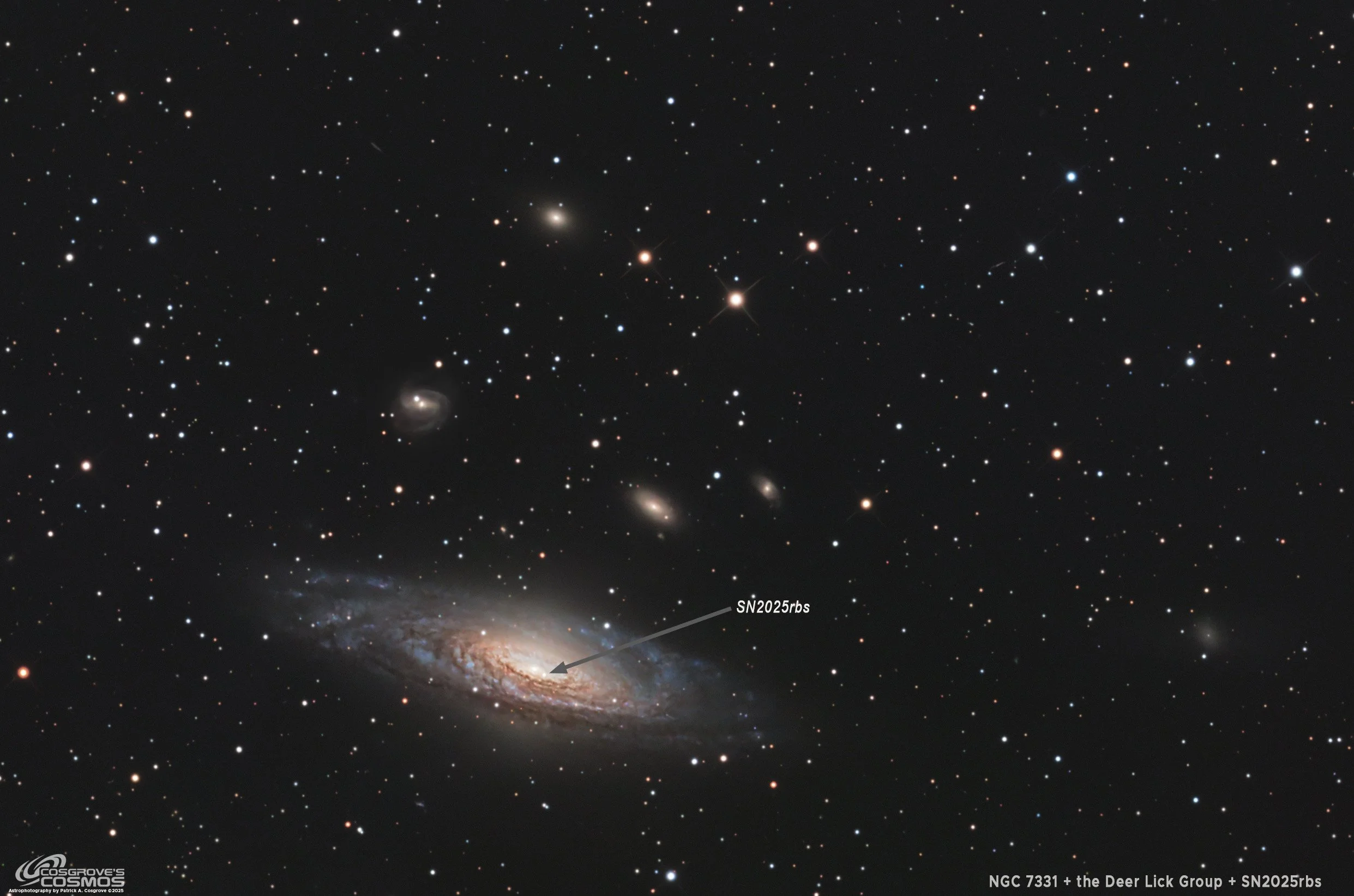
NGC 7331 and the Deer Lick Group with Supernova SN2025rbs (4.7 hours in LRGB)
While on a multi-night streak of capturing subs on my Sharpstar SCA 260 Galaxy scope, I retasked one night of shooting to try and get an image of NGC 7331 while Supernova SN2025rbs was still visible.
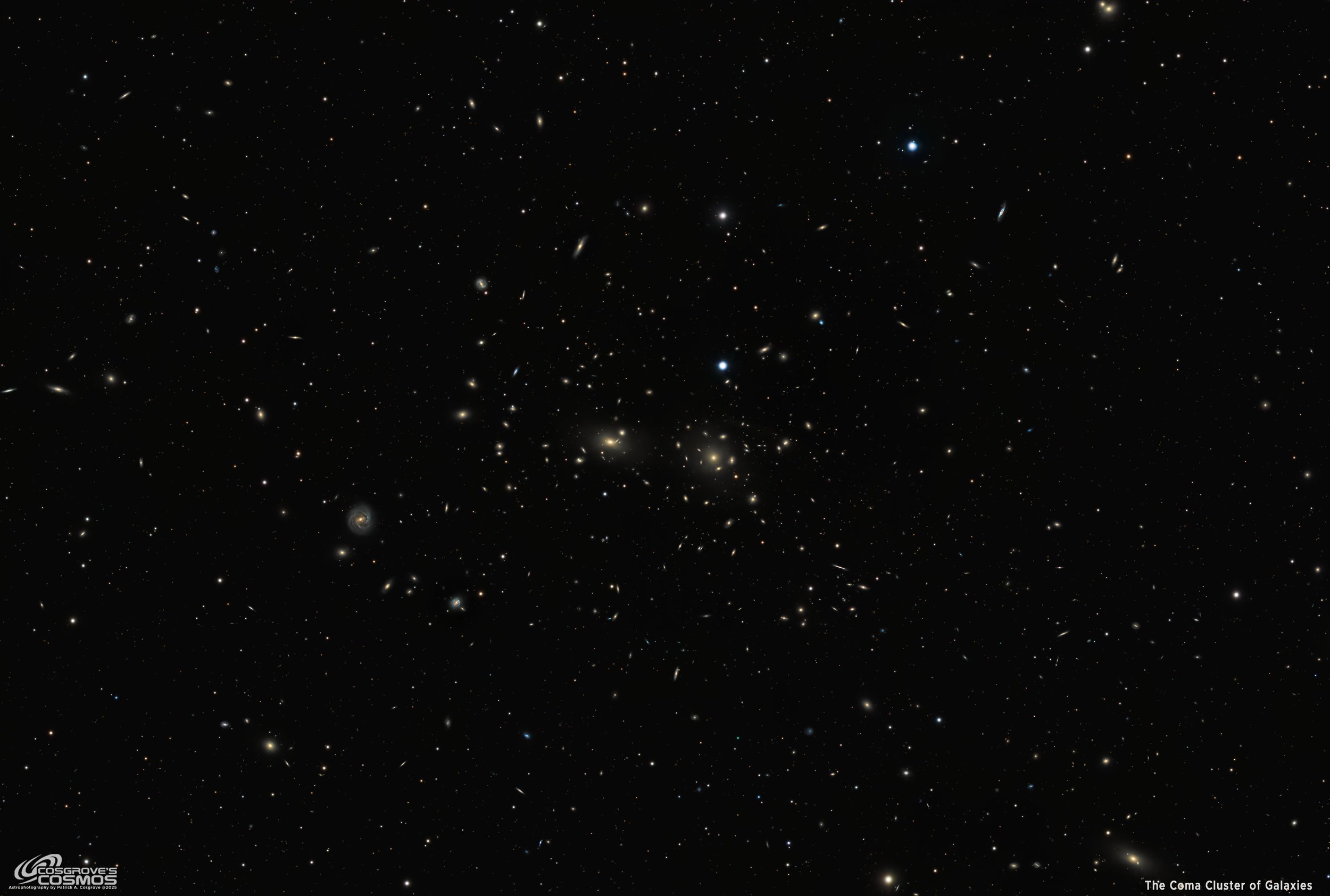
The Coma Cluster of Galaxies (Abell 1566) - Zoom In! 1000 Galaxies, 320M Light-Years Away! (~8.2 Hours of LRGB)
This is not just some star cluster! This image shows an immense cluster of over 1000 galaxies that are on average 320 million light-years away!
This image was the result of 8.2 hours of LRGB exposure taken on my William Optics platform from data collection during the first light of my Whispering Skies Observatory!

The NGC 5364 Group in Virgo - 6.3 Hours of LRGB
The NGC 5364 Group is part of the vast Virgo Cluster of Galaxies and showcase a mix of galay morphologies in one frame.
This shot was the very first from my AP130 platform after it had been installed in my new observatory.

Markarian’s Chain - A Famous Galaxy Cluster with 4.6 hours LRGB
Markarian’s Chain is a group of galaxies 50M light-years away moving together through space.
This image results from 4.6 hours of LRGB exposure from my FRA400 scope. This is the first image from this scope since it was moved to the new observatory!
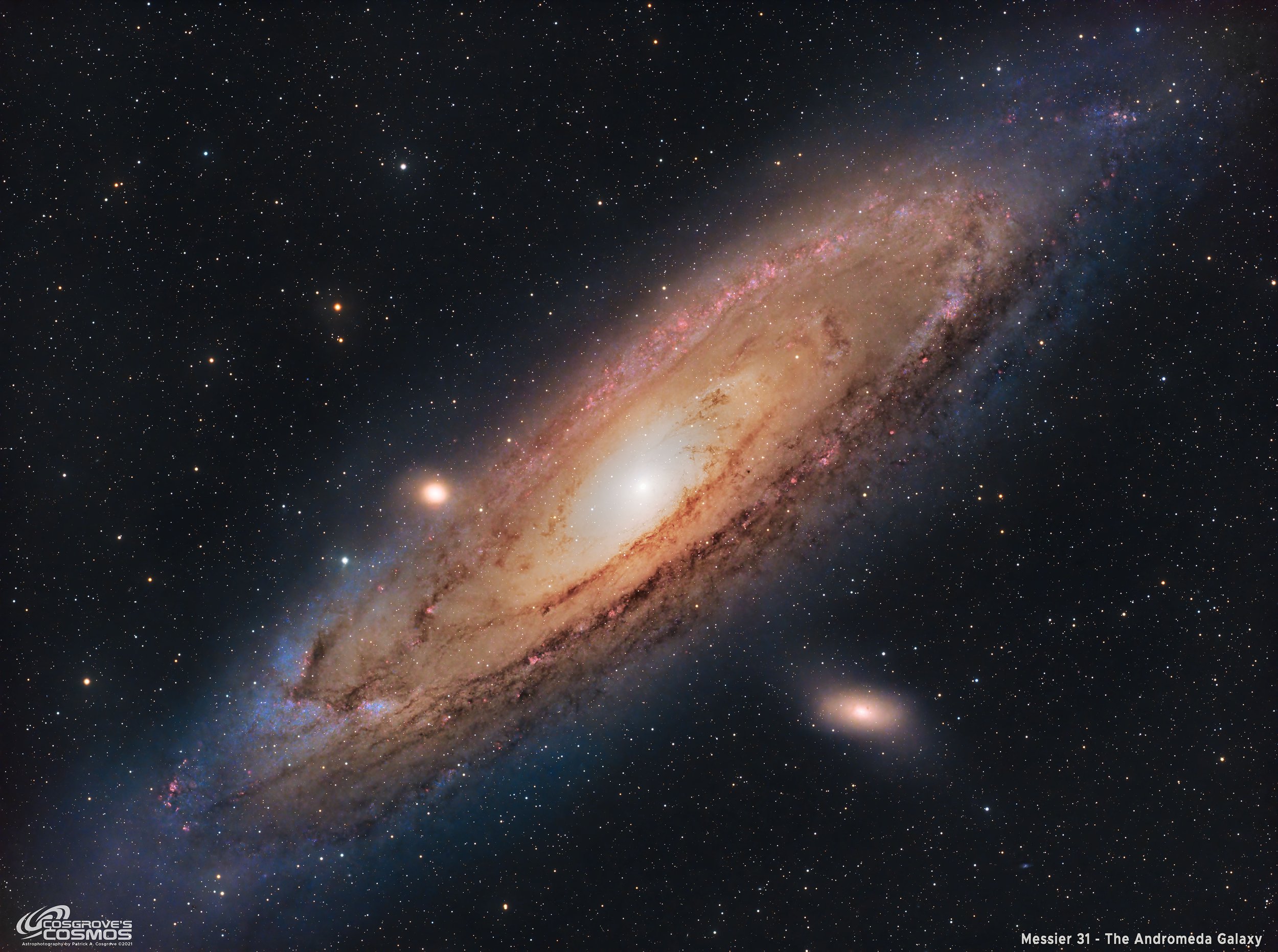
Reprocessing Project: Messier 31 - The Andromeda Galaxy (6 hours in LHaRGB)
This version of M31, taken in November 2021, is my favorite. But it has been a few years since I first captured and processed this data. I have learned a lot since then, and I also have some excellent new processing tools at my disposal, so I wanted to see where I would end up if I were to start from scratch with the data, and this is the result!
Let me know what you think of this new image!
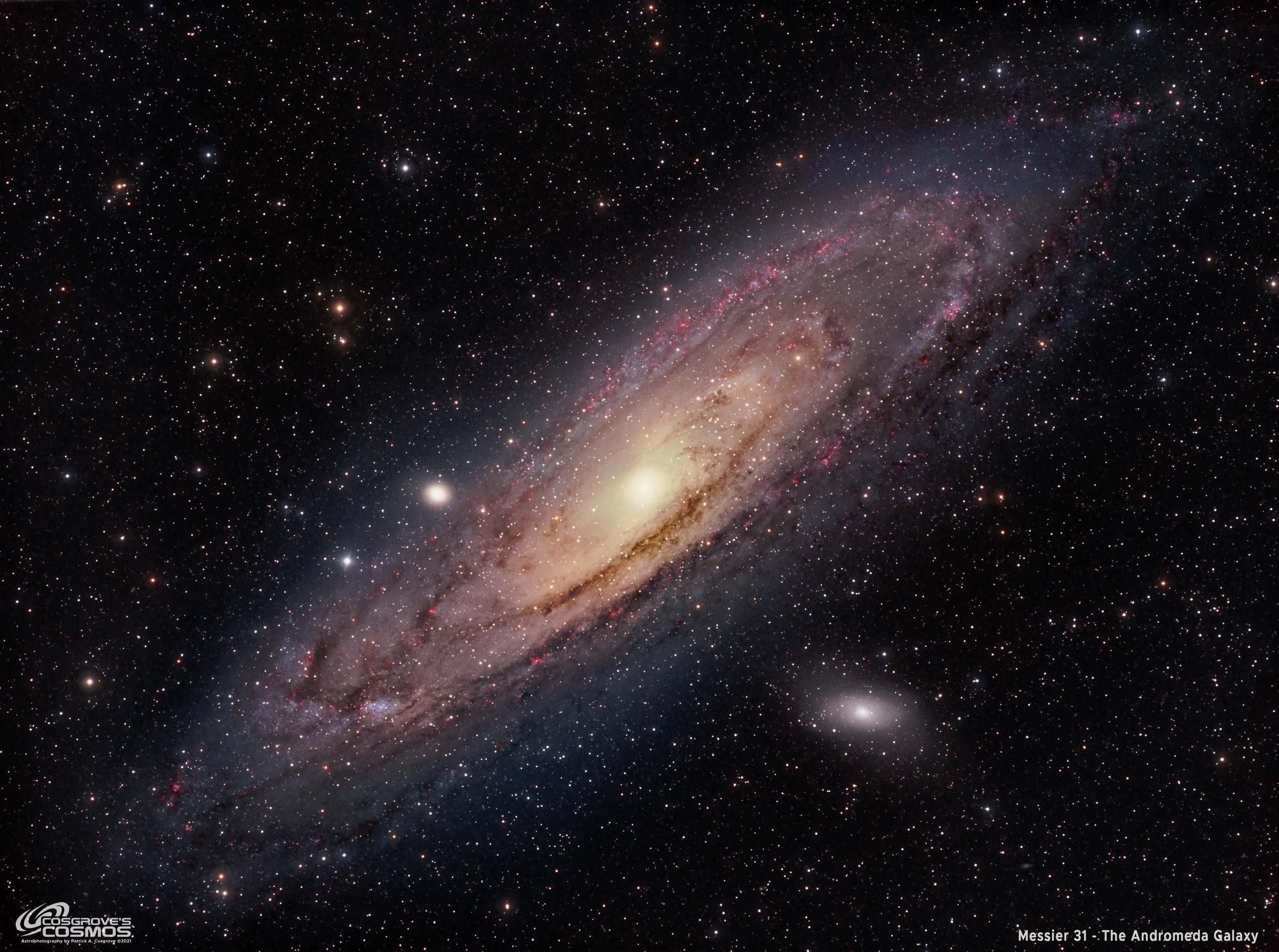
Messier 31 - The Andromeda Galaxy in LHaRGB - 6 hours
This is my third attempt at M31. This time with a widefield system that can fit the entire galaxy into the field of view., and a mono camera that allowed me to collect Ha as well as LRGB data. A total of 6 hours of data integration.
Messier 31 is also known as NGC 224 and the Andromeda Galaxy, or as the Andromeda Nebula before we knew what galaxies were. It can be seen by the naked eye in the constellation Andromeda (how appropriate!) and is our closest galactic neighbor located 2.5 Million light-years away. It is estimated that it contains about one trillion stars - twice that of our own Milky Way.
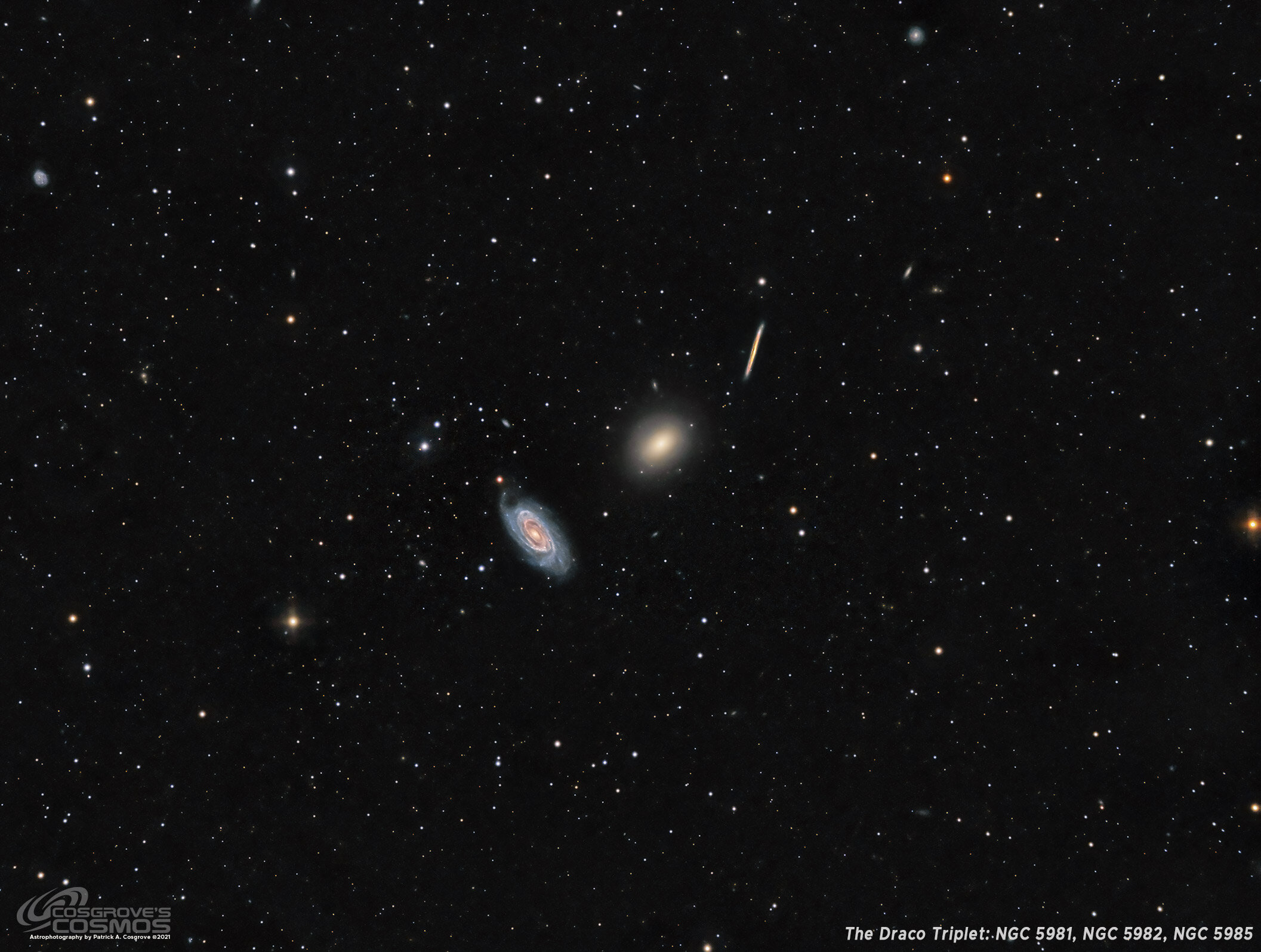
Revisiting the Draco Triplet: NGC 5981, NGC 5982, & NGC 5985
The Draco Trio consists of a close grouping of three very different looking galaxies, found in the constellation Draco. These are small targets for my scope so I needed to carefully process the images to get the most detail possible. See how I did it!
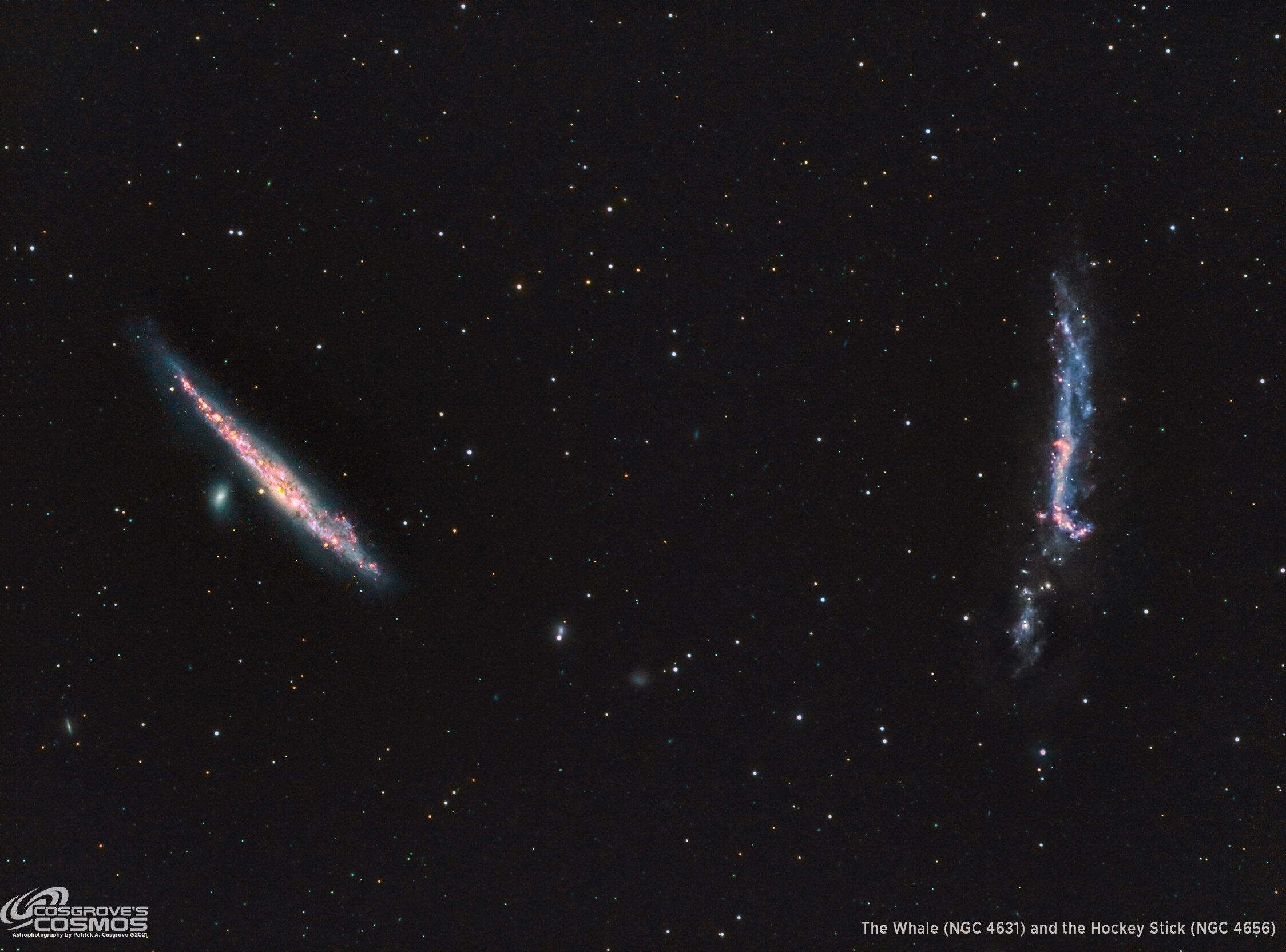
NGC 4631 - The Whale and the Hockey Stick (NGC 4656) - A second attempt, this time in LRGB-Ha…
The Whale and the Hockeystick are two galaxies are found in the constellation Canes Venatici, about 30 Million Light years away. This is my second time shooting this target and the first where I used a mono camera and captured LRGB along with some Ha subs folded in for good measure. As it worked out, I captured a possible supernova that was recently discovered as well.
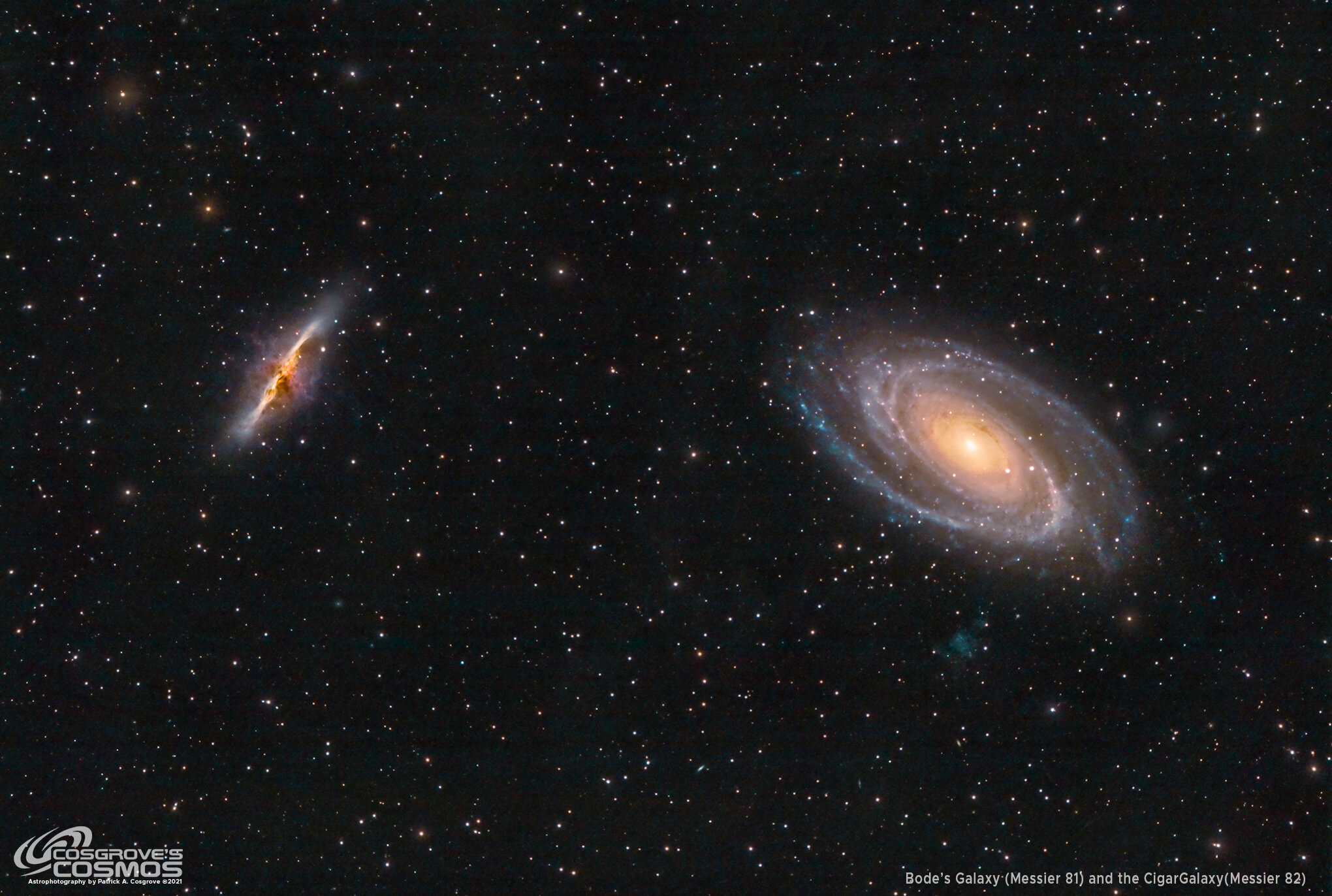
Messier 81: Bode's Galaxy and Messier 82: the Cigar Galaxy
Messier 81, also known as NGC 3031 and Bode's Galaxy, is a beautiful spiral galaxy located 12 Million light years away in the constellation Ursa Major. This post tells the story of this capture -which consists of 9.9 hours of integration using the ZWO ASI294MC-Pro and the William Optics 132mm FLT APO Platform.
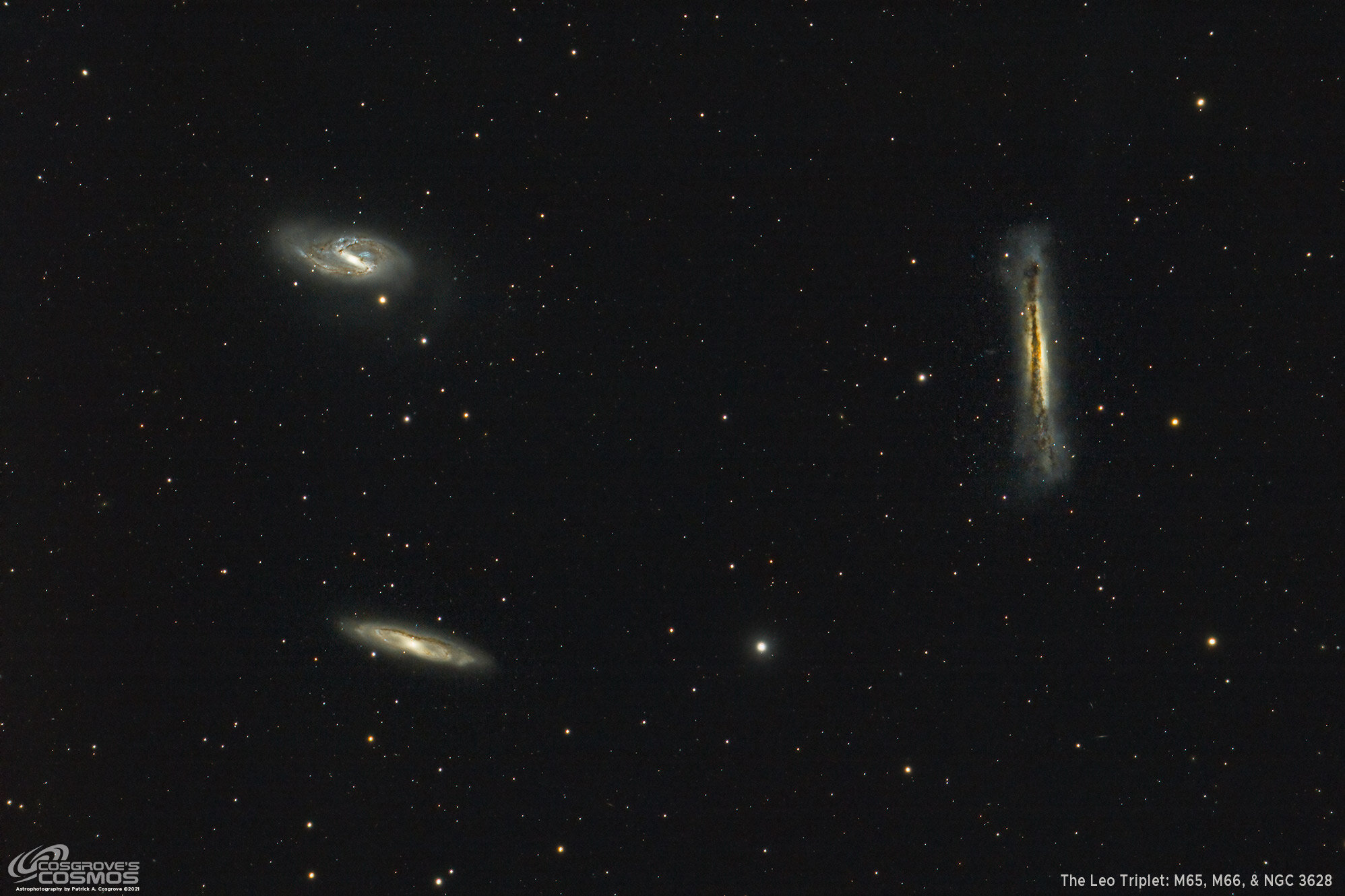
Messier 65, 66, and NGC 3628: The Leo Triplet
The Leo Triplet, also known as the M66 group, is a small group of galaxies located about 35 million light-years away in the constellation Leo. The three prominent galaxies involved are M65 (bottom left), M66 (top left), and NGC 3628 (right). 2.9-hour integration on the William Optics 132mm Telescope Platform
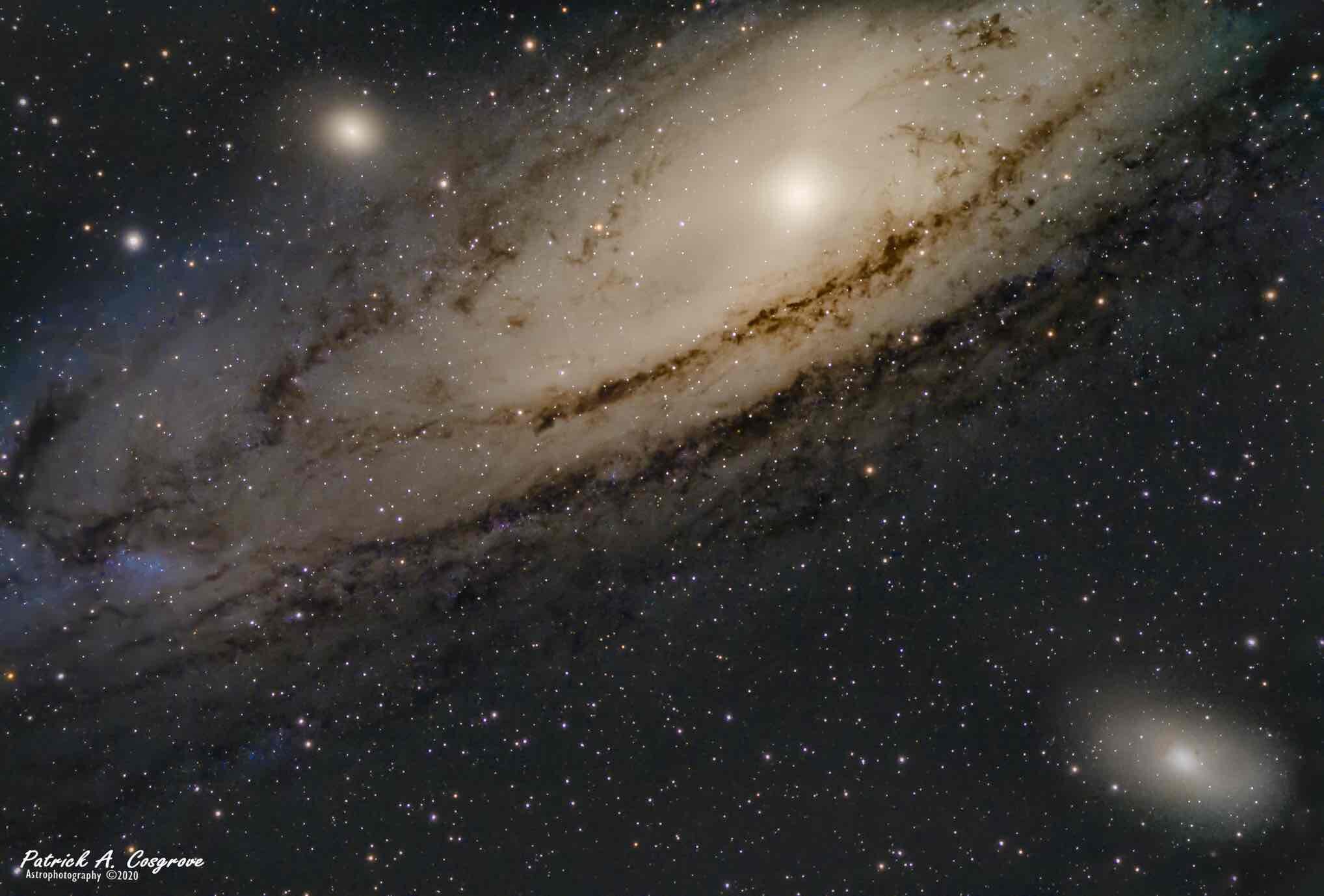
Messier 31 - The Andromeda Galaxy - with Neighbors M32 and M110
This is my second attempt at M31. With a larger focal length, I could not fit the whole galaxy in so I experimented with a framing that showed it’s two neighbors.
Messier 31 is also known as NGC 224 and the Andromeda Galaxy, or as the Andromeda Nebula before we knew what galaxies were. It can be seen by the naked eye in the constellation Andromeda (how appropriate!) and is our closest galactic neighbor located 2.5 Million light Years away. It is estimated that it contains abut one trillion stars - twice that of our own Milky Way.
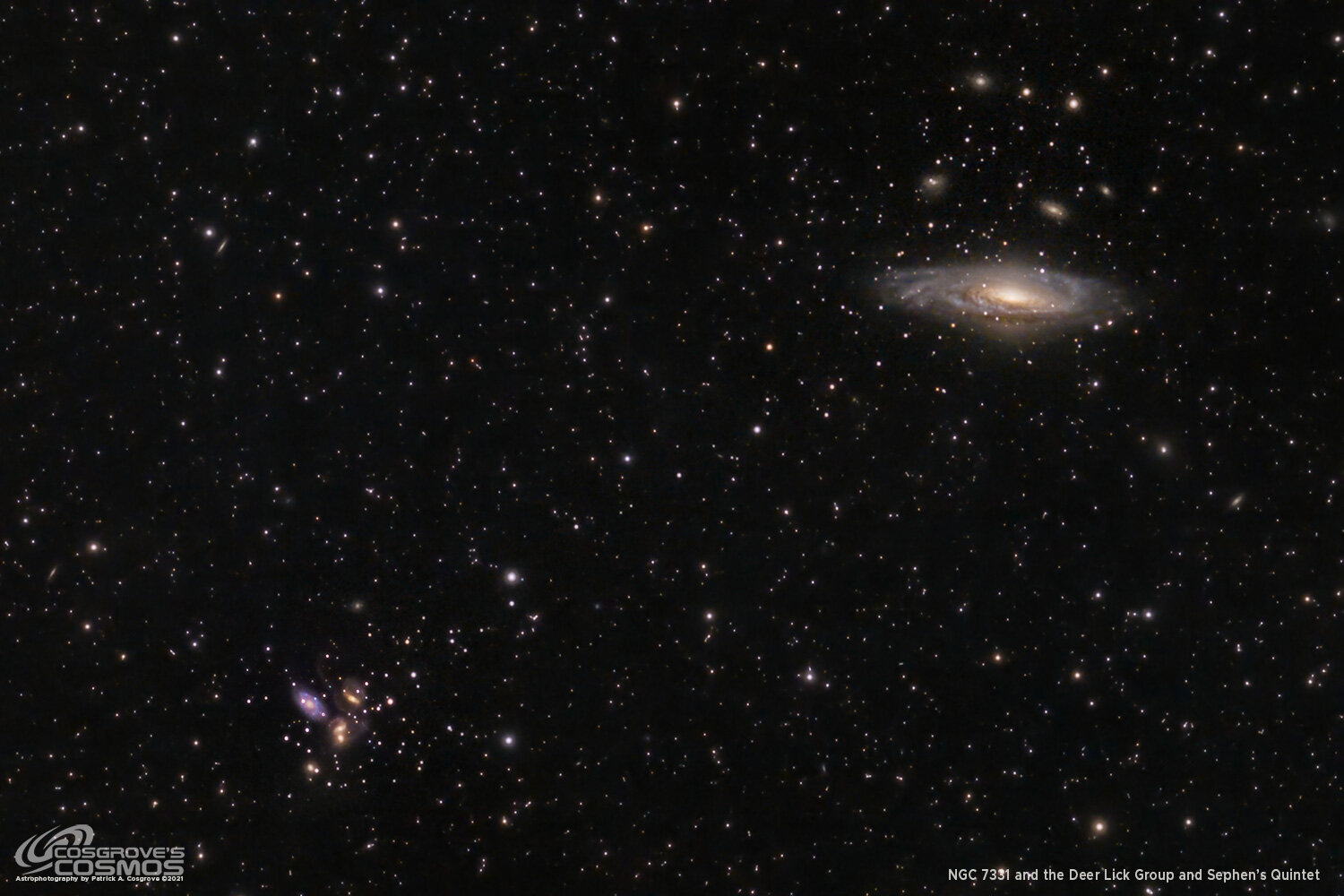
NGC 7331 and Two Galaxy Groups: The Deer Lick and Stephen's Quintet
Hot off the presses from my photo session last night: NGC 7331 and Two Galaxy Groups: The Deer Lick and Stephen's Quintet.
There are plenty of star clusters out there, but I was interested in shooting a cluster of Galaxies. Stephen's Quintet is high enough this time of year to clears my trees about midnight, so I started to plan on capturing that. I soon realized that I could get two for the price, as The Deer Lick Galaxy group would fit in the same frame if I composed the shot well.

Arp 271 - Interacting Galaxies: NGC 5426 & NGC 5427
Arp 271 consists of two distant spiral galaxies, NGC 5426 & NGC 5427) that are interacting and gravitationally linked. The galaxies are located a whopping 130 Million light-years from earth, in the cancellation of Viro. Both galaxies are of a similar size and have been interacting for millions of years, and they will continue to for millions more. It is not known whether they will collide or not. But we do know that the mutual gravitational attraction has created "bridges" of stars, gas, and dust between them.
The Arp designation refers to "The Atlas of Peculiar Galaxies," a catalog of peculiar galaxies produced by Halton Arp in 1966.

NGC 4631: The Whale Galaxy and NGC 4656: The Hockey Stick
NGC 4631(The Whale) and NGC 4656 ((The Hockey Stick) are fascinating pair of galaxies. Both galaxies fit in the same frame, and this creates an interesting composition.
NGC 4631 is the larger and brighter of the two. Located about 30 Million light-years from Earth, this galaxy has a wedge-shaped form that resembles a whale, thus - its name. In addition, NGC 4631 has a nearby dwarf elliptical galaxy, NGC 4627, as a companion.
NGC 4656, the Hockey Stick - also known as the Crowbar Galaxy, is a highly warped barred-spiral galaxy. Its distinctive shape is due to a *recent* gravitational interaction with NGC 4631. T

NGC 5981, NGC 5982, & NGC 5985: The Draco Triplet
The Draco Group of Galaxies are a string of three primary galaxies that can be seen in a common field of view in the constellation Draco. The largest and roundest one seen at the bottom of the frame is NGC 5985. This has a barred spiral structure, and the arms are clearly visible in this shot. NGC 5981 can be seen at the top of the frame. This is also a barred spiral galaxy, but it is seen almost edge-on. The galaxy in the center is NGC 5982. It is an elliptical galaxy - which is typically seen as nebulous without any obvious structure. These galaxies are approximately 100 Million light-years from earth.

Messier 95 & Messier 96
hese twin Barred-Spiral Galaxies, M95 and M96, can be found in the constellation Leo. M95 is in the lower-left corner and is 33 Million Light years away. M96 in the upper right corner is 30 Million light-years away.
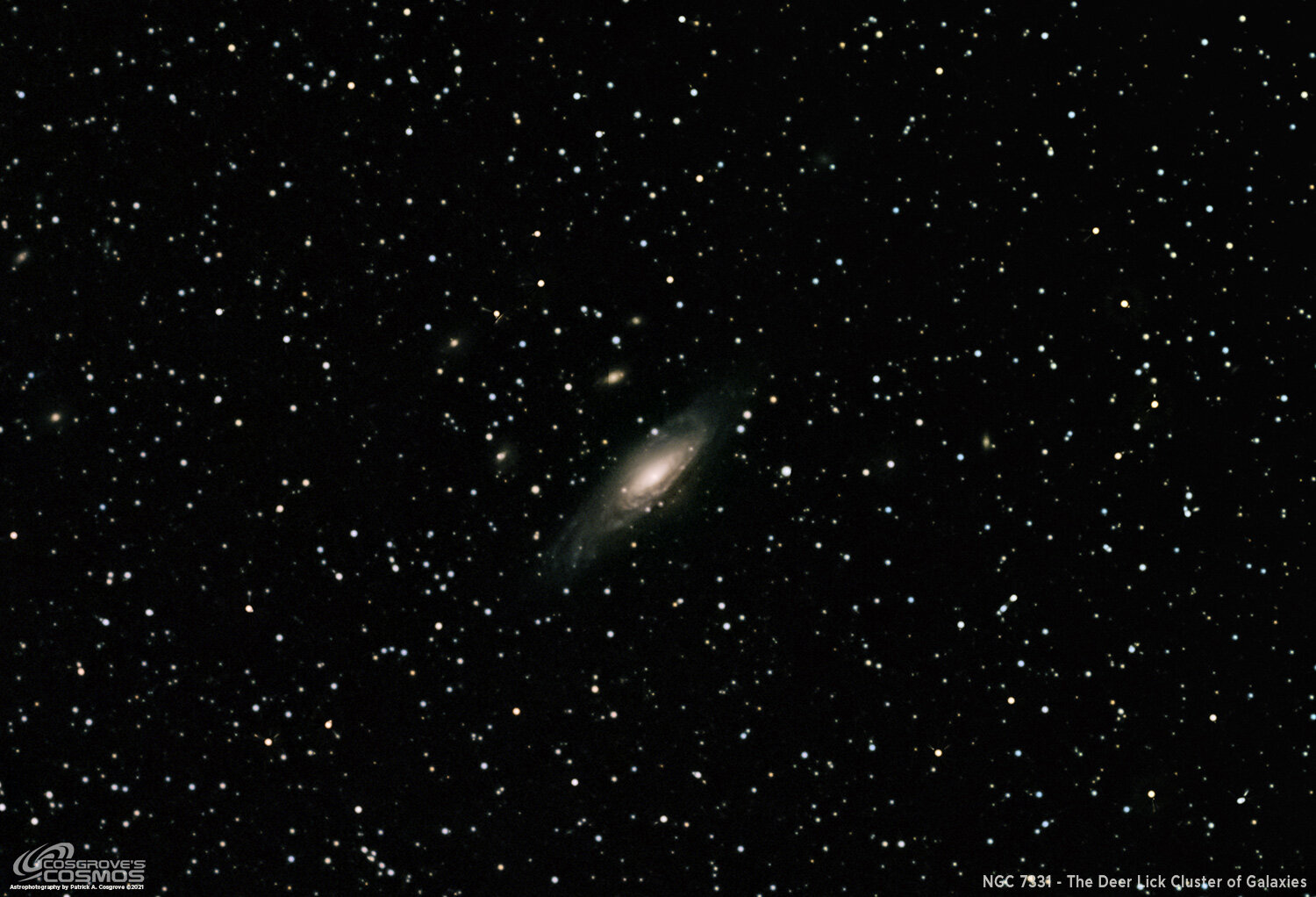
NGC 7331 - The Deer Lick Group - 2019 Version
NGC7331 and a small cluster of galaxies are located in the constellation Pegasus - about 40 million light-years away. The group is known as the NGC7331 group or as the Deer Lick Group, and the small galaxies around it are known as the fleas.