
Astro Exposure Explorer
Viewing note
This builder is usable on smaller screens, but the full layout is easiest to view and work with on a desktop or laptop display.
Astro Exposure Explorer
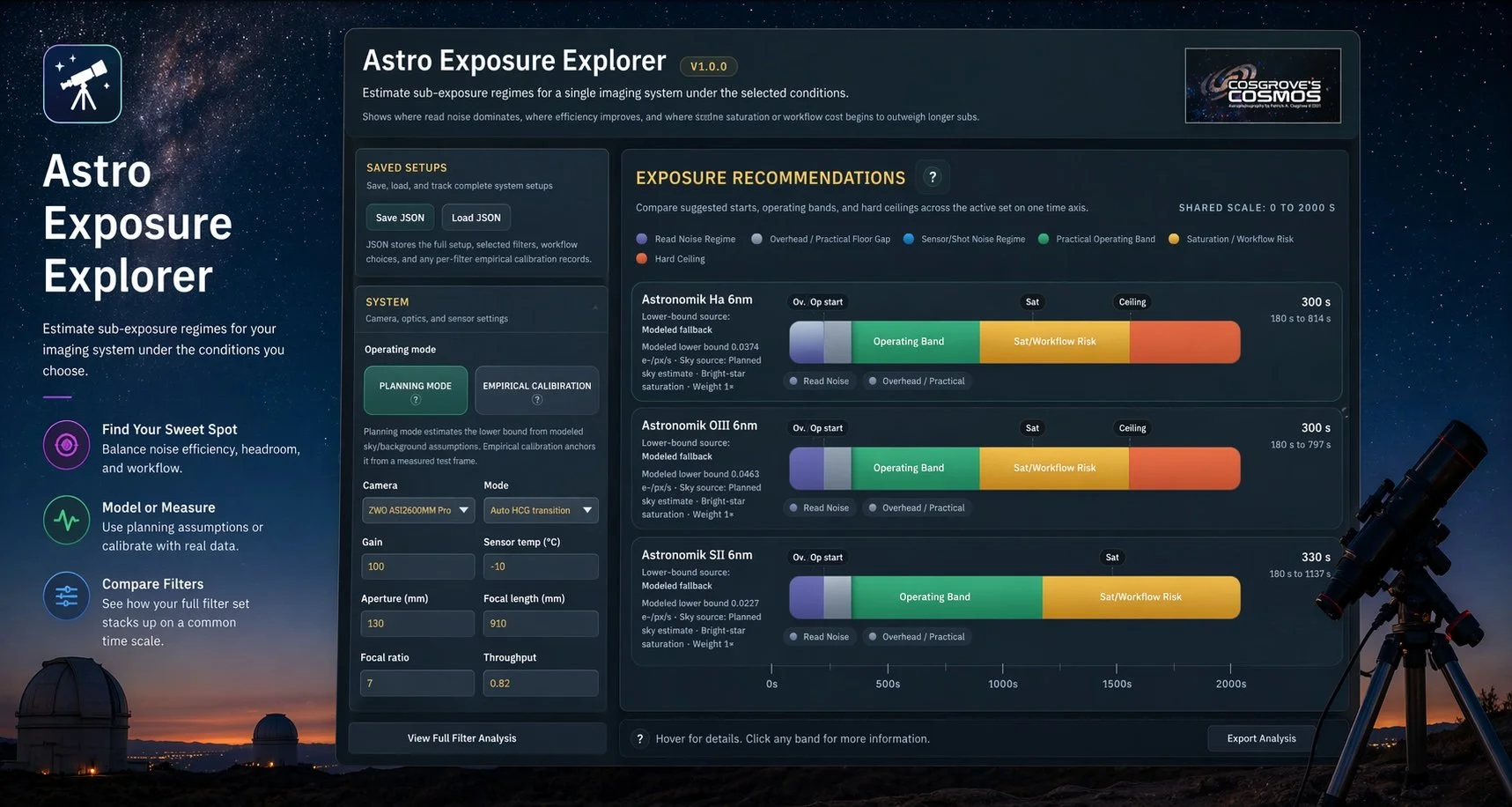
Astro Exposure Explorer is a planning and calibration tool for one of the most persistent questions in astrophotography: how long should your sub-exposures actually be?
There is no single right answer.
Exposures that are too short can suffer from too much fixed read-noise penalty per frame, and very short subs can also become inefficient because dithering, download time, filter changes, focus runs, and other interruptions start to matter too much.
Exposures that are too long are less forgiving. Bright stars may saturate, lost frames become more expensive, and increasing sky background can consume too much of the sensor’s usable well depth.
Between those extremes is the preferred operating range: the part of the problem where the balance between lower-bound noise efficiency, upper-bound headroom, and practical workflow is most favorable.
Astro Exposure Explorer is built to help with that trade. It does not try to hand you one sacred number. Instead, it separates the problem into three related but different questions:
How long must the exposure be before read noise is no longer too large a fraction of the result?
What range of exposure lengths is a sensible, practical working interval for this system and these conditions?
At what point do saturation, sky growth, and workflow penalties begin to make longer subs less attractive?
The goal is not to replace judgment. The goal is to give you a better starting point, a preferred operating band, and a clearer understanding of what is driving the recommendation.
Before You Begin
This tool is a guide, not an oracle.
In Planning Mode, the answer depends on the assumptions you provide: sky brightness, target altitude, field behavior, workflow choices, and other setup details. In Empirical Calibration Mode, the lower-bound estimate becomes better anchored because it uses a measured test frame from your own system.
That matters because sub-exposure choice is not driven by sensor physics alone. Mount performance, guiding quality, focus strategy, dithering policy, target structure, sky brightness, and your tolerance for clipping bright stars can all legitimately move you toward the short side or the long side of the recommended range.
This tool is most useful when treated as informed planning guidance for your own equipment under your own sky.
How to start
Enter your camera, optics, gain, filters, and sky/field assumptions
Use Planning Mode if you are estimating a session in advance
Use Empirical Calibration Mode if you have a representative measured test frame
Focus first on the Suggested Start, Operating Band, and Dominant Drivers
For multi-filter work, use the filter-set view to see whether one common sub-length is practical or whether the filters genuinely want different values
Interpreting Your Result
The Suggested Start is a practical starting point inside the preferred working range. It is not meant to be a sacred number.
The Operating Band is the more important output. That is the range where the balance between lower-bound noise efficiency, upper-bound headroom, and practical workflow is most favorable under the assumptions you entered.
If your priorities differ, you can bias within that band. The short side is often better when bright-star protection, guiding limits, or caution matter most. The long side is often better when you want fewer files and less overhead, provided the upper-risk constraints remain acceptable.
When It Makes Sense to Override the Recommendation
There are good reasons to choose a value other than the Suggested Start.
You may want to go shorter if your mount or guiding will not reliably support the recommendation, if you are trying to protect bright stars, or if you prefer more forgiving subs under variable conditions.
You may want to go longer if the upper-risk region is still comfortable, you want to reduce file count, or you are trying to minimize the operational cost of very short exposures.
If multiple filters end up with similar recommendations, it may also be reasonable to standardize on one common exposure for simplicity rather than chasing small per-filter differences.
Once you are inside a reasonable working range, total integration time usually matters more than obsessing over very small differences in sub length.
Go Deeper
If you want to understand the method in more detail, read the Technical Appendix, which explains the noise terms, operating-band logic, workflow assumptions, and worked examples behind the tool.
The FAQ addresses practical questions such as when to trust Planning Mode, when Empirical Calibration is worth the effort, how workflow choices affect the answer, and why the tool may disagree with common rules of thumb.
Notes
Astro Exposure Explorer is still evolving. Recommendations depend on the quality of the assumptions or measurements you provide, and the result should always be interpreted in the context of your own mount, sky, target, and imaging priorities.
If you run into a case that seems wrong, confusing, or especially interesting, I would be glad to hear about it.