NGC 2174 - The Monkey Head Nebula - 5.1 hours SHO
Date: January 12, 2026
Cosgrove’s Cosmos Catalog ➤#0158
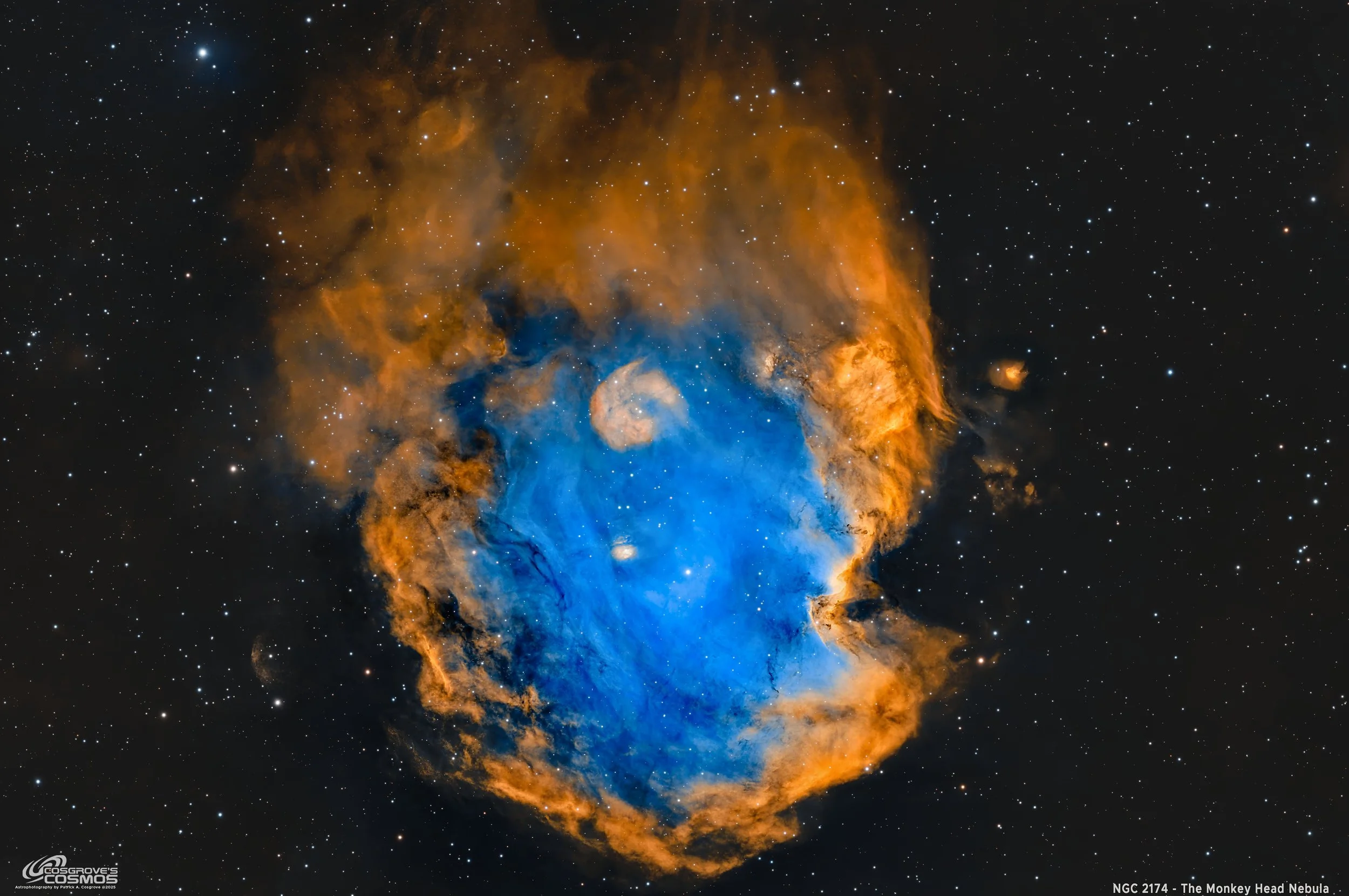
What you’re seeing: A narrowband SHO rendering of Orion’s Monkey Head Nebula: glowing ionized gas carved into ridges and pillars by young, hot stars, with dark dust lanes slicing through the light where denser material still hides star formation. (Click image for hi-res version via AstroBin.com.)
The Monkey Head: ionized gas, dark dust, and newborn stars in mid-creation!
Published in the May 2026 Issue of BBC Sky At Nght Magazine:
(Click to enlarge)
Awarded “Explore” Status on Flickr!

Table of Contents Show (Click on lines to navigate)
Introduction
This data was captured in October as a secondary target after my primary object had set.
With limited integration time and a relatively slow optical system, it was very much a “use the remaining dark hours” project—but it still delivered a result I’m pleased with. It’s also a clear step up from my first attempt at NGC 2174 back in February 2020.
🔭 About The Target
Overview
The Monkey Head Nebula (NGC 2174) is a sprawling emission nebula – essentially a glowing cloud of ionized hydrogen gas – in the constellation Orion. It earned its whimsical nickname because the nebula’s billowing clouds, when seen in visible-light images, resemble the face of a monkey. This nebula lies in the northern part of Orion (near the constellation’s border with Gemini) and is about 6,400 light-years from Earth. As an H II region (ionized hydrogen cloud), it serves as a stellar nursery where new stars are forming within vast clouds of gas and dust.
History
Despite its location in a prominent constellation, the Monkey Head Nebula is relatively faint and remained unnoticed until the 19th century. The nebula was first observed and catalogued by the French astronomer Édouard Stephan in 1877, who spotted it using an 80-cm reflecting telescope.
Prior to Stephan’s observation, the bright open star cluster at the nebula’s heart had been noted by German astronomer Karl Christian Bruhns in 1857, and there is evidence that Italian astronomer Giovanni Batista Hodierna may have seen this cluster as early as the 1650s. These early observations eventually revealed that a faint nebulosity (now known as NGC 2174) surrounds the star cluster, giving rise to the Monkey Head Nebula’s identification in modern catalogs.

Édouard Stephan (August 31, 1837 – December 31, 1923)
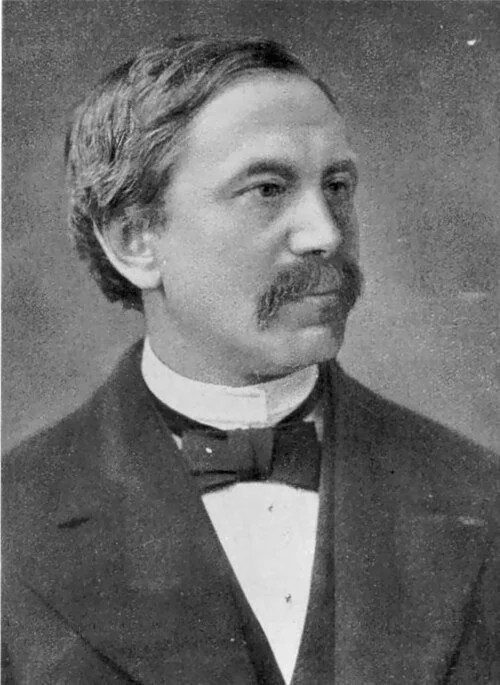
Karl Christian Bruhns (November 22, 1830 – July 25, 1881)

Giovanni Battista Hodierna, (April 13, 1597 – April 6, 1660)
Science
Scientifically, the Monkey Head Nebula is an active star-forming region that envelops a loose cluster of newborn stars. The intense radiation from these young stars – in particular from a massive O-type star near the nebula’s center called HD 42088 – ionizes the surrounding hydrogen gas and makes the nebula glow brightly.
Ultraviolet light and powerful stellar winds from the hot stars are sculpting the nebula’s gas and dust into towering pillars and intricate shapes, similar to the famous pillars seen in other star nurseries. In essence, the Monkey Head Nebula is a cosmic nursery: within its dark cosmic clouds, infant stars continue to form. Many of these baby stars are hidden behind veils of dust in visible light, but they shine at infrared wavelengths, a fact confirmed by telescope observations that show the “monkey’s head” shape disappears in the infrared view .
Interesting Facts
From our vantage point on Earth, NGC 2174 covers a surprisingly large patch of sky – about 40 arcminutes across, larger than the full Moon – yet its light is spread out, making it too dim to see with the naked eye. Only telescopes or long-exposure photographs reveal this nebula’s intricate structure.
Modern astronomical imaging (including amateur astrophotography and space telescopes) has produced stunning views of the Monkey Head Nebula, often using special filters and false-color techniques to highlight details of the gas and dust. For example, infrared emissions can be mapped to visible colors to expose features that would otherwise remain hidden.
These observations not only create beautiful images but also help astronomers study how young stars interact with their birth clouds, and they remind us that nebulae like the Monkey Head are transient celestial sculptures – over the next few million years, the nebula’s own stars will gradually disperse its gas, eventually leaving behind just the cluster of stars that once formed within.
🔭 Project Summary
Target: NGC 2174 — The Monkey Head Nebula
Capture Dates: October 27, & 28, 2025
Constellation: Orion • Distance: ≈ 6,400 light-years
Type: Emission Nebula / H II Region (active star-forming region)
Imaging Period: October 16–28, 2025 • Total Integration: 5 h 10 m (Ha + OIII + SII)
Filters: Ha · OIII · SII (Astronomik 36mm unmounted 6 nm)
Platform (at capture): Astro-Physics 130mm Starfire (Ver 2.1)
- See the platform card below for full computed specs and component links.
Telescope: Astro-Physics 130mm f/8.35 Starfire APO (built 2003)
Camera: ZWO ASI2600MM-Pro (−15 °C; Gain 100)
Mount: iOptron Tri-Pier + custom steel pier
Processing: PixInsight & Photoshop
Location: Whispering Skies Observatory · Honeoye Falls, NY (USA)
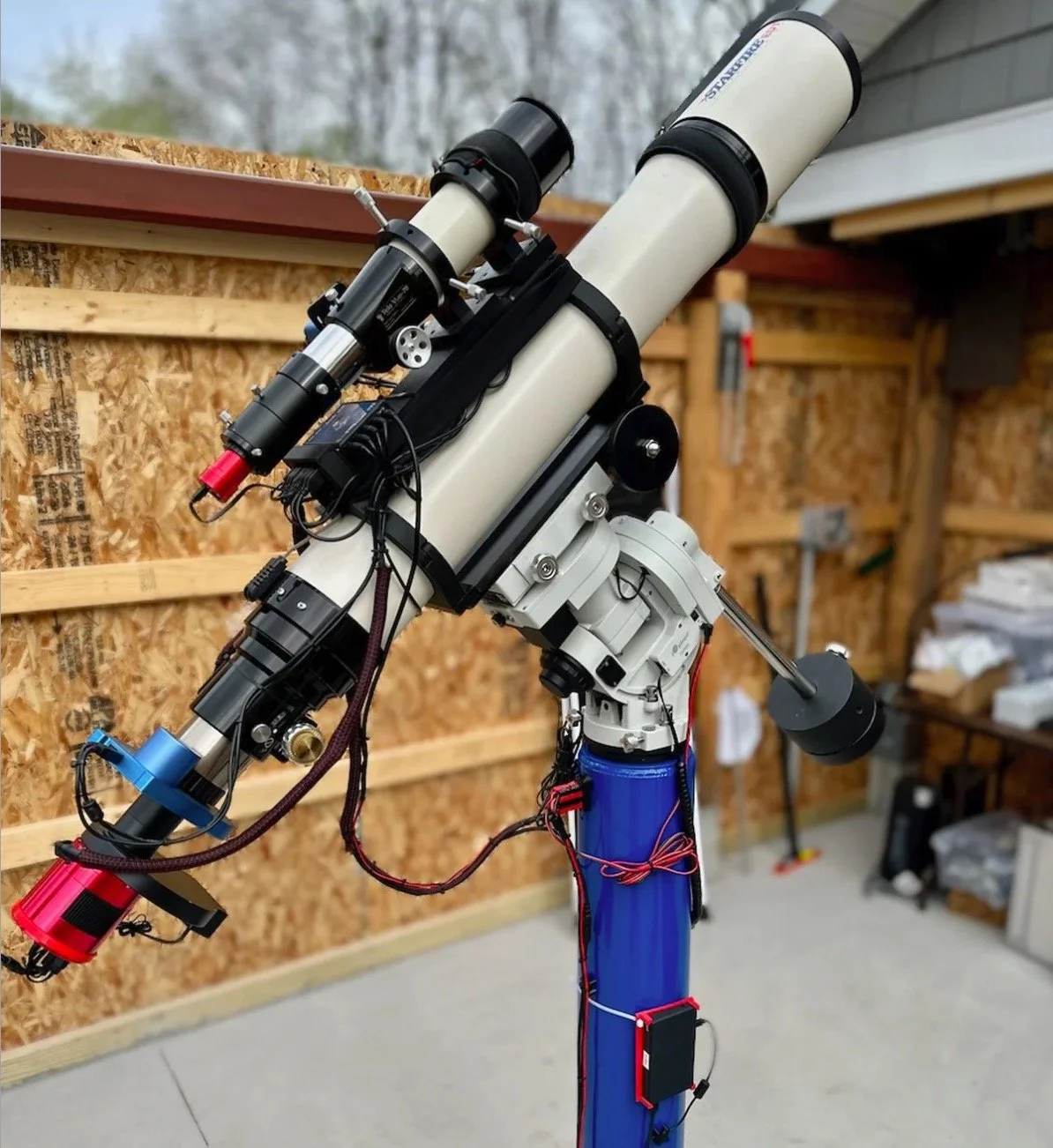
The AP130mm f/8.35 Platform, with a ZWO ASI2600MM-Pro Camera on a iOptron CEM 60 mount.
📸 Capture Details
Nights: October 27 & 28, 2025
Number of frames shown is after bad or questionable frames were culled.
| Channel / Filter | Frames × Exposure | Settings | Total |
|---|---|---|---|
| Ha — Astronomik 36mm 6 nm | 22 × 300 s | bin 1×1 • −15 °C • Gain 100 | 1 h 50 m |
| OIII — Astronomik 36mm 6 nm | 19 × 300 s | bin 1×1 • −15 °C • Gain 100 | 1 h 25 m |
| SII — Astronomik 36mm 6 nm | 21 × 300 s | bin 1×1 • −15 °C • Gain 100 | 1 h 45 m |
| Total Integration: 5 h 10 m (Ha + OIII + SII) | |||
Calibration Frames
- 30 × darks @ 300 s, bin 1×1, −15 °C, Gain 100
- 30 × dark-flats @ each flat exposure time, bin 1×1, −15 °C, Gain 100
- Flats: 15 each — Ha, OIII, SII
Annotated Image
This annotated image was created with the ImageSolver and FinderChart scripts in PixInsight.
The Location in the Sky
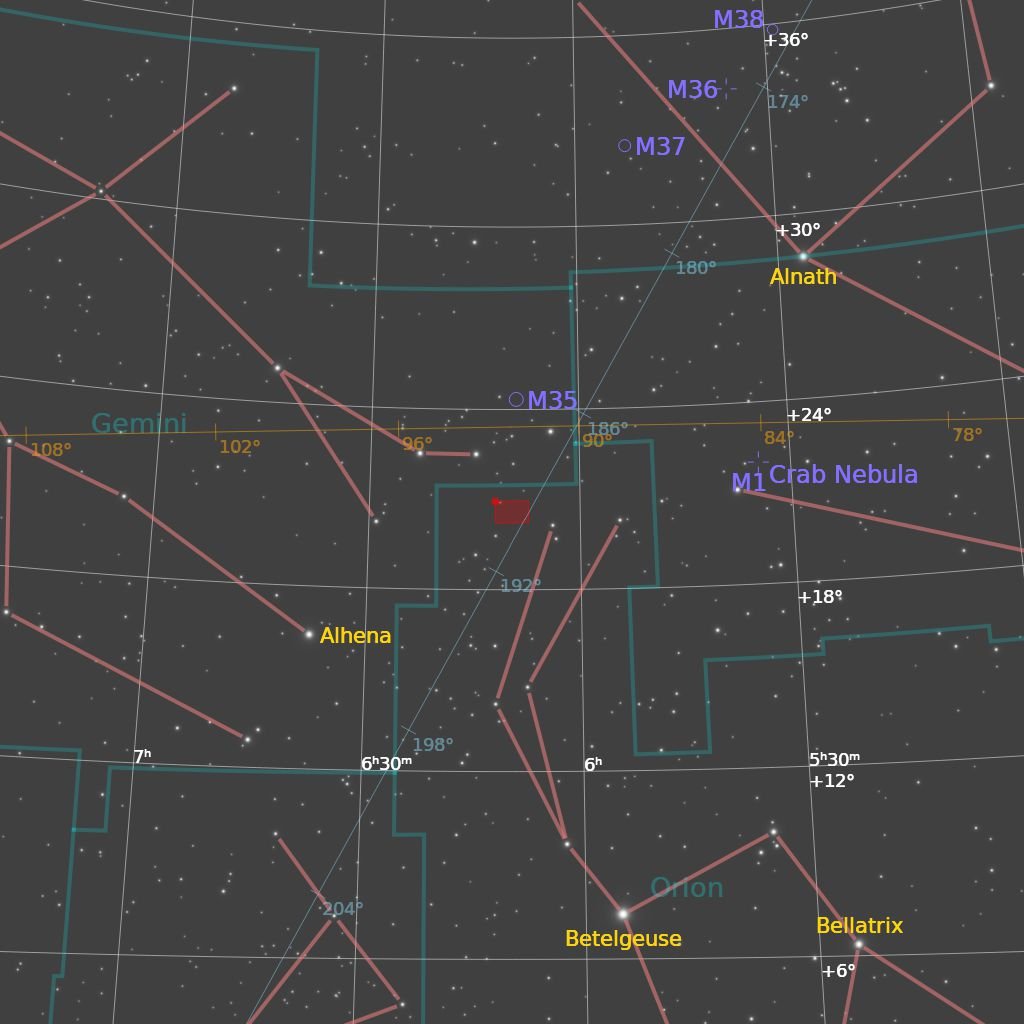
This annotated image created with ImageSolver and FinderChart Scripts in PixInsight.
About the Project
Planning
This was another secondary target that was captured after my primary target had set around 3 am. You have to love these long fall nights! I had some hours of darkness left, and Orion was prominent in the southern sky. It seems that I rarely have the opportunity to shoot targets in my favorite constellation, so I decided to pick a secondary target from this region.
As I reviewed possible targets, I came across NGC 2174 - The Monkey Nebula. I was familiar with this one as I had shot it back in 2020. This is a very early OSC effort and was kind of crude. I liked the idea of redoing this in narrowband and seeing what I could come up with!
With this selection made, I assigned it to my Astro-Physics 130mm f/8.35 scope and created a sequence plan in NINA to execute it.
Previous Capture Attempts
As I said, I first shot this back in February of 2020. It was a very early effort using my William-Optics 132mm FLT and a ZWO OSC. It was a 36-minute exposure and pretty crude. You can see the early imaging project here:
I have also included the image below. As you can see, it would not take much to get a better image of this target!
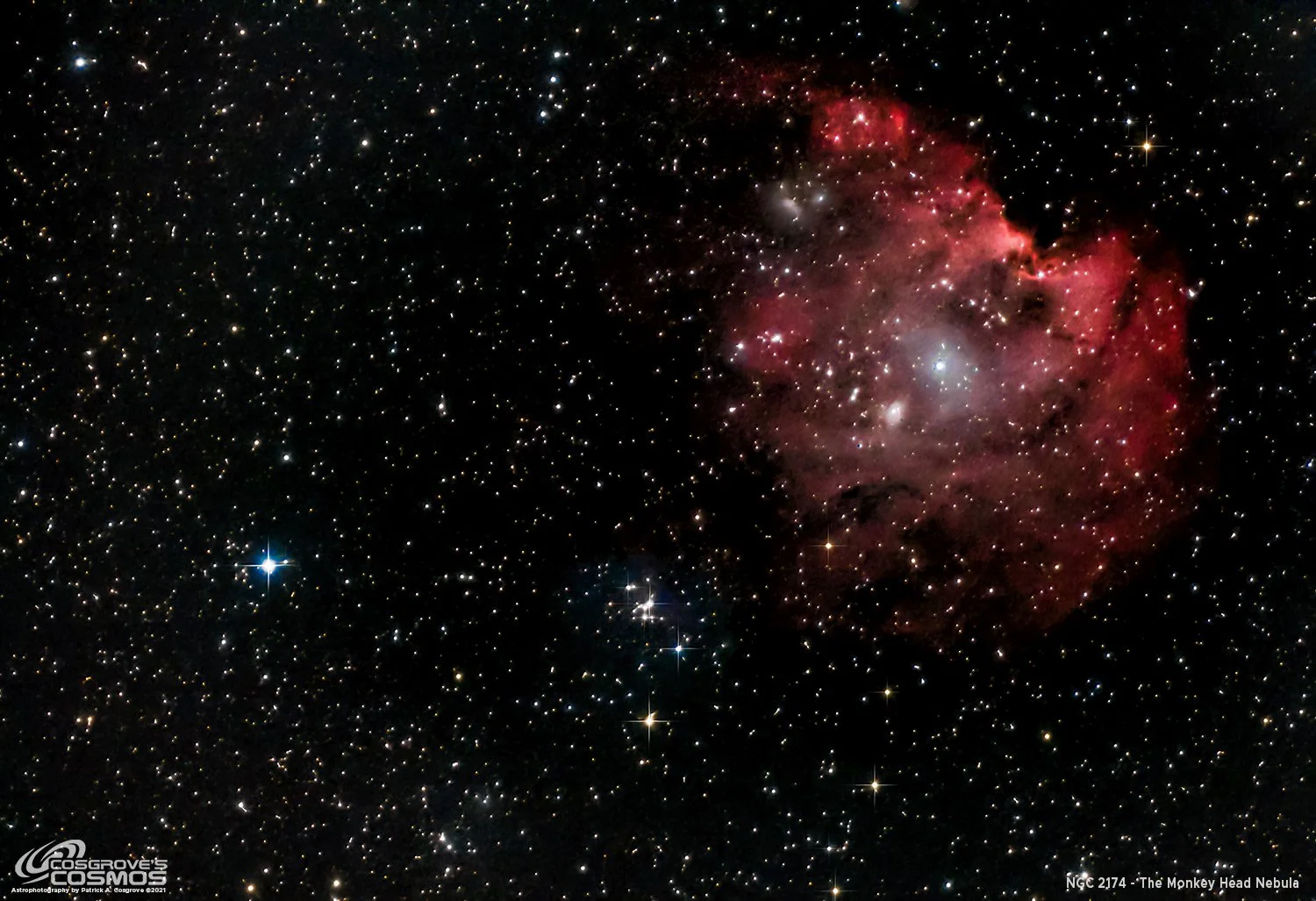
My first attempt from 2020.
At the time, I was pretty excited to get anything at all. This was a target I was unfamiliar with, and I felt like I was exploring strange new targets, and I was thrilled to capture any detail at all!
On the other hand, the image of a monkey’s head is relatively easy to see in this RGB image and much less so in the narrowband SHO image.
Data Collection
I decided to shoot this as a pure narrowband image. 300-second exposures were used for the Ha, O3, and S2 filters. I used a cooler aim temperature of -15 °C and a camera gain of 100.
The collection was started after the primary target had set, with a window of just over 2 hours across 2 nights: October 27 and 28, 2025.
Everything seemed to go well. Tracking was good. Reviewing the data later during the blink process, I found that clouds had passed through this section of sky a few times, so I removed several frames, reducing the capture time to just over 5 hours.
This was a relatively short integration time taken with my slowest scope, f/8.35. From a purely capture standpoint, this was not optimal. But it would be interesting to see how this compares to my first effort!
Processing Overview
This would be a straightforward process using my standard SHO processing flow, shown below. In many ways, this was simple to process. I created an SHO color image early on, and aside from using a starless process, the steps were simple and straightforward. I did not run into any particular problems or challenges along the way.
I suppose the only area of doubt was the final color saturation position.
People who have followed my work know that I am a “high color” guy. Not every astrophotographer rolls that way, and perhaps there are some who dislike my final position. But as I experimented with different looks for the final image, each time I lowered the color level, the results just didn't look right to me.
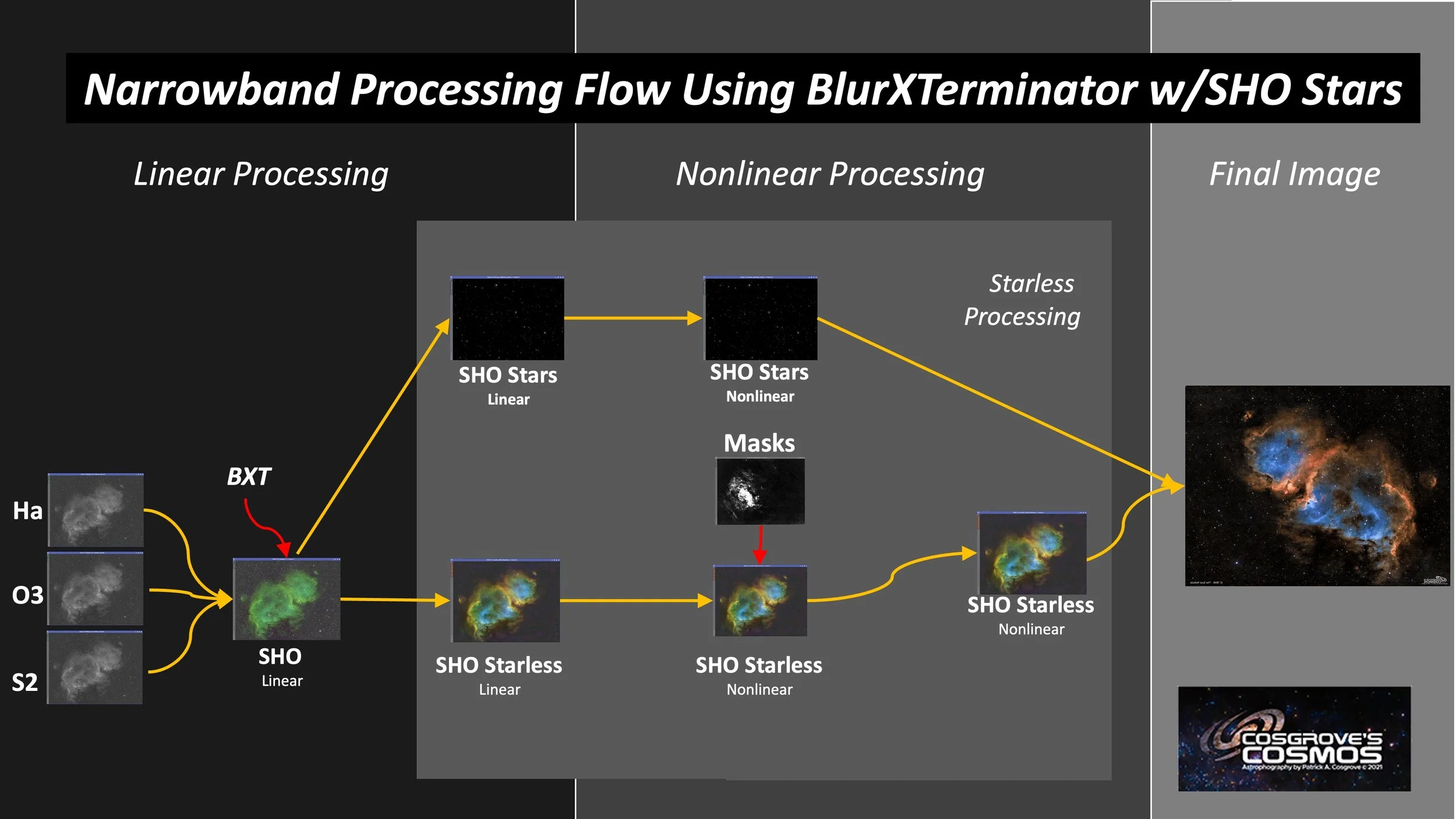
My typical SHO Starless Workflow.
Detailed and Annotated Image Processing Walkthrough
Typically, I conclude one of these imaging projects by documenting the processing steps I used on this image. But this section can make the overall post very large and, at times, slow to load.
I am now creating a secondary, standalone page to hold this information. You can access this page by clicking the link below. Returning to this page is as simple as clicking the back arrow in your browser or selecting a different menu option at the top of the page.
I hope you like this new format!
Hit the Link below to see the detailed image processing walkthrough page for this Imaging Project!
Final Results
There is no question that this image could have benefited from a longer integration time. But even with the limited time and a narrower scope, the final image has great color and detail! It certainly is a big improvement over my first effort back in 2020. There is an amazing amount of detail in the pillars and plumes in the gas.
More Information
🔭 Target Details
SIMBAD: NGC 2174 – Astronomical database entry for NGC 2174, classifying it as an H II region in Orion. Provides precise coordinates, basic object data, and cross-identifications (including the “Monkey Head Nebula” name).
Aladin Lite – NGC 2174 – Interactive sky atlas centered on the Monkey Head Nebula. Allows you to explore the nebula’s location and surroundings on the sky, with overlays of stars and deep-sky surveys.
NGC 2174 (Monkey Head Nebula) – Orion – TheSkyLive – Overview of NGC 2174 with its celestial coordinates, designation as an emission nebula, and visibility information. Includes a star chart and basic data like distance (~6,400 ly) and apparent size (~40′ across).
NGC 2174 – Wikipedia – Summary of the Monkey Head Nebula’s properties and context. Notes that it’s an H II star-forming region in Orion associated with cluster NGC 2175, and that it was discovered in 1877 by Édouard Stephan. Also discusses the ambiguity in use of NGC 2174/2175 for the nebula vs. the star cluster.
📜 History & Naming
Monkey Head Nebula (NGC 2175) – Deep Sky Corner – Details the discovery and nomenclature history. The star cluster (NGC 2175) may have been observed by G.B. Hodierna in the 17th century and was noted by Christian Bruhns in 1857. In 1877, Édouard Stephan catalogued a faint patch of the nebula (later NGC 2174). Describes how a later observation in 1890 (IC 2159) and overlapping designations led to confusion between the nebula and cluster.
Hubble Revisits the Monkey Head Nebula for 24th Birthday (ESA/Hubble) – Announces Hubble’s 24th-anniversary image of NGC 2174 and explains the origin of its popular name. The nebula’s “Monkey Head” moniker comes from its curiously simian shape seen in wide-field images. (Alternate catalog names include Sharpless 2-252 and IC 2159, but all refer to this same star-forming cloud.)
Hubble Telescope Spies Star Factory in “Space Monkey Head” – Space.com – News article on the Monkey Head Nebula as a “starbirth factory,” released for Hubble’s anniversary. Mentions that NGC 2174 is also known as Sharpless Sh2-252 and showcases Hubble’s infrared view of the nebula’s carved gas and dust pillars. Describes how massive young stars are eroding the nebula, highlighting the origin of its striking appearance.
🔬 Science & Observations
NGC 2174 – Hubble 24th Anniversary Infrared Image (NASA) – Official NASA description of Hubble’s infrared mosaic of the Monkey Head Nebula, taken for the telescope’s 24th birthday. Shows “knotty” pillars of gas and dust being carved by radiation from newly formed massive stars. Notes that the nebula’s hydrogen gas glows as it’s ionized by ultraviolet light, and that Hubble’s IR vision peers through dust to reveal ongoing star formation.
Seeing Beyond the “Monkey Head” (Spitzer Space Telescope) – Infrared observations by NASA’s Spitzer reveal dozens of baby stars hidden inside NGC 2174. In Spitzer’s IR image, the “monkey face” shape vanishes as different dust structures appear; warm dust clouds glow at 8–24 μm, highlighting embryonic stars still wrapped in dusty cocoons. Explains how Spitzer’s false-color IR view penetrates the nebula’s dark filaments to preview the next generation of stars.
Evaporating Peaks: Pillars in the Monkey Head Nebula (NASA Visualization) – A 3D visualization and zoom produced by NASA’s Scientific Visualization Studio. It illustrates the towering pillars along the nebula’s edge and how Hubble’s view in visible vs. infrared light differs. Massive young stars’ radiation has “hollowed out” these pillar structures. (The video simulates a flight into the nebula, transitioning from 2D images to a 3D model – a scientifically informed but artistically rendered interpretation of NGC 2174’s geography.)
APOD: NGC 2174 – Stars Versus Mountains (2011) – Astronomy Picture of the Day explanation of the battle between energetic newborn stars and the “mountains” of gas in NGC 2174. Describes how intense UV light and stellar winds from young clusters are eroding and dispersing the dark stellar nurseries (pillars of dust) in this nebula. Also notes that NGC 2174 spans a region larger than the full Moon (apparent size) and shines primarily in the red light of hydrogen emissions.
💡 Interesting Facts & Outreach
National Geographic – Monkey Head Nebula Is a Glittering Stellar Nursery – Readable science article highlighting the Monkey Head Nebula’s stunning appearance. Emphasizes that this “turbulent gas and dust cloud” is a rich stellar nursery about 6,400 ly away, and points out that in wide-field images the nebula’s shape resembles a primate’s head (hence its name). Includes visuals comparing an amateur’s wide-field photo of the nebula to Hubble’s detailed close-up.
Space.com – Amazing Star Factory Inside the “Monkey Head” – Mainstream news piece on Hubble’s Monkey Head Nebula imagery. Describes the nebula as a “distant starbirth factory” with gas knots and pillars being carved by newborn stars. Includes a short video tour and mentions the Hubble anniversary context, making the science accessible. Also notes the nebula’s alternate catalog names and its location near Orion’s arm, connecting with a general audience.
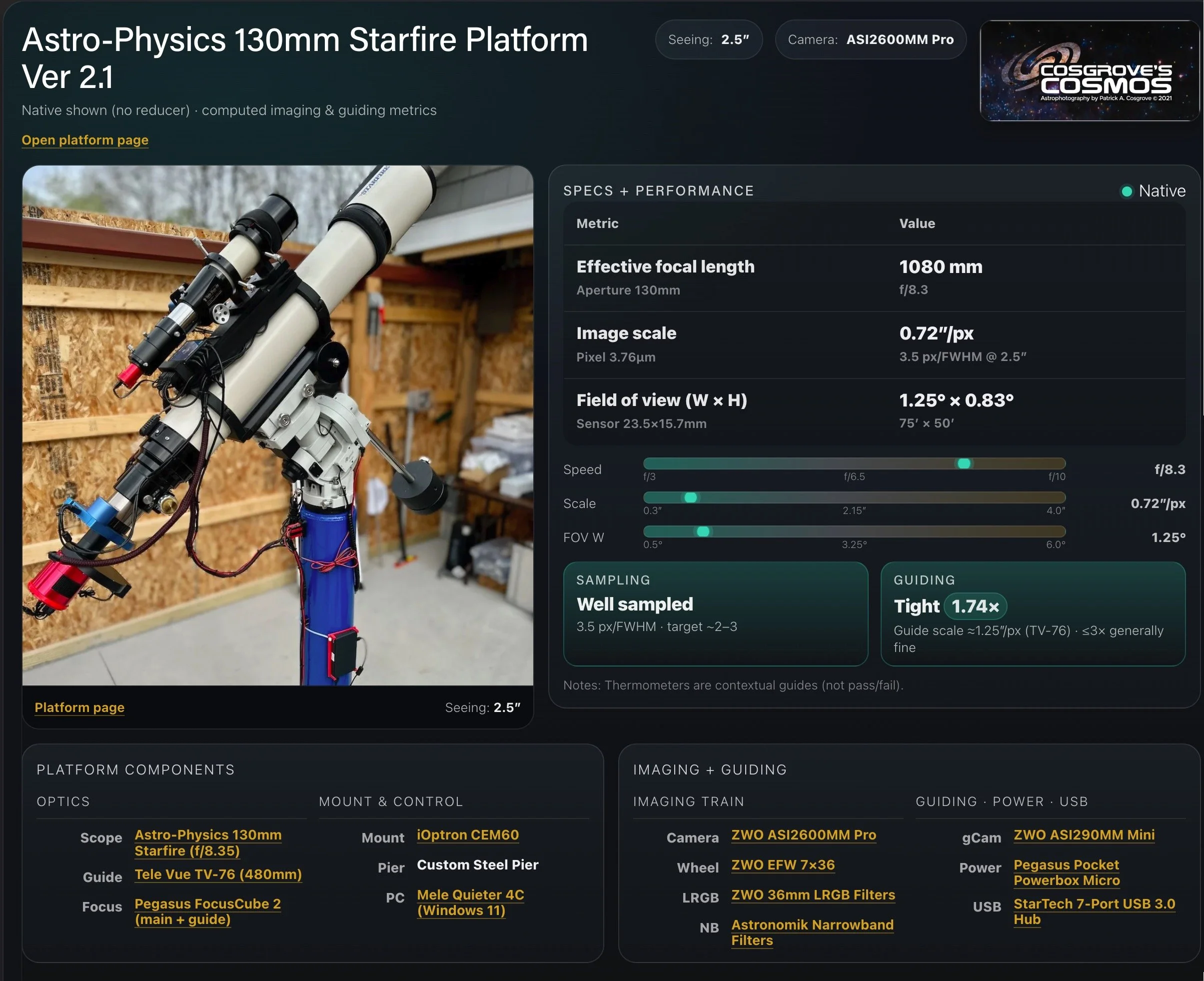
Platform used for this project
Capture Software
Capture Software: PHD2 Guider, NINA
Image Processing: PixInsight, Photoshop - assisted by Coffee, extensive processing indecision and second-guessing, editor regret, and much swearing…..