First Light on the AP155 Platform: M81, M82, and NGC 3077 - 4.6 Hours of HaLRGB!
Date: April 17, 2025
Cosgrove’s Cosmos Catalog ➤#0159
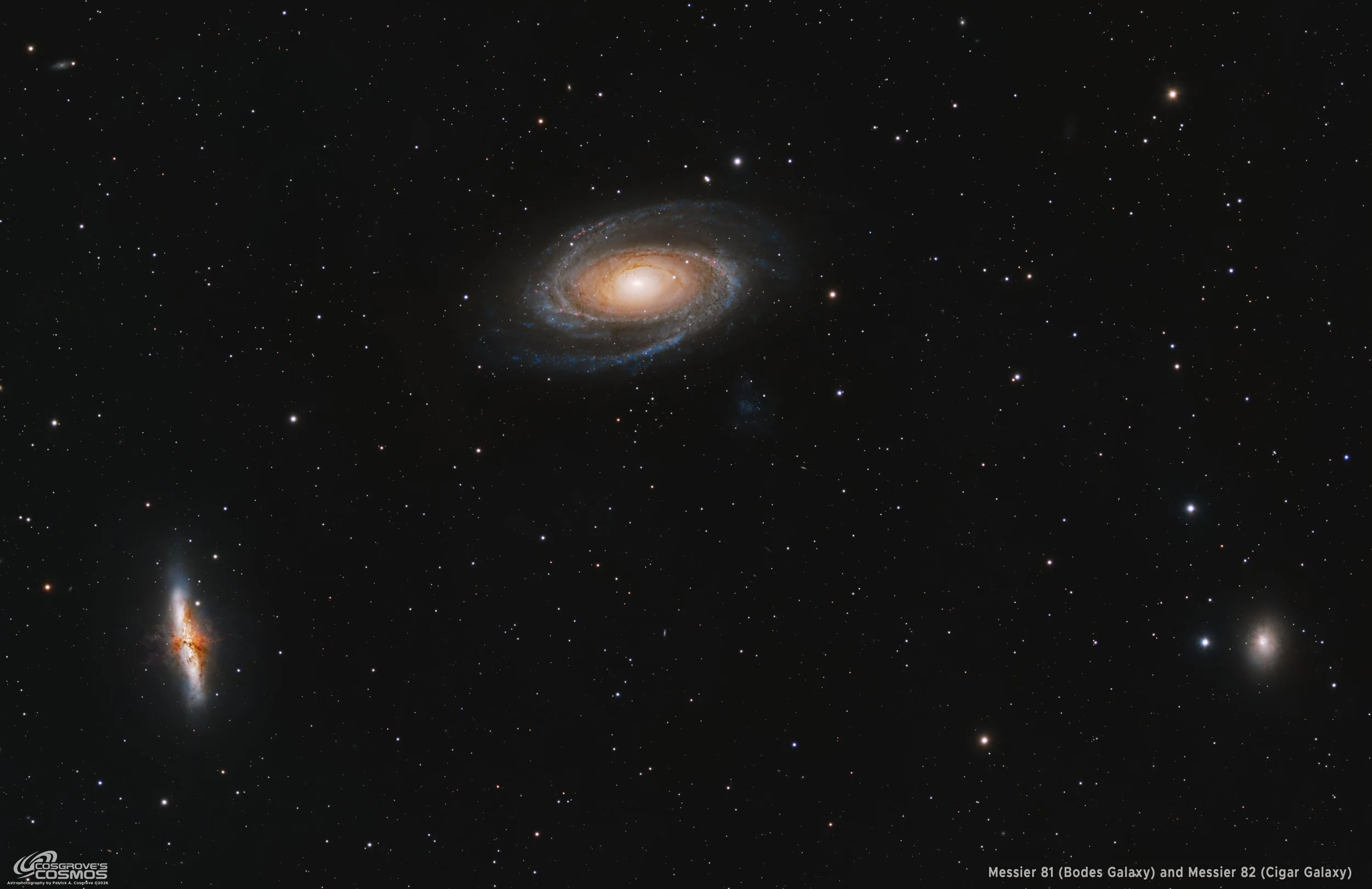
My first test image on the new AP155 Platform - I still have some tracking refinements to work on but not a bad first shakedown cruise! (Click image for hi-res version via AstroBin.com)
First Light on the AP155: M81, M82, and NGC 3077 in Ursa Major
Introduction
Winter of 2025/2026 was cold, snowy, and overcast!
I spent some of this weary weather working on telescope and observatory projects, and one of the biggest was transitioning my AP130 platform over to a new (to me - it's actually 30 years old!) AP155!
Saturday, April 11, we had a rare clear night projected- with the moon not rising until fairly late.
This was my shake-down cruise for this new platform, and as expected, I ran into issues that I had to resolve, and some lingering ones that still need attention.
🔭 Project Summary
Target: M81 (Bode’s Galaxy), M82 (Cigar Galaxy), and NGC 3077
Capture Date: April 11, 2026
Constellation: Ursa Major • Distance: ≈ 11.5–12.5 million light-years
Type: Spiral Galaxy (M81) + Starburst Galaxy (M82) + Disturbed Companion Galaxy (NGC 3077)
Imaging Period: April 11, 2026 • Total Integration: 4 h 36 m (LRGB + Ha)
Filters: L · R · G · B (ZWO 36mm Unmounted LRGB Gen II) + Ha (Astronomik 36mm 6 nm)
Telescope: Astro-Physics 155mm Starfire EDFS f/5.3
Camera: ZWO ASI2600MM-Pro (−15 °C; Gain 0 LRGB, Gain 100 Ha)
Mount: iOptron CEM60 on a custom steel pier
Processing: PixInsight & Photoshop
Location: Whispering Skies Observatory · Honeoye Falls, NY (USA)
Field Includes: M81, M82, NGC 3077
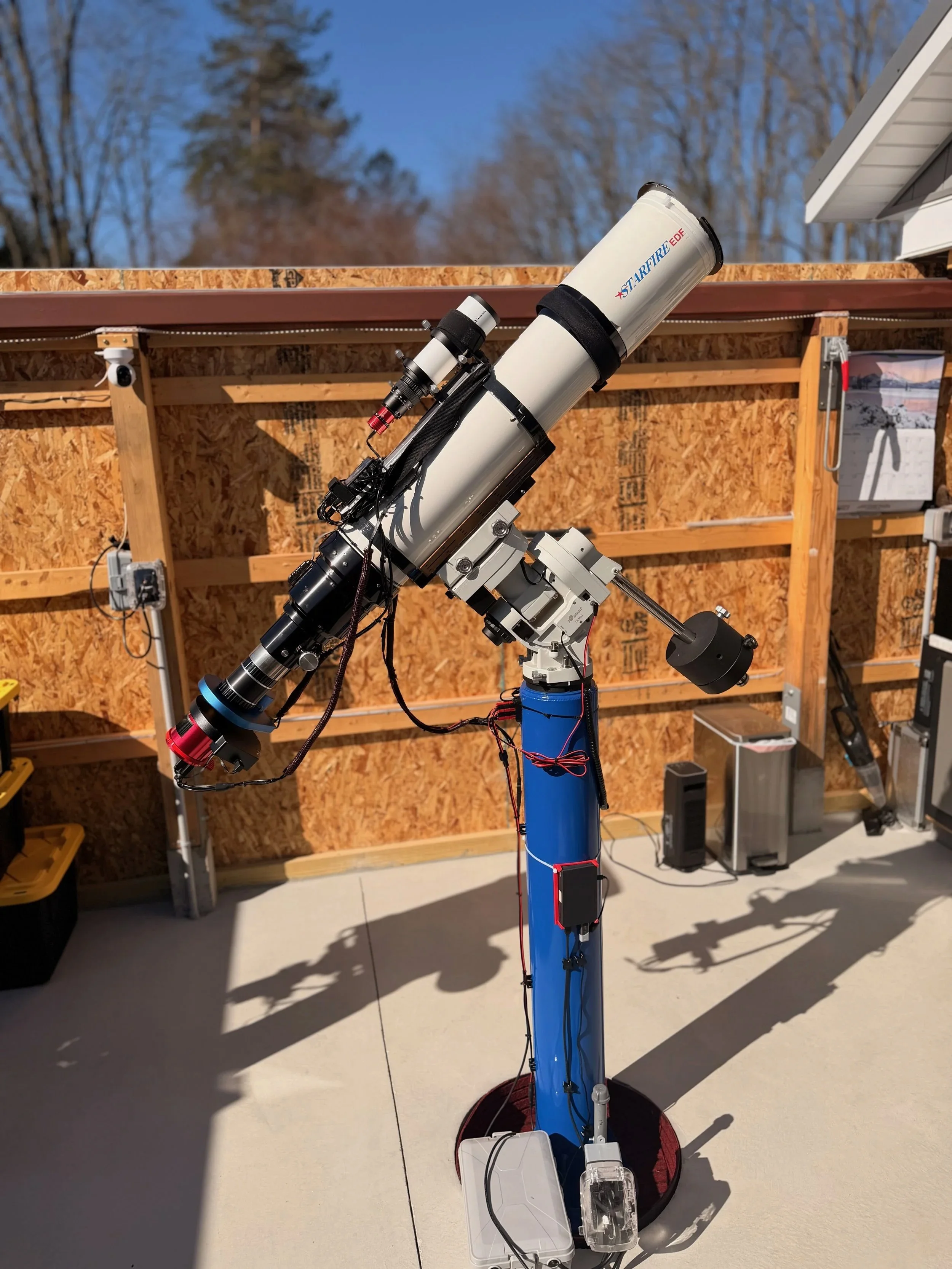
The AP155 f/5.3 Platform, with an iOptron CEM 60 mount, and a ZWO ASI2600MM-Pro camera.
📸 Capture Details
Night: April 11, 2026
Number of frames shown is after bad or questionable frames were culled.
| Channel / Filter | Frames × Exposure | Settings | Total |
|---|---|---|---|
| L — ZWO Lum (36mm) | 47 × 90 s | bin 1×1 • −15 °C • Gain 0 | 1 h 10 m 30 s |
| R — ZWO Red (36mm) | 21 × 90 s | bin 1×1 • −15 °C • Gain 0 | 31 m 30 s |
| G — ZWO Green (36mm) | 23 × 90 s | bin 1×1 • −15 °C • Gain 0 | 34 m 30 s |
| B — ZWO Blue (36mm) | 23 × 90 s | bin 1×1 • −15 °C • Gain 0 | 34 m 30 s |
| Ha — Astronomik 6 nm (36mm) | 21 × 300 s | bin 1×1 • −15 °C • Gain 100 | 1 h 45 m |
| Total Integration: 4 h 36 m (LRGB + Ha) | |||
Calibration Frames
- 30 × darks @ 90 s, bin 1×1, −15 °C, Gain 0
- 30 × darks @ 300 s, bin 1×1, −15 °C, Gain 100
- 30 × dark-flats @ each flat exposure time, bin 1×1, −15 °C, Gain 0 or Gain 100 as needed
- Flats: 15 each — L, R, G, B, Ha
Table of Contents Show (Click on lines to navigate)
Annotated Image
This annotated image was created with the ImageSolver and the AnnotateImage scripts in PixInsight
The Location in the Sky
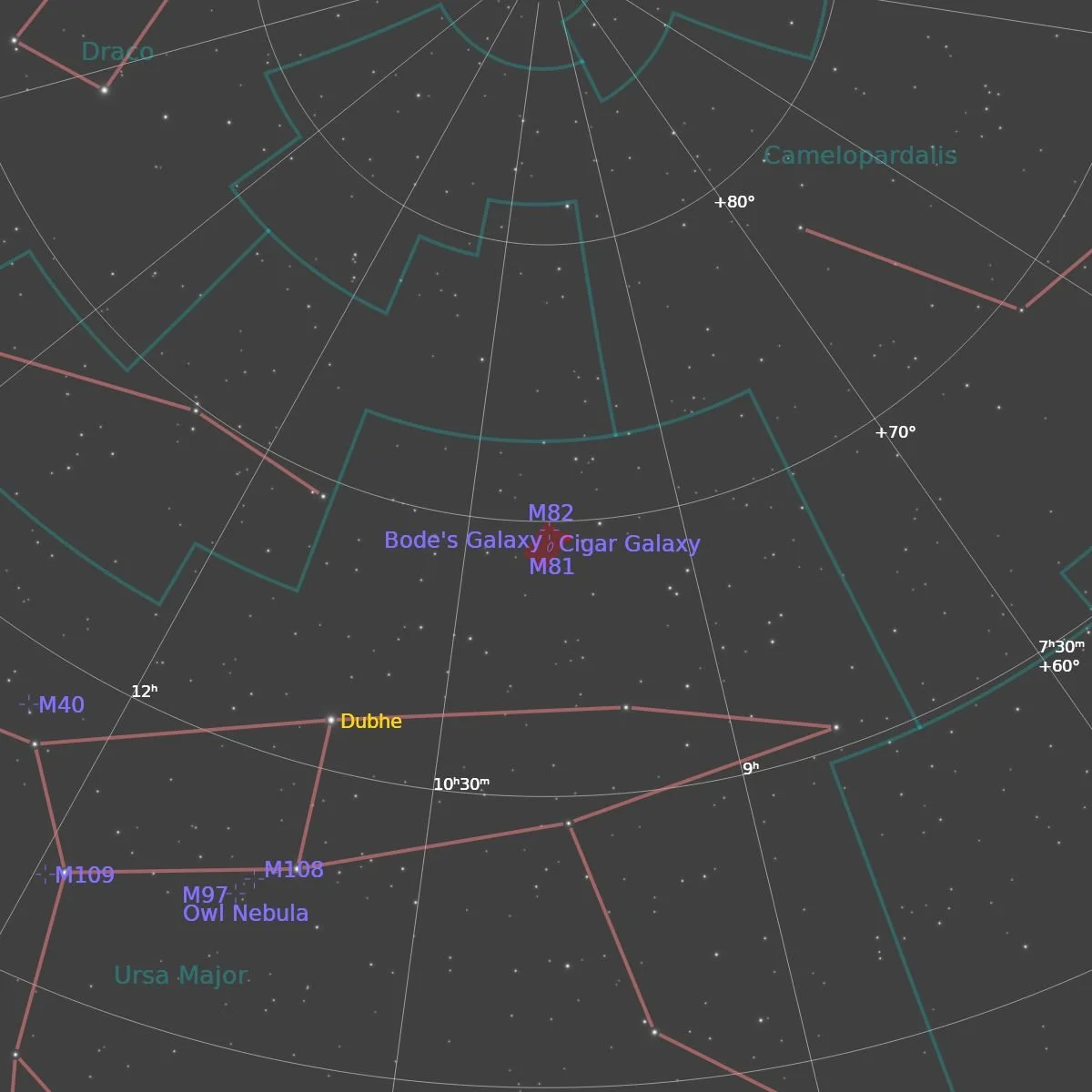
This annotated image was created with the ImageSolver and FinderChart scripts in PixInsight
🔭 About The Target
Overview
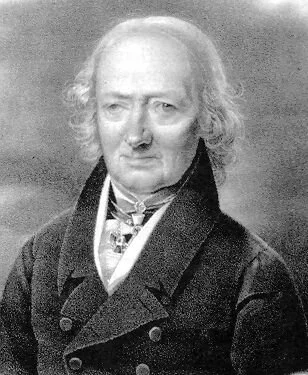
Johann Elert Bode (1747-1826)
This field is anchored by M81 and M82, one of the best-known galaxy pairings in the northern sky. Located in Ursa Major at roughly 12 million light-years from Earth, they are close enough to be frequent targets for amateur imagers and close enough to each other to share the same frame in many moderate focal length systems. M81, also cataloged as NGC 3031 and commonly known as Bode’s Galaxy, is a large grand-design spiral with a bright central core and graceful, well-defined arms. M82, also cataloged as NGC 3034 and better known as the Cigar Galaxy, presents a very different appearance: edge-on, irregular, dust-laced, and visibly disturbed. Also prominent in this field is NGC 3077, a smaller companion galaxy in the same physical group.
History
The history of these objects is well established. Johann Elert Bode discovered M81 and M82 in 1774, and they were later included in the Messier catalog in 1781 after being independently recovered by Pierre Méchain and communicated to Charles Messier. That history explains why M81 is still widely referred to as Bode’s Galaxy, even though both galaxies are most commonly identified today by their Messier numbers. NGC 3077 was discovered later by William Herschel in 1801. Together, these galaxies form part of the nearby M81 Group, one of the closest galaxy groups beyond our own Local Group.
Science
From a science standpoint, M82 is the real standout. Its most striking feature is the reddish material extending above and below the disk, often casually described as jets. More accurately, this is a galactic superwind driven by intense star formation in the galaxy’s core. M82 is a classic starburst galaxy, where the rate of star formation is far higher than normal. The combined effects of stellar winds and supernova explosions are pushing gas and dust out of the galaxy along its minor axis, creating the filamentary red outflow that is so clearly visible in many images. That red structure is not just visually dramatic. It is direct evidence of energetic feedback at work, showing how active star formation can reshape a galaxy and expel material into the surrounding environment.
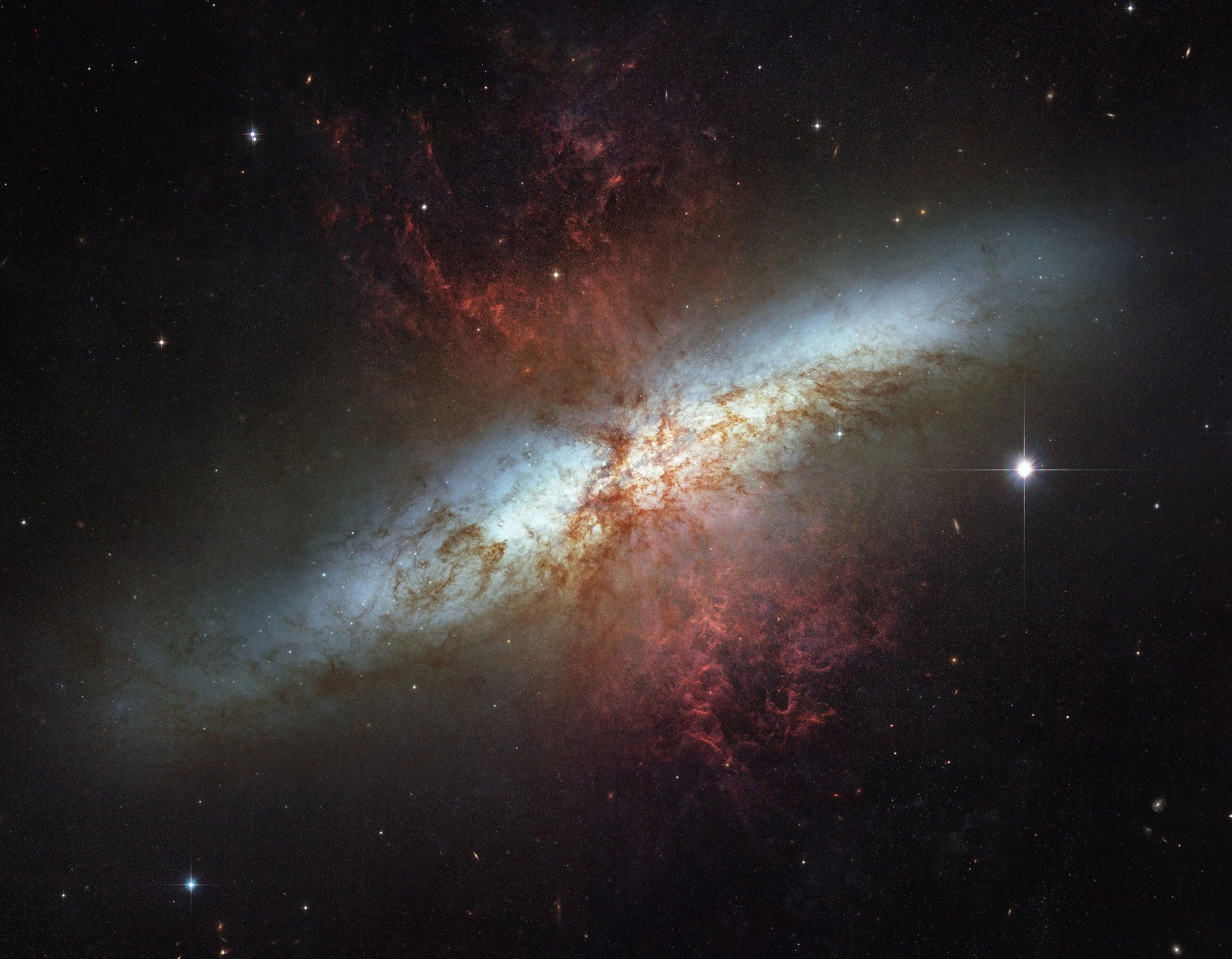
NASA, ESA, and The Hubble Heritage Team (STScI/AURA) - http://www.spacetelescope.org/images/heic0604a/ ([cdn.spacetelescope.org/archives/images/screen/heic0604a.jpg direct link]) http://hubblesite.org/gallery/album/entire_collection/pr2006014a/
M81 provides a useful contrast. It is the dominant spiral member of the group and appears far more orderly, but it is part of the same gravitational story. The interaction between M81, M82, and NGC 3077 has left visible marks across the system, including distorted structure, tidal disruption, and streams of material pulled between the galaxies over time. NGC 3077 may be smaller, but it is far from incidental here, showing its own signs of disturbance from that shared history. For astrophotographers, that is a big part of what makes this field so compelling: a single frame captures a classic spiral galaxy, a violently active starburst galaxy with a visible superwind, and a smaller companion shaped by the same interaction.
Close Up Galaxy Views From this Image
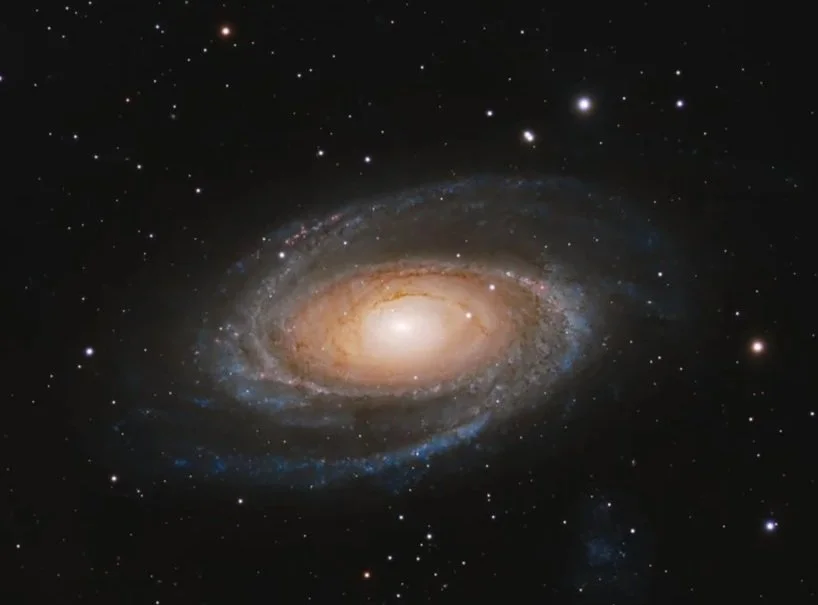
Messier 81 Close-up! You can also see the faint blue galaxy PGC28757 below and to the right.
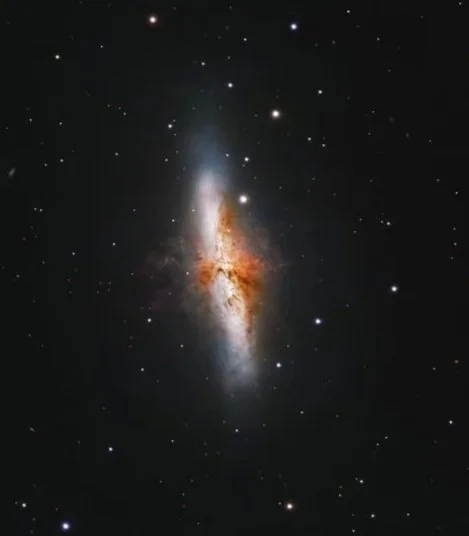
Messier 82 Close up view.
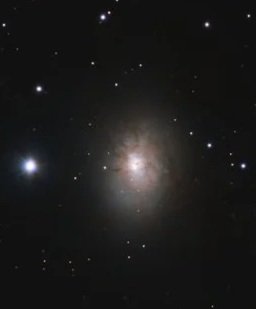
NGC 3077 Close up view.
About the Project
The New Platform
I have already written about my project to convert the AP130 platform to the AP155, so I won’t discuss that here. If you are interested, you can see the project post on that effort here:
Converting my AP130 Over to an AP155
Shortly after I completed that effort, we had a tiny window of clear skies so I could do all of the things you have to do to get a new platform operational: Achieving Focus, setting up autofocus, Plate Solving, Filter focus series, and polar alignment. While doing this, I noticed the fan in the camera was super loud. So I went over to check it out, only to feel a strong vibration coming from the camera!
Long story short, the fan had thrown a blade and was out of balance! So, I had to replace the fan.
That was a whole project in itself. If you want to learn more about that you see the post here:
Greeting Astro “Fans” - Replacing the Broken fan on my 2600 Camera!
After another brief, clear-sky window during the full moon, I tested the camera and fan and got the filter focus series done and such.
After a long stretch of very poor weather, we had a forecast for almost a full clear night on Saturday, April 11th. So my plan was to not only do a shake-down cruise on the AP155, but try and get my first full night of imaging for 2026!
Selection and Planning
Being in galaxy season, I wanted to shoot a mid-sized galaxy that would have sufficient detail and structure so I could evaluate the optics of this new OTA. I looked at a lot of candidates, and I realized that while I had shot M81/82 before, it had been a while. So I figured I would choose this target: the detail in the spiral of M82 and the “jets” of M81 would be a good test of the new system.
Capture Strategy
Because I knew that M82 has a strong Ha component, I decided to capture HaLRGB. This would give me a useful test of the platform’s broadband imaging performance as well as an initial test of its narrowband performance.
I planned to use 300-second subs with a gain of 100 on Ha and 90-second subs with a gain of 0 for LRGB. Further, I decided to take two L subs for each RGB set.
With this strategy in mind, I set up my NINA sequence - first crafting the composition I wanted for my frame, and then setting up the sub capture plan.
Previous Attempts at this target
I first shot this target back in March of 2021. This was a 10-hour integration with an OSC camera, and I think it came out pretty nicely for such an early image. This was shot on my WO132 platform before I put the reducer in. You can see the image project report here:
Here is that image for your viewing convenience:
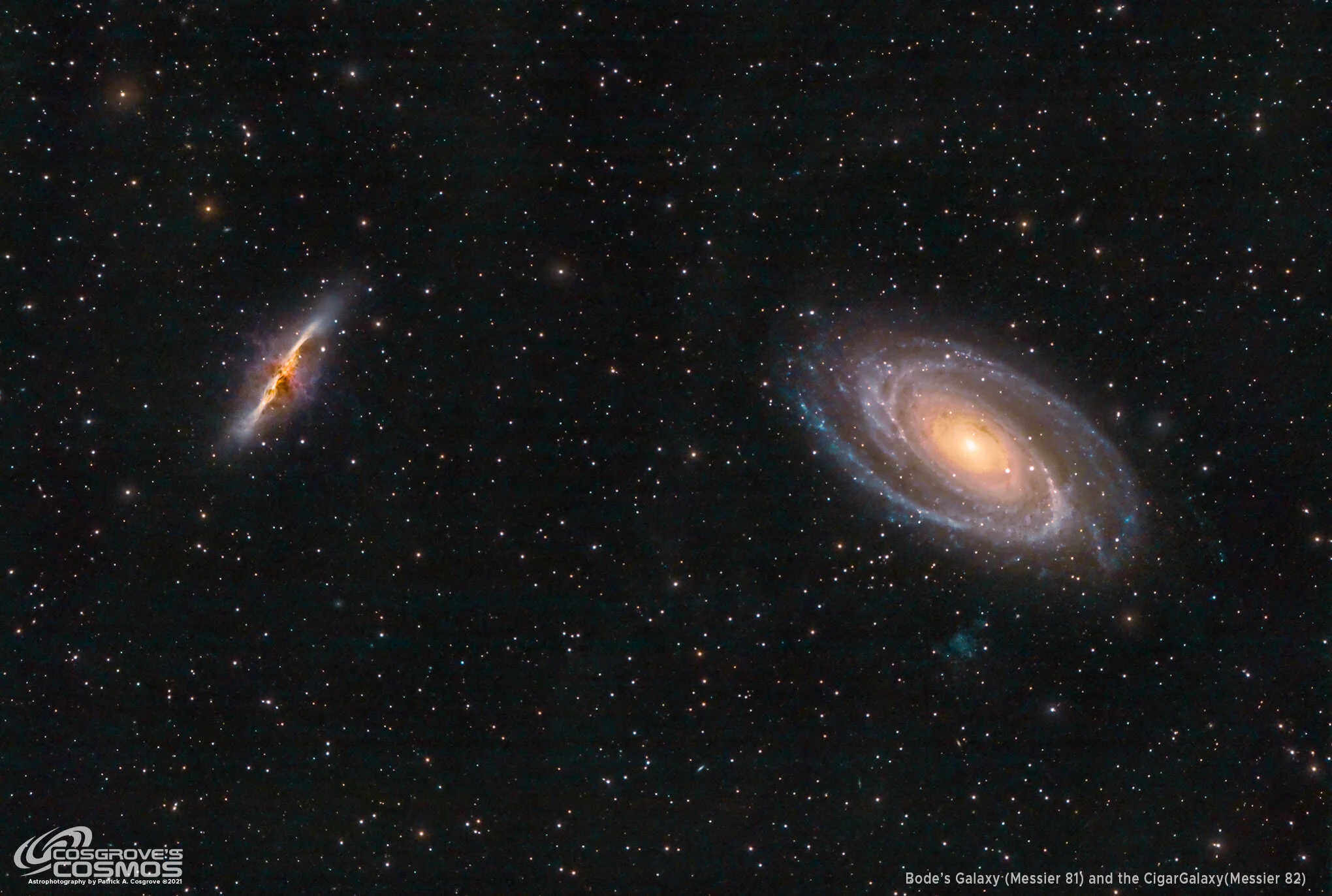
2021 version of my image - not bad!
The next time I shot this target was in 2022. I shot it with my wide-frame FRA400 platform in a quest for IFN in the surrounding field. But the weather only gave me about 3 hours to get it, which was clearly not enough! You can see the report here:
And here is the image for that effort:
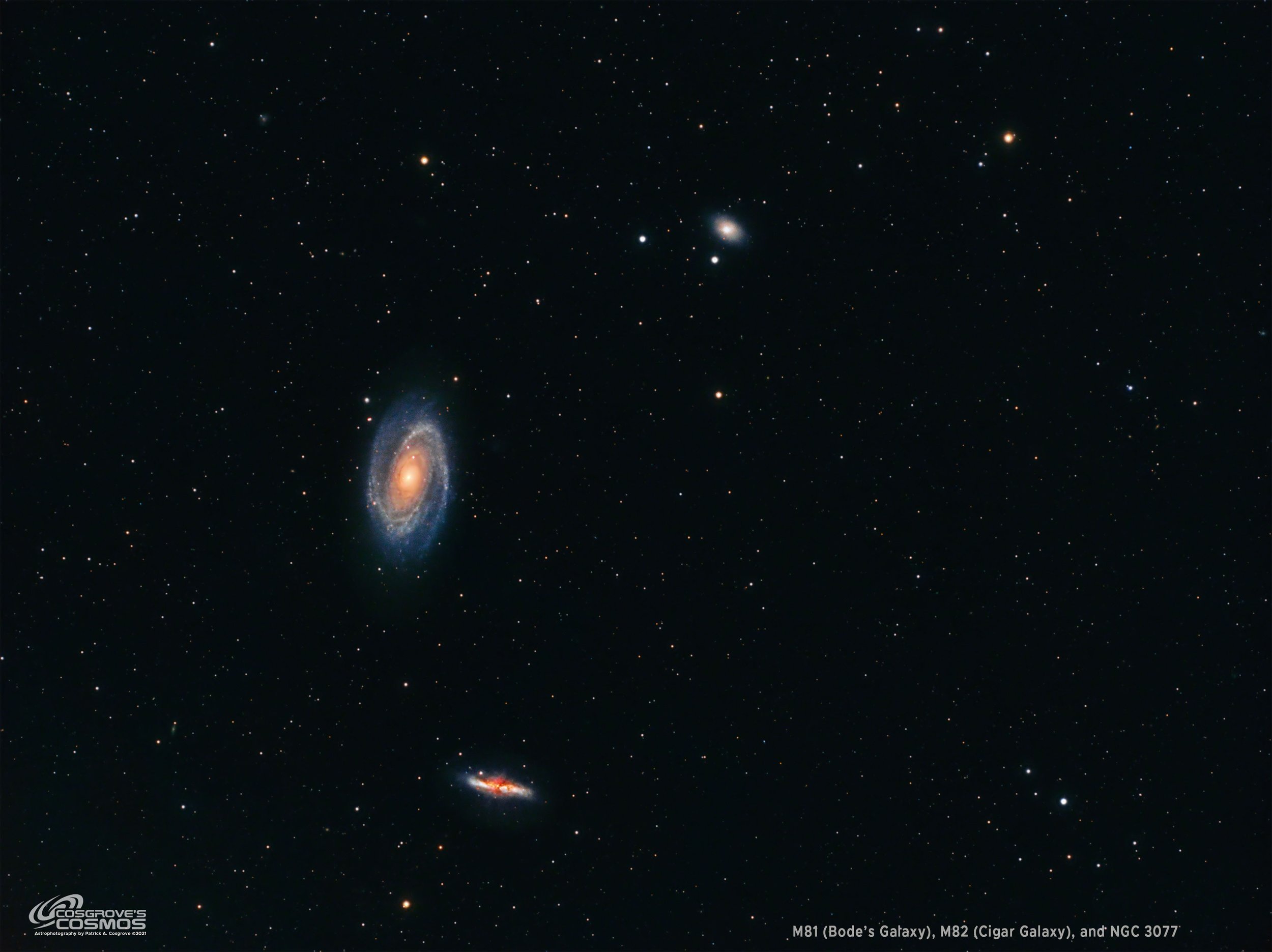
Not one of my favorites.
Data Capture
Since this was the very first time I was using the platform, I expected things to go wrong - and I was not disappointed.
I started the first sub, and the tracking was terrible! Within 15 seconds, PHD2 showed a divergence that it could not control.
I scratched my head on that one. The final platform was close in length to the original AP130 and had almost the same weight. So why would the mount be having a problem?
Then I realized that I had never run Guide Assistant on this configuration - I should definitely do that. Next came the realization that I had never even calibrated in this config. PHD2 must be using an old calibration.
So first I did a cal cycle, and then I did a nice long Guide Assistant run. After applying its recommendation, I started the sequence again, and the tracking was much better - but not perfect. I kept an eye on things through the evening and realized that most of the issues were happening early on, and the longer it went, the better the results.
After my initial problems, I did not get the sequence going until almost 10 pm. Clouds moved in around 3:15 AM and shut me down.
The next week looked cloudy and rainy, so I may not have any follow-up sessions. This is far from ideal - but it sure was good to be capturing photons again!
Looking at the Data
I did have a handful of frames where the tracking was just bad, so I eliminated them. These all came early on in the process. This is what I think I was dealing with:
The mount is 7 years old and has not been used for 6 months. I think it needed to warm up and get the grease distributed again.
I am not sure I have optimized the balance on this new rig - I need to pay more attention there.
I have to make sure that the new, smaller guide scope is really locked in, so I am not getting any flexure there.
So I still have some work to do. But I was eager to start processing the data so I could see what the capture looked like.
Calibration Data
Another new feature of this updated platform is the Wanderer Astro Power Cover. I used this for the first time to help automate the collection of my calibration data. Flats, Darks, Dark Flats all were captured easily from the comfort of my Astro Man Cave in teh house. The data looked great, and I loved the convenience!
🧩 Capture Time by Filter
Processing Overview
The processing for this project aligns with my high-level workflow for the HaLRGB image, as shown below. Sometimes my goal is to use the Ha data in the Red channel, sometimes in the luminance channel, and sometimes in both.
For this project, I planned to use the Ha filter to enhance the red color in galaxies, thereby highlighting regions of rapid star formation.
This high level flow can be seen below.
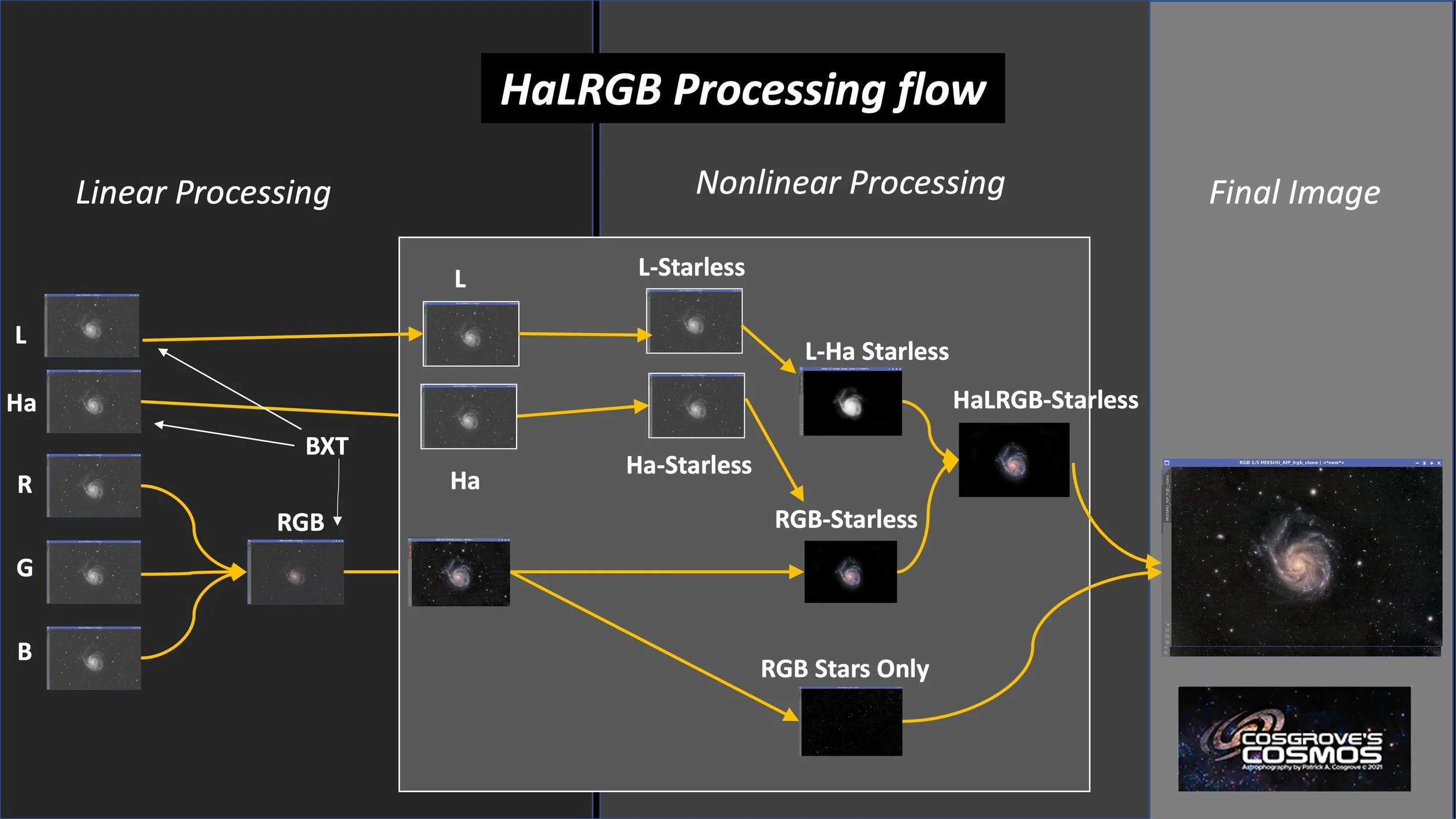
High-level HaLRGB workflow used as the framework for this project.
I performed all linear processing on the Ha, L, and RGB images, then removed the stars.
The starless images became nonlinear, and processing was performed to enhance each. The RGB image was processed to be free of noise and to pull out the colors present. The Lum image was processed for detail and sharpness. The Ha was processed to highlight the key features.
Then I extracted the red layer of the RGB image.
Then I made a mask using the Ha image and used the DynamicPaintBrush to edit it, removing star residuals, small galaxies, and other details I did not want in the Ha signal. This mask was applied to the RGB image.
Then I used a PixelMath expression to blend the R and Ha signals into a new HaR layer. This was then used to reconstruct the HaRGB image.
Finally, I folded the L image into the mix.
Detailed and Annotated Image Processing Walkthrough
Typically, I conclude one of these imaging projects by documenting the processing steps I used on this image. But this section can make the overall post very large and, at times, slow to load.
I am now creating a secondary, standalone page to hold this information. You can access this page by clicking the link below. Returning to this page is as simple as clicking the back arrow in your browser or selecting a different menu option at the top of the page.
I hope you like this new format!
Use the Link below to see the detailed image processing walkthrough page for this Imaging Project!
Final Results
The final results were encouraging. My stars are not yet as round as I want them to be, but they are good enough to show that the platform is close. A little more tuning and tweaking, and I think this platform will perform as I had hoped.
I have shot other versions of M81 and M82, but I seldom see the composition that includes NGC 3077, and I kind of like that aspect of this image.
I do wish I had the opportunity to add more integration, as I am intrigued by the two faint blue galaxies located near Bode’s Galaxy. You can just see them in this image.
All in all, this was not a bad start!
More Information
🔭 Target Details
Messier 81 (NASA) – NASA’s overview of M81, including basic observing information, distance, location in Ursa Major, and discovery notes.
Messier 82 / The Cigar Galaxy (NASA) – A solid NASA summary of M82 with key observing details and a concise description of its starburst nature.
SIMBAD Astronomical Database: M81 – Professional database entry for M81 with identifiers, coordinates, bibliography, and linked catalog data.
SIMBAD Astronomical Database: NGC 3077 – Professional reference entry for NGC 3077 with object identifiers, coordinates, and literature links.
Aladin Lite Sky Atlas: M81 / M82 region – Interactive sky atlas centered on the M81/M82 field, useful for exploring the wider group and surrounding sky context.
The M82 Neighborhood with M81 and NGC 3077 (HubbleSite) – A wide-field view of the trio showing how M81, M82, and NGC 3077 sit together in the same neighborhood.
📜 History & Naming
Messier 81 (NASA) – Includes the basic discovery history of M81, its identification as NGC 3031, and why it is commonly called Bode’s Galaxy.
Messier 82 / The Cigar Galaxy (NASA) – Covers the discovery of M82 alongside M81 and its common “Cigar Galaxy” designation.
Galaxy pair M81 and M82 (ESA) – A short, accessible ESA page explaining the pairing and the long-running interaction between the two galaxies.
Messier 81 – APOD, March 27, 2025 – NASA’s Astronomy Picture of the Day entry for M81, with a concise historical-and-observational style explanation that works well for general readers.
🔬 Science & Observations
NASA’s Webb Probes an Extreme Starburst Galaxy (M82) – A strong modern science summary of why M82 matters, with Webb results focused on star formation and feedback.
Photo Album: M82 (Chandra X-ray Observatory) – Multiwavelength look at M82 that helps explain the energetic outflow and hot gas associated with its starburst core.
M82 – January 13, 2011 (Chandra) – Chandra’s science page on M82 as a starburst galaxy, including the interaction-driven explanation for its extreme activity.
Infrared Universe: Messier 81 (NASA) – A useful look at how M81 appears in the infrared, emphasizing dust, structure, and star-forming regions.
Hubble Finds that “Blue Blobs” in Space Are Orphaned from Their Galaxies (ESA/Hubble) – Explains intergalactic star formation in the M81 group, tied to the interaction among M81, M82, and NGC 3077.
💡 Interesting Facts & Outreach
APOD: 38 Hours in the M81 Group – A visually rich APOD entry showing the broader M81 group and explaining the relationship between its major members in approachable language.
APOD: Galaxy Wars: M81 versus M82 – An outreach-friendly look at the dramatic contrast between the calm spiral structure of M81 and the turbulent starburst appearance of M82.
An Infrared View of the M81 Galaxy (NASA) – Simple, accessible outreach page that frames M81 as a bright nearby galaxy visible to amateur observers.
Pretty in Pink (NASA) – NASA image article highlighting M81 in a colorful multiwavelength presentation that is easy to share with general audiences.
Starburst Galaxy Messier 82 from Hubble (NASA SVS) – Outreach-oriented presentation of M82 that highlights its glowing hydrogen plumes and dramatic central activity.
M82: Starburst Galaxy with a Superwind – APOD, April 17, 2026 – Excellent outreach explanation of the red outflow filaments that make M82 so visually distinctive in amateur images.
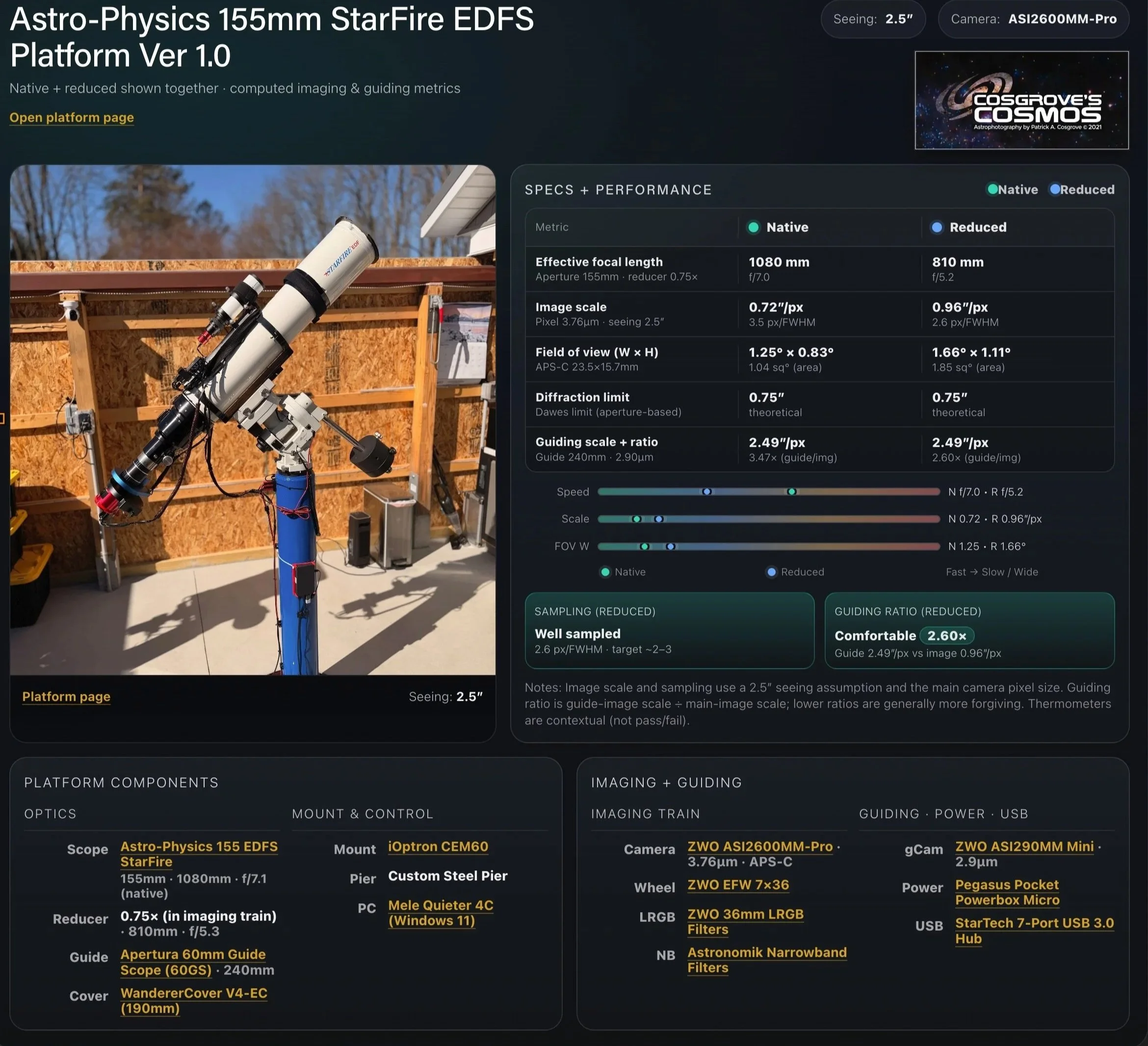
Platform used for this project
Software
Capture Software: PHD2 Guider, NINA
Image Processing: Pixinsight, Photoshop - assisted by Coffee, extensive processing indecision and second-guessing, editor regret, and much swearing…..