Imaging Projects
In this blog, I will share the results of all of my imaging projects. The newest will be at the top and the oldest will be further down the stack. Going back in time here is interesting - some of my early stuff was pretty rough - but I did not see it that way at the time - I was thrilled to get anything back that looked like an image! Hopefully, you will see how my work has progressed with time!
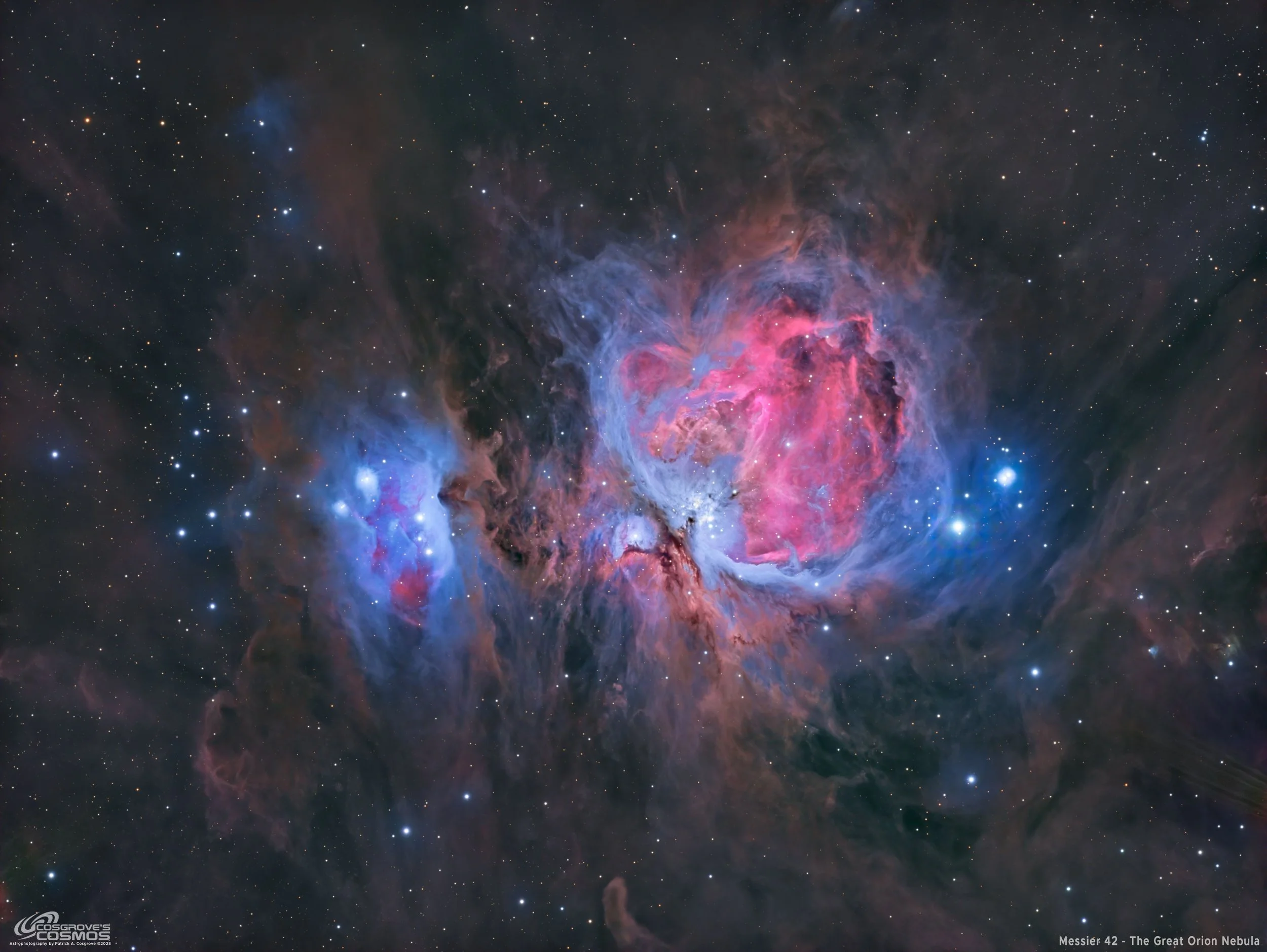
Messier 42/43 – The Great Orion Nebula - 6.35 hours in HaLRGB
Orion’s sword is one of the most famous regions in the night sky, and for good reason. This widefield take on M42/M43 and the Running Man blends short and longer RGB/L exposures with H-alpha to balance the bright core against the faint, sculpted outer nebulosity—an image that showcases both the beauty and the ongoing starbirth of our nearest major stellar nursery.
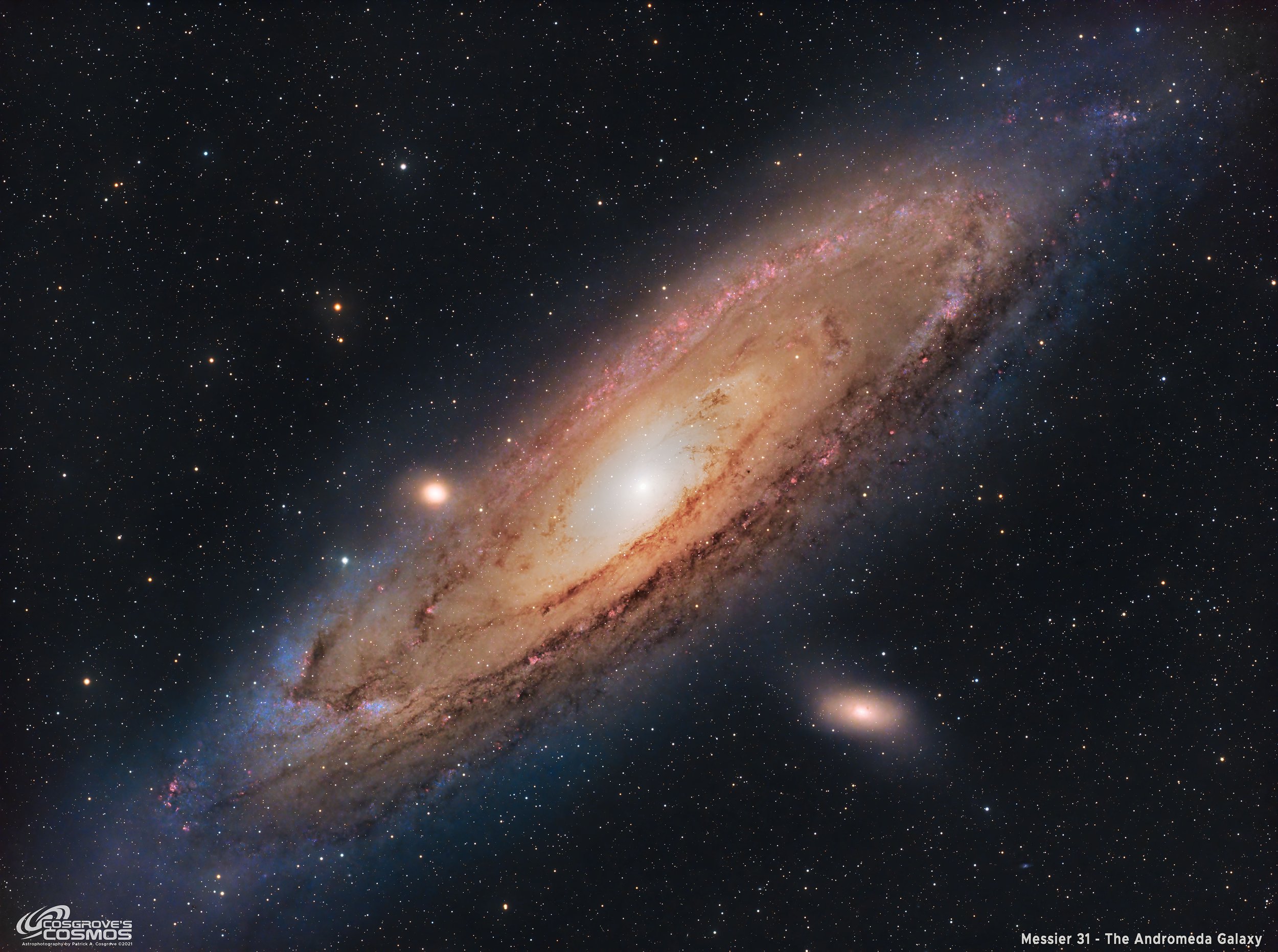
Reprocessing Project: Messier 31 - The Andromeda Galaxy (6 hours in LHaRGB)
This version of M31, taken in November 2021, is my favorite. But it has been a few years since I first captured and processed this data. I have learned a lot since then, and I also have some excellent new processing tools at my disposal, so I wanted to see where I would end up if I were to start from scratch with the data, and this is the result!
Let me know what you think of this new image!
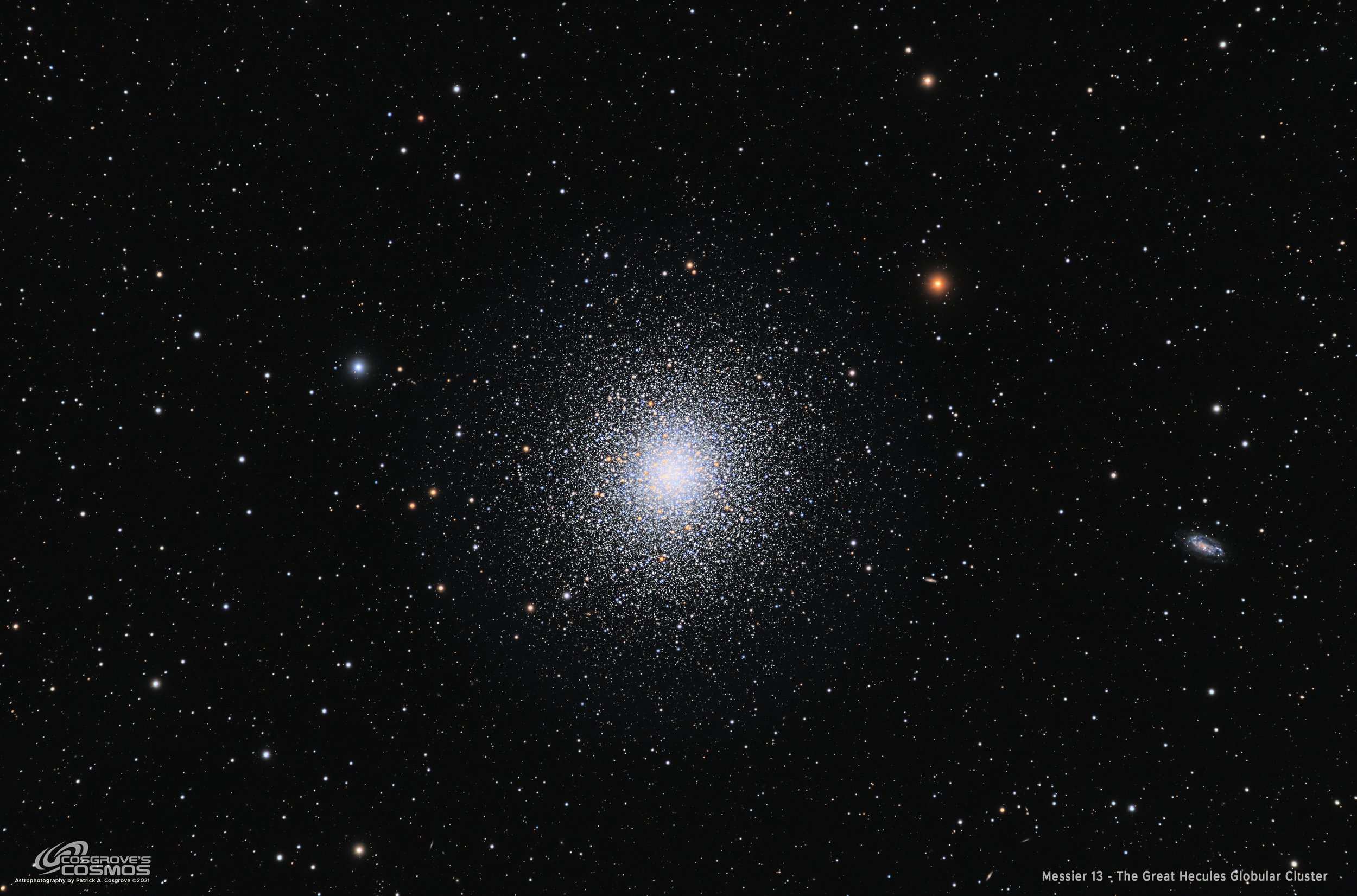
Messier 13 - The Great Hercule Cluster - 8.5 hours in LRGB - Super Sharp!
Messier 13 - the Great Hercules Cluster - is one of the finest examples of a Globular Cluster that can be found in our skies. It consists of a giant ball of 100,000-500,00 stars packed into an area 145 light-years across. M13 can be found between 22,000 and 25,000 light-years away in the constellation of Hercules.
This is a 5.6 8.5 hour integration in LRGB using my Astro-Physics 130mm scope the ZWO ASI2600MM-Pro camera. This is the fourth time I have shot this target and this one is clearly my best - displaying a remarkable sharpness in detail.
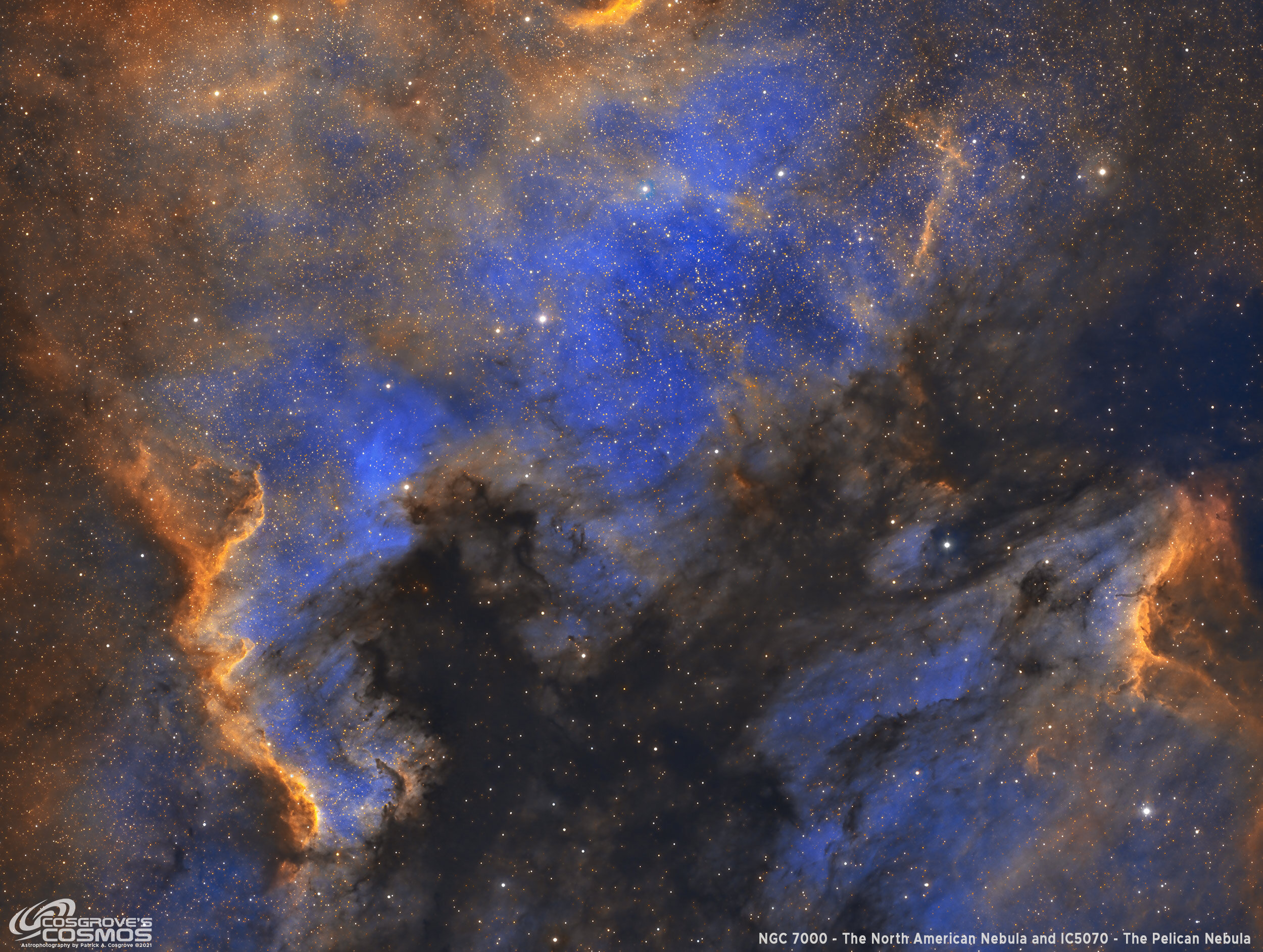
NGC 7000 (The North American Nebula) with IC5070 (Pelican Nebula) in Narrowband- Total of 9.33 Hours
NGC 7000, also known as the North American Nebula and Caldwell 20, is a large H II emission nebula located in the constellation of Cygnus (The Swan). It measures roughly 2 degrees by 1.5 degrees in size, making the nebula about 10X larger than the area covered by the full moon.
Also included in this view is the Pelican Nebula IC 5070
This image is the result of 9.33 hours of integration in Narrowband and rendered in the Hubble Palette.
Extensive notes on image processing are included for the first time.
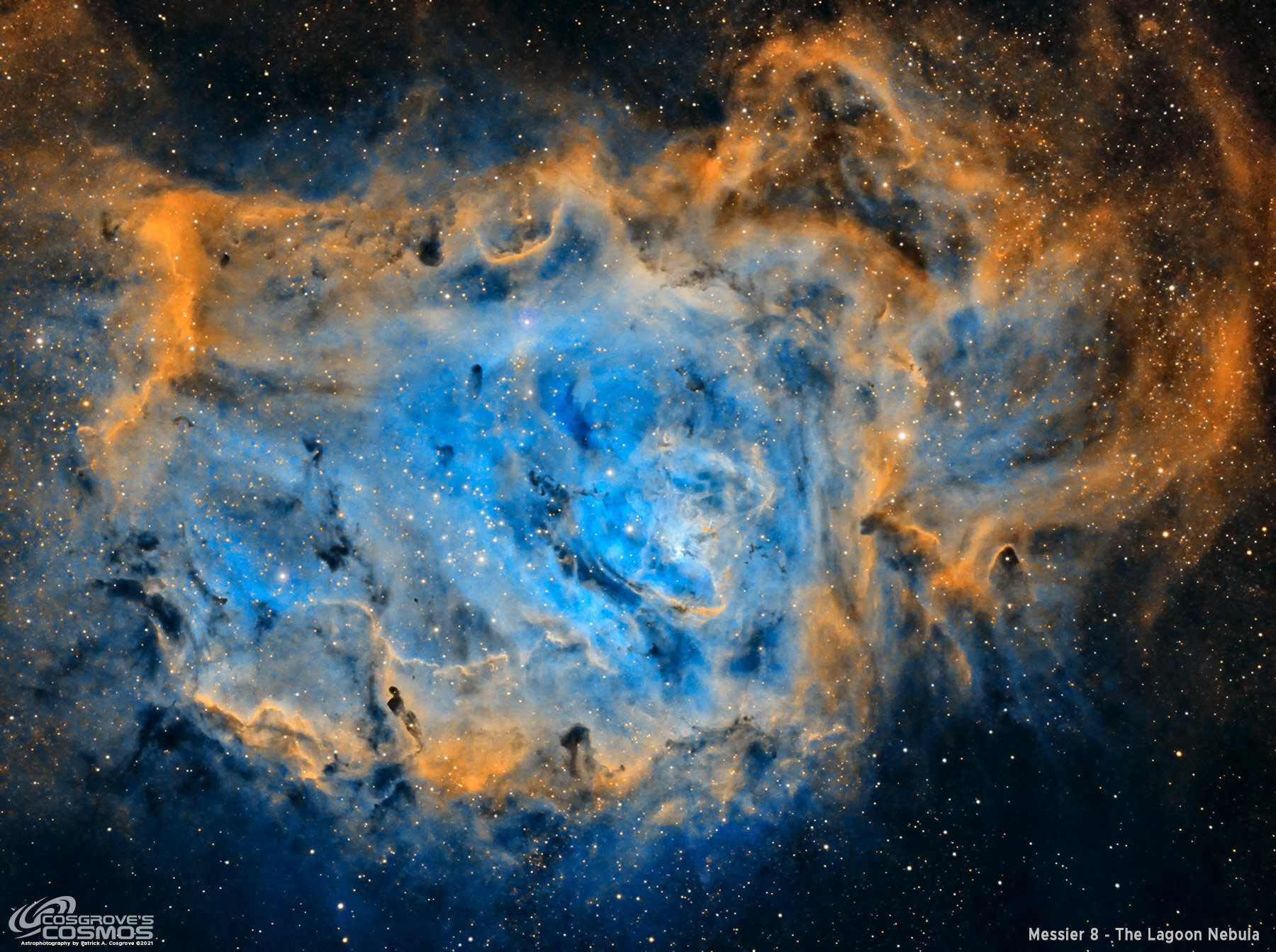
Messier 8 - The Lagoon Nebula In the Hubble Palette
Messier 8, also known as the Lagoon Nebula and NGC 6523, is a huge cloud of molecular gas and dark dust located about 4000-6000 light-years away in the constellation Sagittarius. This is a large emission nebula that is bright enough to be seen with the naked eye. Within the cloud is the open cluster NGC 6530, and a bright central feature is known as the Hour Glass.
This is my third effort on this target - a mono image in SHO - working from minimal data taken the troubling month o July 2021

Messier 20 - The Trifid Nebula - Mono Camera FIrst Light!
Messier 20 is known by the common name “The Trifid Nebula” and by NGC 6514. It is a star-forming region in the constellation of Sagittarius and is located about 4100 light-years away. This was the very first image on the AP-130 platform and my very first use of a mono camera forming an LRGB image!
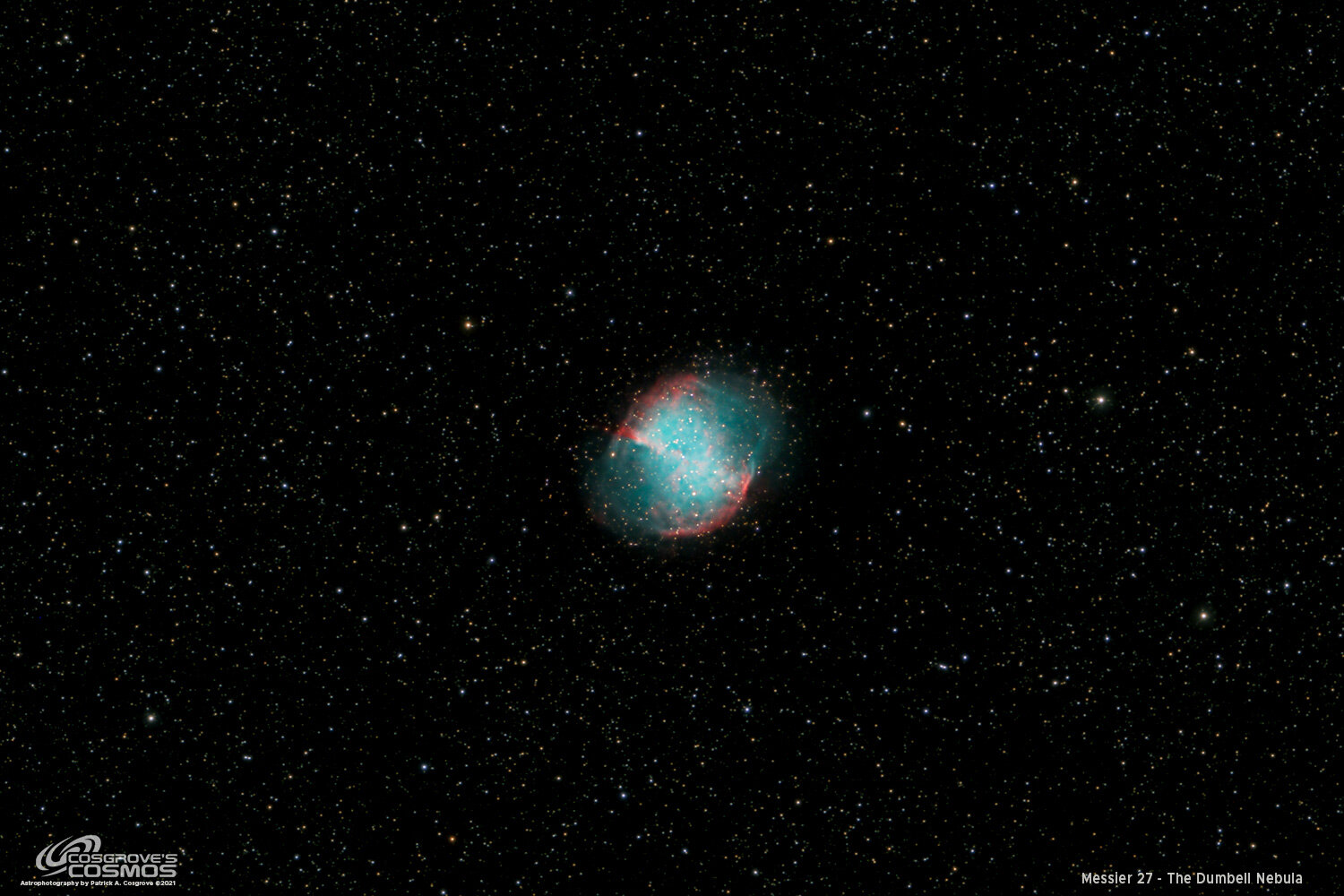
Messier 27 - The Dumbell Nebula
Messier 27 is a planetary nebula in the Constellation Vulpecula and is located about 1200 light-years away. M27 is also known as the “Apple Core” nebula and NGC 6853. It's basically a star the blew up between 10,000 and 14,000 years ago, and we get to see its expanding gas cloud. While this object is small, it is twice the size of the Messier 57 (The Ring Nebula) and allows for a bit more detail to be imaged. This was my second attempt at M27, the first being 2019 when I was first starting. See the comparison between the two.
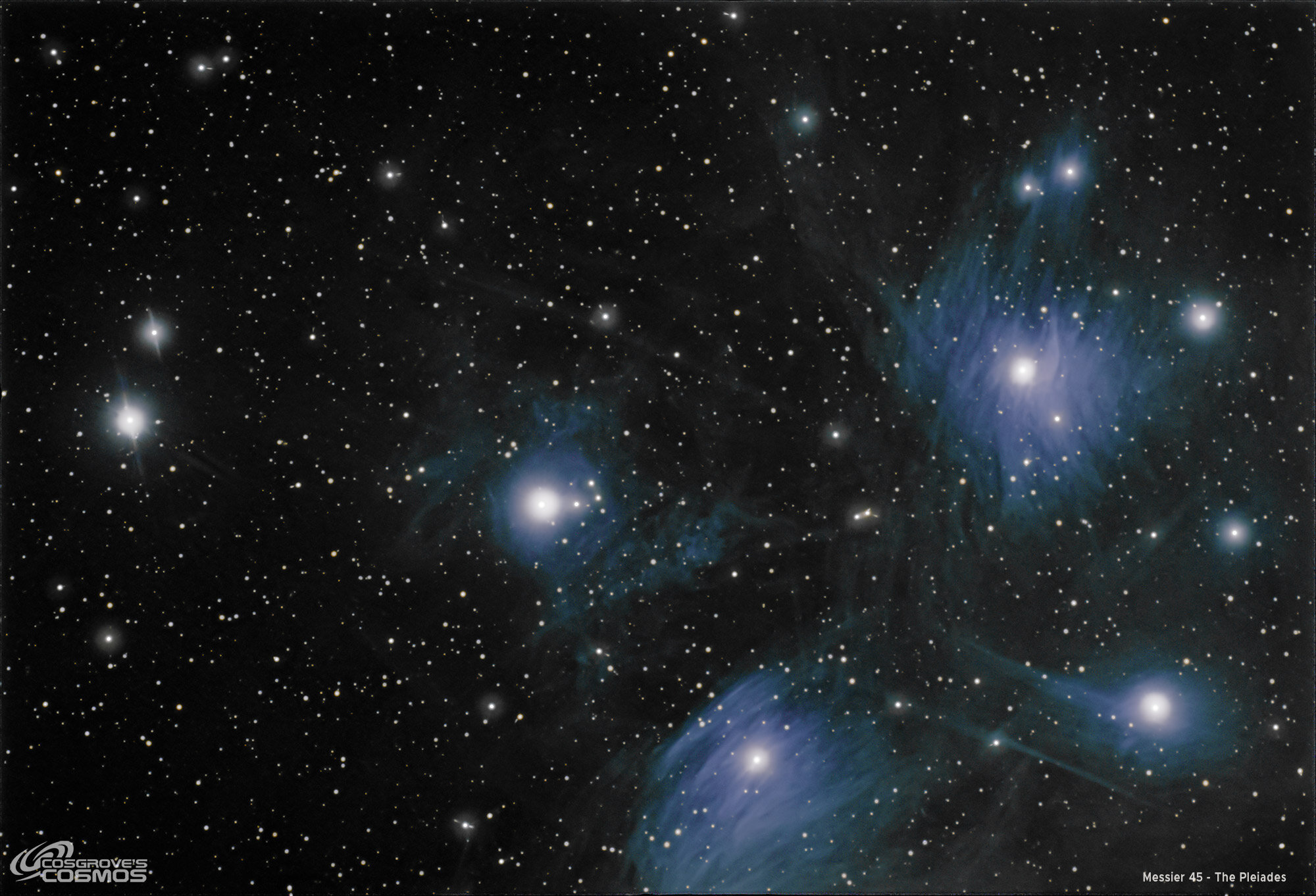
Messier 45 - The Pleiades Star Cluster
Messier 45, better known as the Pleides Star cluster or the Seven Sisters, is a large star group easily seen with the naked eye in the constellation Taurus - the Bull. Wow, Rochester weather in the late fall really sucks. It has been almost 9 weeks since I have had a clear night! Finally, we had a nice clear sky last evening, and the temperature was not too brutal - about 37 degrees F. My first shot of the night was M45, the Pleiades star cluster. Also known as the Seven Sisters, this open cluster is visible to the naked eye in the constellation Taurus. The framing is a bit tight here for my scope focal length, but I was just able to fit them into the field of view. These are a grouping of middle-aged blue stars, and on longer exposures, you can see local dust clouds illuminated by these blue stars. This was the result of 20 three-minute exposures.