Imaging Projects
In this blog, I will share the results of all of my imaging projects. The newest will be at the top and the oldest will be further down the stack. Going back in time here is interesting - some of my early stuff was pretty rough - but I did not see it that way at the time - I was thrilled to get anything back that looked like an image! Hopefully, you will see how my work has progressed with time!

NGC 6543 - The Cat’s Eye Nebula w/ NGC 6522 (14.6 hours in LRGB)
This image of NGC 6543 - The Cat’s Eye - is the result of 14.6 hours of LRGB data captured with my Sharpstar SCA260V2 Platform. It was a faint and challenging object that also had very bright portions. This made it one of the most challenging targets I have processed yet. I must have reprocessed that data 8 or 9 times before I ended where I did. Was this the best image I could get from that data? I don’t think so. In the end, the effort exhausted me and I was ready to move on!!
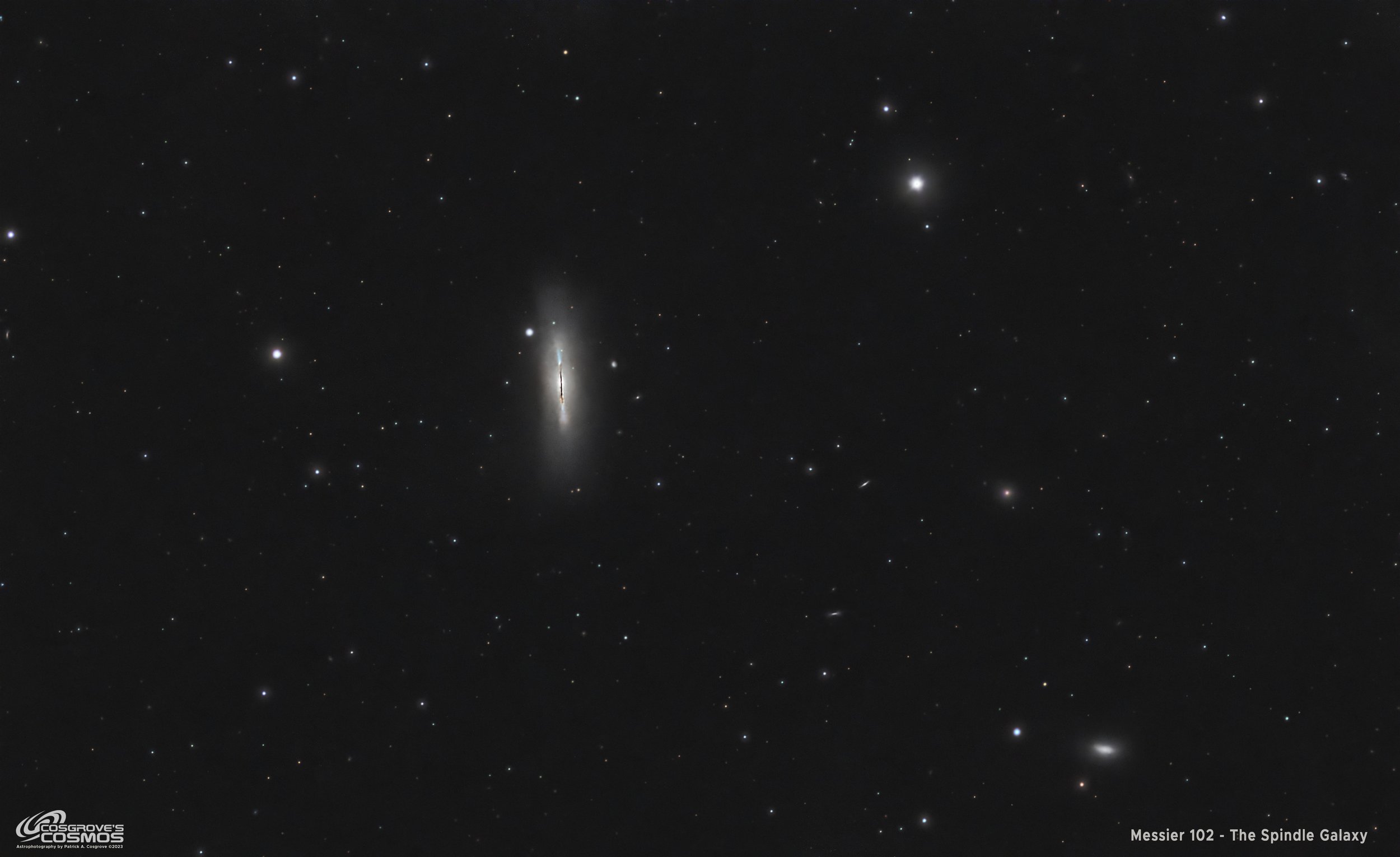
Messier 102 - The Spindle Galaxy - 2.0 Hrs in LRGB - Still Shooting Through the Smoke…
Messier 102, also known as NGC 5866 and the Spindle Galaxy, is located 50 Million light-years away in the constellation of Draco. Its diameter is 60,000 light-years, making it 2/3rds the size of our Milkyway even though it has about the same mass.
NGC 5866 is one of the two galaxies known as the Spindle Galaxy. The other, NGC 3115, is an edge-on lenticular galaxy located in the constellation Serpens.
This was another image from the lul in the smoke plumes from Alberta. Because of this, this image was starved for integration time and shot through some smoke still in the sky - so this image is not as good as I would like it to be. But - if you zoom in, you can see a lot of detail in the galaxy's dust lane!
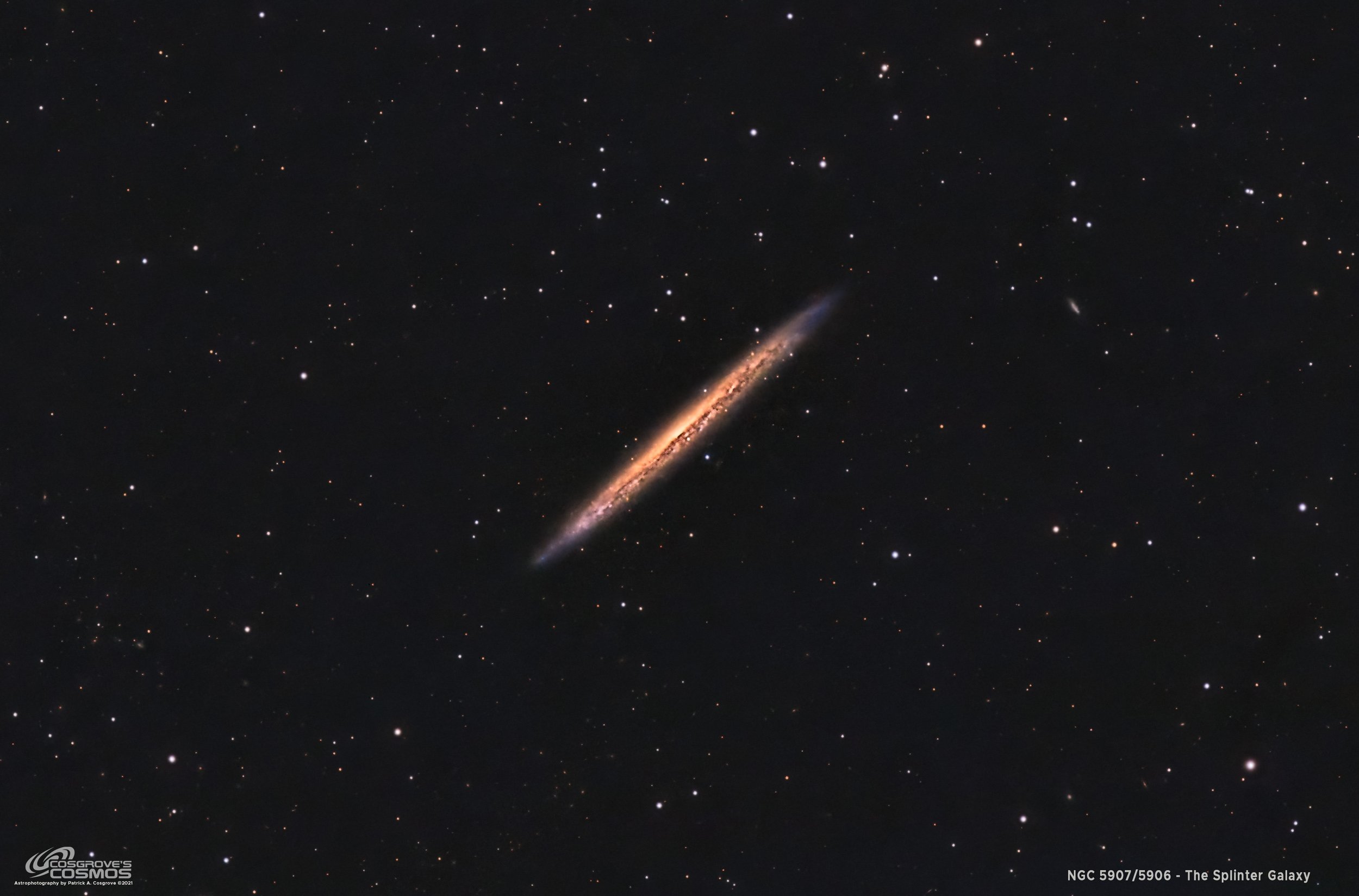
NGC 5907/5906 - The Splinter Galaxy - 8 hrs in LRGB
NGC 5907 -The Splinter Galaxy - is another example of an edge-on Spiral galaxy that displays significant dust lane detail across its middle. Its located 54.5 million Light years away in the constellation of Draco. This was shot with my Astro-Physics 130mm with the ASI2600MM-Pro camera. 8 hours of integration in LRGB. It was a real challenge to pull out the details from this very small galaxy.
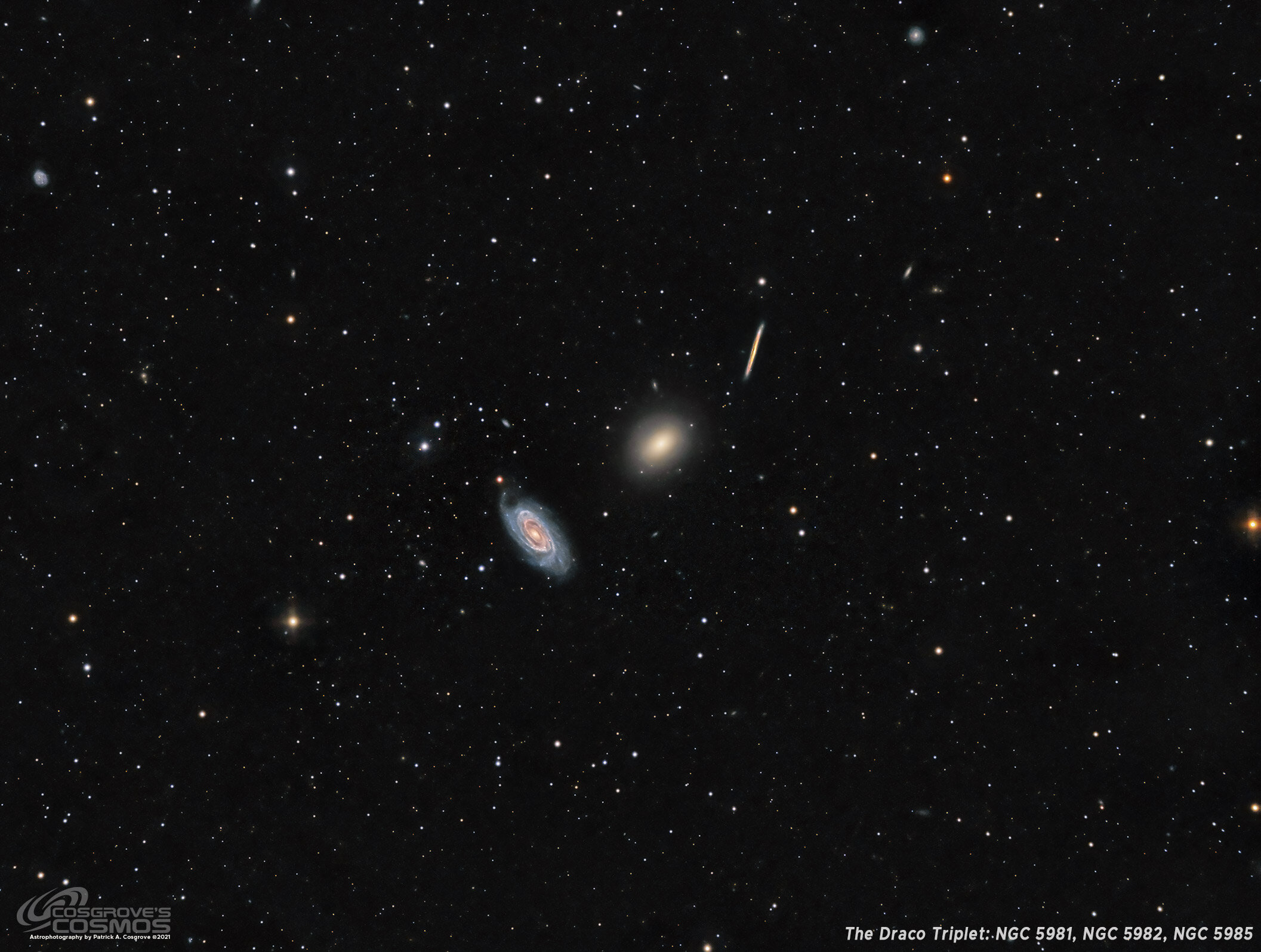
Revisiting the Draco Triplet: NGC 5981, NGC 5982, & NGC 5985
The Draco Trio consists of a close grouping of three very different looking galaxies, found in the constellation Draco. These are small targets for my scope so I needed to carefully process the images to get the most detail possible. See how I did it!

NGC 5981, NGC 5982, & NGC 5985: The Draco Triplet
The Draco Group of Galaxies are a string of three primary galaxies that can be seen in a common field of view in the constellation Draco. The largest and roundest one seen at the bottom of the frame is NGC 5985. This has a barred spiral structure, and the arms are clearly visible in this shot. NGC 5981 can be seen at the top of the frame. This is also a barred spiral galaxy, but it is seen almost edge-on. The galaxy in the center is NGC 5982. It is an elliptical galaxy - which is typically seen as nebulous without any obvious structure. These galaxies are approximately 100 Million light-years from earth.