Astrophotography Gear & Imaging
Curated by Patrick Cosgrove
Created July 2021. Major Revisions: May 2025, January 2026
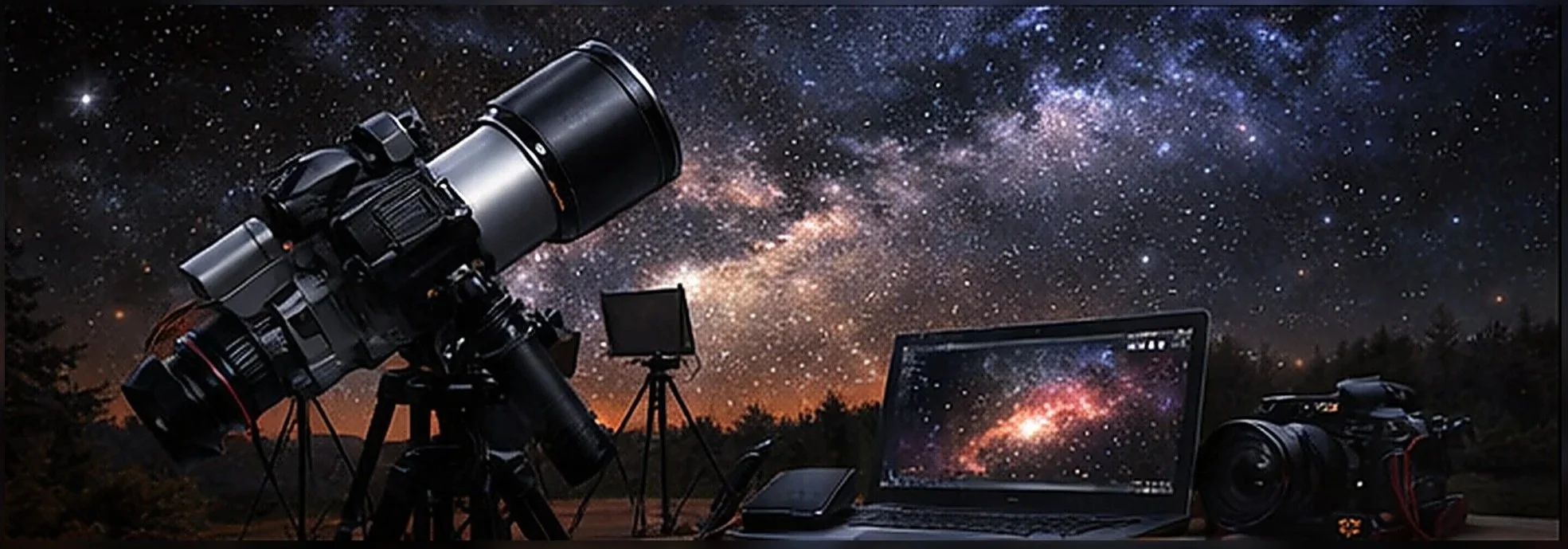
This section focuses on the hardware and capture workflow behind successful astrophotography. It includes curated references for telescopes, mounts, cameras, filters, guiding hardware, power and cabling, and practical setup guidance—plus home observatory and remote-imaging infrastructure resources for building a reliable imaging system.
Area of Focus: “Hardware, capture workflow, and observatory infrastructure for reliable imaging.”
This is a curated reference list maintained by Patrick Cosgrove (Cosgrove’s Cosmos). Links are selected for practical value to observers and astrophotographers.
Last updated: January 2026
Found a dead link or have a suggestion? Use the form on the Resources Hub.
Table of Contents Show (Click on lines to navigate)
For software-based capture/guiding/processing workflows → Astrophotography Software & Processing
For planning targets and night conditions → Observing & Sky Events
Astrophotography Gear - Deep-Sky
Astro Imaging Cameras
ZWO ASI Cameras (Official) – ZWO’s ASI line has become the de-facto standard for amateur imaging, ranging from beginner-friendly APS-C models (ASI533/2600) to full-frame ASI6200 for advanced work. All cameras share a uniform driver, deep cooling (-35 °C ΔT), AR-coated windows, and native support in every major capture program, making integration painless whether you shoot planets at 500 fps or 10-minute narrowband subs.
QHYCCD – Astronomy & Scientific Cameras – QHY’s portfolio covers everything from ultra-fast planetary rigs (QHY5III series) to large-format deep-sky monsters like the QHY600M/Pro with 60 MP. Hallmarks include sealed sensor chambers with desiccant tubes, built-in DDR3 buffer to prevent USB dropouts, and model variants tuned for astronomy, spectroscopy, or C-mount all-sky imaging.
Atik Cameras – Built in Portugal and the UK, Atik’s Horizon-II OSC and the 4-Series mono CCDs remain workhorses for imagers who value simplicity and low noise. The company also bundles free capture/stacking software (Artemis Capture, Dawn), so a first-time owner can go from unboxing to calibrated image without extra purchases.
SBIG / Diffraction Limited – The storied SBIG brand—now under Diffraction Limited—focuses on observatory-grade Aluma and STXL cameras with huge sensors, regulated TECs, and optional internal filter wheels guiding through their own built-in guide chips. These cameras anchor countless university and survey telescopes thanks to unmatched reliability and support.
Starlight Xpress – SX invented the tiny Lodestar guider, but their Trius and Ultrastar mono cameras still punch above their weight, leveraging low-noise Sony CCDs and compact sealed bodies that cool with nothing more than a 1¼″-column of air—perfect for lightweight rigs or Hyperstar setups.
Finger Lakes Instrumentation (FLI) – FLI’s Kepler, MicroLine, and large-aperture PL cameras bring scientific-grade electronics (RMS read noise < 4 e-) and massive sensor options (up to 50 mm diagonal). Each unit is milled from a solid aluminum billet and vacuum-purged, making them a favorite for remote observatories and research labs that demand multi-night, zero-failure performance.
Telescopic Watch – Best Astro Cameras 2025 – An independent buyer’s guide that benchmarks the latest CMOS/CCD models, explains sensor specs (QE, full-well, read noise), and recommends a “best in class” pick for every budget tier—ideal if you’re choosing between ASI/QHY siblings or weighing mono versus OSC.
Guide Cameras
ZWO Mini Guide Cameras – The 1¼″ “Mini” series (ASI120MM Mini, ASI220MM Mini) stuffs a sensitive mono sensor, ST-4 port, and USB2 power into a lipstick-sized barrel. Drop one into any 30-50 mm guidescope or OAG and you’ve got fuss-free autoguiding that plugs straight into popular software or ASIAIR.
QHY5III Series – QHY’s USB 3.0 guide/planetary cams (5III462, 5III485) hit hundreds of frames per second while outputting 12-bit data—handy for lucky imaging Saturn or grabbing bright guidestars through an OAG at f/10. A front-threaded C-mount and included 1¼″ nose make adaptation painless.
Starlight Xpress Lodestar X2 – Still the gold standard for OAG users: its Sony ICX CCD delivers unmatched sensitivity, so you nearly always find a star—even in narrowband filters or on 3 m focal-length scopes. A single USB cable powers and controls it, reducing cable snags on rotators.
Filters
Astrodon Filters (Farpoint) – The benchmark for parfocal LRGB and 3 nm narrowband sets: razor-steep bandpasses, > 95 % transmission, and coatings that never pinhole or degrade—expensive but the last filters you may ever buy.
Chroma Astronomy Filters – US-made, hard-coated 3 nm and 5 nm filters that match Astrodon in performance but in a larger range of diameters (including 50 × 50 mm unmounted) and quick custom runs for observatories.
Astronomik Filters – Trusted mid-tier brand offering everything from CLS light-pollution filters to 6 nm narrowband sets that are AR-coated on both sides and cut from homogeneous glass, minimizing halos on bright stars.
Baader CMOS-Optimized Filters – New “Ultra-Narrowband” 3.5 nm Ha/OIII/SII sets and LRGB filters designed to eliminate pesky CMOS microlens reflections while staying firmly in the affordable bracket.
IDAS LPS Filters – Ion-assisted multilayer coatings block sodium/mercury lines yet keep star colors intact; their NBZ dual-band filter is a cult favorite for OSC imagers hunting nebulae from the suburbs.
Optolong Dual/Narrowband – L-eNhance (dual Ha/OIII) and L-eXtreme (tighter 7 nm dual band) squeeze impressive contrast from one-shot color cameras—excellent bang for the buck if you’re starting out under streetlights.
Cloudy Nights – 2024 Narrowband Shoot-Out – Side-by-side test images and quantitative bandpass plots for the latest budget, mid-range, and premium filters, letting you see real-world halo control and star color.
Filter Wheels
ZWO EFW Series – USB-powered wheels in 5- or 7-slot versions (1¼″, 36 mm, 2″) that bolt directly to ASI cameras and OAG-L, giving mono imagers a seamless, all-ZWO optical train.
Trackers
iOptron SkyGuider Pro – A compact, single-axis star tracker built for widefield/mid-telephoto astrophotography, with an illuminated polar scope and guiding support—one of the most popular “step up from tripod” options.
Sky-Watcher Star Adventurer 2i – A classic beginner-friendly tracker with built-in Wi-Fi and an illuminated polar scope; great for widefield through modest telephoto work and light payloads.
Sky-Watcher Star Adventurer GTi – A portable GoTo tracker mount (SynScan app/control, Wi-Fi/USB) that adds slewing and pointing to the Star Adventurer concept while staying travel-friendly.
Move Shoot Move NOMAD – Ultra-portable “grab & go” tracker aimed at nightscapes and lightweight setups—very approachable for travel and quick sessions.
Fornax LighTrack II – A premium friction-drive portable tracker focused on high tracking accuracy in a compact form—often chosen by experienced widefield imagers who want top performance in the field.
Benro Polaris Astro Edition (3-Axis) – A “smart” motorized head that supports star tracking plus automated timelapse/panorama/focus stacking via app control—more of an all-in-one creative platform than a traditional EQ tracker.
Lonely Speck – Beginner Astrophotography Kit – A practical beginner gear blueprint (camera + lens + tripod + optional star tracker), with clear “what matters” guidance and sensible upgrade steps.
B&H Explora – How to Photograph the Milky Way: An Astrophotographer’s Primer – A straightforward intro that includes a solid gear checklist (camera/lens/tripod + helpful accessories) and explains what upgrades (like a tracker) actually change.
Mounts
Sky-Watcher EQ Mounts – The HEQ5 Pro and EQ6-R Pro remain sweet-spot choices for deep-sky imaging, with belt drives, 1″ worm errors (~20 arc-sec), and easy firmware updates; the beefier EQ8-R handles 50 lb imaging loads for large OTAs.
Celestron CGX / CGX-L & AVX – User-friendly NexStar hand-control, PPEC, and the “All-Star” polar routine—great for imagers stepping up from star trackers; CGX-L carries 35 kg at ±3 arc-sec native PE once tuned.
iOptron CEM & HEM Harmonic – Center-balanced CEM40/70 for big payloads in lighter heads, or the new strain-wave HEM27 that packs 13 kg capacity into an 8 lb body—perfect for airline travel.
Losmandy GM-8 / G-11 – Machined-in-California classics with all-metal worms and modular RA/DEC assemblies; Gemini 2 GoTo now supports Ethernet and guide-port dithering.
Astro-Physics Mach2GTO – Zero-backlash direct-drive motors, absolute encoders, and 0.3 arc-sec PE; many users shoot 10-minute subs unguided—top of the food chain for portable precision.
Software Bisque Paramount Series – Robotic mounts (MYT, MX+, ME II) with integrated homing sensors, through-mount cabling, and TheSkyX Pro software license—designed for remote automation from day one.
10Micron GM HPS – High-precision absolute encoders + onboard model builder = sub-arc-sec unguided tracking for 20+ minutes. Perfect for all-sky imaging sequences without a guide scope.
ZWO AM5 Harmonic – Counterweight-free harmonic drive head that still slews at 6°/s; controlled via Wi-Fi and ASIAIR, it brings premium strain-wave tech to the mid-price market.
Telescope Finders and Laser Pointers
Handheld Laser Pointer vs. Red-Dot Finder: Which Do You Need?– This post by a laser pointer manufacturer discusses the differences between the two approaches.
Control Systems (Controllers & On-Scope Computers)
These are the ‘brains’ (and power backbone) of the rig—what you use to run capture and keep the system reliable.
ZWO ASIAIR (Official Product Line) – Turnkey controller (phone/tablet): runs capture, alignment, plate solving, guiding, and autoruns from a mobile device. Best fit when your imaging setup is largely ZWO-compatible.
StellarMate X (Official) – Turnkey controller (phone/tablet): an ASIAIR-style controller built around INDI + KStars/Ekos with broad gear support. A strong option if you want a controller workflow without being locked to one camera brand.
PrimaLuceLab EAGLE (On-Scope Computer Platform) – On-mount Windows computer: replaces a laptop at the rig while running your preferred Windows software stack (NINA/ASCOM, etc.). Higher cost, maximum flexibility.
Pegasus Astro Pocket Powerbox (Official) – Power/USB management: not a controller, but a major reliability upgrade once your rig grows beyond a simple DSLR setup (clean power distribution, dew control options, fewer “why did it disconnect?” nights).
Focus Motors
ZWO EAF – USB-controlled stepper focuser with built-in temp sensor; plugs straight into ASIAIR and popular PC apps for reliable autofocus on refractors, SCTs, or Newtonians.
Pegasus FocusCube 3 – Self-contained motor + controller (USB-C, Wi-Fi) and OLED screen; swap brackets to fit crayford, SCT, or R&P focusers—makes cable clutter disappear.
PrimaLuceLab SESTO SENSO 2 – Clamps directly to the micro-focus knob, retaining manual feel when you disengage; ASCOM/INDI/Wi-Fi for smartphone tweaks.
MoonLite High-Res Stepper Focusers – CNC anodized crayfords with built-in stepper and clutch—rock-solid for heavy imaging trains, plus plug-and-play with NiteCrawler rotator.
Optec TCF-S3 – Drawtube focuser with internal temp compensation: once calibrated, it nudges focus a few microns per °C so your stars stay tight all night.
Celestron SCT/Edge Focus Motor – Attaches behind the mirror on Celestron OTAs, letting you remote-focus your EdgeHD 8–14″ without mirror shift.
Camera Rotators
Pegasus Astro Falcon Rotator v2 – 18 mm thick, 0.05° precision, and native M68 threads—rotates your entire imaging train for perfect framing or alt-az de-rotation, controlled via USB/ASCOM.
Optec Pyxis 2″/3″ – Rugged, observatory-proven rotator (since 2005) with slip-ring cabling so you never snag wires; integrates tightly with TheSkyX and MaximDL.
MoonLite NiteCrawler – Combo rotator + focuser with sub-arc-sec repeatability—rotate 360° and refocus to 2 µm, perfect for remote observatories or mosaics.
PrimaLuceLab ARCO – Ultra-thin stepper rotator that attaches to ESATTO or SESTO focusers, giving a fully modular focus/rotation stack under Wi-Fi or USB control.
WandererAstro Rotator Pro – Harmonic-drive rotator with large 68 mm aperture but only 19 mm thick; USB-C and Bluetooth for quick framing tweaks from ASIAIR or NINA.
Flat Light Sources
Gerd Neumann Aurora Panels – Electroluminescent “glow foils” in sizes up to 600 mm that deliver beautifully even flats; thin enough to slip into a filter drawer for wide-field lenses.
Optec Alnitak Flat-Man / Flip-Flat – Stand-alone EL panel or robotic cap + flat combo (Flip-Flat) beloved by remote imagers—schedule it to close the OTA and shoot flats before dawn.
Pegasus Astro FlatMaster – USB-dimmable LED panel (120–320 mm) with very high brightness, perfect for narrowband flats that need longer exposures.
Spike-a LED Panels – Bright, rigid acrylic panel with manual or USB dimmer; tough enough for field use and can illuminate large reflectors.
WandererAstro Wander Flat – Slim LED panel with stepless dimming via phone app or USB-C; integral diffuser gives excellent evenness—great for portable rigs.
AstroWorld – Flat Panel Comparison – Side-by-side luminance-uniformity test of EL vs. LED panels, flip-caps, and DIY tracing pads.
Telescopes & Astrographs
Celestron EdgeHD & RASA OTAs – EdgeHD SCTs deliver coma-free, flat fields for galaxies & planets; RASA f/2 astrographs gulp photons for ultra-short deep-sky exposures—both share Fastar-compatible correctors.
Sky-Watcher Esprit APO & Quattro Newts – Factory-tested triplet APOs with matched flatteners (Esprit 80–150 mm) and fast f/4 imaging Newtonians that pair well with coma correctors—value kings of the mid-range market.
William Optics RedCat / GT & ZenithStar – Travel-friendly Petzval and triplet refractors (51–132 mm) with built-in flatteners, rotatable focusers, and all-metal fit-and-finish that belies their price.
Takahashi FSQ / TOA / Epsilon – Optics revered for pinpoint stars: FSQ-106ED Petzval, TOA-130 triplet, and f/3.3 Epsilon hyperbolic astrographs—premium glass for perfectionists.
PlaneWave CDK Astrographs – 12.5″–24″ corrected DK reflectors with carbon tubes or trusses, delivering < 10 µm RMS spots across full-frame sensors—standard kit in university observatories.
ASKAR FRA & FMA Series – Innovative quintuplet astrographs (FRA400, FRA600) that are fully corrected out of the box; the tiny FMA180 rides on star trackers for postcard-wide nebulae.
Astro-Physics StarFire EDF Refractors – Hand-figured triplets (92–175 mm) with 0.72× flatteners giving two-inch-corner stars—coveted by imagers for legendary color correction and resale value.
Telescopic Watch – Imaging Scope Buyer’s Guide – Independent recommendations from entry-level 72 mm doublets to premium 250 mm RCs, complete with real-image examples.
Guide Scopes & Off-Axis Guiders
ZWO Off-Axis Guider – 11 mm thick OAG with M42/M48 threads and adjustable prism—fits between ASI wheels and cameras for flexure-free guiding on SCTs/RCs.
Celestron Universal OAG – Large 12.5 mm prism, rotatable helical focuser, and spacer kit to reach focus with DSLRs or cooled cameras—ideal for EdgeHD owners.
Innovations Foresight ONAG – IR beamsplitter lets you guide using the full field and block mirror-shifts; excellent for long-focus spectrographs or dual-scope arrays.
OPT – Guide Scope vs. OAG Article – Side-by-side pros and cons (flexure, star availability, setup complexity) to help pick the right guiding method for your focal length.
Telescope Flaps, Caps & White Sources
Optec Alnitak Flip-Flat – Motorized dust cap that swings shut after imaging and doubles as an EL flat panel—indispensable for robotic observatories.
PrimaLuceLab ALTO Cover + GIOTTO Panel – Pair the GIOTTO LED flat lamp with the ALTO motor arm to create a smart flip-cap system controllable via Wi-Fi for remote flats and OTA protection.
WandererAstro Flip Panel – USB-C/Bluetooth-controlled hinged cap with integrated dimmable LED flat source; lightweight enough for portable refractors, yet strong for RCs up to 12″.
DIY White-T-Shirt Sky Flats – Field method: stretch a clean T-shirt over the objective and shoot twilight flats—cheap, effective, and still used by veteran imagers in remote dark sites.
Astrophotography Gear - Planetary
Planetary Imaging (Sky & Telescope – tag page) – A solid collection of practical lunar/planetary imaging articles that covers technique, expectations, and common beginner pitfalls.
Atmospheric Dispersion Corrector (ADC) Explained (ZWO) – A clear explanation of what an ADC does, when it matters (low-altitude planets), and why it’s a meaningful upgrade later.
Barlow Lens Basics (Sky & Telescope) – Explains what barlows do and how to use them sensibly without chasing unusable magnification.
IR-Pass Filters for Planetary Imaging (Astronomy.tools) – Why IR-pass filters can improve planetary detail under mediocre seeing and how to think about when they help.
Astrophotography - YouTube Channels
Amy Astro – Beginner-friendly PixInsight tutorials and software walkthroughs delivered step-by-step.
Astro Backyard - This was the very first Asto Imaging channel I happened onto when starting my own Astrop Photo Journey. Friendly, equipment-agnostic tutorials that walk you through entire imaging sessions from backyard to finished photo.
AstroBiscuit – Entertaining, budget-minded projects and DIY hacks that prove astrophotography doesn’t have to be expensive.
Astro Imagery (Karl Perera) – Beginner-friendly videos on capture, processing, and gear selection.
The Astro Imaging Channel – Weekly panel discussions and guest presentations on every facet of astro-imaging.
Bill Blanshan – PixInsight Scripts – Author of walkthroughs of his free time-saving PI scripts.
Chuck’s Astrophotography – 1 000 + deep-sky videos covering capture techniques, gear tests, and detailed processing demos.
RC Astro (Russ Croman) – Creator of Blur/Star/Noise-XTerminator plugins shares tips and image-processing insights.
Cosgrove’s Cosmos (YouTube) – My own channel: imaging projects, complete image processing walk-throughs, gear talk, and tech tips.
Cosmic Capures - A channel by Tim Ciasto - well done videos on all aspects of astrophotography (brought to my attention by Rich Heite)
Cuiv – The Lazy Geek – Advanced automation, ASIAir deep dives, and honest equipment reviews.
Dylan O’Donnell – Observatory vlogs, gear reviews, and high-energy astrophotography sessions from Australia. Some great and fun content here delivered with Aussie humor and solid technical depth!
Galactic Hunter – Monthly “Target of the Month,” processing guides, and Las Vegas-based imaging adventures.
High Point Scientific – Retailer-run channel with clear equipment explainers, livestream Q&As, and observing guides.
Milky Way Mike – Night-scape shooting and editing tutorials aimed at photographers transitioning into astrophotography.
Nebula Photos – DSLR-centric deep-sky guides, budget rig builds, and clear PixInsight walkthroughs.
Patriot Astro – N.I.N.A. tutorials, mini-PC builds, and workflow automation guides. A great channel with lots of detailed “How To” videos. THE place to go when first learning N.I.N.A. Some great videos on buying and setting up mini PCs for use in astro imaging. N.I.N.A. software deep dives, mini-PC builds, and workflow automation tutorials.
PixInsight – Official Channel – Updates, tutorials, and conference talks from the PI development team.
SETI v2 – Free PixInsight scripts demonstrated with real imaging data.
Visible Dark Astro – Deep PixInsight workflows, live-streamed imaging sessions, and product reviews.
Alyn Wallace – World-traveling night-scape expert sharing Milky Way planning, shooting, and time-lapse secrets.
Chris Woodhouse – AstroShed – Author of The Astrophotography Manual shares image-processing and observatory-build content.
Astrophotography Book Recommendations
The Deep-Sky Imaging Primer, 2nd Ed. – Charles Bracken’s definitive, math-light guide from sensor theory to advanced processing.
The Astrophotography Manual, 2nd Ed. – Chris Woodhouse’s end-to-end workflow for capturing and calibrating DSLR/CMOS/CCD data.
Astrophotography (Thierry Legault) – Master-level techniques from wide-field nightscapes to high-resolution planetary and solar imaging.
Digital SLR Astrophotography – Michael Covington’s DSLR-focused handbook on capture, stacking, and enhancement.
Getting Started: Long Exposure Astrophotography – Allan Hall’s practical roadmap for deep-sky imaging on a modest budget.
Getting Started: Budget Astrophotography – Shows how to build a capable imaging rig and workflow without breaking the bank.
The Art of Astrophotography – Ian Morison’s step-by-step guide covers every astro-imaging genre from Moon to nebulae.
Wide-Field Astrophotography – Detailed techniques for capturing sweeping Milky Way vistas and large nebula complexes.
Photographing the Deep Sky – Coffee-table showcase of nebulae and galaxies with behind-the-scenes imaging notes.
An Amateur’s Guide to Observing & Imaging the Heavens – Bridges the gap between visual observing and advanced imaging in one comprehensive volume.
A Photographer’s Milky Way Processing Guide – Step-by-step Photoshop workflow for turning raw nightscape frames into striking Milky Way shots.
Wide-Field Stellar & Planetary Imaging (Long Exposure) – Companion volume diving deeper into long-exposure capture and stack processing.
The 100 Best Astrophotography Targets by Ruben Kier - This excellent list of classic targets is a great resource when trying to pick what you are going to shoot next. (Thanks to Vaughn Payne for suggesting this one!)
Atlases & Star Charts
Historical
Linda Hall Library – Digital Star Atlases Collection – High-resolution scans of landmark works such as Bayer’s Uranometria (1603), Hevelius’s Firmamentum Sobiescianum (1690), Bode’s Uranographia (1801), and Cellarius’s Harmonia Macrocosmica (1660).
Bayer Uranometria (1603) – David Rumsey Map Collection – The first atlas to chart the entire celestial sphere; all 51 engraved constellation plates are viewable and downloadable in full detail.
Flamsteed Atlas Coelestis (1729) – OU Digital Collections – Complete folio plates from the first modern star atlas based on telescopic positions, freely browsable online.
Bode Uranographia (1801) – Archive.org Facsimile – Monumental 20-sheet atlas plotting 17,000+ stars and boundary lines for every constellation; considered the last of the great pictorial star atlases.
Burritt’s Geography of the Heavens Atlas (1856) – Beautiful hand-colored constellation maps that popularized star-gazing in 19th-century America; full atlas hosted by the Library of Congress.
Hevelius Firmamentum Sobiescianum (1690) – AtlasCoelestis Mirror – Digital plates from Hevelius’s posthumous atlas introducing 11 new constellations and exquisite artistic engravings.
Linda Hall Library – Digital Star Atlases Collection – High-resolution scans of landmark works such as Bayer’s Uranometria (1603), Hevelius’s Firmamentum Sobiescianum (1690), Bode’s Uranographia (1801), and Cellarius’s Harmonia Macrocosmica (1660).
Bayer Uranometria (1603) – David Rumsey Map Collection – The first atlas to chart the entire celestial sphere; all 51 engraved constellation plates are viewable and downloadable in full detail.
Flamsteed Atlas Coelestis (1729) – OU Digital Collections – Complete folio plates from the first modern star atlas based on telescopic positions, freely browsable online.
Bode Uranographia (1801) – Archive.org Facsimile – Monumental 20-sheet atlas plotting 17,000+ stars and boundary lines for every constellation; considered the last of the great pictorial star atlases.
Burritt’s Geography of the Heavens Atlas (1856) – Beautiful hand-colored constellation maps that popularized star-gazing in 19th-century America; full atlas hosted by the Library of Congress.
Hevelius Firmamentum Sobiescianum (1690) – AtlasCoelestis Mirror – Digital plates from Hevelius’s posthumous atlas introducing 11 new constellations and exquisite artistic engravings.
Free Digital Star Atlases (Printable / Interactive)
TriAtlas Project (A, B & C Sets) – 300-page PDF atlas series (to mag 12.6) offering wide-field, intermediate, and ultra-detailed charts—excellent all-sky companion for deep-sky observers.
Deep-Sky Hunter Star Atlas – 110 printable A3 charts down to mag 10.2 (stars) and mag 14 (DSOs) plus 21 zoom maps of galaxy clusters; ideal for serious visual sweeps.
Taki’s 8.5-Magnitude Star Atlas (PDF) – 146 A4 charts plotting stars to mag 8.5 and 2,900+ DSOs—lightweight but deeper than most commercial pocket atlases.
Mag-7 Star Atlas – Free, printer-friendly charts to mag 7.25 with 550 deep-sky objects—great grab-and-go atlas for binocular or small-scope sessions.
Pretty Deep Maps – Hyper-linked PDF atlas covering the entire sky to about mag 18, with 6,700+ charts and 100k-object index for image-identification and planning.
Skymaps.com – Monthly Evening Sky Map – Free PDF star chart issued each month for northern, equatorial, and southern latitudes, annotated with current planet/comet positions and observing highlights.
Telescope & Gear Reviews
Cloudy Nights – User Review Index – The largest collection of amateur-written telescope, eyepiece, and accessory reviews, sortable by brand and aperture.
Telescopic Watch – Independent site that has ranked and hands-on tested 300 + telescopes, with candid pros/cons and performance scores.
Sky & Telescope – Test Reports – PDF archive of S&T’s lab-bench telescope evaluations, covering optical quality, mechanics, and field performance.
Astronomy Technology Today – Free online magazine featuring in-depth gear reviews, upgrade projects, and how-to articles for hobbyists and imagers.
AstroBackyard – Gear Reviews – Practical, photo-rich reviews of mounts, cameras, and accessories from a deep-sky astrophotographer’s perspective.
Space.com – Telescope Buying Guides – Regularly updated “best of” round-ups and individual product tests by an editorial review team.
High Point Scientific – Astronomy Hub Gear Guides – Retailer-authored, sales-free articles that explain telescope setup, accessories, and real-world gear performance.
AstroBlender – Telescope Review Playlist (YouTube) – Hands-on video reviews of popular telescopes, mounts, and imaging gear with honest pros and cons.
Sky & Telescope – Choosing a Telescope Guides – Buyer’s-guide articles that decode specs, compare designs, and spotlight budget-friendly options.
For software-based capture/guiding/processing workflows → Astrophotography Software & Processing
For planning targets and night conditions → Observing & Sky Events